The short version
- AI search did not replace SEO fundamentals. The strategy inside each budget category shifted. The categories themselves held.
- Your content, link building, technical SEO, and reporting budgets all keep their current shape. What those budgets purchase inside each category changed.
- Three costs are net new. AI citation monitoring, prompt research, and presence work on review and directory platforms we do not own all require funding.
- Fund those new items by cutting what AI search made less effective. Thin keyword only articles, rank tracker only subscriptions, and vanity metric reporting are the primary cut lines.
- Measurement widens. Track citations, share of AI answers, branded search lift, and lead quality alongside the organic metrics you already report.
If you or your team runs SEO internally, the budget you locked in before AI Overviews rolled out now buys different results than it did when you set it. The results differ because the answer surface itself has been reshaped.
AI Overviews now intercept a meaningful share of top of funnel queries across most categories. AI Mode and generative answer surfaces continue to lift their share of query volume quarter over quarter. Across the broader AI search space, referral traffic from ChatGPT, Gemini, and Perplexity grew by orders of magnitude after generative answer surfaces reached scale.
Search is alive. The mechanics of how people find answers, and which content AI surfaces cite, shifted in ways that your previous budget allocation did not anticipate.
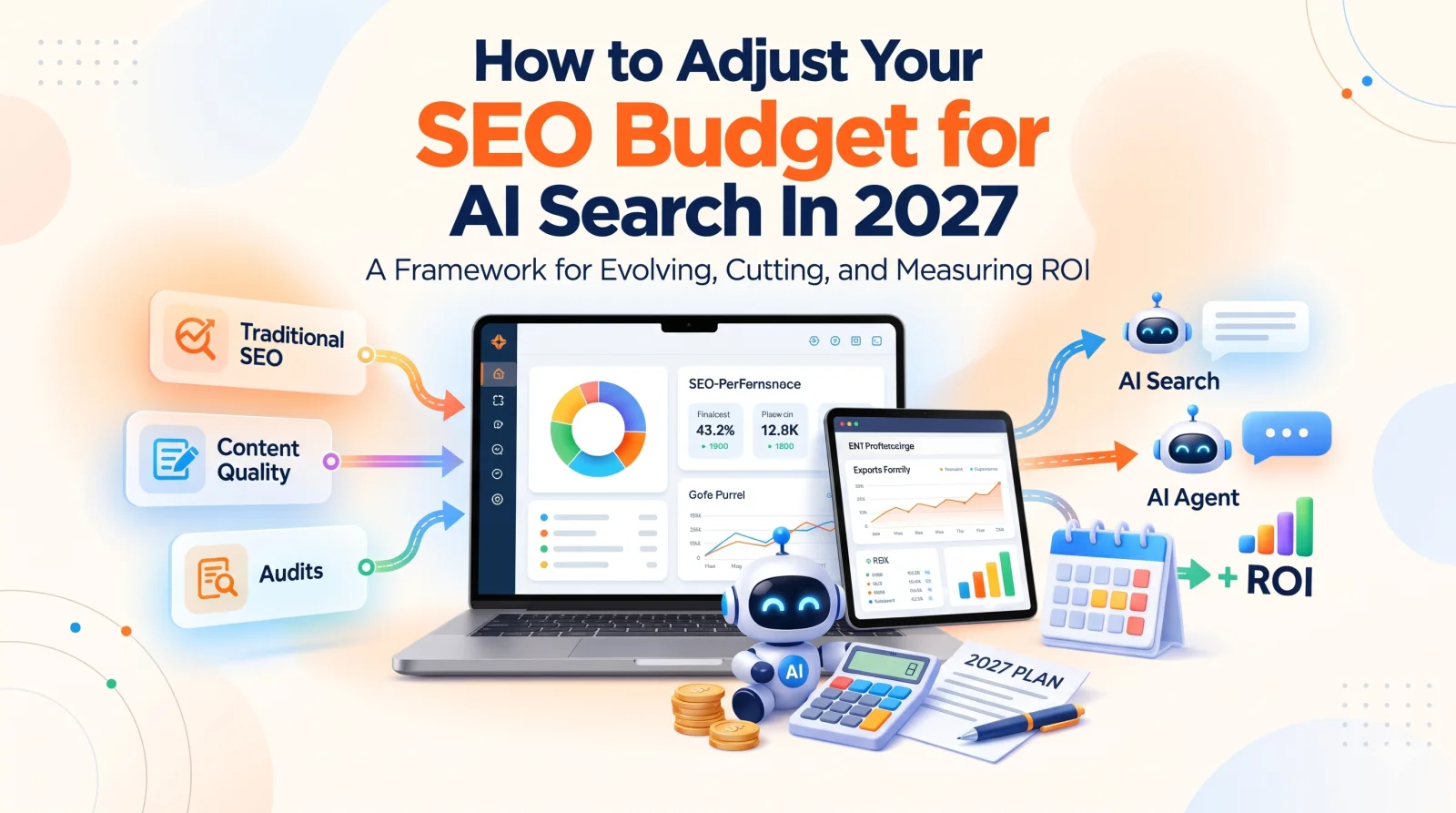
The adjustment runs on reallocation. You upgrade what your existing SEO dollars buy, fund a few net new line items by cutting work that AI search made less effective, and measure success with a wider lens. Your current program stays intact while the work inside it sharpens.
This article gives you the full framework. What evolves inside each category, what is net new, what to cut, and how to measure whether the shift is working.
AI search changed what good SEO produces
One clarification before the budget details. Your SEO fundamentals still work, across Google's classic results and the AI answer surfaces alike.
The pages that rank well in classic search are, overwhelmingly, the same pages AI models cite when generating answers.
What changed is what good SEO output looks like. AI models reward depth over volume. They cite articles with original data more often than articles that repackage someone else's figures. They prefer structured, direct answers over long paragraphs that bury the point. They pull from brands that show up across several trusted platforms, and they underweight brands that rank only on a single owned property.
When we talk about adjusting your SEO budget for AI search, we are describing how to upgrade what you build on top of your foundation. The foundation itself stays.
The single most expensive mistake we see is a company that panics, strips its traditional SEO budget, and spins up a separate AI search optimization program. That new program then duplicates most of the work the SEO team was already doing, at twice the cost. Do not do this. Build on what you have.
Your content budget stays. Your link building budget stays. Technical SEO and reporting budgets stay. What each one purchases is the lever you move.
For a deeper view of how brand presence across platforms drives AI visibility, we wrote a separate guide on increasing brand mentions for AI search.
How each SEO budget category evolves
You are changing what the money buys inside the four categories you already have. Here is what that looks like across each pillar of a typical SEO retainer.
Content shifts toward depth
The old approach produced 4 keyword targeted articles per month, each built to rank for a phrase.
That approach still works for some queries. For the growing share of searches where AI Overviews appear, a thin 800 word article that restates what 10 other articles already say will not earn a citation. It will not even earn a click. The AI model already answered the question using someone else's better article.
The shift produces fewer articles with more depth per article. 2 answer led assets per month with original data, clear sourcing, and structured answers that AI models can cite directly. 2 content refreshes on existing pages to hold them current, accurate, and worth citing.
Same monthly hours, fewer published articles, more research per article.
The hardest part of this shift is psychological. Many marketing teams measure output in articles published per month. When that number drops from 4 to 2, the team feels the number as a cut. The team is doing different work that produces more durable results.
Link building expands to citations
Traditional link building is alive. Backlinks from authoritative sites still drive rankings in both classic and AI search. Domain authority still matters. That part did not change.
The definition of an authoritative site did change. AI models pull answers from a wider source set than Google's classic algorithm. Review platforms, industry directories, niche publications, roundup articles, and data aggregators all feed AI models. These are the places AI models look for information about your category. A brand that sits on those platforms with accurate, detailed information earns citations. Absent brands cede those citations to whichever competitor shows up in their place.
Link building expands to carry this wider target list. A mention on a trusted industry review site does double duty. It builds a backlink and it makes your brand visible to AI models. A placement in a roundup article with strong sourcing serves the same dual purpose.
Same outreach effort, wider target set. Your link building team does not need a new title or a new budget line. The team needs an expanded target list that includes the platforms AI models actually pull from.
Technical SEO gets a longer checklist
Your technical SEO work stays the foundation. Crawl fixes, page speed, mobile experience, and core web vitals all remain required.
The checklist gets four additions. Entity markup and organization schema so AI models understand who you are and what you do. FAQ and HowTo schema on commercial pages so AI models parse your answers cleanly. Passage level content structuring so individual sections of your pages are worth citing on their own. An AI crawler access audit, because some companies have accidentally blocked the crawlers that ChatGPT, Google's AI features, and other AI platforms use to index content.
Schema sits inside your existing technical SEO retainer. The retainer covers this kind of implementation. The checklist got longer.
Reporting swaps KPIs inside the same line item
This is where the change feels most visible, even though the cost holds flat.
Your old reporting tools tracked rankings, organic traffic, and conversions. Those metrics still matter. They no longer tell the full story.
Reporting now tracks four more signals alongside the originals. AI citation rate shows how often AI models mention your brand for relevant queries. Share of AI answer shows whether you appear as primary source, secondary mention, or absent. Branded search volume lift shows whether AI visibility is driving brand awareness. Lead source attribution shows how often prospects say they found you through an AI tool.
The reporting budget stays flat. What the reporting budget measures shifts. The tool mix may move. You might swap a rank tracker only subscription for a tool that also monitors AI citations. Monthly spend holds similar.
The biggest change here is the conversation with leadership. When your CMO asks how SEO is performing, the answer now includes visibility metrics that extend past click through rates.
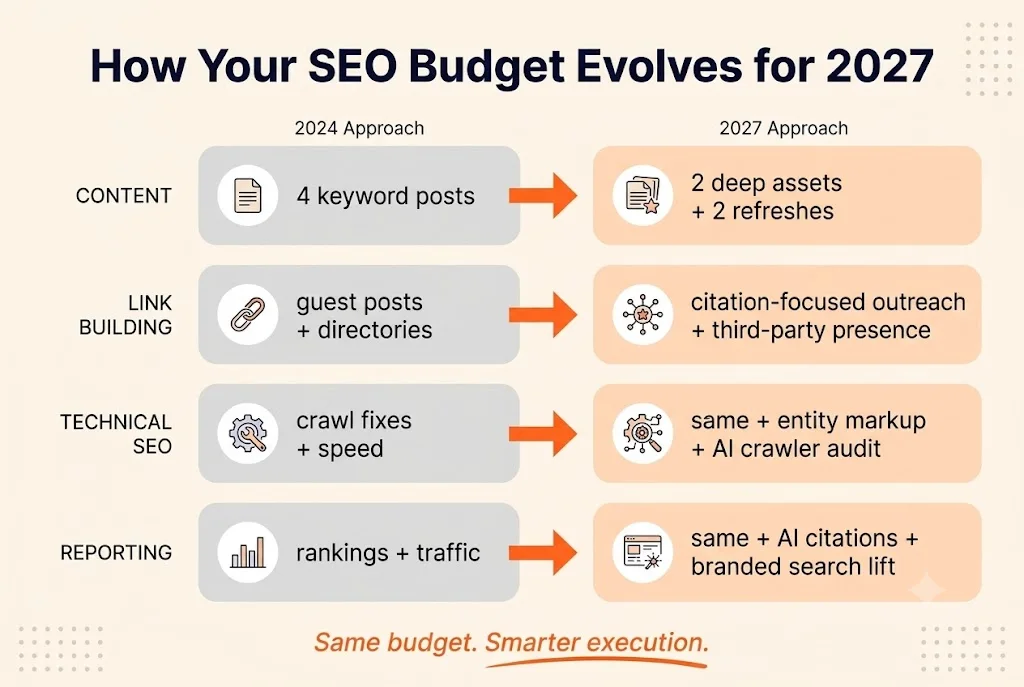
Fig 1 - SEO budget evolution inside each category
The genuinely new costs
Three costs are net new, and acknowledging them is part of running an honest budget conversation.
AI citation monitoring
Your existing rank tracker does not tell you whether AI models cite your brand. That is a different data set, drawn from a different source set.
AI citation monitoring tracks what ChatGPT, Gemini, Perplexity, and Google's AI Overviews say when someone asks a question in your category. This is a new line item.
Cost range sits between 100 and 500 dollars per month depending on how many queries you track and how many surfaces you monitor. Some teams start with manual prompt audits, which are free and time heavy, before they commit to a paid tool.
Prompt research
Understanding what questions your buyers ask AI models, and what those models answer back, is the new form of keyword research.
The method works like this. Pick 10 to 20 priority queries that matter to your business. Search them in ChatGPT, Gemini, and Perplexity each month. Document what shows up, which brands get mentioned, and where the gaps sit.
The work takes 2 to 4 hours of analyst or strategist time per month. It can sit inside existing content strategy hours if you cut something else in that scope. It can also sit as a new scope item if your team is already fully allocated.
Third party presence management
Getting your brand into the directories, review platforms, and data sources AI models actually reference is work that may or may not exist in your current scope.
If you already run local SEO, you already cover some of this surface. Google Business Profile, directory listings, and review management overlap with what AI surfaces reward. AI search adds platforms that classic SEO often ignores. Industry specific review sites, business directories that AI models pull from, and data aggregators that feed AI training sets all require accurate, current entries for your brand.
Some of this work overlaps with your existing link building and local SEO budgets. Some is net new depending on your category and how visible your brand already is on these platforms. Audit what you have before you add a whole new line.
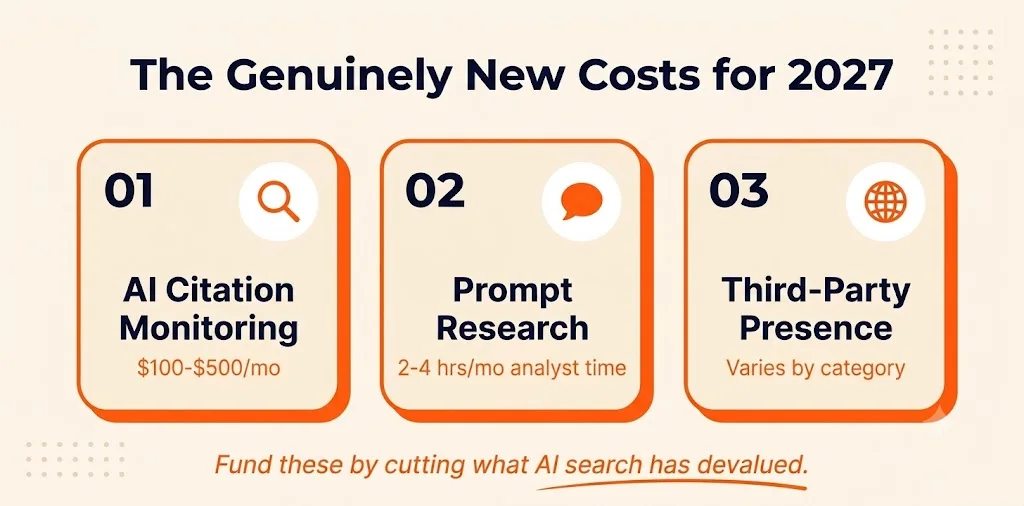
Fig 2 - Three new AI search budget line items
Where to find the money
The new costs need funding. Here is where to find that funding without expanding total SEO spend.
You are redirecting dollars away from work AI search made less effective and into work that produces more value now. Total SEO spend holds flat for most companies. Only the mix changes.
Thin keyword only content - Articles written to rank for a phrase and nothing else. The AI model already answers the query using someone else's better article. Cut production volume. Redirect those hours into deeper articles and refreshes on existing pages.
Rank tracker only subscriptions - Tools that report ranking position and nothing else no longer carry enough signal on their own. Consolidate into a single tool that covers rankings, citations, and branded search in one surface.
Generic listicle production - Roundups built to rank for a comparison query without original analysis earn the lowest citation yield. Cut.
Vanity dashboards - Impressions, position averages, and raw organic traffic figures without lead quality signals obscure performance. Replace with a single sheet that reports the five KPIs we describe below.
What to add and why it matters
The money freed up above funds the additions below. Each addition lifts visibility in both classic and AI search.
Answer led content - Articles that lead with a direct answer in the opening paragraph and then explain the reasoning. AI models cite the direct answer. Human readers trust the article and keep reading. Both metrics improve.
Schema and entity markup - Technical signals that help AI models parse who you are, what you do, and what your pages answer. Sits inside the existing technical SEO retainer.
Placements worth citing - Review site entries, industry directory listings, and data aggregator submissions that put accurate brand information in the places AI models pull from.
AI citation monitoring and prompt research - The two tools and workflows we described above. Together they form your measurement surface for AI visibility.
Budget reallocation by spend tier
The framework above applies to every company, with specifics that change with scale. We restructure SEO budgets across every tier. Here is what the adjustment typically produces at each level.
Small business tier at 2,000 to 5,000 dollars per month
Your biggest lever is content mix. Stop producing 4 thin articles per month. Produce 1 to 2 deep articles. Use the saved production hours for schema implementation and content refreshes on your best performing existing pages.
The new cost to absorb is basic AI citation monitoring at 100 to 150 dollars per month. Fund it by cutting one generic listicle from next month's content calendar.
At this budget level, one person usually handles SEO alongside three or four other responsibilities. Adding AI search monitoring, prompt research, and outreach focused on citations on top of that work is often unrealistic. This is typically where companies bring in an external partner to handle the strategy evolution while the internal team focuses on execution.
Mid market tier at 5,000 to 10,000 dollars per month
Your biggest lever here is shifting content mix toward depth and adding quarterly prompt research. Expand your link building scope to include placements worth citing alongside guest posts.
The new cost to absorb is AI monitoring tools and 4 hours per month of prompt research. Fund it by cutting the weakest content from the production calendar and consolidating overlapping rank tracker subscriptions into a single tool that covers both classic rankings and AI visibility.
At this tier, the shift is manageable with a dedicated SEO person internally. If SEO is a part time responsibility for someone wearing several hats, the expanded scope will stretch them thin.
Growth stage tier at 10,000 to 25,000 dollars per month
Your biggest lever is dedicated analyst time for AI search. Run structured answer optimization across your top 50 commercial pages. Shift digital PR toward publications and platforms AI models cite.
The new cost to absorb is a full AI citation tracking suite and dedicated monthly prompt research across all major AI platforms. Fund it by eliminating generic guest posting that chases domain authority numbers alone and by consolidating reporting into an integrated dashboard.
This is the tier where companies typically see the fastest ROI from the budget shift. Enough existing content and authority sits in place to generate AI citations quickly once the structure lands.
Enterprise tier at 25,000 dollars per month and above
Your biggest lever is cross functional coordination. AI search optimization touches content, technical SEO, PR, brand, and product marketing at the same time. At enterprise scale, the risk is fragmentation. Five teams doing overlapping work with no shared measurement produces noisy outputs and no ownership.
The new cost to absorb is enterprise level monitoring across all AI platforms, ongoing prompt research at scale, and sustained presence management across external platforms. Fund it by eliminating redundant content production across business units and by consolidating fragmented vendor relationships into a unified program.
The enterprise challenge is ownership. Someone needs to own AI search visibility as a cross functional program with a budget and a scoreboard.
The 90 day rollout
Do not try to restructure your entire SEO budget in one quarter. The shift works best as a phased rollout with a decision gate at the end of month 3.
Month 1 covers audit and baseline
Pull your Google Search Console data. Identify which pages AI Overviews intercepts. The signal is high impressions with declining click through rate.
Run manual prompt audits. Search your top 20 commercial queries in ChatGPT, Gemini, and Perplexity. Document what comes up, which brands get mentioned, and where your content is missing.
Set up baseline measurement for citations, branded search volume, and lead source attribution. Add AI tool as an option on your contact forms and phone scripts.
Hold the budget steady this month. Month 1 is data collection. The audit tells you exactly where the gaps sit so you can prioritize intelligently in month 2.
Month 2 covers first adjustments
Cut or pause the weakest performing thin content from next month's production calendar. You identified these pages in the month 1 audit. High impressions, dropping click through rate, no leads.
Redirect those production hours into answer led rewrites of your top 5 to 10 commercial pages. These are the pages where an AI citation would directly produce business.
Add FAQ schema and entity markup to those pages. The work sits inside your existing technical SEO scope. Same team, same retainer, expanded checklist.
Expand next month's outreach targets to include review and directory sites worth citing in your category. Your link building team does the same work against a wider target list.
Month 3 covers measurement and decision
Compare your month 1 baseline to your month 3 data. Look at citation rate, branded search volume, AI answer visibility, and lead quality.
Month 3 is the decision gate. If AI metrics move in the right direction, scale the reallocation to more pages and queries in the following quarter. If the numbers are flat, dig into why before you increase spend. The problem might be content quality, missing schema, or a brand presence gap on external platforms.
Month 3 is where most internal teams stall. The audit and first adjustments are doable with internal resources. Sustained measurement and optimization across several AI platforms, while keeping classic SEO performing, usually requires a dedicated hire or a specialized partner.
If your audit reveals pages Google does not index properly, our guide on fixing indexation issues in Google Search Console covers the technical side of this audit.
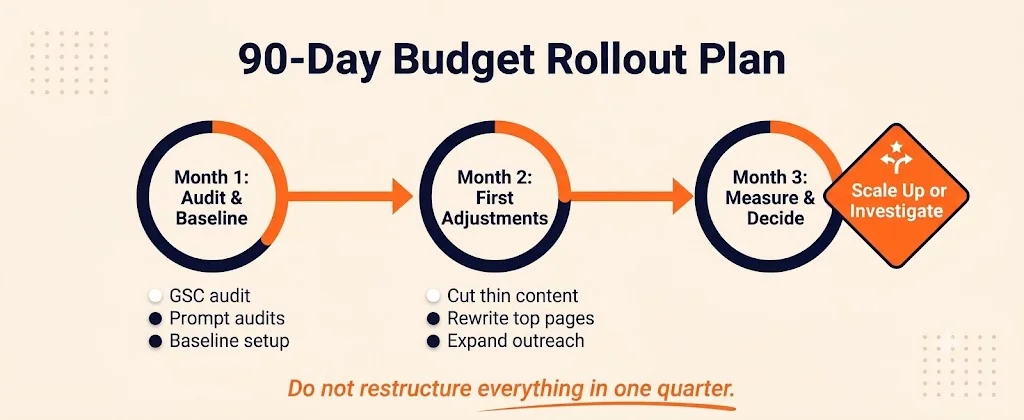
Fig 3 - 90 day rollout plan
How to measure ROI on AI search spend
If you cannot show your CFO these numbers after 90 days, the budget shift will not survive the next planning cycle. The measurement framework below makes the reallocation defensible.
The five KPIs split into two groups. The first three show whether the reallocation generates visibility. The last two show whether that visibility converts into business.
Table 1 - ROI measurement framework for AI search spend
Most companies over index on citation rate and under index on lead attribution. Citations feel good. If no customer who finds you through an AI answer ever becomes a paying account, the visibility carries no revenue weight. Measure both.
A realistic timeline sits between 60 and 90 days for baseline data and roughly 6 months for meaningful trend lines. AI search optimization accrues value the way classic SEO does. If someone promises results in 30 days, treat the claim with skepticism.
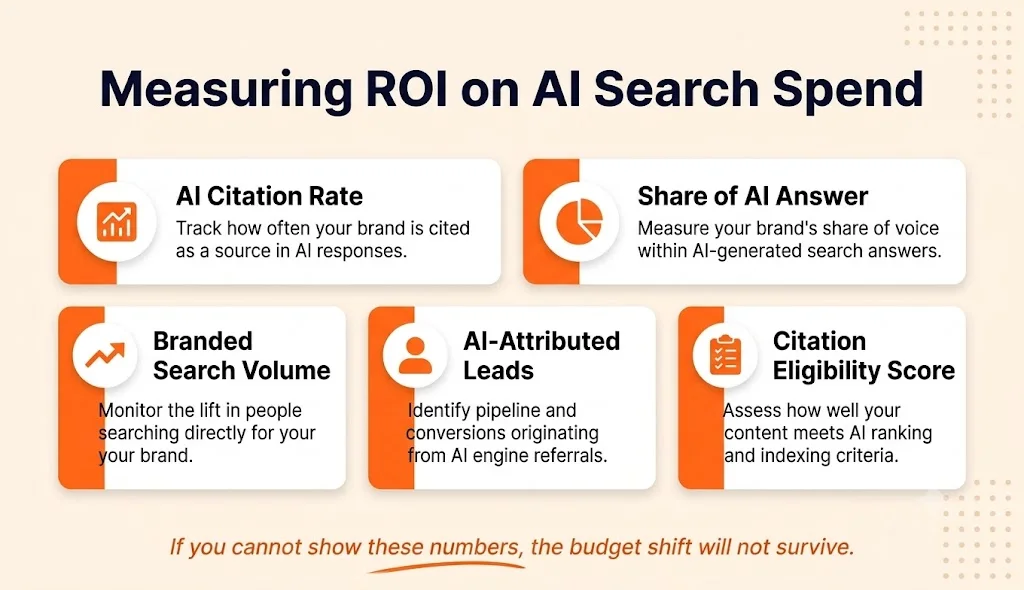
Fig 4 - Five KPIs for AI search ROI
For how AI tools fit into your broader marketing measurement surface, see our guide to AI marketing automation.
Why most internal teams need help with this shift
The observation below is not a criticism of internal teams. It is a scope observation.
Adjusting your SEO budget for AI search touches content strategy, technical SEO, digital PR, brand management, and data analysis at the same time. The shift requires monitoring several AI platforms, running prompt research, coordinating outreach across classic and AI cited sources, and measuring results with metrics most analytics dashboards do not yet support out of the box.
Most marketing teams have one or two people handling SEO alongside email, paid media, social, and whatever else lands on their desk that week. Adding AI search strategy on top of that is a bandwidth constraint. Adding a full time hire to cover the gap is rarely the right economics when sharper options exist.
The audit and initial adjustments from the 90 day rollout above are doable internally. Pull your GSC data, run some prompt audits, update your schema, and cut the thin content. That gets you started.
Sustained execution is where companies typically bring in a partner. Running AI citation tracking across five platforms, producing answer led content on a consistent schedule, managing presence on external platforms, and measuring ROI against new KPIs while keeping your classic SEO engine running represents a full workload for a dedicated team.
See how we applied this approach for a medical fintech company targeting AI citations and a UAE rental platform optimizing for AI search.
Want an expert review of your SEO mix?
If you are weighing which of these moves to make first, we can audit your current SEO scope, map the gaps against AI visibility signals, and hand you a reallocation plan in two weeks.
Request an SEO budget audit
Closing summary
Adjusting your SEO budget for AI search carries three moves.
The first move upgrades what you already buy. Content, link building, technical SEO, and reporting budgets all hold. The work inside each one gets sharper, more structured, and more aligned with how AI models find and cite content.
The second move funds a few net new costs. AI citation monitoring, prompt research, and presence work on external platforms are real line items that did not sit in the budget you set before AI Overviews rolled out. They cost real money. Acknowledge that.
The third move cuts what has lost value. Thin keyword only articles, rank tracker only subscriptions, generic listicles, and vanity dashboards consume budget that produces better returns when redirected into the items above.
Companies that execute this shift in the current planning cycle will hold their organic pipeline and build the kind of multi platform visibility that accrues over time. Their brands show up wherever buyers search, whether that surface is Google, ChatGPT, Gemini, or the next surface after those.
Companies that wait will spend the following cycle trying to close the gap.
FAQs about adjusting your SEO budget for AI search