c-84, sector 65, Noida

Zoho has 55+ apps. Most businesses need help setting it up, and the wrong partner costs more than doing it yourself. We have run 50+ Zoho implementations and we keep seeing the same mistakes in how companies pick their partner. This guide covers the six things that actually predict whether a Zoho implementation consultant will deliver, 12 questions for your first call, and the red flags that should end the conversation.
Here is something we see all the time. A business buys Zoho, tries to set it up themselves (or hires the cheapest firm they can find), and six months later they are paying someone else to redo the whole thing.
Zoho itself is straightforward enough. The gap between buying the software and getting your team to use it correctly is bigger than most people expect.
Zoho now has more than a million paying customers, with 32% customer growth in 2025 alone. That is a massive ecosystem. And in a market that big, anyone can call themselves a Zoho implementation partner. There is no gatekeeping on the term.
So how do you tell the difference between a firm that will actually deliver and one that just interviews well?
We have been on both sides of this. We run Zoho consulting engagements with 32 certified practitioners across our team, and we also clean up other people’s failed implementations regularly. This guide is everything we wish businesses knew before their first call with any Zoho consulting partner.
If you are setting up a single CRM for five people, you can probably handle it yourself. Zoho’s documentation is solid enough for that.
That is almost never the situation when someone calls us.
Usually it looks like this. Sales is on CRM, finance is on Books, support is on Desk. Nobody can get a clean revenue number because the three systems are not wired together properly. Or someone set up the CRM two years ago with a flat data model and now you need subforms, blueprints, and lookup fields that were never planned for.
That is the gap where a Zoho implementation consultant earns their fee. We know where configuration ends and custom Deluge code begins. We know which Zoho edition gates which feature (this trips people up more than you would think). We know that Zoho One is cheaper than per app pricing at a certain user count, and more expensive below it.
If your setup crosses departments, needs integrations with outside systems, or has grown messy enough that two reports on the same number disagree, the right partner pays for themselves in the rework they prevent. We wrote about exactly how these gaps turn into budget overruns in our guide to ERP implementation risks.
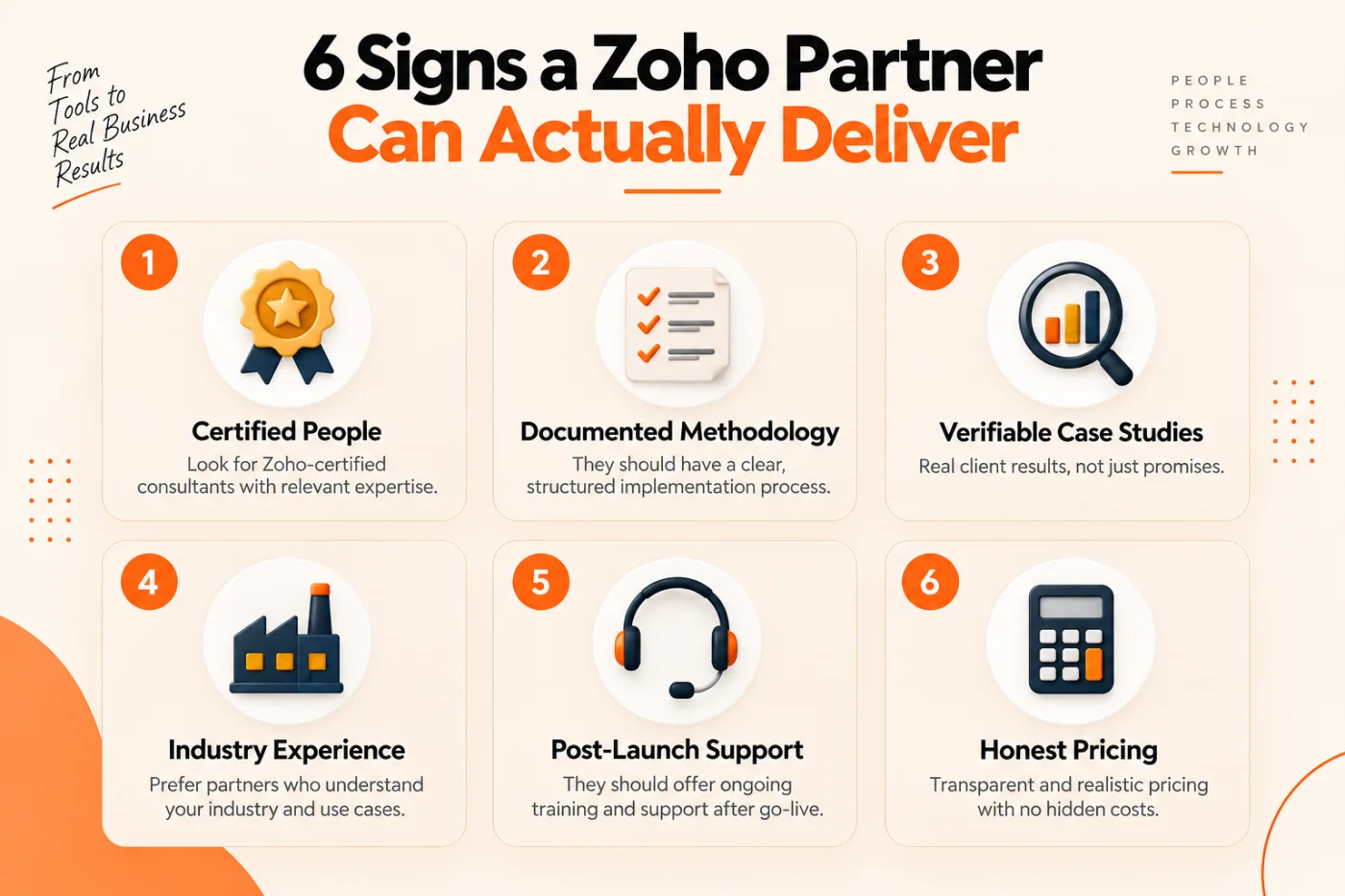
We have seen businesses pick partners based on website design, Google Ad placement, or who showed up first on a referral list. None of that predicts project success. These six things do.
Zoho offers certifications for individual products including CRM, Books, Analytics, Desk, and Creator. These are real exams that test actual product knowledge.
Here is the part that trips people up. Zoho awards the certification to a person, and the firm holds none of it. A company might have 30 certified practitioners on their website. That means nothing if the person assigned to your project holds no certification at all.
Ask a sharper question. “Which people will work on my project, and which certifications does each of them hold?”
At Clixlogix, 32 of our practitioners hold current Zoho certifications. Our team also carries CBAP, PMI-PBA, and Six Sigma credentials, because mapping your business requirements correctly matters just as much as knowing the software. And we name who is on your engagement before the work starts, with the certifications each of them holds.
Ask them to walk you through their process. Not the sales version. The actual implementation process with named phases, written deliverables at each gate, and clear criteria for moving forward.
A firm that has done this 50+ times will have it written down. A firm that is figuring it out as they go will give you something vague about “agile” and promise to “scope it out once we start.”
You want phases. You want written artifacts you own at every step. You want to know what you walk away with if the engagement ends after phase one.
Look for real case studies that describe the business problem, the Zoho configuration, what went wrong along the way, and the measured outcome. A logo wall tells you nothing.
If a partner cannot share a single detailed writeup, they either have not done the work or it did not go well enough to talk about.
Even better, ask for a reference call with a past client. Fifteen minutes with someone who lived through the engagement will tell you more than any proposal.
Each one started the same way, with a Zoho estate that had outgrown the setup it was built on. Open any of them to see which apps were in play, where configuration ended and Deluge began, what the data migration had to clean up, and the numbers the client measured after go live. That is the level of detail this guide tells you to ask any partner for, which is why we publish it.
A Zoho setup for a real estate team looks completely different from one built for a manufacturer. The modules change, the data model changes, the automation logic changes.
If you are in real estate, you want someone who has actually configured Zoho CRM for property workflows before. If you are in manufacturing, you need a partner who already understands BOM structures and inventory modules. Learning them on your budget costs you the difference.
Ask how many implementations they have delivered in your industry. If the answer is zero, that changes the risk profile of the entire engagement.
What happens when your team hits a wall in month three? When a new hire cannot figure out the CRM? When your reporting needs change after a quarter?
A good partner builds the support plan into the proposal from day one. That means a defined response time, a named point of contact, and clear pricing for ongoing work.
A partner who treats go live as the finish line is selling you a project. You want a partnership.
Any partner quoting you a fixed number before they understand your data model, user count, integrations, and reporting needs is guessing. That guess comes back to you later as change orders.
Good consulting starts with a paid discovery phase. The partner learns your setup, maps the real problems, and then quotes based on what they found. The discovery gives you a written assessment you own, whether or not you continue with them.
| What to Check | What Good Looks Like | What Should Worry You |
|---|---|---|
| Certified people | Named individuals with current Zoho certs assigned to your project | Firm claims certification but will not say who works on your account |
| Methodology | Written phases, defined deliverables at each gate, clear exit criteria | Vague promises to figure it out as you go |
| Case studies | Detailed writeups with measured outcomes, reference calls available | A logo wall and nothing else |
| Industry fit | Multiple implementations in your sector, understands your workflows | Zero projects in your industry, learning on your budget |
| Support after launch | Defined SLA, named contact, clear pricing for ongoing help | Go live is the last thing on the statement of work |
| Pricing | Paid discovery first, then scoped quote based on findings | Fixed price quoted before seeing your setup |

Fig 1 – These six things predict project success. Badges and directory listings do not.
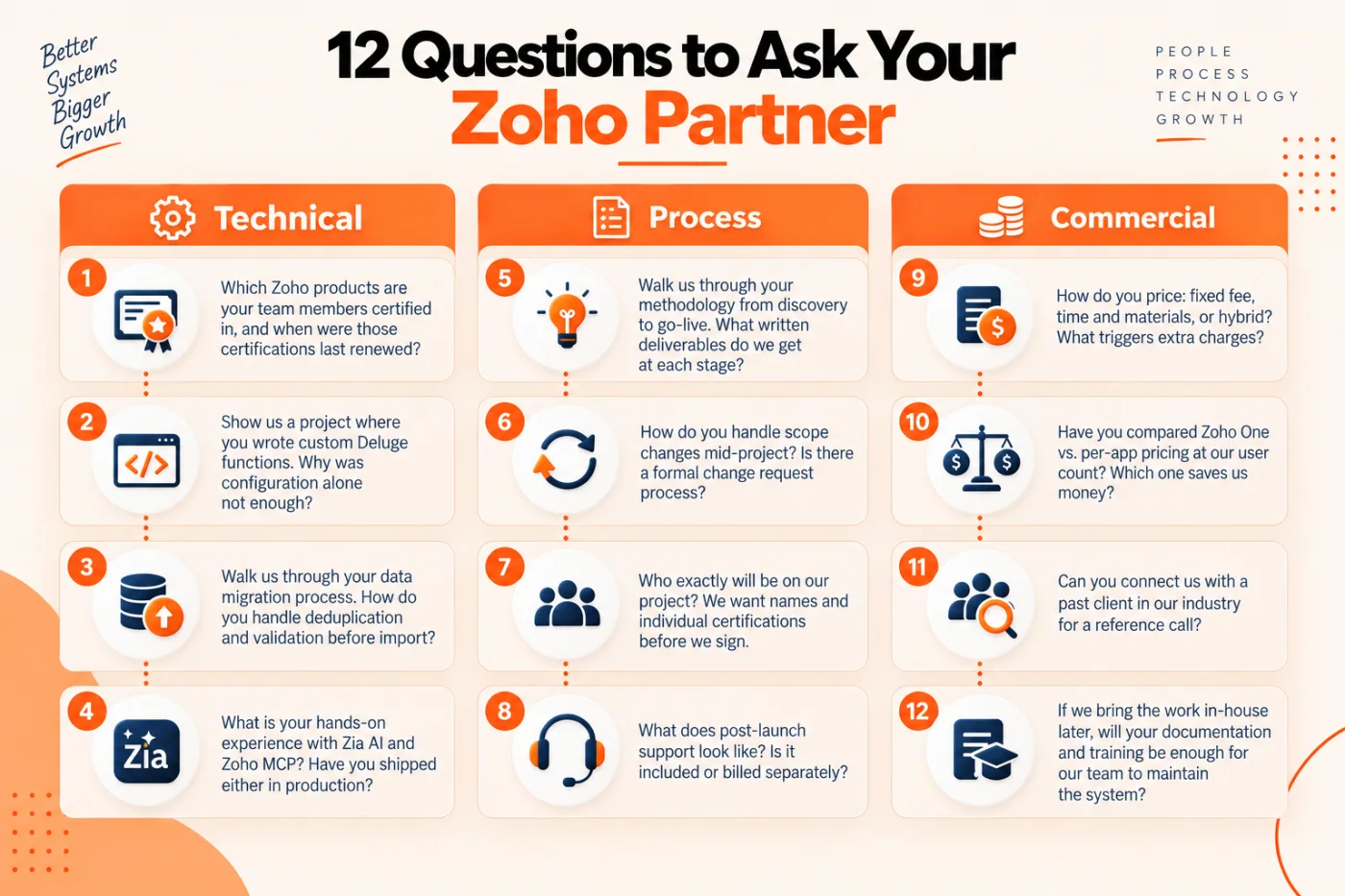
We put together this list based on what we wish every client asked us (and every competitor) on the first call. Bring these. The answers will tell you more than any proposal deck ever will.
| Category | Question |
|---|---|
| Technical | Which Zoho products are your team members certified in, and when were those certifications last renewed? |
| Technical | Show us a project where you wrote custom Deluge functions. Why was configuration alone not enough? |
| Technical | Walk us through your data migration process. How do you handle deduplication and validation before import? |
| Technical | What is your hands on experience with Zia AI and Zoho MCP? Have you shipped either in production? |
| Process | Walk us through your methodology from discovery to go live. What written deliverables do we get at each stage? |
| Process | How do you handle scope changes part way through a project? Is there a formal change request process? |
| Process | Who exactly will be on our project? We want names and individual certifications before we sign. |
| Process | What does support after launch look like? Is it included or billed separately? |
| Commercial | How do you price: fixed fee, time and materials, or hybrid? What triggers extra charges? |
| Commercial | Have you compared Zoho One against per app pricing at our user count? Which one saves us money? |
| Commercial | Can you connect us with a past client in our industry for a reference call? |
| Commercial | If we bring the work in house later, will your documentation and training be enough for our team to maintain the system? |

Fig 2 – Print this. Bring it to your first call.
A partner who answers these without flinching has nothing to hide. A partner who gets vague on questions 3, 7, or 12 is telling you something important.
We clean up a lot of other firms’ work. These are the warning signs we hear about after the fact, every time.
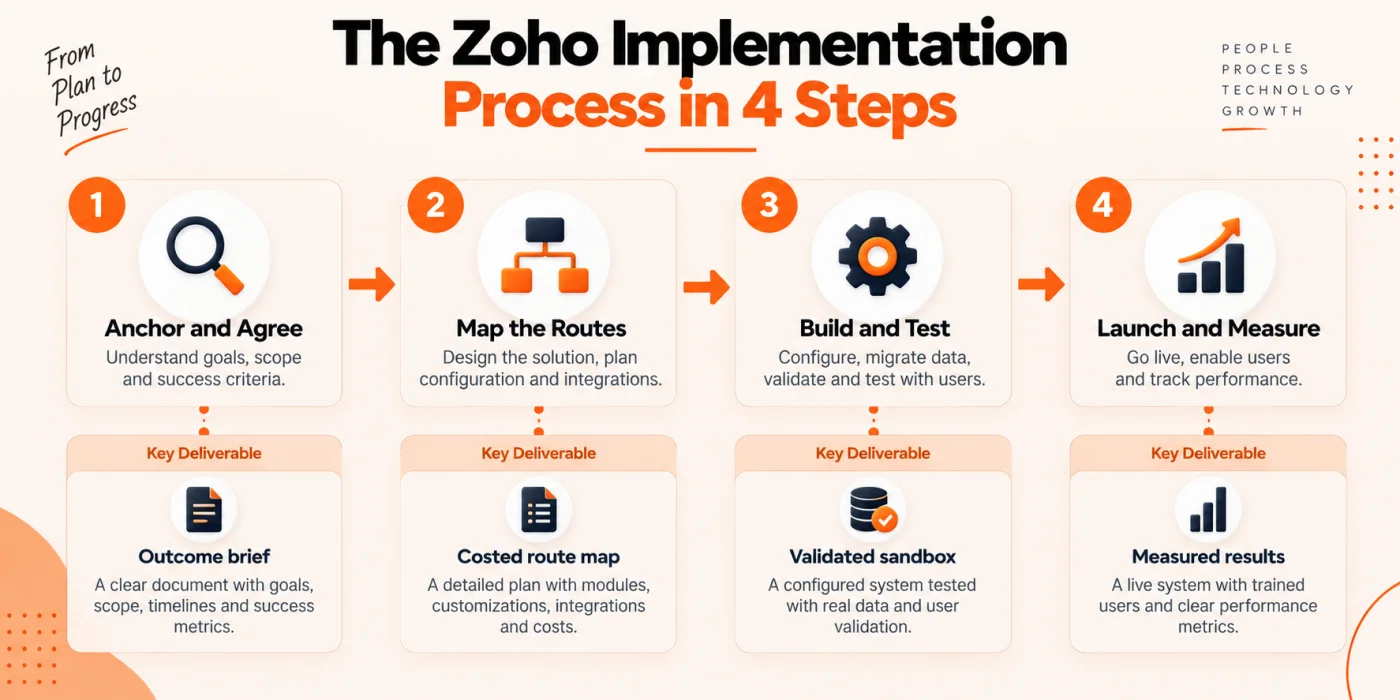
We have run enough of these to know what works. A well run Zoho implementation follows a phased structure. Each phase ships something you can hold, review, and challenge. You always know what you have before the next phase starts.

Fig 3 – Each phase delivers something written that belongs to you, whether or not you continue.
Phase 1: Anchor and agree. We learn your business before we touch Zoho. We map how work actually runs today, figure out what it is costing you, and agree on the specific numbers this project has to move. You get a written outcome brief.
Phase 2: Map the routes. There are usually multiple ways to reach the same outcome. We map each option, test it against your Zoho edition limits and data model, and cost it. You get a route map that ranks each option by return against effort.
Phase 3: Build and test. We build in a sandbox. Your team validates before anything goes live. Nothing ships until it has been tested against the outcomes we agreed on in phase one. This is the phase where the configuration, the integrations and any custom Deluge actually get written.
Phase 4: Launch and measure. The first win should land within weeks. We measure it against the number you agreed on, and use what it returns to fund the next step.
We publish what each phase costs, what you get at every gate, and who from our team runs it. A health check on one application starts at $500. Consulting work beyond an assessment runs $25 to $35 per hour. Build work carries its own scope and its own number, quoted once the route map says what actually needs building.
If your current Zoho setup involves CRM and Projects working together, read our writeup on the seven gaps in Zoho CRM and Projects integration before your first call with any partner. Knowing the pain points upfront gives you sharper questions to ask.
Not sure where to start?
Tell us which Zoho apps you run and where the setup is straining. We will tell you which engagement fits, what it costs, and who from our team would run it, before you commit to anything.
A Zoho implementation partner is a firm or consultant that sets up, customizes, and supports Zoho applications for businesses. The best ones hold individual Zoho product certifications earned through Zoho University exams, carry business analysis credentials, and can show you a track record of completed projects with measured results.
It depends on scope. A single app health check can start around $500. Implementations that span CRM, Books, Desk, and integrations run from a few thousand to tens of thousands of dollars. Across the market, hourly rates typically fall between $25 and $75 depending on the firm’s region and the complexity of your setup. Our own consulting work runs $25 to $35 per hour, and build work is quoted per project.
Ask for the names of the people who will work on your project and their individual Zoho certifications. Individuals earn these certifications through Zoho University exams, and companies never hold them directly. If a firm claims 30 certified people but cannot tell you which of them are on your project, those certifications are irrelevant to your engagement.
For a single app setup with fewer than 10 users, a solo consultant can work well. For deployments that span several apps, integrations, or anything that involves Deluge custom code and ongoing support, a firm gives you a team with different specializations, a tested methodology, and backup when someone is unavailable.
List which Zoho apps you currently use, your user count, which departments are on the system, your biggest pain points, and what you want the implementation to change. The more specific you are about the business problem, the faster any partner can tell you whether they are the right fit.
Rework. A poorly scoped implementation means you pay once to build it wrong and again to fix it. The most common failure we see is a partner who builds exactly what was asked for without questioning whether it was the right thing to build. That is why business analysis capability matters as much as Zoho product knowledge.
You can, but it is expensive. The new partner has to audit what was built, understand the decisions behind it, and reverse anything that does not hold up. This is exactly why phased delivery with written artifacts at each gate matters. You own the work product at every step, which makes a switch painful but possible.

Akhilesh leads architecture on projects where customer communication, CRM logic, and AI-driven insights converge. He specializes in agentic AI workflows and middleware orchestration, bringing โless guesswork, more signalโ mindset to each project, ensuring every integration is fast, scalable, and deeply aligned with how modern teams operate.
We are here to answer your questions 24/7