c-84, sector 65, Noida
A New York independent home insurance agency runs cited carrier appetite guidance, AI guided endorsement intake, and property photo screening on Zoho CRM.
A mid sized New York independent home insurance agency engaged Clixlogix to connect its core agency platforms through the existing Zoho CRM environment and apply AI where it changes agent economics. The workflow now runs on Zoho CRM with the agency management system as the system of record. Two AI workflows are in pilot, one for cited carrier placement and one for conversational endorsement intake. A third, for property photo screening ahead of carrier inspection, is undergoing shadow evaluation against human reviewers.
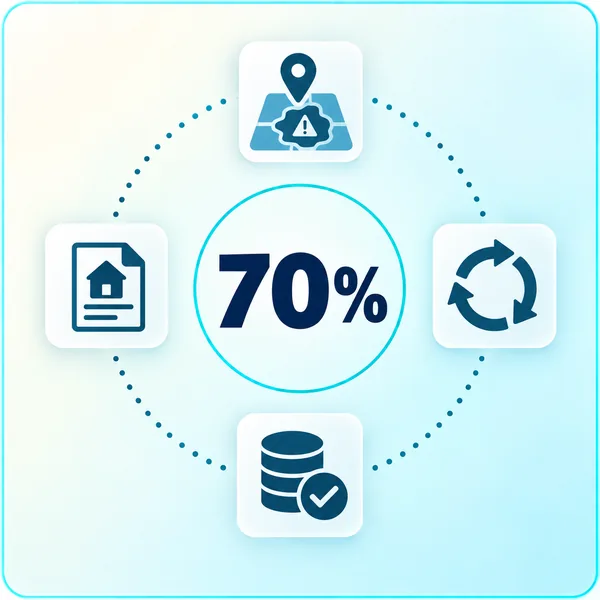
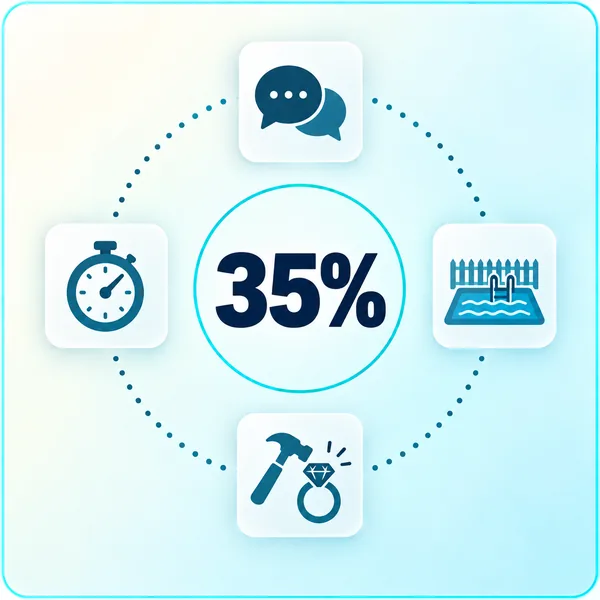
Delivery ran across one discovery stage and eight implementation stages over nine to twelve months. Since the workflow automation and AI pilots launched, duplicate property risk lookups are down 70%, handling time for the three pilot endorsement types decreased by 35%, and the placement recommender agreed with senior agents in 92% of reviewed cases.
The client is a mid sized independent home insurance agency operating across the New York metropolitan area, with meaningful exposure to coastal, flood, and protection class variability. The agency holds appointments with multiple admitted carriers, places hard to place risks through the New York Property Insurance Underwriting Association and the coastal market assistance program, and depends on an incumbent comparative rater for multi carrier quoting.
Records and policy accounting live in the agency management system, calls and SMS run through RingCentral, corporate accounting sits in QuickBooks, and email runs on Google Workspace. Zoho was already in place but limited to note keeping and light lead capture. Each system served its own purpose, and none shared context with the others, so every customer touch that spanned systems was reconstructed by hand.
Industry context
Hard to place coastal homes in New York have two named escape valves. The New York Property Insurance Underwriting Association (NYPIUA), the state’s FAIR Plan, writes basic property coverage on risks the standard market declines. The Coastal Market Assistance Program (C-MAP), directed by the NYS Superintendent of Financial Services, is a voluntary program where participating carriers agree to consider coastal risks that meet C-MAP eligibility. The Advisory Appetite Matcher treats both as legitimate outputs alongside admitted carriers, so a coastal risk that the standard market declines still surfaces a real placement path in the same view.
Sources are nypiua.com and dfs.ny.gov.
Speed from first inquiry to a bound policy is the primary economic driver in home insurance distribution, and defensibility of every coverage recommendation, declined coverage acknowledgement, and carrier communication is the second. Endorsements and renewals generate the majority of touches, and carrier inspection findings drive avoidable cancellations. Property risk data, carrier appetite guidelines, and customer supplied photographs each carried economic weight and each lived in a different place.
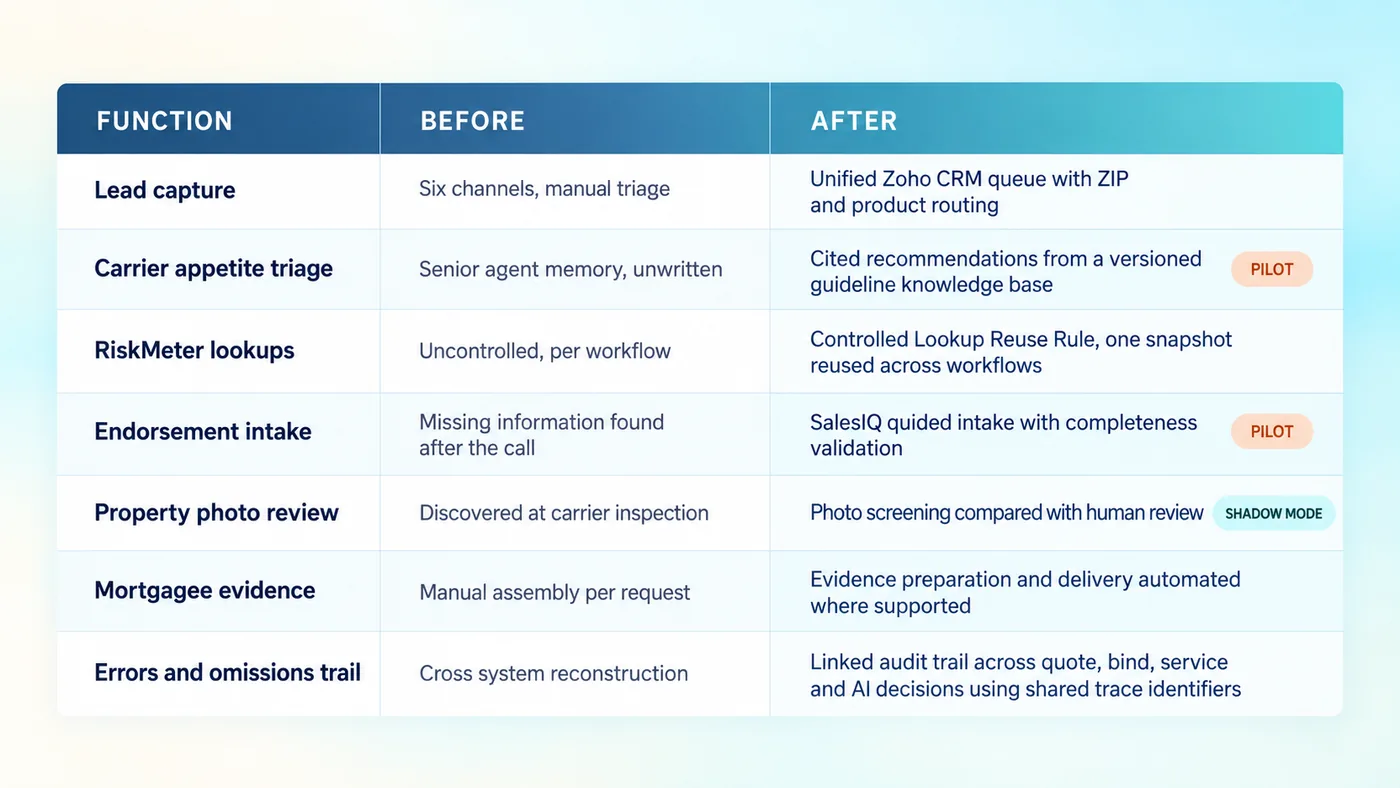
Before the engagement began, the agency’s systems operated without a shared workflow layer. Lead capture ran across six channels with no consolidated queue. Carrier appetite triage lived in senior agents’ memory. RiskMeter lookups were being duplicated across multiple workflows, which created avoidable usage and data governance problems. Endorsement intake surfaced missing information after the agent had already called the carrier. Carrier inspection failures arrived without warning, sometimes on properties the agency had photographs of on file. The evidence of errors and omissions defense was scattered across the agency’s systems.
Fig 1 – Operational shift delivered against the pre engagement baseline
| Function | Before | After |
|---|---|---|
| Lead capture | Six channels, manual triage | Unified Zoho CRM queue with ZIP and product routing |
| Carrier appetite triage | Senior agent memory, unwritten | Cited recommendations from a versioned guideline knowledge base [Pilot] |
| RiskMeter lookups | Uncontrolled, per workflow | Controlled Lookup Reuse Rule, one snapshot reused across workflows |
| Endorsement intake | Missing information found post call | SalesIQ guided intake with completeness validation [Pilot] |
| Property photo review | Discovered at carrier inspection | Shadow mode photo screening compared with human review [Shadow mode] |
| Mortgagee evidence | Manual assembly per request | Evidence preparation and delivery automated where supported |
| Errors and omissions trail | Cross system reconstruction | Linked audit trail across quote, bind, service, and AI decisions using shared trace identifiers |
Table 1. Pre engagement baseline against the delivered state. Directional descriptors only.
A New York independent agency faces the same margin pressure as every home insurance distributor, compounded by coastal exposure, a strict residual market process, and a customer expectation that a portal request receives a same day answer. Five constraints made the initiative unavoidable.
New agents wasted quote effort on carriers that were never going to accept the risk. Coastal distance rules, roof age rules, prior loss guidelines, and occupancy restrictions changed frequently, and no one document held the current version. Every hour spent quoting an ineligible risk was margin the agency did not recover.
Property risk lookups fired from the quoting workflow, the placement workflow, and customer service, sometimes within days of each other on the same address. Duplicate calls created avoidable usage and data governance problems, and uncontrolled reuse fell outside what the license was designed to tolerate.
A customer requesting to add a pool, schedule a piece of jewelry, or notify a renovation reached an agent by phone or email, and the agent then discovered that the required carrier questions had not been asked. Endorsements often took three calls, and the carrier’s turnaround suffered accordingly.
Trampolines without safety nets, pools without visible fencing, overhanging tree limbs, and roof deterioration were the hazards that drove avoidable cancellations. The agency had photographs of many of these properties on file, but no way to review them against the carrier’s specific guideline before the inspector arrived.
Quotes lived in the comparative rater. Documents lived in the agency management system. Communications lived in RingCentral and email. Notes lived in Zoho. Reconstructing what the agency had told a customer, and when, took hours and did not always resolve cleanly. Every hour of reconstruction added to the agency’s operational and errors and omissions exposure.
Full Process Delivery over nine to twelve months for a cross functional team of five to seven. Clixlogix owned scope, architecture, and delivery from discovery through pilot. Delivery ran as one discovery stage followed by eight implementation stages. The existing systems, including the agency management system and the incumbent comparative rater, were connected through the workflow layer. None were replaced.
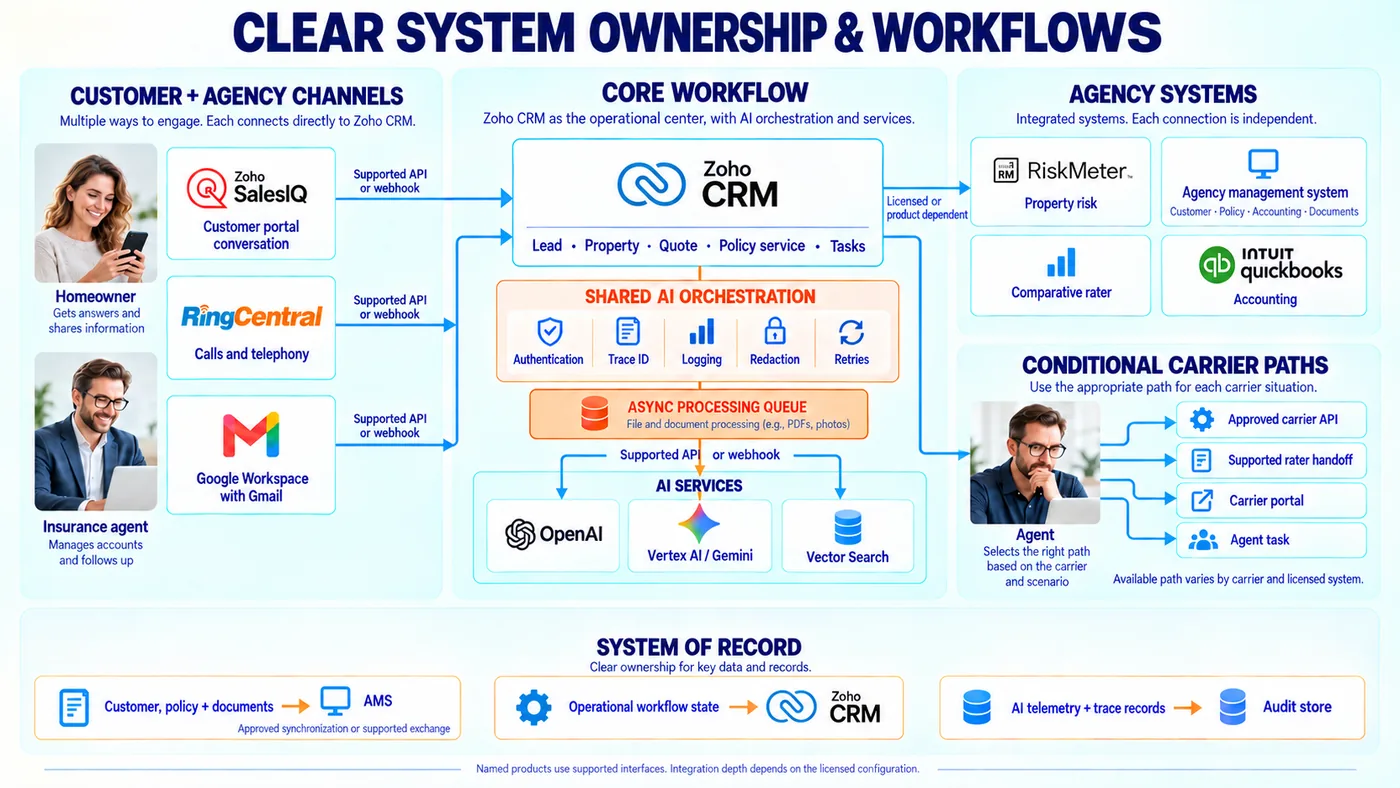
Zoho was already in place but limited to note keeping, and the engagement expanded it into the workflow layer that now orchestrates operations on top of the agency management system. The agency management system remains the system of record for customer, policy, document, and policy accounting data, while corporate accounting stays in QuickBooks and Zoho CRM orchestrates workflows on top of the AMS.
The operational workflow and integration foundation shipped before any customer facing AI. The AI stack shipped on top of that foundation in a defined sequence. Carrier guideline knowledge base and advisory appetite matcher came first, portal smart intake assistant second, multimodal photo screening third. Each AI stage inherited the shared orchestration layer, citation schema, audit trail, and human review policy established by the stage before it.
The table below carries one status per capability. Each capability moves to the next status only against defined criteria.
| Capability | Status |
|---|---|
| Operational agency workflows | Production |
| Carrier guideline knowledge base | Production |
| Advisory Appetite Matcher | Pilot |
| SalesIQ Smart Intake Assistant | Pilot |
| Multimodal Photo Screening | Shadow mode and tuning |
Table 2. Current implementation status by capability.
The advisory appetite matcher runs in pilot with a subset of carriers. The SalesIQ smart intake assistant runs in pilot for three request types, covering new pool, renovation or addition, and scheduled jewelry or valuables. The multimodal photo screening runs in shadow mode against human reviewers and remains in tuning until agents begin using it operationally.
Several decisions were adopted before build began to address external and enforceable constraints. Those constraints include the RiskMeter and CoreLogic data reuse license, agency errors and omissions exposure, carrier submission rules, the SalesIQ webhook card file handling limits, and the agency management system role as the retention system of record.
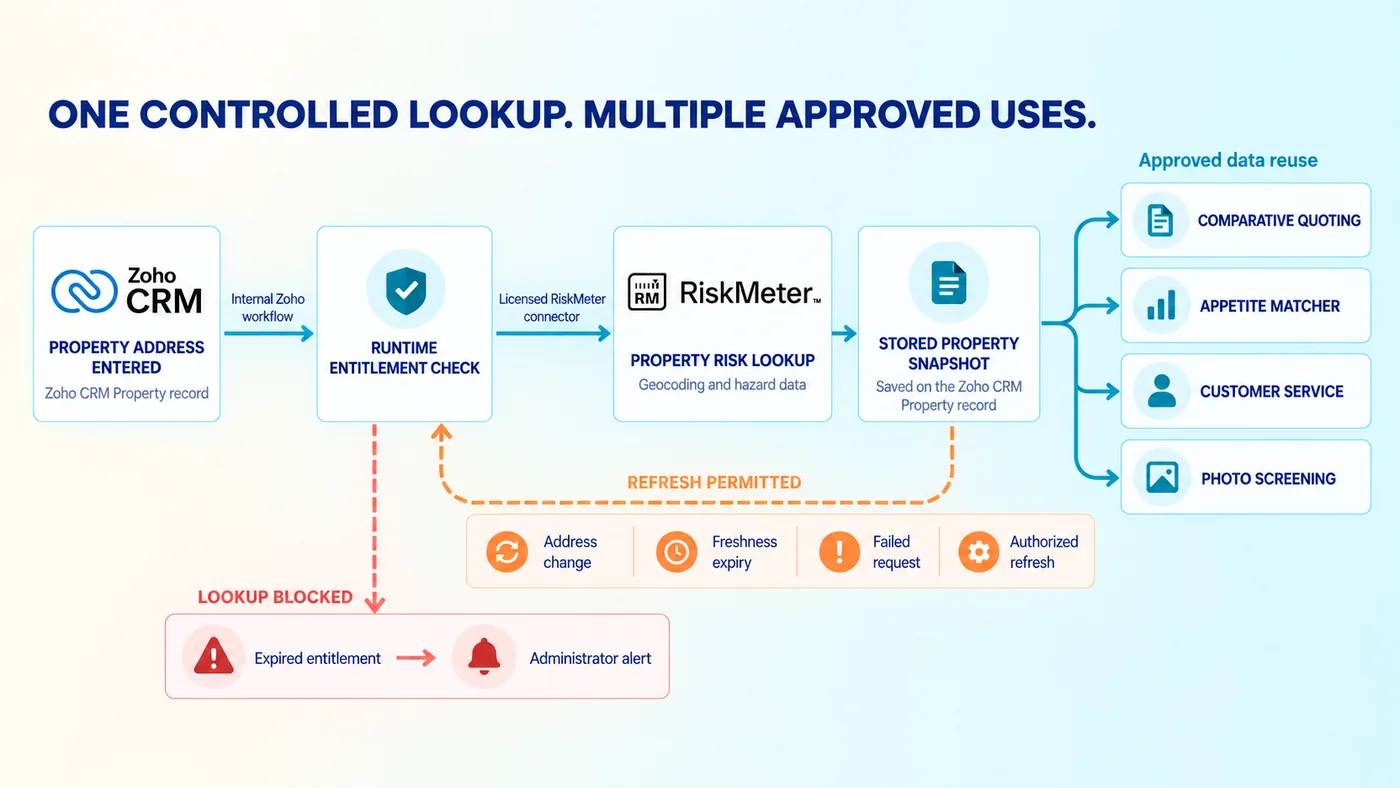
Adopted to address the terms of the agency’s contract with RiskMeter and CoreLogic. Subject to those terms, every downstream consumer, including the comparative rater workflow, the appetite matcher, and the multimodal photo screening, reads a single stored snapshot on the Zoho property record. Independent duplicate lookups were removed from every workflow.
Refresh conditions are explicit and split into two categories.
Concurrent requests for the same property deduplicate at ingress. The agency verified pricing, caching, retention, redistribution, and derivative use rights in its agreement before persistent storage and LLM consumption were enabled.
Adopted to address errors and omissions exposure and audit defensibility. OpenAI, Vertex AI, Vector Search, and Zoho all route through one authentication, authorization, logging, redaction, retry, and cost monitoring surface. No individual workflow holds direct model credentials. OpenAI receives only the retrieved guideline passages, structured visual findings, and citations needed to continue a conversation, and does not directly hold Vertex AI service credentials or independently access the vector store.
Adopted to address the agency’s retention, legal hold, and audit policy without turning the document repository into a technical log archive. Each artifact lands in the tier that fits its purpose.
| Tier | Holds | Retention driver |
|---|---|---|
| Agency management system | Original customer files, approved customer facing outputs, and customer record evidence | Regulatory retention, legal hold, and audit |
| Zoho | Persistent operational state, including customer and household profiles, property records, RiskMeter snapshots, consent, agent decisions, and service status | Operating record and errors and omissions defense |
| Orchestration audit store | Prompts, model versions, retrieval index versions, rule versions, trace events, and technical telemetry | AI defensibility and engineering audit |
Table 3. Three tier archival split.
Portal upload staging in Zoho and AI processing intermediates are transient and purge only after archival to the appropriate tier is verified. A failed archive never triggers deletion of the only available copy; it enters an exception queue.
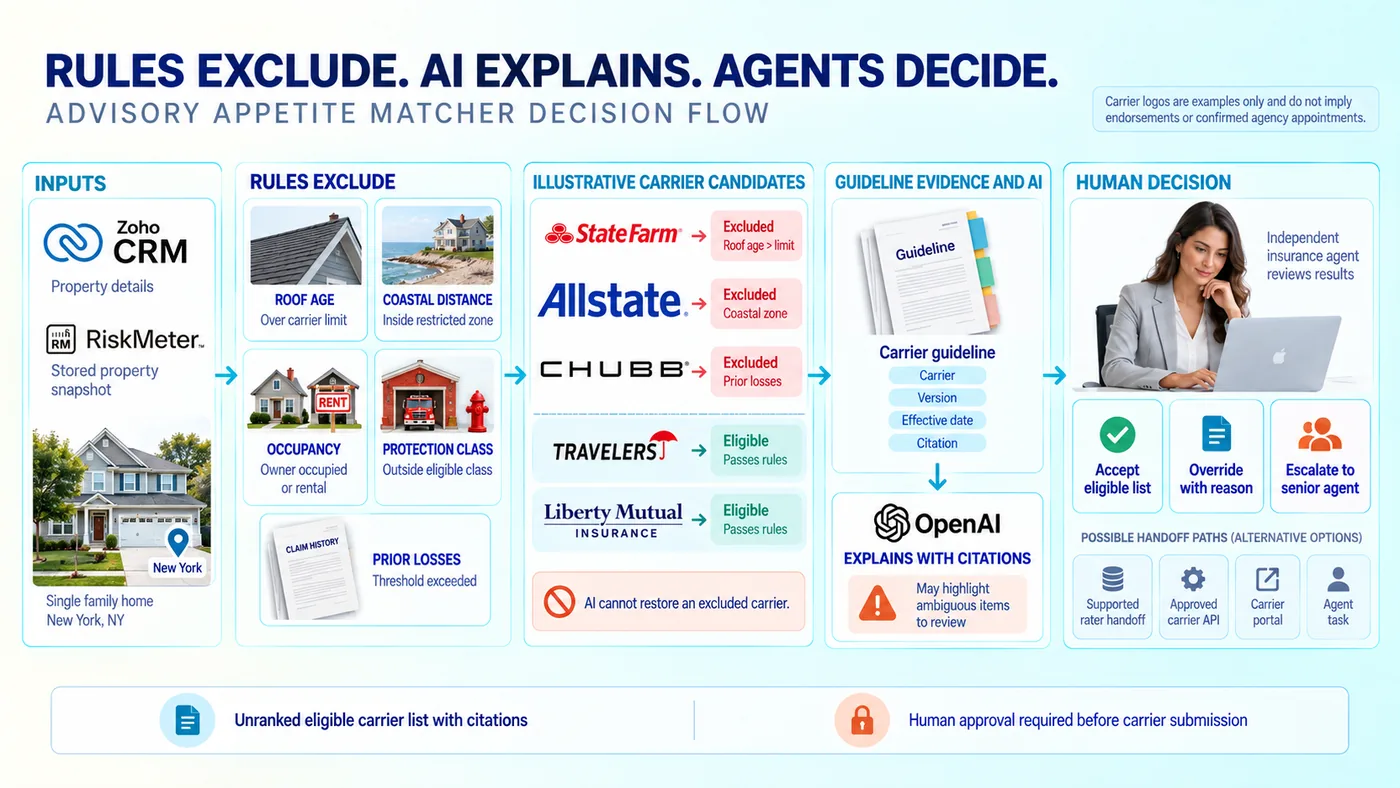
Adopted to address the reality that many carrier eligibility conditions are exact, including roof age limits, coastal distance restrictions, occupancy rules, protection class limits, and prior loss thresholds. Coded eligibility rules run first against the stored RiskMeter snapshot and customer supplied attributes. A carrier that fails a deterministic rule is excluded before any LLM reasoning runs. Retrieval and LLM explanation are bounded to interpretive work on the passing set, and the system does not convert a clear carrier decline rule into a probabilistic recommendation.
Adopted to address carrier submission rules and errors and omissions exposure. The matcher recommends carriers, cites the applicable guideline, and displays the property factor and carrier rule responsible for the result. An agent decides, and no recommendation reaches a carrier without human approval. Low confidence, missing, or contradictory guideline conditions escalate to a senior agent. The system does not default to a match.
Adopted to address the SalesIQ webhook card inability to carry raw uploads. Customer files land in the approved portal ingestion path first. A short lived authorized file reference enters the AI orchestration workflow. The same reference carries through Vertex AI processing, Zoho request creation, and agent review, so the audit trail links the conversation, the file, the model output, the guideline citation, and the human decision under one shared trace identifier.
Adopted to address evaluation and validation requirements grounded in the NIST AI Risk Management Framework and Vertex AI evaluation guidance. Fine tuning was deferred until a large, correctly labeled, human reviewed dataset exists. The multimodal photo screening runs on grounded prompting, retrieval against a controlled guideline library, and human review of every finding, with shadow mode comparison against human reviewers before agents begin using its output operationally.
Adopted to address model behavior risk in a regulated insurance workflow and the explicit model version and retirement lifecycle policy for Vertex AI. The tested Gemini Pro and Gemini Flash versions are pinned in each deployed environment. Upgrades do not happen automatically.
Any move to a newer version requires regression testing against the evaluation dataset, senior agent approval, and a documented rollout that carries the version change through the citation schema and the audit trail. Retirement notices trigger the same controlled migration path, planned against the retirement window, with the work scheduled well before it closes.
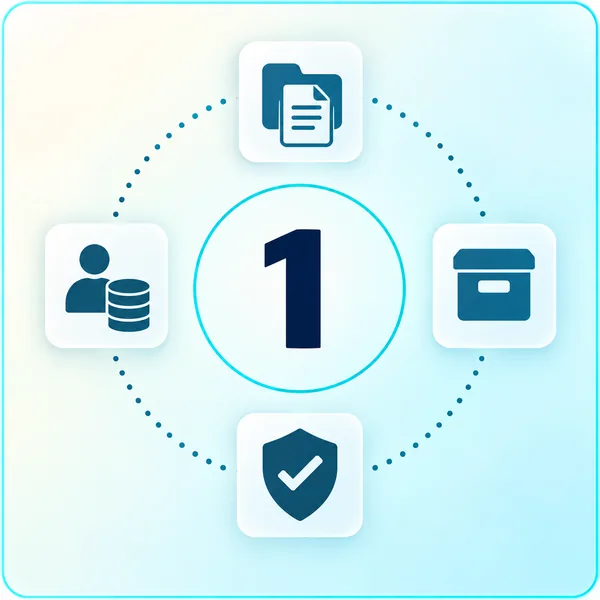
Clixlogix delivered 21 agency workflow modules across six functional areas, plus 2 additional AI modules covering conversational intake and multimodal photo screening. Of the 23 modules, 3 contain AI. The Advisory Appetite Matcher sits inside the placement workflow, so it counts among the 21 agency workflow modules. The SalesIQ Smart Intake Assistant and the Multimodal Photo Screening are the 2 additional AI modules.
| Functional area | Modules |
|---|---|
| Lead and customer management | Omnichannel lead management, customer and household management, property risk pre screening |
| Placement and quoting | Carrier appetite and placement guidance, comparative quote coordination, coverage review, application and document collection |
| Bind and onboarding | Quote acceptance and bind coordination, customer onboarding, mortgagee and evidence of insurance servicing |
| Service and retention | Policy service and endorsements, renewal and remarketing, carrier inspection follow up, agency assisted claim intake, billing and payment assistance |
| Communication and self service | Customer communication and service, customer self service, sales, retention, and cross sell automation |
| Governance and analytics | Compliance and errors and omissions controls, agency analytics and reporting, integration and exception management |
Table 4. 21 agency workflow modules grouped by functional area.
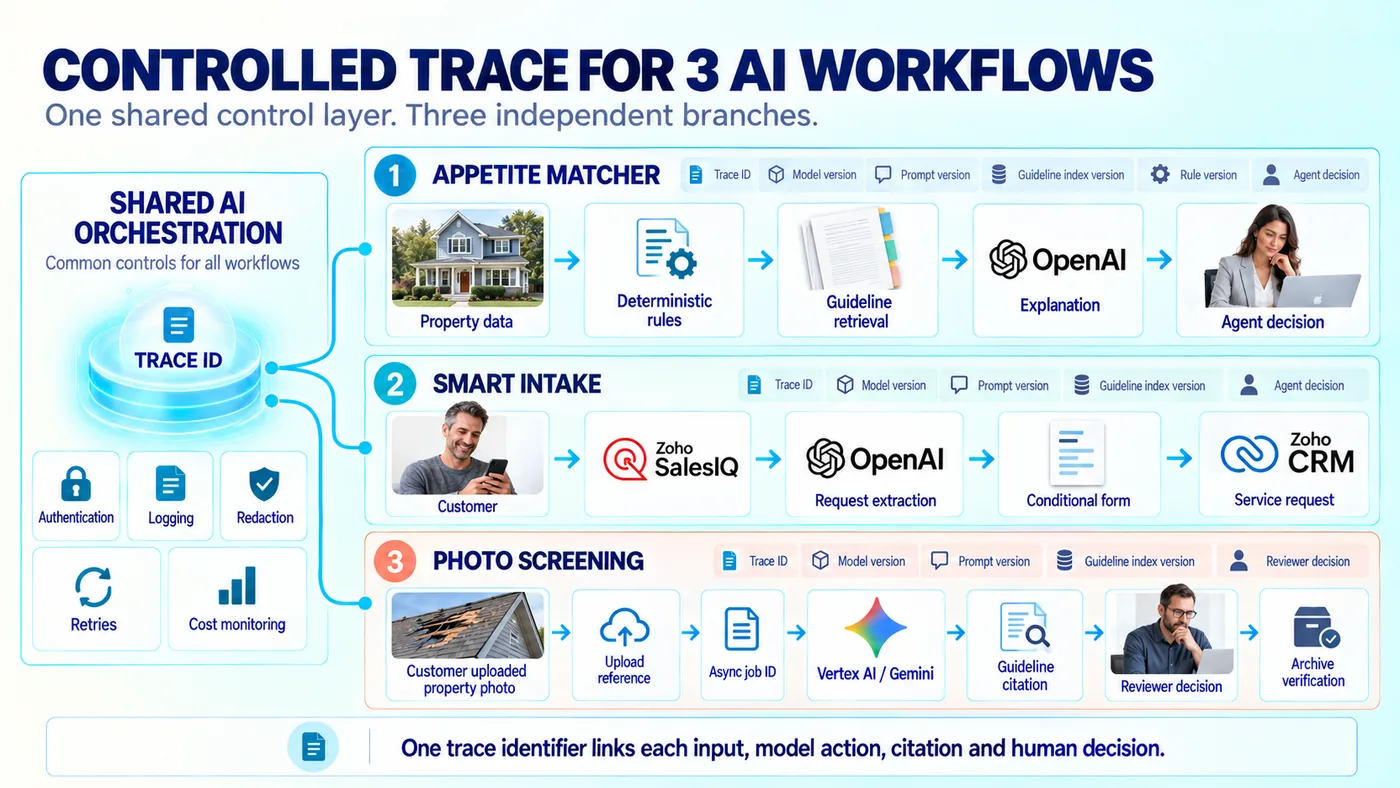
Storage follows the three tier split defined in Architecture Decisions. The three workflows containing AI share one orchestration layer, one citation schema, one linked audit trail, and a common human review policy.
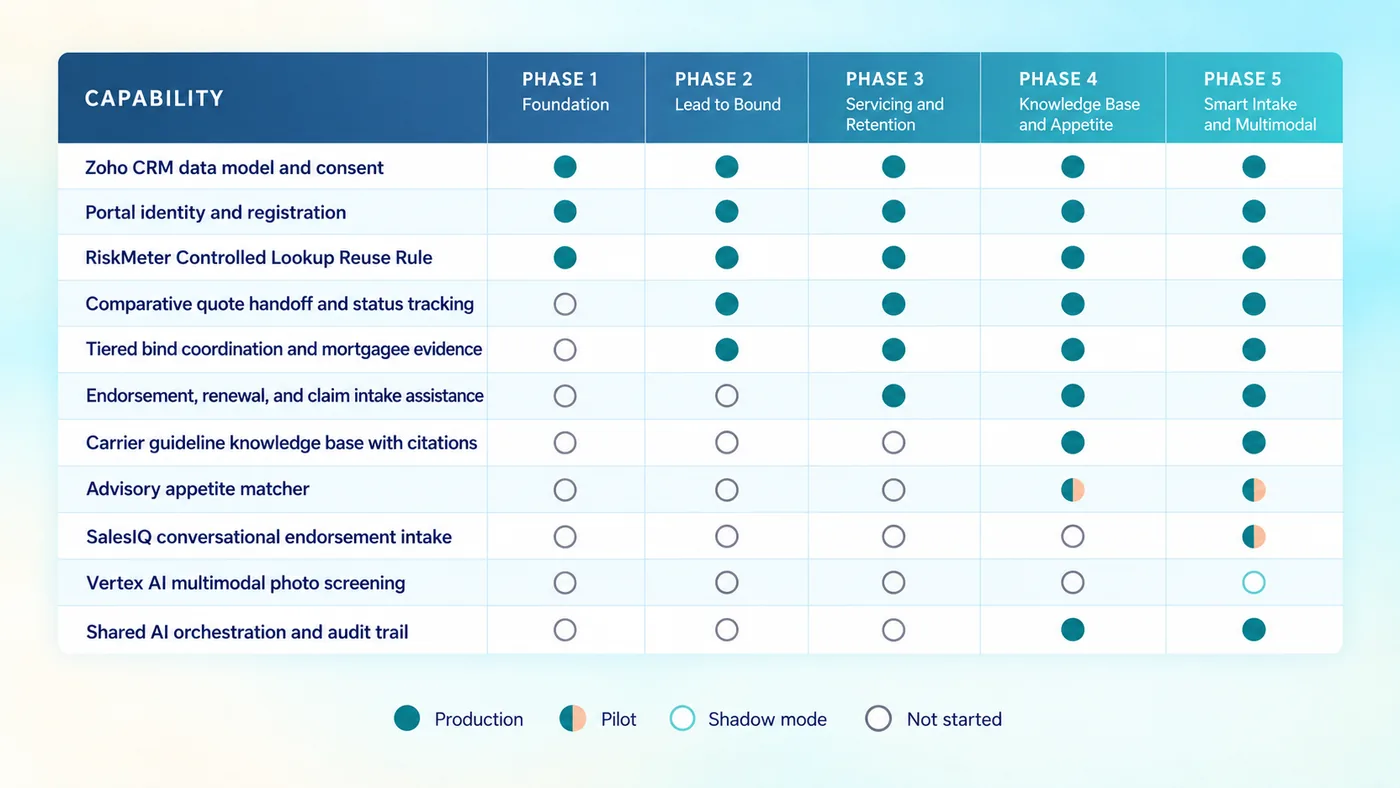
The build ran as one discovery stage followed by eight implementation stages. The first seven implementation stages are grouped into five delivery phases. Stage 8 is the continuing optimization track that runs on top of everything shipped. Foundation and consent came first. The lead to bound customer journey followed. Servicing and retention closed the operational loop. The carrier guideline knowledge base and advisory appetite matcher opened the AI arc. Smart intake and multimodal photo screening completed it.
| Stage | Name | Phase |
|---|---|---|
| Stage 0 | Discovery and solution design | Phase 1 |
| Stage 1 | Platform and integration foundation | Phase 1 |
| Stage 2 | Lead to quote MVP | Phase 2 |
| Stage 3 | Quote to bind and customer onboarding | Phase 2 |
| Stage 4 | Policy servicing and retention | Phase 3 |
| Stage 5 | Carrier guideline knowledge base and appetite matcher | Phase 4 |
| Stage 6 | Portal smart intake assistant | Phase 5 |
| Stage 7 | Multimodal photo and inspection audit | Phase 5 |
| Stage 8 | Optimization and expansion | Ongoing |
Table 5. Stage to phase mapping.
Fig 2 – Capability status across the five delivery phases
Legend. ● Production ◐ Pilot ◌ Shadow mode ○ Not started
The Zoho CRM data model was designed to hold the customer, household, property, quote, policy, request, and claim identifiers cleanly, so that every downstream workflow and every AI capability drew from a single spine. Multiple property relationships, named insured detail, mortgagee detail, prior carrier detail, and communication preferences all live on the customer and household records. Duplicate customer detection and clear ownership rules for customer and policy data are enforced at the data model level.
Consent capture, opt out management, and communication preference tracking were built into the customer profile from the first release, so that every later workflow, including the AI ones, could read a single consent state.
A customer portal shell shipped with authentication, account registration, consent capture, and password recovery. The portal to CRM identity map was established before any policy service feature was exposed, so that later stages could build service features onto a secure identity foundation.
Each record class has one system of record. Everything else reads or references.
| Record | System of record | Zoho role |
|---|---|---|
| Customer and household | Agency management system | Working profile for CRM workflows |
| Policy | Agency management system | Reference and workflow status |
| Documents and images | Agency management system document repository | Transient staging during upload and processing |
| Policy accounting, carrier billing, customer account transactions | Agency management system | Reference and workflow status |
| Corporate accounting and summarized general ledger entries | QuickBooks | Not held in Zoho |
| Calls and SMS | RingCentral | Linked interaction history |
| Portal chat | Zoho SalesIQ | Linked interaction history |
| Google Workspace with Gmail | Linked interaction history | |
| Linked communication history across channels | Zoho CRM | Owns the linked record |
| Property attributes | Zoho property record | Owns the record, including workflow state |
| RiskMeter snapshot | Zoho property record | Governed by the Controlled Lookup Reuse Rule |
| Consent and communication preferences | Zoho customer profile | Authoritative for every workflow, AI included |
| Quote status and bind status | Zoho | Reference to the comparative rater quote artifact |
Table 6. Record ownership matrix.
A property address straddles customer records and property attributes, so ownership is defined per address type.
| Address type | System of record | Notes |
|---|---|---|
| Mailing address | Agency management system | Follows the customer, used for correspondence |
| Insured property address | Agency management system | Attaches to the policy |
| Normalized geocoding address | Zoho property record | Address fingerprint used by downstream workflows |
| RiskMeter lookup address | Zoho property record | Stored as part of the RiskMeter snapshot, tied to the normalized address |
Table 7. Address ownership by type.
Address, mortgagee, and named insured changes route through Zoho and push to the agency management system through the integration framework, with the AMS acknowledgement confirming the change. Resolution follows field ownership. When both systems change an important field before synchronization completes, the change enters the integration exception queue for agent review, and no automatic winner is selected.
The rule is strictest on three field groups, where an automatic AMS wins rule could overwrite a legitimate correction.
Every reconciliation records the pre change and post change values from both systems under the shared trace identifier for errors and omissions defense.
Zoho CRM, Zoho SalesIQ, RingCentral, Google Workspace, QuickBooks, and the AI services connect through their supported APIs and webhooks. RiskMeter, the agency management system, the comparative rater, and carrier systems use approved APIs where available under the agency licensed configuration. Where an approved API is unavailable, the workflow uses supported file exchange, comparative rater handoff, portal assistance, or an agent task.
Every path lands on a common exception framework.
QuickBooks synchronization is scoped to corporate accounting only; it does not duplicate the agency operational accounting records or carrier billing.
Omnichannel lead capture consolidated website, aggregator, phone, SMS, email, and chat inquiries into a single Zoho queue with ZIP and product based routing, round robin agent assignment, and lead scoring. RingCentral screen pop shows the caller Zoho record on inbound. Abandoned quote follow up and referral tracking are automated.
Zoho checks the address for completeness and normalizes its format before submission. RiskMeter then geocodes the address, resolves the property location, and returns the permitted property risk information. The response is stored on the Zoho property record under the Controlled Lookup Reuse Rule, with address fingerprint, source, request timestamp, report version, and relevant risk attributes captured alongside. Every refresh records its reason.
Fig 3 – Controlled Lookup Reuse Rule for RiskMeter property data
Qualified leads transfer into the incumbent comparative rater with applicant and property data prefilled. The integration must be confirmed against the client licensed product configuration before build for three capabilities, acceptance of stored property data from the Zoho property record, return of quote status back to Zoho, and support for the carrier facing bind request handoff. Selected quotes bind through the rater carrier supported bind request handoff, and the bound policy synchronizes back to the agency management system as the system of record.
The coverage review checklist runs at quote time across these areas.
Declined coverage acknowledgements are captured with electronic signature. Missing document reminders and status tracking run on top of the agency document repository.
Bind requests submit through whichever carrier connector the appointed carrier supports. Carrier binder retrieval, policy number capture, mortgagee evidence delivery, and paperless enrollment reminders run through that connector, and failed binds surface as exception alerts.
Automation depth varies by carrier. Each appointed carrier is mapped to one of four capability tiers, and the workflow adapts accordingly. The connector automates transmission and retrieval only. It does not replace customer acceptance, agent authorization, or carrier approval.
| Capability tier | What runs on this tier | Trigger for use |
|---|---|---|
| Direct API automation | Following documented customer acceptance and agent authorization, bind request submission, binder retrieval, policy number capture, and evidence delivery run automatically through the approved carrier API | Carrier exposes documented APIs the agency has been approved for |
| Comparative rater handoff | Bind submission and status sync run through the rater carrier supported path | Carrier is supported by the incumbent comparative rater bind request handoff |
| Assisted download or upload | Agent uploads bind requests and downloads binders through the carrier portal, with Zoho tracking status and reminding on outstanding items | Carrier exposes a portal but no API or rater support for the agency |
| Agent task when no supported automation exists | Zoho creates a full agent task with checklist, deadline, and communication template; nothing automates against the carrier | No portal, API, or rater path is available |
Table 8. Carrier connector capability tiers.
The tier for each appointed carrier is stored on the carrier record and drives which subworkflow the bind coordination step enters.
Endorsement request intake, mortgagee change workflows, renewal task automation, comparative rater remarketing, carrier inspection follow up, agency assisted first notice of loss and claim intake, customer self service, cross sell campaigns, and retention dashboards were delivered as the operational service loop. Zoho supports agency assisted claim intake only. Coverage decisions, adjuster assignment, reserves, settlement, and payments remain with the carrier. Every service request has an owner and a deadline. Every carrier submission and response is traceable. Renewal opportunities are created automatically ahead of the renewal window.
Campaign types feed a single agent opportunity queue with campaign attribution and conversion reporting.
The following controls run inside the operational workflow layer and produce a linked audit trail using shared trace identifiers.
The carrier guideline knowledge base is a controlled document library carrying carrier, state, product, version, and effective date for every guideline. Documents are chunked, embedded, and indexed for retrieval. A shared carrier rule taxonomy and citation schema binds every AI recommendation to a specific guideline passage with its version and effective date. Re indexing runs when carrier guidelines change.
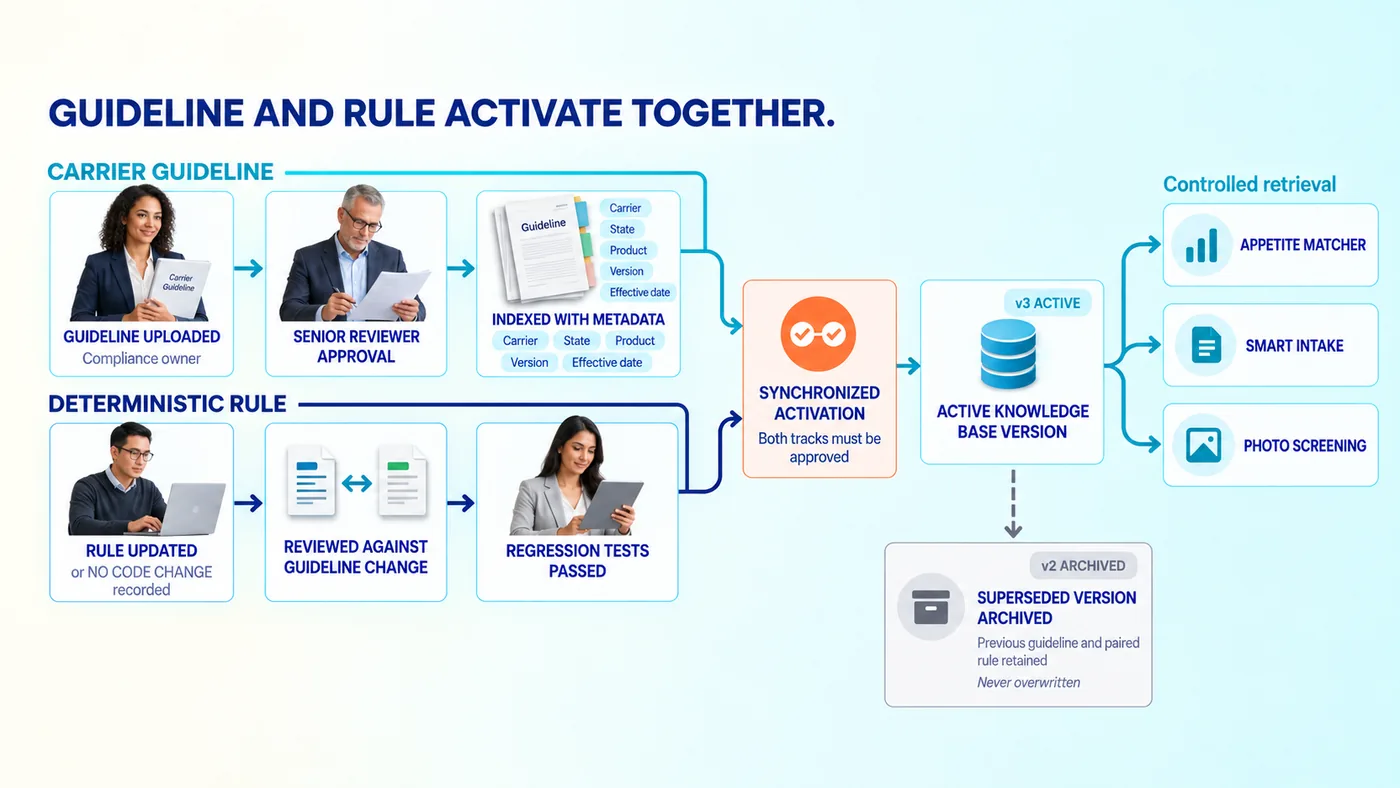
A designated compliance owner on the agency side uploads new and revised carrier guidelines through a controlled ingestion path in Zoho. A senior agent reviewer approves each document before it enters the retrieval index. Version, effective date, and carrier metadata are captured on approval, and the previous version is archived. Retirement of a superseded guideline is an explicit step, so the retrieval index never carries two active versions of the same rule.
Fig 4 – Carrier guideline knowledge base ingestion and retirement lifecycle
Every deterministic carrier eligibility rule carries the same carrier, product, state, guideline version, and effective date as its source document. A new guideline and its coded rule counterpart activate together only after both pass review and regression testing. Coded rule changes never ship independently of a guideline change, and a guideline change never enters the retrieval index without a matching coded rule commit or an explicit no code change flag. This prevents drift between what the retrieval layer cites and what the deterministic exclusion layer enforces.
The matcher is positioned as pre quote triage on information the comparative rater does not expose. It does not replace the rater own eligibility filters. Its job is to keep clearly ineligible risks out of the quoting queue and to surface residual market paths early, before the rater is called.
Carrier eligibility runs on a four step design. LLM ranking alone does not decide it. Roof age limits, coastal distance restrictions, occupancy rules, protection class limits, and prior loss guidelines are often exact conditions, and the LLM does not convert a clear carrier decline rule into a probabilistic recommendation.
The output for the agent is a list of eligible carriers that passed step 1, each with the property factor and carrier rule responsible for the result, the supporting guideline citation with version and effective date, the LLM explanation, and any flagged ambiguities. No ranking is applied. Recommendations are advisory only and never reach a carrier without human approval.
Fig 5 – Advisory Appetite Matcher four step decision flow
Phase 4 stood up the orchestration service defined in Architecture Decisions. It is the foundation the next two AI capabilities inherit.
Fig 6 – Shared AI orchestration and the trace identifier across three AI workflows
The providers were selected for different roles following internal evaluation against the agency conversational, retrieval, and multimodal requirements.
| Provider | Role in the stack |
|---|---|
| OpenAI | Advisory Appetite Matcher explanation and ambiguity detection, SalesIQ Smart Intake Assistant dynamic questioning and structured extraction |
| Vertex AI with Gemini and Vector Search | Multimodal Photo Screening image and PDF analysis, carrier guideline retrieval |
Table 9. AI provider roles.
The portal smart intake assistant launched with three high volume request types, covering new pool, renovation or addition, and scheduled jewelry or valuables. The multimodal photo screening launched into shadow mode with a limited set of visually distinct hazards.
The assistant runs a hybrid design. Form rules do the load bearing work on mandatory carrier questions, and AI does the interpretive work around them.
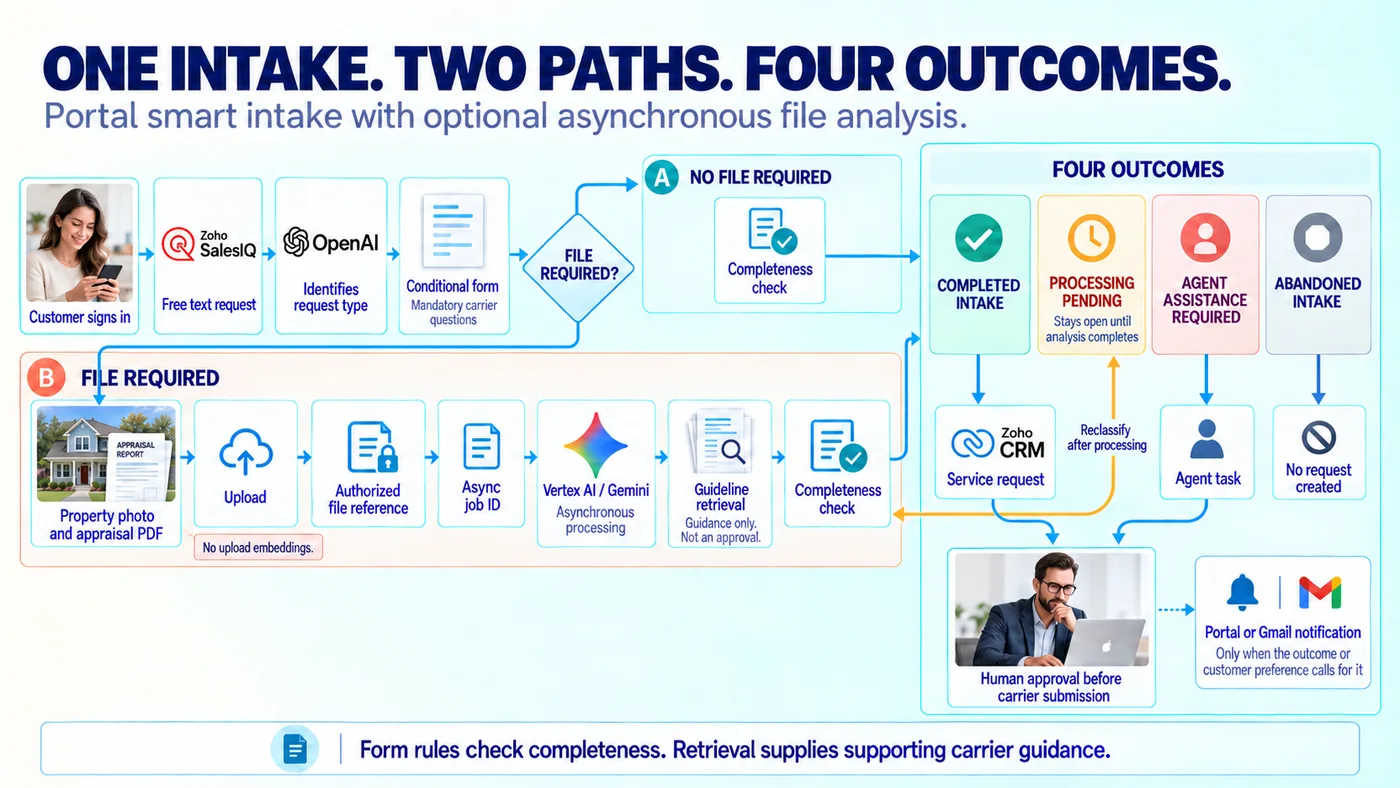
Large photographs and multi page inspection PDFs process in the background. The conversation is not blocked. SalesIQ receives a processing job identifier as soon as the upload lands on the ingestion path, and the conversation continues on the questions that do not depend on the analysis result.
When the multimodal analysis completes during the conversation, the finding attaches to the same trace identifier and appears inline. When analysis finishes after the conversation has already closed, the finding attaches to the same trace identifier, the customer receives a portal notification and an email with a secure link back to the conversation record, and complex or contradictory findings escalate to the assigned agent, who reaches out directly by email or a scheduled callback.
Completeness validation runs before submission. Conversation outcomes route into four distinct states so the service queue stays clean.
| Outcome | Definition | Zoho record created |
|---|---|---|
| Completed intake | All mandatory form rules pass and the customer confirms submission | Structured service request for agent review and carrier submission |
| Processing pending | Mandatory fields pass but multimodal analysis is still running after the conversation closes | Placeholder request tagged pending, converts to a completed intake or agent assistance record when the result returns |
| Agent assistance required | Mandatory fields cannot be resolved through the assistant, or the finding is ambiguous or contradictory | Agent task with the partial conversation, uploaded files, and specific gap noted |
| Abandoned intake | Customer leaves before mandatory fields are complete and does not return within the retention window | Lightweight follow up record with the last known state, no service request created |
Table 10. Smart Intake conversation outcomes.
An agent reviews and approves every service request or agent task before the request reaches a carrier.
Uploads move through a lightweight control set before analysis begins.
JPEG, PNG, HEIC, and PDF. Other types are rejected with a customer facing message.
Fig 7 – Portal smart intake with asynchronous upload processing and four outcomes
Gemini Pro and Gemini Flash serve different tiers of analysis, and PDFs and images route differently before either model runs.
For large inspection PDFs, text and page structure are extracted first. Only the pages relevant to the request enter visual analysis, and full document reasoning across pages runs only when cross page context is necessary, for example a repair narrative that spans several pages of an inspection report. This keeps Flash and Pro off pages that offer no visual signal.
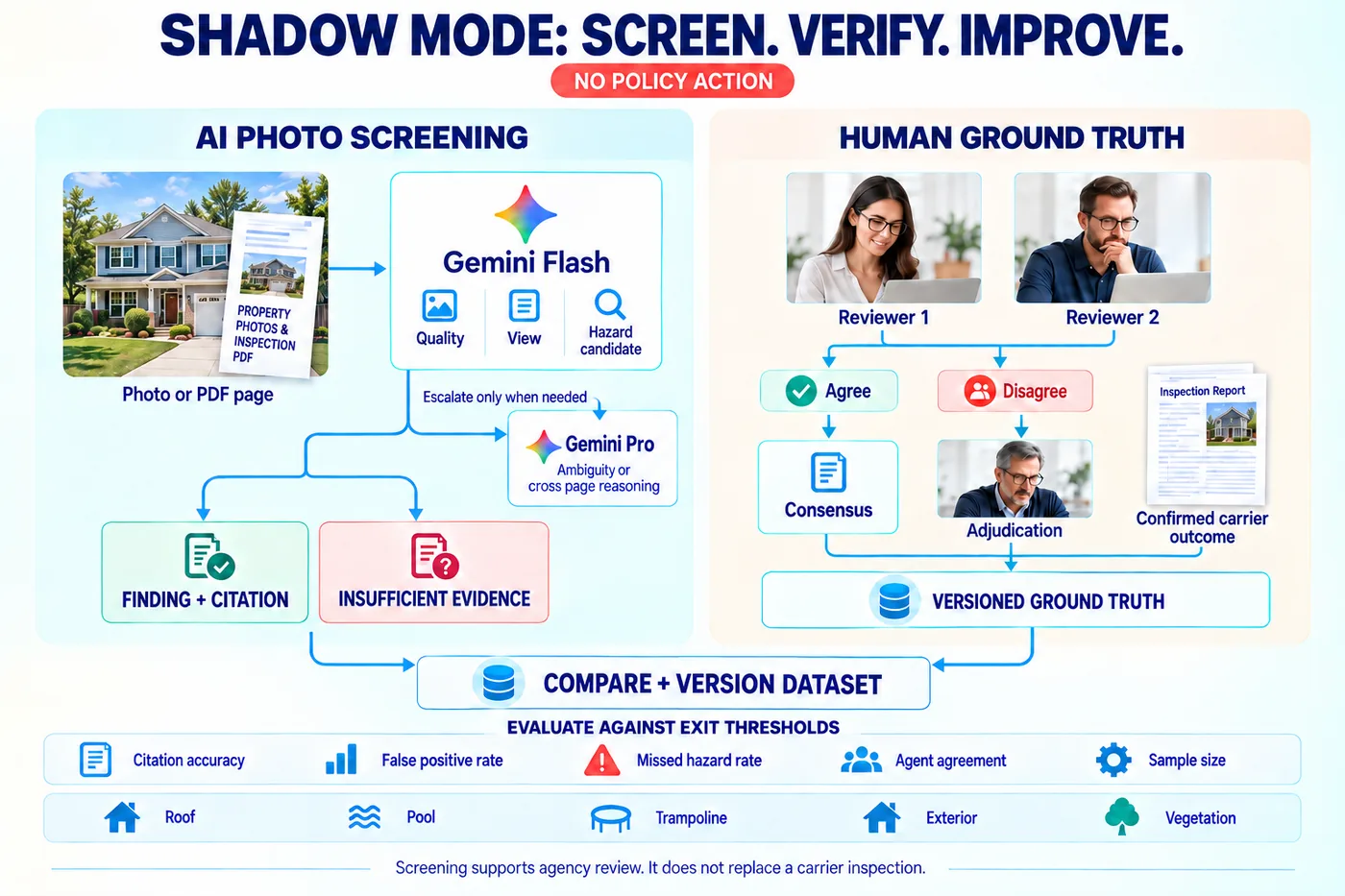
Flash runs first on the images and PDF pages that reach visual analysis, for fast quality gating and view classification. Pro runs only when Flash flags a hazard candidate that needs deeper analysis, when image content is ambiguous, or when a multi page PDF requires reasoning across pages. Every trace records which model handled the work. Running both models on the same input is permitted only when Flash is inconclusive and the case escalates to Pro.
Photo screening is scoped to specific service workflows. It does not run as a universal step on every policy. It triggers inside servicing requests, endorsement intake, carrier inspection follow up, and proof of repair. New business photographs move through the standard review path unless one of those triggers applies.
Customer uploaded property photographs and inspection PDFs from the scoped workflows pass through Vertex AI multimodal processing with Gemini Pro and Gemini Flash. Visual observations are checked against the carrier guideline library retrieved from the shared knowledge base. Structured findings carry severity, confidence, supporting evidence, and guideline citation. An insufficient evidence result is returned when image quality or the applicable guideline is unclear.
Findings create high priority Zoho CRM tasks that display the exact photograph or PDF page, the retrieved carrier requirement and its effective date, and the recommended next action. Agent acceptance, override, and dismissal are recorded for audit and future tuning. Photo screening runs in shadow mode and tuning, with results compared against human reviewers. It moves to operational use only when agents begin using its output in the service workflow.
The multimodal photo screening provides preliminary agency assistance and does not replace a carrier underwriting inspection or a professional inspector opinion. Findings must be grounded in a current, approved carrier guideline, must include the source image or document page, and require agent approval before any information is sent to a carrier. Low confidence or conflicting findings escalate to manual review.
Consulting insight
A non renewal initiated by the carrier is a three cost event. The direct cost is remarketing effort. The indirect costs are a probable price step up on the replacement carrier and customer relationship attrition. Photo screening in servicing, endorsement, inspection follow up, and proof of repair is agency side triage that keeps a placement stable before the underwriter reaches a decision point. Read it as a retention lever in the operating model.
Fig 8 – Multimodal photo screening shadow mode evaluation loop
Phase 5 applies the three tier archival split defined in Architecture Decisions. Portal upload copies of every finalized image and PDF land in the agency management system document repository with checksum, permissions, and retrieval status verified. Prompts, model versions, trace events, and processing intermediates land in the orchestration audit store. Transient Zoho staging and AI processing copies purge only after both archives are verified.
A shared trace identifier links the SalesIQ conversation, uploaded file, Vertex AI processing result, guideline citation, Zoho request, and agent decision, so any customer touch reconstructs cleanly for errors and omissions defense. Configuration versions travel with the trace to the orchestration audit store.
Fig 9 – System architecture, ownership and the three archival tiers
The outcomes below combine structural outcomes from the delivered architecture with the three business results the client and delivery team have signed off on. Five describe the shape of what shipped. Three are measured. Additional business results will follow as pilot data continues to accumulate.
The 70% reduction comes from RiskMeter usage logs reconciled against the Zoho lookup event log. The 35% comes from Zoho service request cycle time, measured against the pre engagement baseline for the same request types. The 92% comes from the Zoho agent decision log across the reviewed sample.
Two further business results are instrumented and will slot into the outcomes grid once the sample size and client sign off are complete.
Every number in this section is held until the client and the delivery team both sign off.
The three workflows containing AI are monitored against a defined measurement set. The set is instrumented from launch, so the underlying numbers exist for engineering verification once a representative sample size has accumulated.
A single human reviewer opinion is not ground truth. Ground truth for the multimodal photo screening is an agreed label produced through one of three paths.
The ground truth set is versioned alongside the retrieval index and the deterministic rules, and every measurement is reported against a named ground truth version.
The multimodal photo screening moves out of shadow mode only when each of the following clears its threshold against a defined minimum sample size.
The Advisory Appetite Matcher and SalesIQ Smart Intake Assistant carry their own thresholds against citation accuracy, agent agreement, and incomplete intake rate. The specific numeric thresholds and minimum sample sizes are held internally and reviewed with the account team before publication.
Thresholds for pilot expansion, hazard category expansion, and any future fine tuning are set against these measurements.
Every row names what Clixlogix built with or integrated to, with its role in the stack.
| Layer | Technology |
|---|---|
| CRM and workflow orchestration | Zoho CRM for leads, customers and households, properties, quotes, policy references, service requests, agency assisted claim intake, and custom modules. The workflow spine every other system reads from. |
| Conversational and chat | Zoho SalesIQ for portal chat, dynamic questioning workflows, webhook cards, and the file reference handoff that keeps raw uploads out of the card. |
| LLM and reasoning | OpenAI for dynamic questioning, structured data extraction, and guideline grounded appetite recommendations. It receives retrieved passages and citations only, and holds no Vertex AI credentials. |
| Multimodal and vector | Vertex AI for multimodal processing and evaluation, with Gemini Pro and Gemini Flash for image and document analysis grounded in carrier guidelines. Tested versions are pinned per environment and public copy names the model family, since documented versions carry explicit retirement lifecycles. Vector Search serves approved carrier guideline retrieval only; customer uploads are not embedded. |
| AI orchestration | A shared orchestration service carrying authentication, authorization, logging, redaction, retries, cost monitoring, and unified trace identifiers. No workflow holds direct model credentials. |
| Property risk | RiskMeter for property geocoding, flood zone, distance to coast, fire protection class, wind exposure, and geographic hazard reports, under the Controlled Lookup Reuse Rule subject to CoreLogic contract terms. |
| Telephony and messaging | RingCentral for calls, SMS, screen pop on inbound, and call logging linked to the Zoho record. |
| Google Workspace with Gmail for customer email, linked into the interaction history. | |
| Agency systems of record | The incumbent agency management system for customer, policy, document, and policy accounting data, and the incumbent comparative rater for multi carrier quoting. Both were integrated, neither was replaced. |
| Accounting | QuickBooks for corporate accounting and summarized general ledger entries, scoped away from operational accounting and carrier billing. |
| Compliance and audit | Zoho CRM audit and activity logs, electronic signature evidence, and the orchestration audit store holding prompts, model versions, trace events, and telemetry. |
Table 11. The stack behind the build, with the agency management system retained as the system of record.
Our team can share client references, scope your project, and answer any question about your delivery.
More engagements where our delivery teams shipped similar outcomes for clients across industries. Read on for context on the patterns we reused, the trade offs we navigated, and the metrics that landed in production.