c-84, sector 65, Noida
Berlin furniture retailer went from 12% to 81% indexed pages. Clixlogix fixed crawl budget, deployed hreflang, added schema. EUR 420K added quarterly.
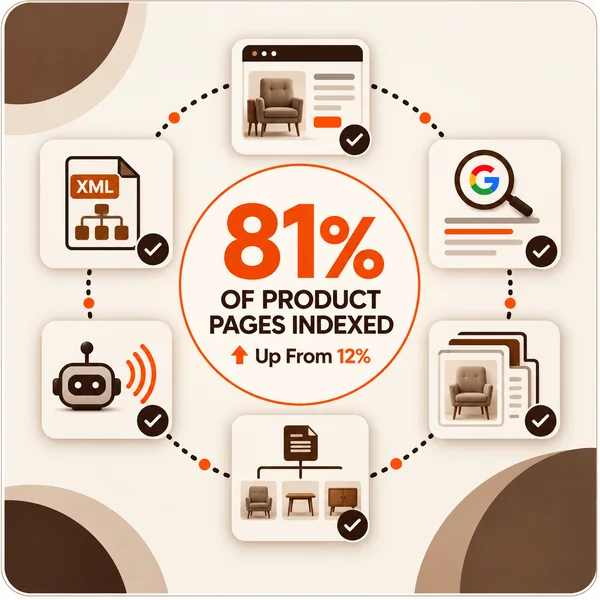
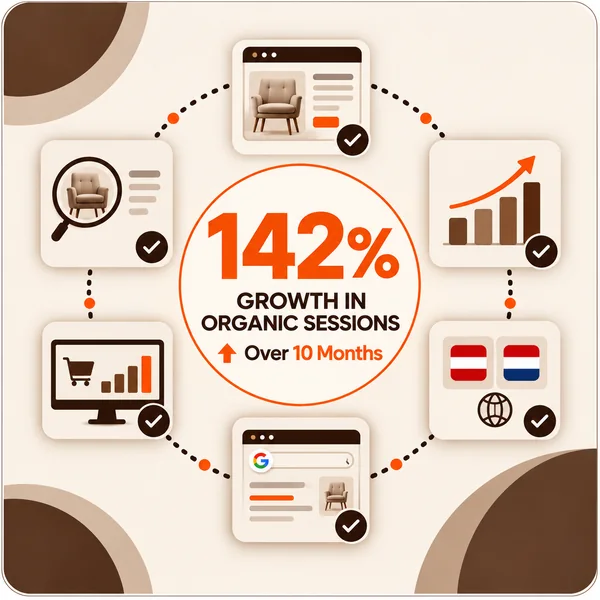
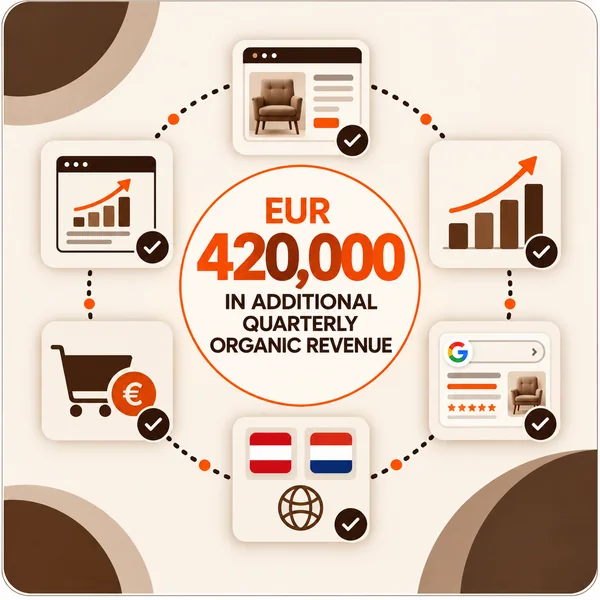
A Berlin direct to consumer furniture brand selling Scandinavian inspired home goods across Germany, Austria, and the Netherlands was losing ground in organic search. Google indexed only 12% of the brand’s 9,000 product pages, and organic traffic contributed 18% of total revenue, well below the 33 to 45% benchmark for mature European ecommerce stores. Clixlogix migrated the site from WordPress to Shopify, restructured the store’s faceted navigation to stop generating thousands of duplicate URLs, deployed hreflang tags for 3 target markets, built programmatic product description templates with full schema markup, and shipped structured content that lifted the brand’s visibility in AI search results. Indexed product pages jumped to 81% within 5 months, organic sessions grew 142%, and organic revenue share reached 31%, adding EUR 420,000 in quarterly sales.
The retailer started as a single physical showroom in Berlin’s Prenzlauer Berg neighborhood, selling mid range Scandinavian inspired furniture. The pitch stayed simple and specific. The furniture looks like it belongs in a design magazine, ships flat packed, and assembles without tools. The retailer sat in the price gap between mass market flat pack furniture and high end Danish design houses, and that positioning worked. By the time the pandemic began, the showroom had grown into a mid sized operation with a loyal local following and a reputation for carrying pieces that felt like imports from Copenhagen at half the price.
When foot traffic vanished during the pandemic, the team built an online store on WordPress with WooCommerce. The store worked well enough at first, handling a few hundred products and a modest volume of orders. The catalog grew fast. The team added 3D product renders so customers could rotate furniture from every angle. They rolled out an augmented reality feature called Room Preview that let shoppers point their phone at a corner of their living room and see a bookshelf or sofa placed there in real time. These features drove conversions in the showroom’s absence. They also made the website heavy and slow. Page load times climbed past 5 seconds. The WordPress plugin count grew to 38 active plugins, and updates broke things with enough regularity that the marketing team stopped publishing blog posts for weeks at a time because something would crash.
The catalog reached 9,000 products across furniture, lighting, textiles, and home accessories. The retailer served customers in Germany, Austria, and the Netherlands through a single .de domain with no language or regional targeting in place. The site’s faceted navigation, built to let shoppers filter by material, color, room type, price range, and size, generated thousands of filter combination URLs that Google crawled and indexed alongside the actual product pages. The result was a store customers saw well and search engines barely saw at all.
When the team reviewed analytics in the lead up to this engagement, the numbers told a blunt story. Organic search contributed 18% of total revenue. Paid advertising carried the rest, and the cost per acquisition was climbing quarter over quarter. The retailer needed to fix its search visibility before the ad budget became unsustainable.
| Function | Before | After |
|---|---|---|
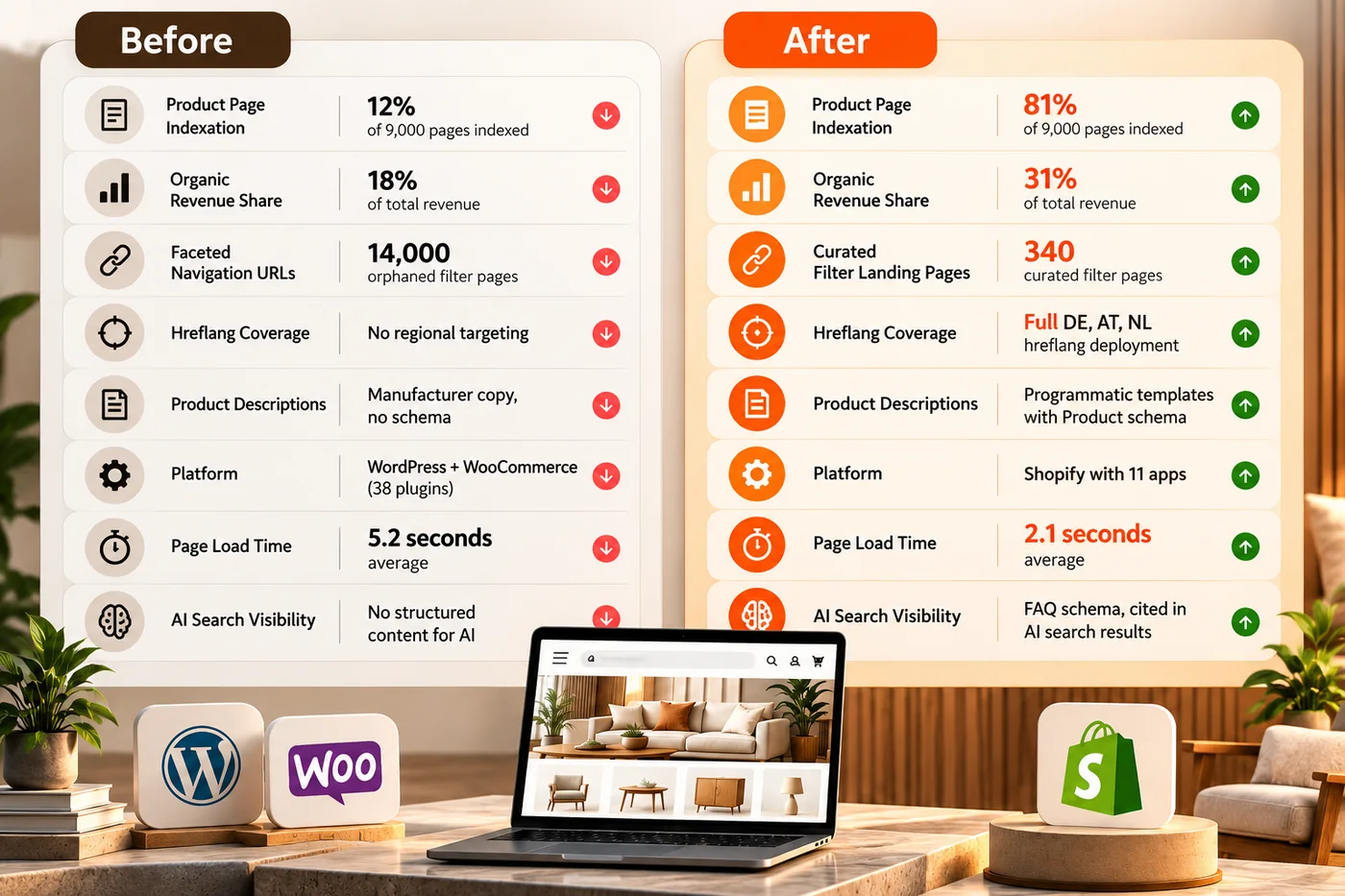
| Product Page Indexation | 12% of 9,000 pages indexed | 81% of 9,000 pages indexed |
| Organic Revenue Share | 18% of total revenue | 31% of total revenue |
| Faceted Navigation URLs | 14,000 orphaned filter pages | 340 curated filter landing pages |
| Hreflang Coverage | No regional targeting | Full DE, AT, NL hreflang deployment |
| Product Descriptions | Manufacturer copy, no schema | Programmatic templates with Product schema |
| Platform | WordPress + WooCommerce (38 plugins) | Shopify with 11 apps |
Table 1 - Before and After the Engagement
Fig 1 - From 12% indexation and 18% organic revenue to 81% and 31%.
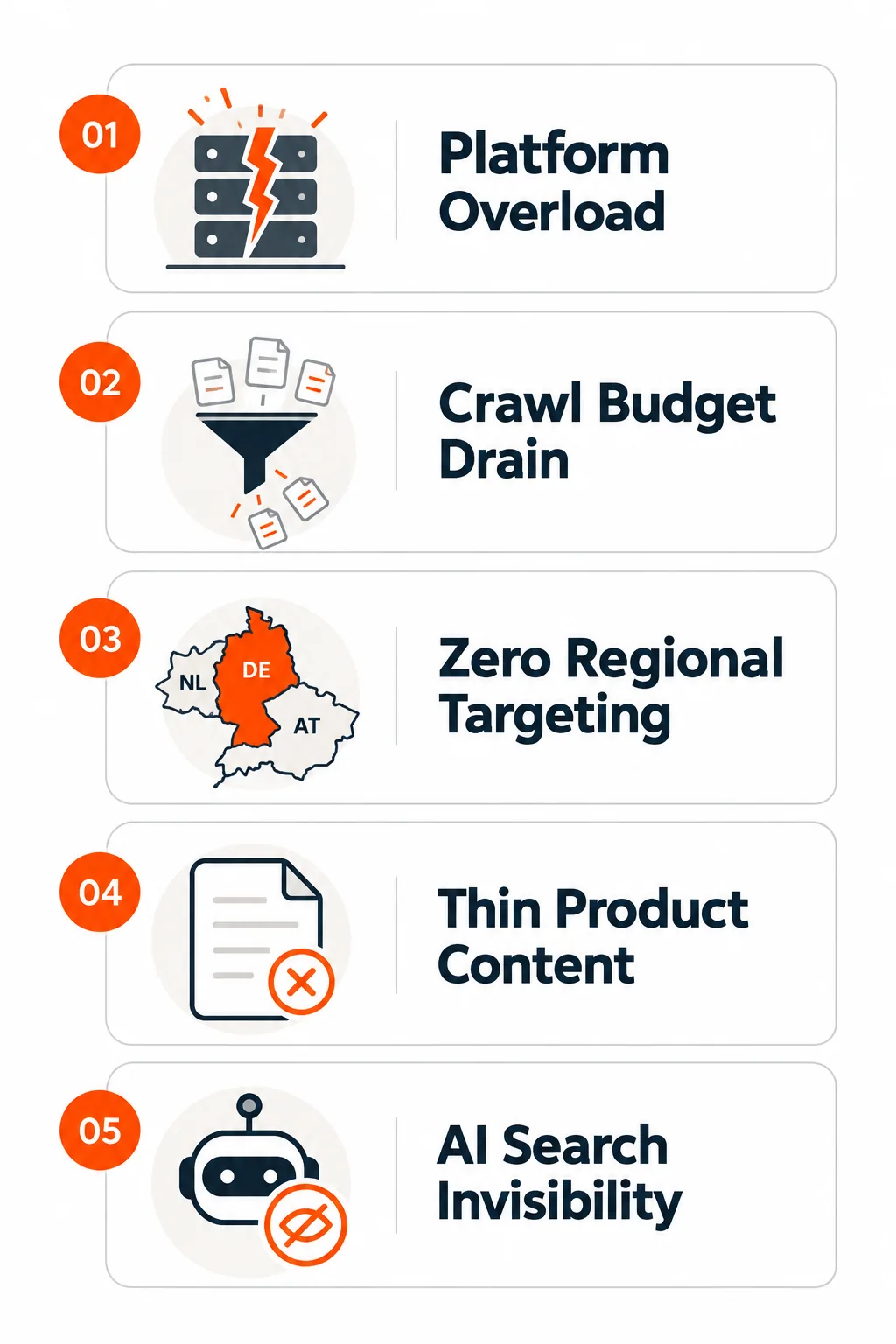
The retailer’s organic search problems were not the kind a few meta title tweaks could fix. 5 structural issues worked against each other, and each one made the others worse.
A platform that could not keep up with the product - The WordPress and WooCommerce setup had served the store well when the catalog was small. With 9,000 products, 38 active plugins, and resource heavy features like 3D product viewers and augmented reality, the site had outgrown its infrastructure. Pages took 5.2 seconds to load on average. Plugin conflicts broke the checkout twice during a holiday sale, costing the retailer an estimated EUR 35,000 in lost orders over a single weekend. The development team split most of its hours between patching plugin conflicts and chasing feature work that rarely shipped. Clixlogix published a full guide on WordPress to Shopify migration covering when the switch makes sense and when it does not.
A crawl budget eaten alive by filter pages - The store’s faceted navigation let shoppers filter products by material, color, room type, price range, size, and availability. The filters served shoppers well and devastated the site’s SEO. According to Google Search Central, faceted navigation accounts for roughly 50% of all crawling issues on ecommerce sites. Filter combinations had generated over 14,000 unique URLs that Google was crawling and indexing, none of which carried any search demand. Those 14,000 orphaned pages consumed crawl budget that should have gone to the 9,000 actual product pages. That failure left Google indexing only 12% of real product pages. Clixlogix covers this failure mode in detail in a guide on fixing discovered but not indexed pages.
Three markets, zero regional targeting - The retailer shipped to Germany, Austria, and the Netherlands from a single .de domain. All 3 markets saw the same product pages, the same currency, and the same German language content, with no hreflang tags telling Google which pages belonged to which market. Austrian and Dutch customers searching in their local Google instances often landed on irrelevant results or saw no results from the store at all. The retailer was paying for advertising to reach customers that organic search should have delivered for free.
Thin product descriptions that said nothing Google could use - The majority of product pages carried manufacturer supplied copy, often 2 sentences repeated across dozens of variants with minor wording changes. The pages carried no Product schema markup, no FAQ content, and no structured specifications. Google had little reason to treat these pages as authoritative answers to buyer queries, and the product pages ranked poorly even when Google did index them. Long tail product keywords drive the highest intent traffic in ecommerce, provided the page content gives Google enough to work with.
Invisible to AI search engines - During the lead up to this engagement, AI search tools including ChatGPT, Perplexity, and Google AI Overviews started driving measurable referral traffic to ecommerce sites. Industry traffic from AI search engines multiplied 16x in the 2 years leading to this engagement. US ecommerce AI referral traffic from ChatGPT grew 210.5% year over year in the most recent quarter. The retailer’s product pages carried no structured FAQ content, no schema markup, and no citation ready information that AI models could pull from. The brand was absent from every AI search recommendation in the Scandinavian furniture category. The Clixlogix guide on Generative Engine Optimization explains why this matters and what the fix looks like.
Why this mattered
The retailer was spending over EUR 180,000 per quarter on paid advertising to compensate for the organic traffic it was not getting. Every month that crawl budget leaked into orphaned filter pages, and that product descriptions sat without schema, was a month the store paid full price for customers that should have arrived through search. If the trajectory held, the paid acquisition cost would outpace margin growth within 2 quarters.
Fig 2 - The five structural problems working against the retailer’s organic search performance.
Clixlogix structured the engagement as 5 parallel work tracks, with no sequential phasing. The platform migration and crawl budget cleanup had to happen at the same time, because fixing the URL architecture on a platform the client was about to leave would have doubled the work. The three market SEO, programmatic content, and AI search readiness tracks ran alongside the migration, each one building on the technical foundation the first two tracks established.
Clixlogix assigned a cross functional team covering SEO strategy, Shopify engineering, content production, visual design, and delivery coordination, with timelines synchronized across all 5 tracks. Here is how the Clixlogix delivery model works on engagements of this size.
| Capability | Migration | Crawl Architecture | Three Market SEO | Content and Schema | AI Readiness |
|---|---|---|---|---|---|
| WordPress to Shopify migration | ● | ○ | ○ | ○ | ○ |
| URL redirect mapping (1,200+ redirects) | ● | ● | ○ | ○ | ○ |
| Faceted navigation restructuring | ○ | ● | ○ | ○ | ○ |
| Orphaned URL cleanup (14,000 pages) | ○ | ● | ○ | ○ | ○ |
| Hreflang deployment (DE, AT, NL) | ○ | ○ | ● | ○ | ○ |
| Programmatic product descriptions | ○ | ○ | ○ | ● | ○ |
| Product schema markup | ○ | ○ | ○ | ● | ● |
| FAQ content and structured data | ○ | ○ | ○ | ○ | ● |
| AI search citation optimization | ○ | ○ | ○ | ○ | ● |
Table 2 - Work Track Coverage Matrix
Clixlogix made the hardest call first and left WordPress entirely - The retailer had invested years into the WooCommerce setup, and WordPress plugins ran the 3D product visualization and AR Room Preview features with no direct Shopify equivalent. Clixlogix ran a cost analysis that showed the retailer was spending 22 hours per week on WordPress maintenance, plugin conflict resolution, and hosting management. That consumed nearly a full time employee’s worth of hours each week, time the business needed for growth.
Clixlogix mapped every product, variant, customer record, and blog post into Shopify’s data structure. Clixlogix converted the 3D product renders into Shopify’s native 3D model format using .glb files, which Shopify supports without plugins. Clixlogix moved the AR Room Preview feature to Shopify’s built in AR Quick Look on iOS and Scene Viewer on Android, replacing the custom WordPress plugin that had carried most of the page weight. A test batch of 200 products went through first, and Clixlogix caught 14 field mapping errors that would have repeated across all 9,000 products if the full import had gone first.
The redirect map covered 1,247 URLs. Every product, collection, blog post, and informational page got a 1 to 1 301 redirect from its old WordPress path to its new Shopify path. Clixlogix tested every redirect on the Shopify staging domain before the DNS switch, and kept a copy of the pre migration traffic baseline, keyword rankings, and backlink data for every URL so the team could trace any post launch traffic change to a specific cause.
Why this track mattered
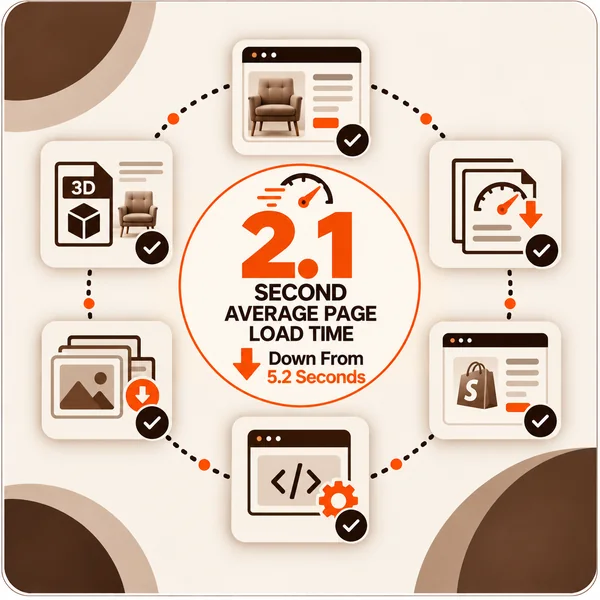
The migration cut page load time from 5.2 seconds to 2.1 seconds and reduced the active plugin count from 38 to 11 Shopify apps. The practical benefit sat behind the metrics. The migration gave the SEO work a clean platform to run on. Fixing crawl budget and deploying hreflang on a WordPress site that broke every time a plugin updated would have been building on sand.
This was the track that turned 12% indexation into 81% - The retailer’s faceted navigation had been generating a unique URL for every combination of filters a shopper could apply. Material, color, room type, price range, size, and availability combined into 6 filter dimensions and multiple values per dimension, and the combinatorics produced over 14,000 crawlable URLs from a catalog of 9,000 products. Google spent its crawl budget on filter pages, with the actual product pages those filters pointed to receiving almost no crawl attention.
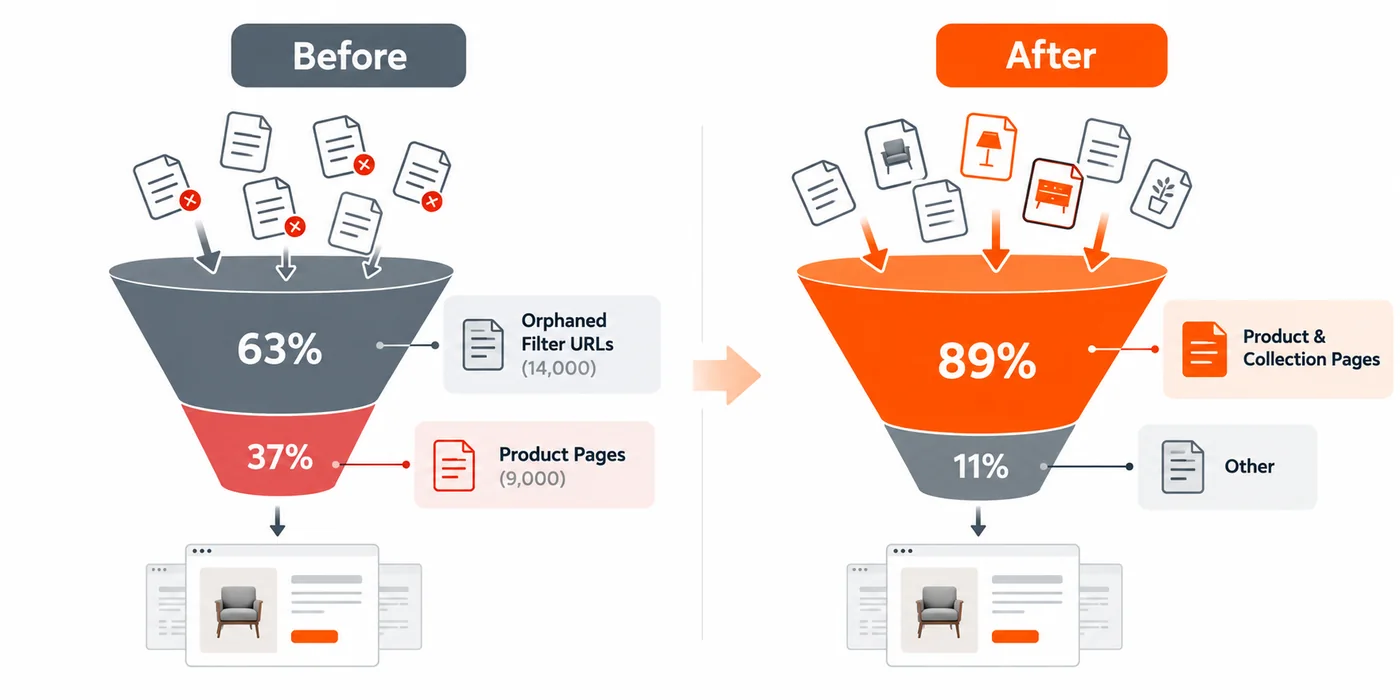
Clixlogix ran a log file analysis on 3 months of Googlebot activity and found 63% of all crawl requests went to filter combination URLs. Googlebot crawled the actual product pages less than once every 18 days on average. For a store with 9,000 products and weekly inventory changes, that crawl frequency meant Google was working with stale data on the majority of the catalog. Many of these pages fell into the discovered but currently not indexed bucket in Google Search Console.
Clixlogix restructured the faceted navigation on Shopify using a 2 tier approach. The first tier identified 340 filter combinations that had real search demand, phrases like “linen sofas” or “oak dining tables under EUR 1,000,” and built those into proper collection pages with unique URLs, unique titles, and curated product grids. These 340 pages got clean indexable URLs with proper URL structure, and Clixlogix wired them into the site’s internal linking structure.
The second tier handled everything else. Clixlogix converted all remaining filter combinations to client side JavaScript interactions. When a shopper applied filters on Shopify, the URL did not change, and Googlebot never saw a crawlable link. This approach followed Google Search Central’s guidance. Faceted navigation is the single largest cause of crawling problems on ecommerce sites, and the recommended fix is to stop crawlers from finding low value filter URLs in the first place.
Clixlogix also submitted a segmented XML sitemap that prioritized product pages by sales velocity. High selling products appeared in the primary sitemap with daily change frequency signals. Seasonal and low stock items went into a secondary sitemap with weekly signals. This gave Google a clear signal about which pages mattered most.
Fig 3 - Crawl budget shifted from 63% wasted on filter URLs to 89% on product and collection pages.
Why this track mattered
Within 8 weeks of the crawl architecture changes, Google’s crawl of the site shifted from 63% filter pages to 89% product and collection pages. The indexed product page count climbed from 12% to 54% by month 3 and reached 81% by month 5. The store’s product pages were finally visible to the search engine supposed to send them customers.
Selling to 3 countries from 1 domain without hreflang is like mailing catalogs to the wrong addresses - The retailer used a single .de domain for all 3 markets. German customers got the right experience. Austrian customers occasionally saw prices without the correct shipping context. Dutch customers, many of whom searched in Dutch or English, often found the store buried on page 4 of Google.nl results or missing entirely.
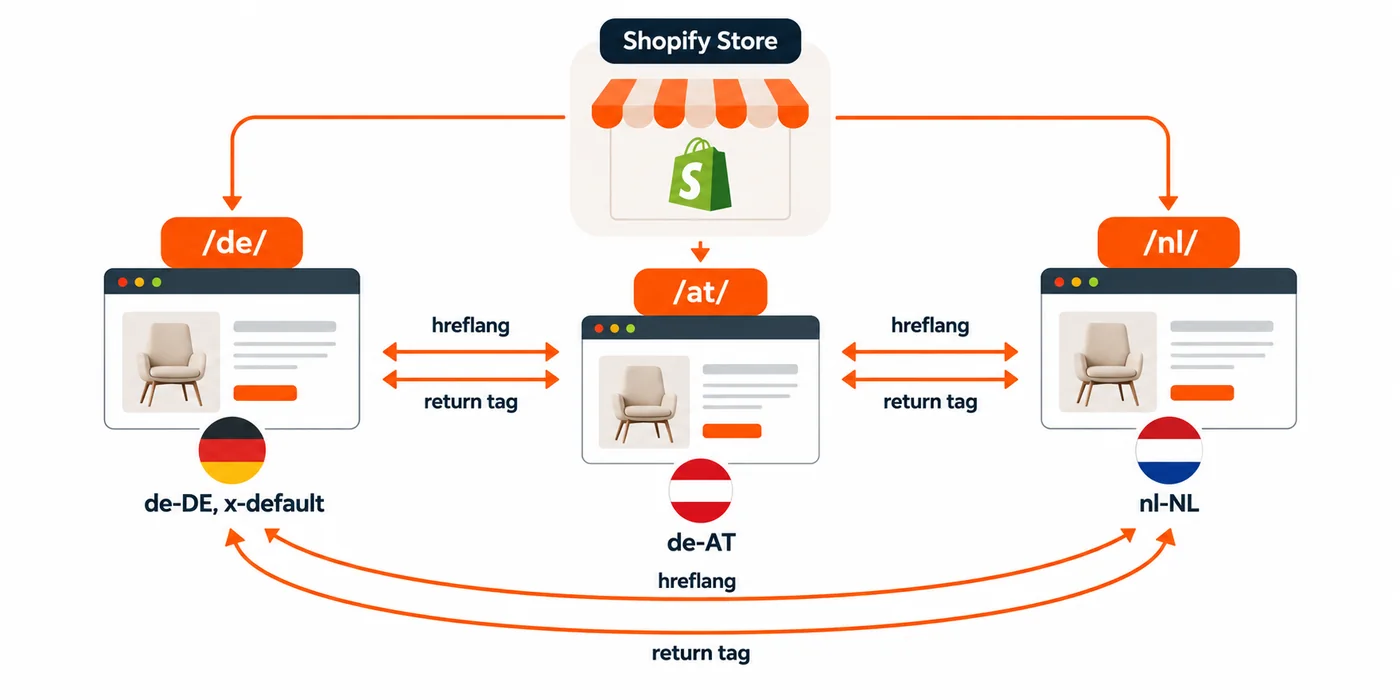
Clixlogix implemented hreflang tags across all product, collection, and informational pages for 3 language region pairs. These were de-DE for Germany, de-AT for Austria, and nl-NL for the Netherlands. The Austrian pages carried German language content with Austria specific pricing, shipping timelines, and VAT handling. The Dutch pages required a separate content set in Dutch for the top 600 product pages by revenue, covering the product descriptions, collection pages, and FAQ content that drove the most organic traffic.
The hreflang implementation used Shopify’s multi market architecture with subdirectory targeting. These were /de/ for Germany set as x-default, /at/ for Austria, and /nl/ for the Netherlands. Clixlogix validated every hreflang annotation using a third party hreflang validator to catch mismatched return tags, a common error that breaks multi market indexing without obvious signals.
The Dutch market content needed more than a word for word translation. Clixlogix worked with a native Dutch freelancer to localize product descriptions, adjusting both language and cultural references. Dutch furniture buyers search differently from German ones. Terms like “wandkast” (wall cabinet) and “eethoek” (dining corner) have no direct German equivalent, and ranking for them required original Dutch language content built from Dutch keyword research.
Fig 4 - Hreflang architecture linking the three target markets with return tag validation.
Why this track mattered
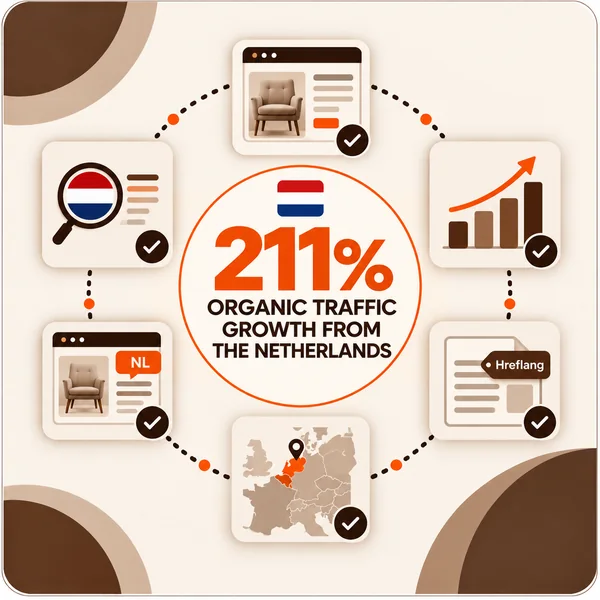
Within 4 months of the hreflang deployment, the store’s organic traffic from Austria grew 67% and organic traffic from the Netherlands grew 211% from a near zero baseline. The Dutch market, which had been entirely dependent on paid advertising, started generating organic sessions at a cost per acquisition of EUR 0.
Writing unique descriptions for 9,000 products by hand would have taken 18 months and a team of writers the budget could not support - Clixlogix built a programmatic template system. Clixlogix created 47 description templates organized by product category. These covered sofas, dining tables, chairs, shelving, lighting, textiles, and accessories. Each template pulled structured product attributes such as dimensions, materials, weight capacity, assembly method, and care instructions from Shopify’s product metafields and assembled them into natural sounding paragraphs.
The templates went beyond fill in the blank construction. Each one followed a specific structure. An opening sentence covered the product’s design intent, a paragraph covered materials and construction, a specifications block held structured data, and a closing paragraph covered care and maintenance. Clixlogix wrote the base templates and built a Shopify Liquid based rendering engine that populated them from product data. The result read like a human wrote each description one at a time, because a human wrote the structures, and the product data filled in the specifics.
Every product page received full Product schema markup covering name, description, price, currency, availability, brand, material, color, dimensions, weight, SKU, and aggregate review ratings where available. The schema rendered as JSON-LD in the page header. Clixlogix validated a sample of 500 product pages using Google’s Rich Results Test and Schema.org’s validator, fixing 23 markup errors before the full rollout.
Clixlogix also added FAQ schema to the top 200 collection pages, answering the most common buyer questions for each product category. The questions covered assembly difficulty, material sourcing, delivery timelines, and return policies. These FAQs were not generic. Each one pulled from actual customer service tickets the retailer’s support team had logged over the previous 12 months. The click through rate improvements from rich results showed within weeks.
Why this track mattered
Within 3 months, product pages with the new descriptions and schema saw a 38% increase in organic click through rate compared to the old manufacturer copy. Rich results covering star ratings, price, and availability appeared for 2,100 product pages in Google search results, up from 0 before the schema deployment.
This track started as a side project and turned into the engagement’s most forward looking investment - During the lead up to this engagement, AI search referral traffic to ecommerce sites grew fast. US ecommerce AI referral traffic from ChatGPT grew 210.5% year over year in the most recent quarter, reaching 20.5 million visits. Website traffic from AI search engines grew 16x in the 2 years leading to this engagement. The retailer was getting none of it.
Clixlogix built a structured content set designed for citation by AI search models. This included FAQ schema on the top 200 collection pages, already covered in the content track, and a set of 35 long form buying guides answering the exact questions AI search tools tend to surface. These covered queries such as “best Scandinavian dining table for small apartments,” “how to choose a sofa fabric for pet owners,” and “flat pack furniture that does not look flat pack.”
Each buying guide followed a structure optimized for AI citation. A clear question served as the H1, a direct 2 sentence answer opened the paragraph, supporting detail cited specific products, and a comparison table appeared where relevant. Clixlogix wrote each guide with the same specificity the team brought to the product descriptions. The guides carried real dimensions, real materials, real price comparisons, and sourced claims.
The structured Product schema on every product page also helped. When AI search tools such as ChatGPT or Perplexity answered furniture related queries, they pulled from pages with structured data that clearly stated the product name, price, material, and availability. The retailer’s product pages, now carrying full schema markup, started appearing in recommendations generated by AI search models alongside established competitors that had been the only names in those results.
Why this track mattered
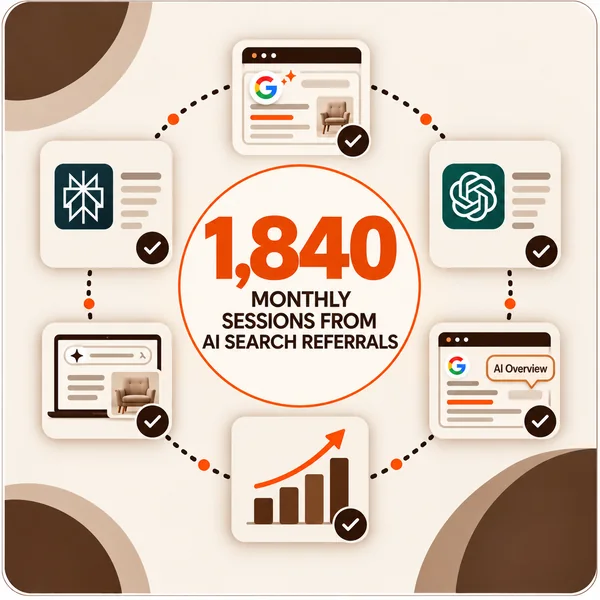
By month 10, the retailer tracked 1,840 monthly sessions from AI search referrals across ChatGPT, Perplexity, and Google AI Overviews, a channel that had generated 0 sessions before the engagement. These visitors converted at 2.3%, compared to 1.6% for non branded organic search.
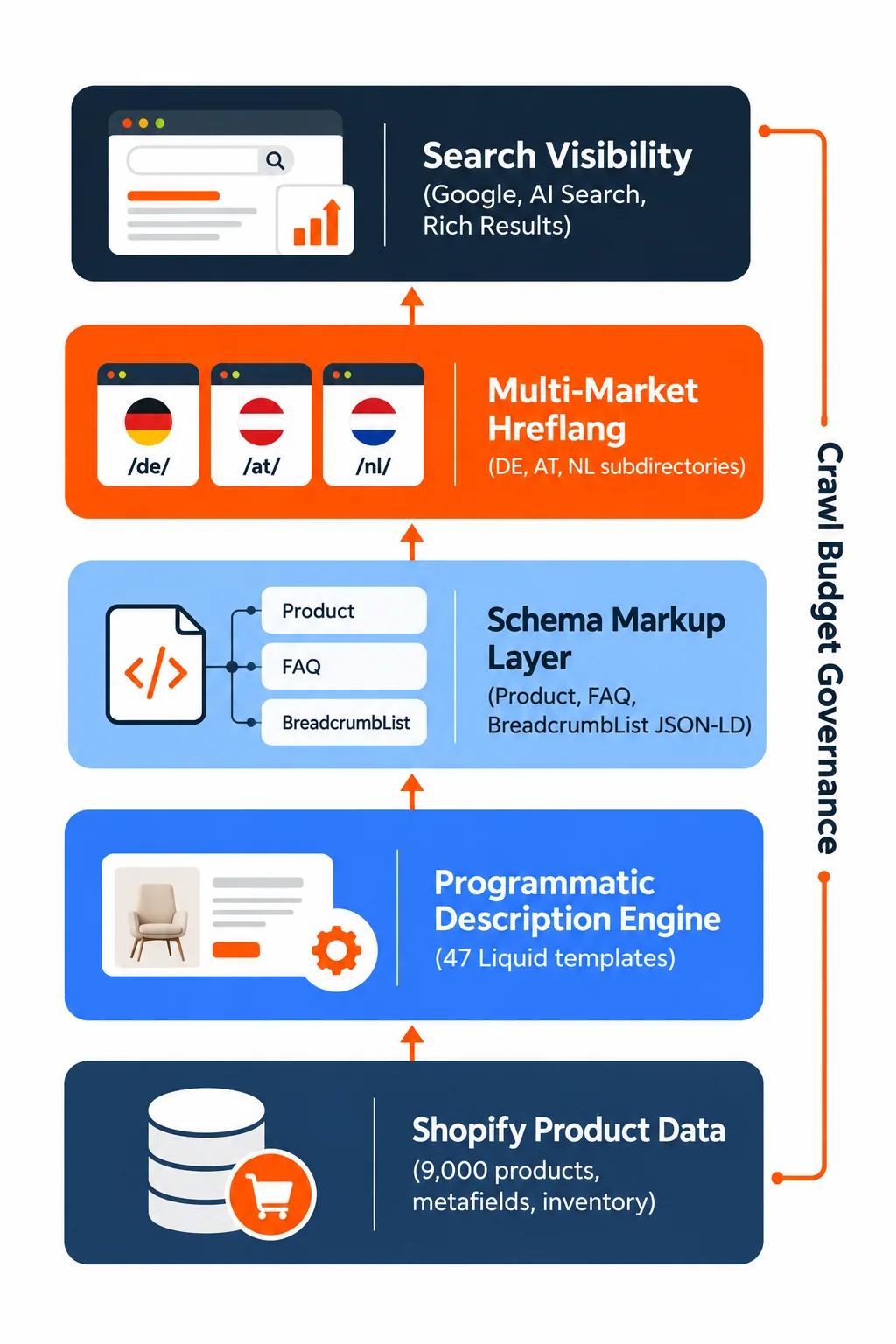
Fig 5 - Complete system architecture from product data through search visibility.
The engagement produced measurable results across indexation, traffic, revenue, and a new AI search channel that did not exist before the project started.
Market context
Organic search drives 43% of ecommerce traffic globally and accounts for 48% of conversions. Mature ecommerce stores with 12 or more months of SEO investment capture 33 to 45% of total traffic from organic search. The retailer moved from well below that range to the lower end of it in 10 months.
| Area | Technologies and tools |
|---|---|
| Ecommerce Platform | Shopify, migrated from WordPress and WooCommerce |
| SEO Crawling and Audit | Screaming Frog, Google Search Console, Log File Analyzer |
| Keyword Research | Ahrefs, Google Keyword Planner across DE, AT, NL markets |
| Schema Markup | JSON-LD across Product, FAQ, BreadcrumbList, and Organization types |
| Hreflang Validation | Aleyda Solis Hreflang Tags Generator, Google Search Console International Targeting |
| Content Templating | Shopify Liquid, product metafields |
| Analytics | Google Analytics 4, Google Search Console, Shopify Analytics |
| AI Search Monitoring | Manual tracking of ChatGPT, Perplexity, and Google AI Overview referrals via GA4 referral source reports |
| 3D and AR | Shopify native 3D model viewer with .glb format, AR Quick Look on iOS, Scene Viewer on Android |
| Project Management | Asana |
Table 3 - Technologies and tools used across the engagement
Our team can share client references, scope your project, and answer any question about your delivery.
More engagements where our delivery teams shipped similar outcomes for clients across industries. Read on for context on the patterns we reused, the trade offs we navigated, and the metrics that landed in production.