TLDR
A Lovable app can reach production in days. Production security is a separate check from whether the app works. Lovable ships Quick and Deep security scans that cover database rules, dependencies, authorization, secrets, payments, and sensitive data exposure. Lovable states in its own documentation that these tools do not guarantee complete security and recommends an additional professional review for sensitive or critical applications. The highest risk areas sit in data access, authorization, server functions, secrets, storage, payments, and privileged fields. A production readiness audit tests the application as a signed out visitor, as 2 ordinary users, and as a privileged user, through the API as well as the interface, and tests what each security setting actually allows.
Why a working Lovable app can still be unsafe
These are composite scenarios drawn from the Lovable applications the Clixlogix audit sees. The security scan goes green. A second user signs up and finds data that belongs to the first. The is_admin field, sitting on the users table in plain sight, turns out to be writable from the browser console.
A founder with row level security enabled on every table and a green publish scan watches the first real signal of trouble arrive with the second user who signs up. That user starts browsing and surfaces data belonging to the first user. The platform’s own tooling marked the configuration as fine. The rules the agent generated still let one user read another’s record. The next question concerns the scope of Lovable’s own definition of secure.
Each failure involves a Lovable app that functioned as the agent built it. The failure sits beneath the interface, in the rules that are supposed to govern who can read, who can write, and what the server will accept.
Production readiness begins when the application faces users the builder has not met. The threshold is whether the application behaves correctly when a different user signs in, when a request bypasses the interface, and when a load spike or a destructive mistake hits production. The vibe coding audit checklist covers the broader audit discipline Clixlogix runs across AI generated applications.
Before any checkpoint runs, you need to know the parts of your application and where each one sits.
What a Lovable app is made of
Before any question about whether a Lovable application is secure, you need a clear picture of what the application consists of. A Lovable app with a backend has 5 parts that matter for security, each sitting at a different point on the responsibility line between you and the platform. A Lovable app without a backend (a static page, a client only tool, a frontend that calls only third party services) has the frontend and provider parts and no Supabase pieces of its own.
A Lovable app runs on 1 of 2 configurations.
- Lovable Cloud - Bundles the database, auth, storage, and edge functions and manages them inside Lovable’s own infrastructure, so you get a working backend without creating accounts outside Lovable.
- Bring Your Own Supabase (BYOS) - Points the application at a Supabase project you created and own directly, which means you hold the keys, the database settings, and the audit logs.
Which configuration you picked matters for who sees your database settings, who holds the service role key, and who you call when something breaks. The audit sequence that follows works on both, and a few checks fall more heavily on you in the connected configuration because you own more of the surface.
- Frontend code - The React application the Lovable agent generates. It runs in the user’s browser, so every line of it, and every environment variable prefixed with
VITE_, is visible to anyone who opens the page. - Lovable Cloud - Where the application is hosted and the URL is served. Lovable also exposes a Lovable Cloud bundle for the database and functions that saves setup time.
- Supabase backend - The database (Postgres), authentication, storage buckets, and edge functions behind the frontend. Lovable Cloud runs a Supabase foundation managed by Lovable inside Lovable’s own infrastructure. A BYOS project points at a Supabase account you created and own directly. A backend free Lovable app has no Supabase at all.
- Row level security - The policies on each Supabase table that decide which role (authenticated or
anon) may read, write, or delete which rows. Postgres checks table grants before RLS, so grants and RLS are 2 gates in sequence between the frontend’s publishable key and the data. - Stripe and other provider integrations - Payment, subscription, email, and messaging flows the frontend calls, with webhooks delivering authoritative state back to the backend.
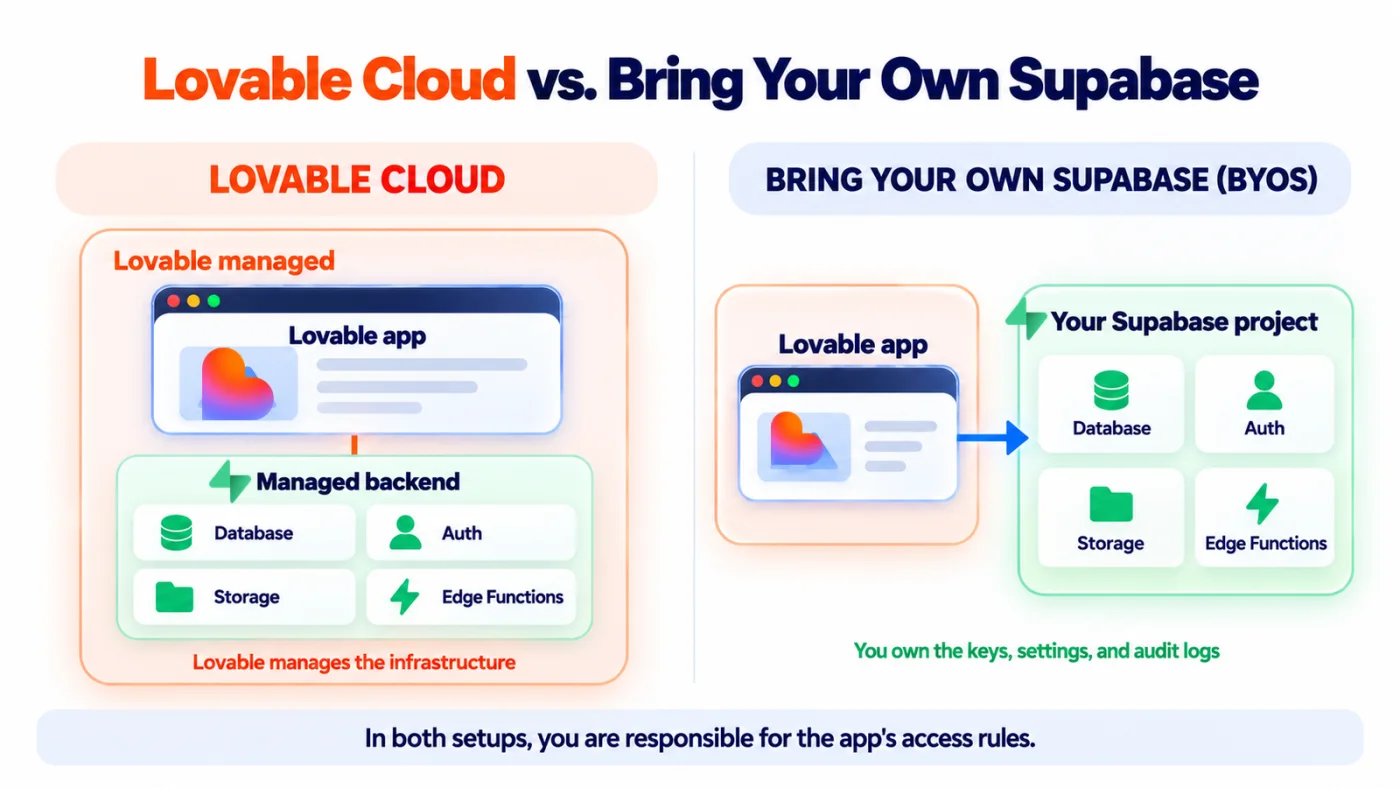
Fig 1 - Lovable Cloud keeps the backend within Lovable managed infrastructure. BYOS connects the Lovable app to a Supabase project whose keys, settings, and audit logs you control.
Each of the 10 checkpoints further down tests one of these parts in the configuration the agent generated, as it stands or as you changed it after.
Is Lovable secure?
Lovable provides platform controls, secure secret storage, database security checks, dependency scanning, and application code review. The security of an individual application still depends on whether the generated access rules and business logic match what the owner intended for every user type and every protected action. 2 different questions sit inside the phrase “is Lovable secure?” and each one carries its own answer.
The platform covers the editor, project access, hosting infrastructure, Lovable accounts, and the internal controls that keep one builder’s work isolated from another’s. The platform is Lovable’s own responsibility, and Lovable publishes its security posture in its security documentation.
Is the application built with Lovable secure?
The application covers the users, the database, the permissions, the server functions, payments, uploaded files, integrations, and the production configuration. The application remains the owner’s responsibility. Lovable’s documentation says the built in tools help identify common security issues and cannot guarantee complete security, and recommends an additional professional review for applications handling sensitive data or critical functionality. The application question is where the audit does its work.
The short answer
A Lovable app is as secure as the access rules and application logic governing its data and privileged actions. A production ready application needs those rules verified against the behavior they produce when real users exercise the system. The remainder of this post walks the audit sequence Clixlogix runs on Lovable applications heading to production.
What Lovable secures and what the owner controls
Platform security and application security are 2 different responsibilities. Each one needs its own inspection. The table below separates them so you can see which checks sit on your side of the line.
Table 1 - Lovable Platform and Application Owner Responsibilities
2 technical distinctions carry most of the audit’s weight, and both are routinely collapsed by builders who read the generated code and assume the agent handled both halves.
Authentication and authorization are different checks
The agent builds the login flow and sometimes treats the login as the complete answer. A production application separates the two concerns and performs each one in its own place.
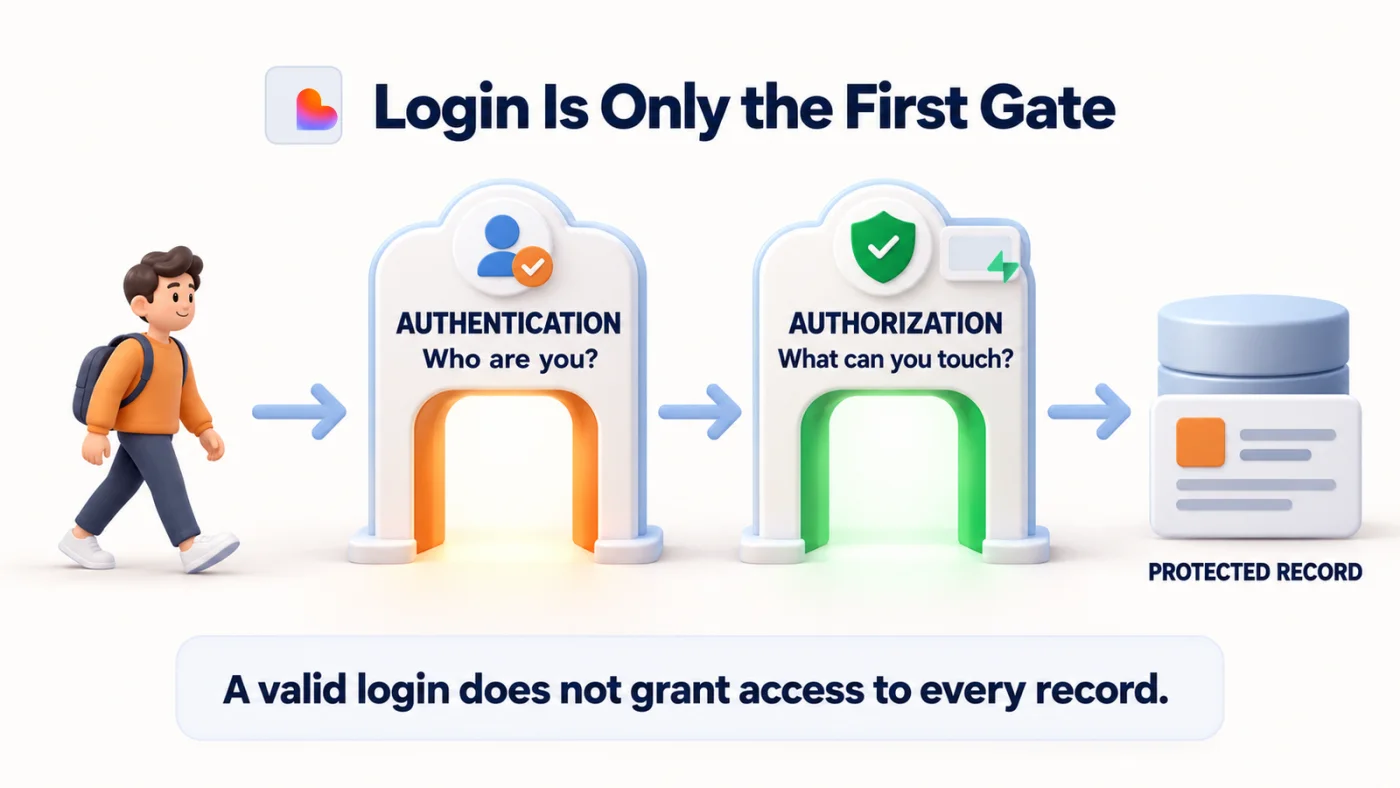
Fig 2 - Authentication confirms identity. Authorization separately checks whether that identity may access the specific record.
Authentication - Answers the question of who the user is. A working login proves authentication and nothing beyond it.
Authorization - Answers the question of what the user may see or change. Every privileged backend operation needs its own authorization check, performed on the server, against the record being touched and against the role of the caller. Authorization is where generated applications commonly fall short.
Public keys and secret keys are different things
Supabase uses 2 different key types and the application has to use them differently. Confusing the two is a common secret handling mistake in Lovable apps.
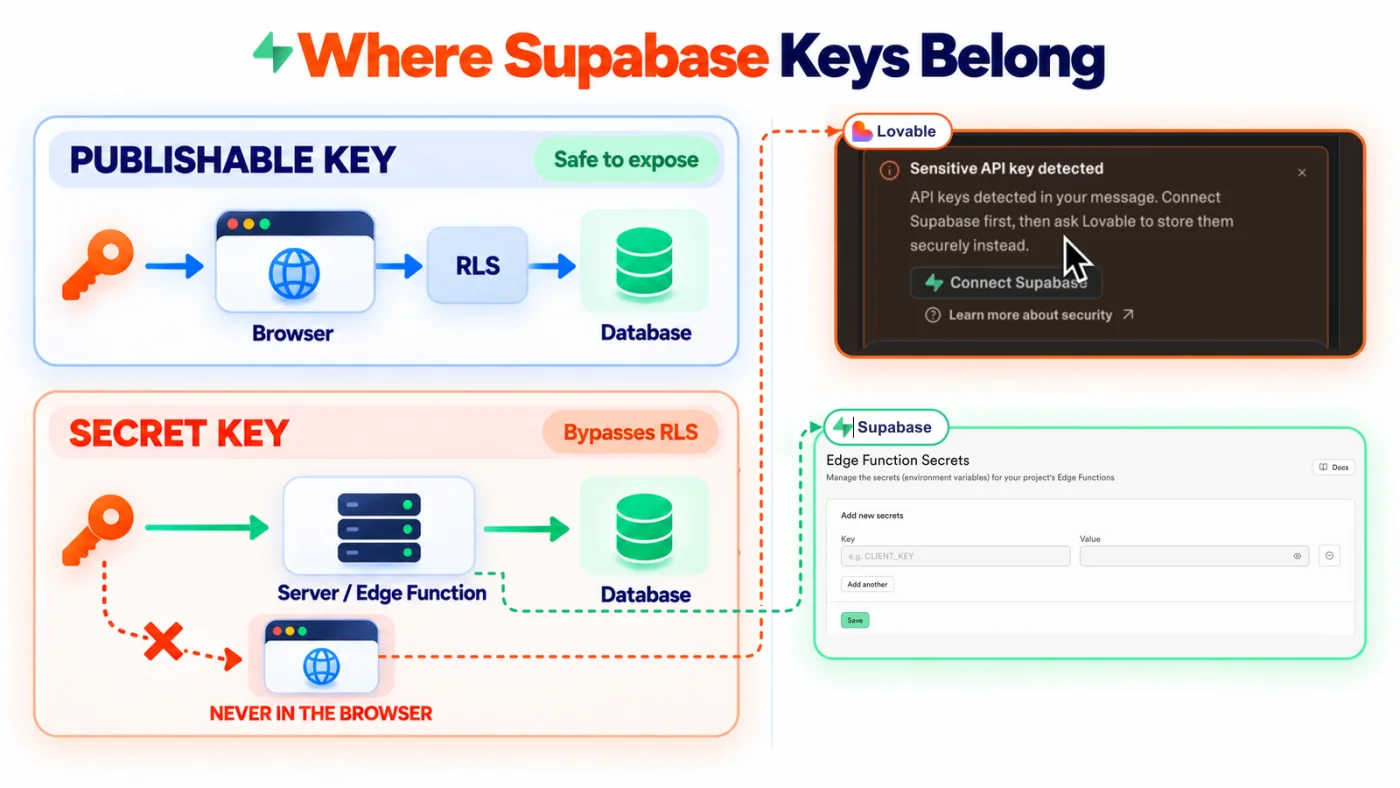
Fig 3 - Publishable keys can be exposed to the browser when RLS and grants restrict data access. Secret keys bypass RLS, belong only in server or Edge Function secrets, and must never reach the browser.
Publishable keys - A Supabase publishable key or legacy anonymous key is designed to be shipped to the browser. It is safe when the database restricts what the key can reach through row level security and grants.
Secret keys - A Supabase secret or service role key bypasses row level security and must never appear in the browser or in source control. Supabase documents the distinction in its data security guide.
What the public Lovable security events show
2 categories of public events inform how any Lovable application should approach a review. The events show that generated applications and platform behavior both require clear ownership, correct configuration, and independent verification when real users or sensitive data are involved.
Table 2 - Public Lovable Security Events by Type
Each event teaches a different lesson for application owners, and together they make the case for an independent audit on any Lovable application headed for real users.
Lovable documents the platform regression and its response in its public incident post. The regression affected public projects, their source code, and their chat history. Private projects and Lovable Cloud were not in scope. The lesson for owners is that project visibility carries security meaning the owner has to understand and set, and that the application’s own data security is governed by a different set of controls.
The earliest RLS reports
Early community discussion concerned row level security configurations in generated applications, with Lovable maintaining that individual application owners carry responsibility for protecting application data. The lesson for owners is that an enabled RLS policy is a precondition, and the policy itself has to describe the correct rule for the application’s ownership model.
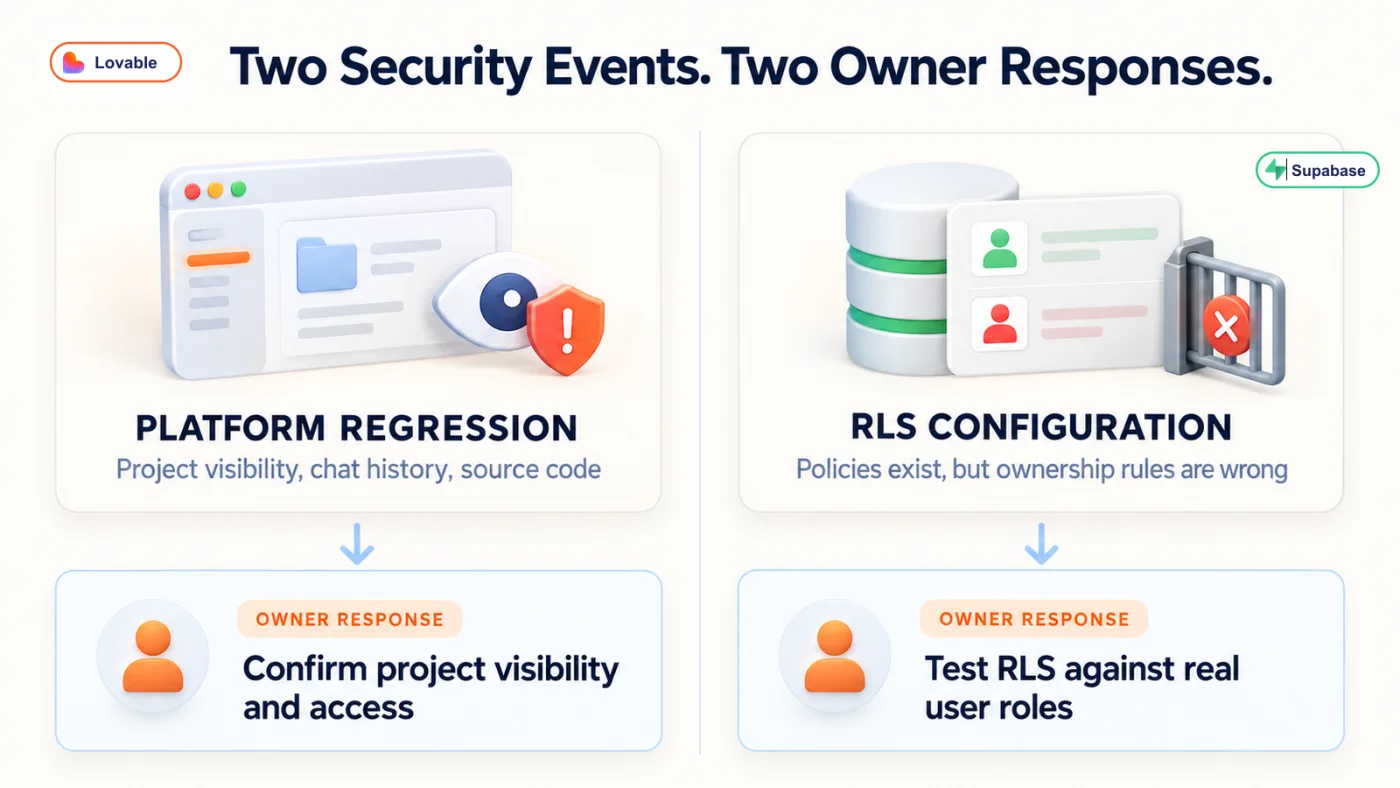
Fig 4 - Platform regressions call for visibility and access checks. RLS configuration failures call for testing ownership rules against real users.
What the built in Lovable security scans cover
Lovable ships 2 scans and a set of supporting features. The description below reflects the current scanning capability Lovable has published in its engineering post. Both scans are useful, and each covers part of the audit.
Quick security scan
The Quick scan is the pre publish gate Lovable runs on every project. It is fast enough to not slow down the publish flow and specific enough to catch the configurations most commonly missed in generated code.
What it checks - Tables without row level security, access rules that allow every caller, leaked password protection, known vulnerabilities in npm dependencies, and MCP server configurations exposed without authentication.
When it runs - Automatically every time the owner opens the publish dialog. The scan finishes in 10 to 15 seconds and returns pass, warnings, or critical results. Workspace admins can configure critical results to block publishing. If Wiz is connected to the workspace, the Quick scan also runs Wiz. Database checks run only for projects with a connected database.
Deep security scan
The Deep scan goes past configuration into the application code the agent produced. It takes longer and the owner has to start it, but it reaches areas the Quick scan cannot touch.
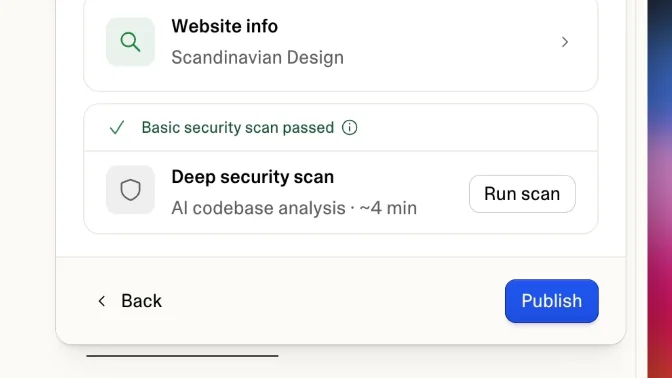
Fig 5 - Lovable’s publish dialog separates the fast basic security scan from the optional Deep security scan that analyzes the application codebase.
What it checks - Everything in the Quick scan plus an AI assisted review of the application code across access control and authorization, unauthenticated or abusable endpoints, unsafe input and injection, leaked secrets and credentials, payments and billing, authentication and account security, and exposure of personal or sensitive data.
When it runs - The Deep scan takes 2 to 4 minutes and does not run automatically during ordinary development. Owners start the Deep scan from the project Security view or the workspace Security center. On Enterprise plans, workspace admins can schedule the scan weekly or monthly across selected projects. If an application exposes an MCP integration that allows access without sign in, publishing starts a Deep scan in the background.
Where the built in scans stop
The built in tools cover more ground than they did at launch. The gap they leave is specific, and Lovable’s own documentation names it.
- Gap #1. Business rule verification - A scanner identifies suspicious configurations in code and data. A scanner cannot know whether a given access control check expresses the owner’s intended rule. The scanner can see that a check exists. The scanner cannot see whether the check reflects the right policy for a workspace with 3 admin roles, 2 tenant levels, and a plan dependent set of entitlements.
- Gap #2. Operational readiness - A production readiness review carries operational responsibilities that Lovable’s built in scans do not cover. Backups, restore testing, monitoring, rate limiting, incident response, and recovery procedures sit outside the generated application and inside the owner’s operational responsibility. Lovable states that its tools support secure application development and do not replace a thorough security review.
- Fix cycle risk - A consumer application builder working through a cycle of scanner findings describes the application breaking after each round of generated fixes, with signups, payments, and application functions needing a full rebuild and retest. Lovable supports fixing individual findings, selected groups, or all eligible findings followed by a fresh scan, so sequencing is available. The gap is that generated fixes can introduce regressions in features the scan does not retest, and independent workflow testing is what catches those regressions before the next fix lands.
The gap the scans leave is where the 10 checkpoint audit does its work.
The 10 checkpoint production readiness audit for Lovable apps
The 10 checkpoints below are the audit sequence Clixlogix runs on Lovable applications heading to production, and the same sequence you can run yourself to validate the application before bringing anyone in. The sequence follows one organizing principle. A running application has passed one check, and security needs its own. A row level security policy has to be tested against the correct ownership rule, and a working payment button has to be tested against every other path to a paid feature. The order matters. Later checkpoints assume the earlier ones have been completed.
1. Map the application’s data and trust boundaries
The audit begins with a one page access sheet. Inventory every table and view, Storage bucket, RPC or database function, Edge Function or server endpoint, webhook, scheduled job, administrative action, and connected service. Without a written rule for who may do what, there is no expected result to test.
Each row names the resource, actor, request path, operation, expected permission, and enforcement point. Actors include visitors, signed in users, cross tenant users, owners, administrators, user scoped server operations, elevated server operations that bypass RLS, and verified external services. The operation vocabulary fits the resource type, so a table uses database CRUD, a bucket uses file actions, an Edge Function or RPC uses invocation, a webhook uses receipt, and administrative or payment actions use their own business verbs. The request path records the trust boundary, such as browser to Data API or Stripe to webhook; the enforcement point names the RLS or Storage policy, column grant, server authorization check, database constraint, or verified signature. Enforcement lives on the server or in the database.
Flag privileged fields such as is_admin, plan, or credits separately. RLS controls rows. Individual columns need their own protection, so an owner who may update a profile can also change these fields unless column privileges, a resulting row constraint, a protected table, or a server only write path prevents it. The remaining checkpoints test the application against this sheet.
2. Review Supabase RLS policies and table grants
The classic failure is simple. User A replaces a record ID with User B’s and receives User B’s data. The policy checked authentication and skipped the ownership check. Scanners catch structural gaps such as disabled RLS or USING (true), but cannot reliably infer every ownership rule specific to your application.
Enable RLS on every exposed table, then compare the effective grants and policies with the CP1 access sheet. A role that should have no access needs no grant or policy; without an applicable policy, RLS denies by default. Each operation has its own clause semantics. SELECT and DELETE use USING, INSERT uses WITH CHECK, and UPDATE applies USING to the existing row and WITH CHECK to the result, with a matching SELECT policy required. When WITH CHECK is omitted, PostgreSQL reuses USING. Ownership reassignment becomes possible when the resulting row check is broader, validates the wrong field, another permissive policy admits the row, or the request bypasses RLS.
Evaluate policies together. Applicable permissive policies combine with OR, so one broad rule can neutralize narrower ownership rules; restrictive policies only narrow access already granted by a permissive policy. Views need their own check. A security_invoker = true view uses the caller’s permissions, while a creator privileged view can bypass the base table’s RLS. Other bypass paths include Supabase secret or legacy service_role credentials, BYPASSRLS roles, table owners, and privileged SECURITY DEFINER functions. Also distinguish the unauthenticated anon database role from Supabase anonymous sign in, which uses authenticated plus an is_anonymous claim.
Finally, test each exposed table and view through the direct API as signed out, User A, User B, a cross tenant user, and an application administrator. Exercise allowed and denied CRUD operations, unfiltered lists, inserts carrying another owner’s ID, and updates that try to change user_id or tenant_id. Test elevated credentials separately because they bypass RLS. Supabase documents the model in its row level security guide.
3. Test object level and role based authorization
Anything the frontend sends can be reproduced or modified, so a hidden button or filtered screen cannot enforce authorization. Watch the request in browser developer tools, resend it with a different record ID or role, and confirm the backend rejects it on its own.
Every backend operation needs 2 checks. Function authorization asks whether the role may invoke the operation; object authorization asks whether this caller may act on this particular record through ownership or tenant membership. Roles must come from a protected membership table or claims the server writes into app_metadata. The request body, user_metadata (which users can edit) and frontend state stay untrusted.
An Edge Function using a Supabase secret or service_role bypasses RLS, so it must verify the user, load trusted membership, authorize the action and object, and scope the elevated query. It must also allowlist writable properties. An owner can otherwise add role, tenant_id, or is_admin to a legitimate request body.
Test each operation the application exposes to a client directly as the owner, as a member of the same tenant who does not own the record, as a user from another tenant, as an ordinary user attempting the administrative action, and as a signed out visitor. Apply the same test to ordinary reads and edits as well as role assignment, invitations, impersonation, deletion, exports, and reports.
4. Inspect secrets and browser exposed configuration
Some credentials are designed for the browser. Supabase publishable and legacy anon keys and Stripe pk_ keys are designed for client code. Supabase sb_secret_ and legacy service_role keys, Stripe sk_, rk_, and whsec_ secrets, and private email, AI, or messaging credentials must remain server side.
Prompt, place, publish. Each prompt hands you a key. Put it where it belongs, publish, and see what any visitor can see.
sb_publishable_ Supabase publishable key - belongs in the browser. It is built for client code, and row level security decides what it can reach.anon Legacy Supabase anon key - belongs in the browser. The legacy anon key works like the publishable key, under the same row level security.sb_secret_ Supabase secret key - stays on the server. It bypasses row level security, so it lives in Edge Function secrets.service_role Legacy Supabase service role key - stays on the server. Full database access belongs only in trusted server code.pk_live_ Stripe publishable key - belongs in the browser. Checkout and Elements need it, and it cannot create charges.sk_live_ Stripe secret key - stays on the server. It creates charges and refunds, so only your server holds it.rk_live_ Stripe restricted key - stays on the server. Any key that can act on your Stripe account stays on the server.whsec_ Stripe webhook signing secret - stays on the server. It proves each webhook came from Stripe.VITE_MAPS_KEY Browser restricted Maps key - belongs in the browser. A VITE_ prefix makes a value public, so it suits only keys built for the browser, like this Maps key locked to your domain.
Vite exposes VITE_ variables to client code, and projects can also leak values through envPrefix, define, hardcoded literals, server responses, network calls, or published source maps. Sensitive credentials belong in Edge Function secrets or another server environment the browser cannot reach; an .env filename alone provides no protection. Check the current source, deployed assets, browser network traffic, source maps, git history, logs, error responses, project chat, previews, and previous deployments.
If a secret leaked, first contain the path so the replacement will not leak too. Create a replacement, store it server side, update every legitimate consumer, redeploy, and confirm the new value is absent from client assets. Then revoke the compromised credential, verify that it fails, and review provider logs for misuse. If exploitation is active, revoke immediately even if that causes a short outage.
5. Test server functions, APIs, and edge functions directly
A Lovable application has 2 faces. One is the browser interface. The other is the set of HTTP endpoints behind it, reachable by anyone who can send a request. Whether a given endpoint requires login depends on the operation (a public signup form behaves differently from an administrative route). The server must establish who the caller is and whether that caller may perform the requested operation, without relying on the browser.
The audit covers every deployed endpoint, including those the current interface never calls. Each endpoint identifies the authentication mode appropriate to how it is called. User operations need an explicit user authentication path, and a successful platform verify_jwt check is insufficient on its own, because that check also passes publishable and secret API keys that carry no user. Webhooks verify the provider’s signature against the raw request bytes before JSON parsing, plus the provider’s timestamp window where that applies. Calls between services verify the caller’s service identity through a Supabase secret, a signed token, mTLS, or an equivalent credential. A deliberately public endpoint like a signup or contact form is protected by scope limits and throttling.
CORS restricts which browser origins may read a response. Scripts, terminal clients and other servers can still call the endpoint directly. Reproduce the test as a caller who skips the interface. Hit each function with no token, an invalid token, an expired token, and for webhook paths with an altered body or stripped signature. The failure that catches owners here is a function marked public for the interface’s convenience that accepts unauthenticated requests without the scope controls or throttling a public endpoint still needs.
6. Review storage buckets and uploaded files
Invoices. Identity documents. Private photos. Exports of a client’s records. The files live in Supabase Storage, which runs its own row level security on storage.objects. The policies on your application tables do not carry across to the files those rows reference. Each file operation (list, read, insert, update, delete, move, copy) needs its own policy on storage.objects that expresses the ownership rule the matching application record already expresses.
Private buckets keep every object behind a Storage policy. Public buckets allow anonymous GET on any object whose path the caller already has; listing or writing in a public bucket is still governed by RLS. MIME type and size limits are set on the bucket and enforced server side, because browser validation is a convenience and declared MIME type is not proof of file contents. Code that issues a signed URL must authorize the requesting user against the specific file before signing. Expiration limits how long a bad URL lives, so authorization has to happen before the URL is issued.
Reproduction walks the ownership rule across the operations that have distinct policy semantics. Signed in as user A, try to list user B’s folder, download their file, upload into their path, overwrite one of their objects through upsert, delete it, request a signed URL for it, and where the application exposes move or copy, do that too. Try the same signed out. Filename predictability is a risk indicator when it combines with a lax policy or a public bucket; the authorization boundary is the Storage policy. A correctly configured private bucket stays safe even when filenames are guessable.
7. Verify payments, subscriptions, credits, and privileged fields
This is the checkpoint where a defect becomes a line item on the P&L. A paid field a user can write directly is a free upgrade. A webhook that accepts replayed events grants the same credit twice. A trial status flipped in the browser extends the trial forever. The server is the only part of the system that can read the authoritative signal (a signed Stripe event) and refuse to be lied to.
The review walks every path that writes to a privilege bearing field (role, plan, paid, credits, is_admin, or the application’s equivalents). RLS operates on rows. Column protection uses a column grant, a trigger that rejects the write, a protected table only server code writes to, or a SECURITY DEFINER function. For entitlements derived from payment, the server creates the Checkout Session with its own credentials and binds price, quantity, metadata, and client_reference_id to the authenticated user. The webhook handler maps each event to the application account through the verified customer and a binding the server stored when that customer first appeared. A signature proves origin only. Events can arrive out of order, so the handler retrieves the current Stripe object or checks a monotonic value the application maintains before applying state. Cancellation, failed renewal, downgrade, refund, and dispute each remove or adjust access. The grant and the processed event ID commit in one transaction, and credit consumption locks the balance row against concurrent double spend.
Reproduction treats the application as a hostile client. Try to update paid or credits from the browser console; the row should refuse. Replay or forge the Checkout success URL without completing payment, submit a cheaper price or smaller quantity, deliver the same webhook twice, and deliver events out of order. Confirm cancellation, failed payment, and refund events remove access, and fire concurrent spend requests against the same balance.
The question is where the string goes. A piece of user input validated for the HTML page it was pasted into can still be unsafe when the same string is later inserted into an email template, written to a CSV cell, embedded in a URL, or appended to an AI system prompt. Each destination has its own escape rules, and the generated code often misses one or two of them. The AI prompt is the newest destination and the one generated code most often trusts by mistake. Functions that accept AI inputs require the additional isolation, validation, and tool access controls covered in our AI agent sandbox production security guide.
Untrusted inputs come from forms, stored rows, webhooks, imported files, third party APIs, URL fragments, and AI output. Validation decides whether a value is acceptable; each sink then needs its own mechanism. SQL uses parameterized queries. The browser keeps untrusted content out of script bodies, event handlers, and generated CSS; framework safe rendering and maintained sanitizers cover other output. URLs the server fetches validate against a scheme and host allowlist. File paths canonicalize inside an intended root. CSV cells neutralize leading =, +, -, @ characters. Commands and templates receive values as parameters. AI output is itself untrusted. The server limits model tools and runs its own authorization for each consequential action.
Dependency review covers direct and transitive packages from the committed lockfile, and the deployed build uses those versions. CVE scanning catches known disclosed vulnerabilities. Maintenance, supply chain compromise, and reachability each need separate attention. Findings rank by exposure and real use. Dev dependencies execute during install, test, and build. Unused and abandoned packages leave, and every update ships with a regression pass. In a controlled test environment, trace a canary carrying markup, a formula, a traversal path, a URL, and a tool instruction through the live sinks. The rendered page, delivered email, exported CSV, fetch log, and AI tool call log each hold inert text.
9. Check logging, monitoring, rate limits, and recovery
Three in the morning on a Tuesday, the application starts returning 500s on the payments endpoint. The earlier checkpoints covered how the application should behave. This one covers how the team notices a failure, caps the resources behind the application, and recovers after a failure.
Observability captures every security relevant event with actor, action, target, result, timestamp, and correlation identifier, and leaves tokens, secrets, and unnecessary personal data out of the log. Retention lasts long enough to investigate; Supabase retention follows the plan, and log drains can forward records to external storage for longer retention. Rate limits scope to IP for signed out traffic, user and tenant for signed in traffic, and operation for expensive calls, before any AI, email, SMS, or payment call runs. Limits run across every function instance, with concurrency ceilings and spending caps where one permitted call is still expensive. Recovery covers the database, Storage objects and bucket configuration, Edge Functions, Auth settings and keys, environment secrets, Realtime and extension configuration, and the deployed application revision. The team records recovery point, recovery time, backup retention, who initiates and verifies, and when a full restoration was last exercised on a working copy. Alerts fire on broken signals and on signals that go silent, like payment webhooks or scheduled jobs.
Reproduction tests the operational controls in practice. Exceed a limit from one IP, one user, and one tenant to confirm each scope holds and the cap applies across function instances. Trigger a controlled authorization or payment failure in a safe environment and verify the alert reaches the responsible person. Restore the database, Storage objects, and required configuration into a safe environment and bring a working copy of the application up on it. The failure most Lovable applications carry here is an alert that exists only in configuration, a limit scoped to one instance so the fleet can still exceed it, and a restore procedure that has never been exercised end to end.
10. Validate the deployed application and retest every fix
The last checkpoint is the one that proves the first 9 mattered. The audit may have found every policy gap, every unauthenticated endpoint, every exposed secret, and every pricing bypass in the source code, and still miss them in production because the deployment pipeline carried an older copy of the configuration, because a staging value went to production under a slightly different name, or because the fix landed on a branch that never shipped. The release gate discipline from AI agent evals and CI/CD release gates governs this final checkpoint. Confirm that the fixes landed in production and that each one closed the attack path it was supposed to close.
The validation runs against the deployed environment. The audit records the application commit, the migration history in supabase_migrations.schema_migrations, the RLS policies, grants, views, and functions in effect, the Storage buckets and their policies, the Edge Function bundles and their config.toml auth settings, and the webhook, scheduled job, and environment configuration. Supabase tracks migrations separately from Git, so the deployed state can diverge. Security headers, debug endpoints leaked into the build, and live scan results all run against the deployed artifact. Vite disables production source maps by default, so a published map is intentional and must not expose internal paths, comments, or server code accidentally bundled. Every fix retests with the original steps. The unauthorized action must fail and the authorized workflow must still succeed.
Destructive, payment, and high volume reproduction runs against a production equivalent environment with isolated credentials. Safe checks against production use dedicated test users, tenants, and records. Configuration that reproduction cannot safely verify gets checked directly. The served build matches the deployed release across the public URL, CDN, browser cache, and service worker. Each retest records the reproduction steps, the expected denied and legitimate results, the environment tested, the deployed release identifier, the evidence captured, and the final pass or fail.
The 10 checkpoints together produce the body of evidence the audit report rests on. The next section explains how the audit relates to the automated scans the owner is already running.
Scanner versus application specific audit
The scanner and the audit answer different questions. The scanner finds suspicious configurations in code and data at the speed of software. The audit confirms whether the application behaves correctly against the owner’s rules, from the perspective of every user type, under the operational conditions production will put it through. The table below separates the two.
Table 3 - Scanner Scope and Audit Scope by Question Type
Automated scans form the baseline. A production readiness audit connects the scanner’s findings to the application’s actual users, data, business rules, and recovery requirements. The code review discipline from AI code review for engineering leaders carries that connection work, applying judgment the scanner itself does not make.
The question any owner reaches after the audit is whether the fastest path to production is a set of targeted fixes or a slice level rebuild. Both decisions are legitimate. The honest answer depends on how widely the defects are distributed across the application and whether the generated architecture supports the rules the application now needs. The next 2 subsections give the signals that point to each direction.
Remediation reads as the direct path when the application’s core already holds together and the defects cluster in known places. Core user journeys land correctly, the database expresses clean ownership with consistent columns across tables, and the deployed architecture matches the application’s expected traffic and data sensitivity. The security issues are limited to a specific set of policies, functions, or endpoints, and the surrounding code is modular enough that an engineer can isolate the affected area, change it, and test it without pulling the application apart. The team can also wrap tests around current behavior before changing anything, which keeps regressions visible. The cluster of signals decides the call.
When a rebuild of one slice makes sense
A rebuild of one slice is the right call when the application’s structure cannot carry the rules it now needs. Authorization assumptions vary across the application, different code paths check the same action differently, and the same privileged check sits copy pasted across many files, so any patch misses at least one. Sensitive business logic runs in the browser where patching cannot secure it, and the database structure cannot cleanly represent tenants, roles, or ownership.
Clixlogix once rebuilt a 3D printing quote configurator built on Lovable Cloud that returned different quotes for the same uploaded file because the pricing math ran in the browser through a mesh repair path. The engagement that followed moved the backend to a client owned Supabase account and replaced the client side math with a server side CAD kernel.
The maintenance signal completes the picture. Changing one flow repeatedly breaks another, which tells you the architecture no longer supports the rules the application now needs. The affected code carries no clean seam the team can isolate for safe modification, and the remediation estimate approaches the cost of recreating the validated functionality cleanly. 3 or more of these signals showing up in the same slice usually means that slice is better rebuilt than patched.
Use containment before deciding
Clixlogix runs this decision through the Containment Method on every Vibe Code Rescue engagement. The method bounds the audit output into one vertical slice at a time, characterizes current behavior with tests the team can run on demand, repairs or rebuilds the contained slice, and retests the slice before expanding the work. The method keeps blast radius small and known, and avoids the week 2 situation in which a change deep in the codebase breaks a flow the team has not yet mapped.
Table 4 - Remediation Direction by Audit Condition
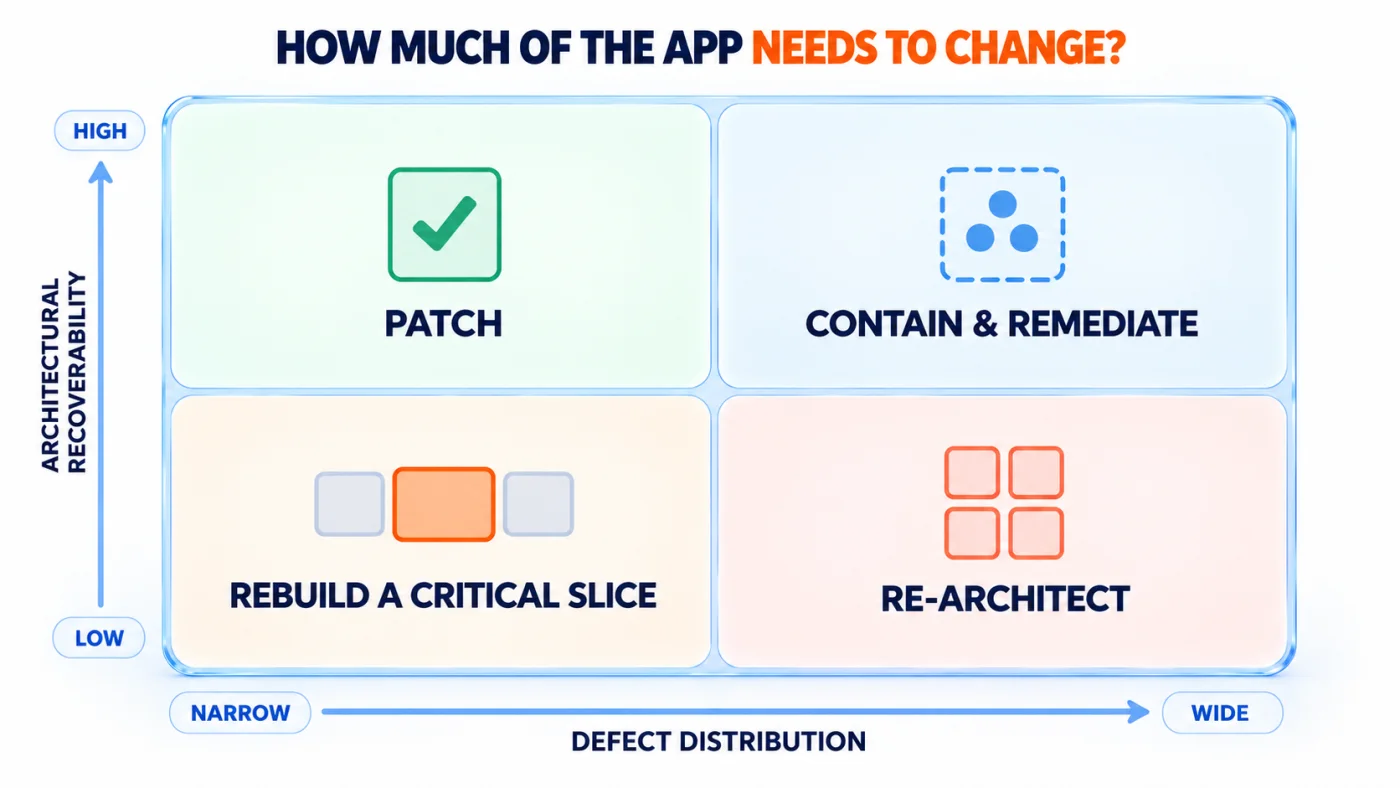
Fig 6 - Narrow defects in a recoverable architecture can usually be patched. As defects spread or the architecture becomes harder to recover, the safer direction moves toward containment, rebuilding a critical slice, or rearchitecting.
What a Clixlogix audit of your Lovable app delivers
A Clixlogix audit goes past the scanner score to show what can happen, who can cause it, which data or users are exposed, how to fix it, and whether the fix worked. The engagement produces a specific set of artifacts your team can execute from and your business can sign off on.
The audit opens with a risk register the Clixlogix team hands over for your approval before any code changes. Alongside it come characterization tests the team can rerun on demand, scoped first to the largest and riskiest files, so the current behavior is captured in a form the engineers can trust. The findings arrive as a scope versus implementation matrix with a prioritized issue list, each finding carrying reproduction steps an engineer on your team can rerun independently. The audit also carries a remediate or rebuild recommendation at the slice level, with a separate call for the application as a whole, a 500 line slice plan with the pre-commit hook ready so blast radius stays small when fixes start, and a constitution file that captures the architectural decisions that must not drift back. Retest evidence after each slice uses the original reproduction steps, and the accepted risks that remain after remediation are documented so the decision survives the next team transition.
Each finding reads to a fixed structure. The finding names the component affected, the severity and the reasoning behind it, the evidence that establishes the issue, the business impact in plain language, the recommended fix with estimated hours or days, and the retest status after remediation. Engineers execute from it, business owners sign off on it.

The anonymized sample shows the audit cover, a representative source backed finding, and the structure used to turn technical evidence into a release decision. Download the full sample audit (PDF).
Lovable app security checklist before launch
A production launch checklist for a Lovable application reads as follows:
- Run both the Quick and Deep security scans
- Triage every finding and treat every confirmed critical or high finding as a launch blocker unless there is evidence of a false positive or documented compensating controls that reduce the risk
- Document which users may access each sensitive resource
- Test every protected table signed out and across 2 user accounts, through the API as well as the interface
- Confirm no secret or service role key reaches the browser
- Test functions and APIs independently of the interface
- Verify storage permissions and private file access
- Confirm payments and entitlements are enforced on the server
- Set up monitoring, rate limits, backups, and restore procedures
- Retest the deployed application after every fix
If the application handles customer data, payments, proprietary information, health records, financial records, or privileged business actions, the checklist above is the start of the review. The full audit sequence covers the gaps the checklist alone cannot close. For a documented example of what passing a pre launch review looks like for a vibe coded consumer app, the AI dating app rescue case study covers an engagement that cleared App Store review on first submission.
Find the gaps the checklist alone cannot close
The launch checklist tells you where to look. A full audit walks the 10 checkpoints against your actual codebase and database rules, delivers reproduction evidence for every finding, and sets a defensible call on what to repair and what to rebuild. The engagement begins with a free codebase assessment.
Request your free codebase assessment
Frequently Asked Questions on Lovable App Security Audit