c-84, sector 65, Noida
A premium audio brand replaced a third party WordPress plugin with a client owned magazine content model and migrated its full historical archive.
At the opening of the engagement, the brand was running its online magazine on a third party content plugin while rebuilding the public website around it. That placed years of accumulated editorial authority on a data model and maintenance schedule the brand did not control, and raised the cost of carrying the dependency through the rebuild.
Clixlogix was engaged to move the magazine onto a brand owned WordPress content model, migrate the historical archive under the client’s sign off, and complete the handover inside the wider website rebuild window. At handover, the editorial team could manage issues and articles through native WordPress admin screens, while future changes to the content model entered the client’s own engineering workflow. The client retained control of acceptance, production release, and the post handover roadmap.
The client is a long established US manufacturer of premium audio equipment. Its catalog spans source components, amplification, power products, loudspeakers, streaming, and integrated systems. Product design, circuit engineering, and acoustic measurement sit at the center of the organization, and its equipment is reviewed regularly in the specialist audio press.
The brand sells directly to customers in its domestic market and works with specialist dealers internationally. High end audio buyers rarely transact on a first visit. A component in this category is a considered purchase, often made after weeks or months of research, listening sessions, review reading, and forum participation. The commercial journey is therefore education led, and the depth of the brand’s content materially supports the buying decision.
At the time of the engagement, the brand also published a long form online magazine on a regular issue based schedule. It covered audio culture, equipment, listening, artists, and essay length commentary from staff and commissioned writers. The magazine ran as a top level section of the WordPress site, with its own information architecture of issues, articles, author bylines, and a multi year archive.
The publication served several roles at once: a lead building surface for the storefront, an authority marker between product cycles, a community touchpoint, and a customer education channel where readers could encounter the brand’s engineering thinking before reaching a product page.
During the engagement, the brand’s internal engineering team ran the WordPress estate, controlled production release decisions, and owned the AWS environment used for development and staging. The team was small enough that outsourcing the custom plugin and migration was more efficient than diverting internal capacity, and experienced enough that architecture review and every production promotion remained on the client side.
Four findings shaped the engagement.
The magazine often met the audiophile reader before a product page did and carried the brand’s authority through some of the longest form content on the site. Its issues, articles, bylines, and taxonomy relationships lived inside custom post types supplied by a third party WordPress plugin. As a result, years of editorial investment were coupled to a component whose roadmap and compatibility schedule the brand did not control.
Industry context
When an editorial property treats a third party plugin as the system of record for its content model, it inherits that plugin’s release and compatibility cadence. For a magazine embedded in a commercial website, a routine WordPress upgrade can therefore become a wider editorial and operational decision.
Past issues continued to appear in search results, forum discussions, newsletters, and the brand’s own internal links. Their value lay not only in article bodies but also in issue membership, author relationships, taxonomies, media references, and identifiers.
The migration therefore had to begin with a field by field schema map and preserve enough source identity to reconcile any migrated record later. Legacy identifiers supported that traceability, but they were not treated as a substitute for permalink handling, redirects, or URL validation.
The brand’s engineering team was concurrently rebuilding the WordPress estate with a page builder whose template system and CSS conventions differed from the standard WordPress theme model. A plugin coupled directly to one theme’s templates would have created a second integration cycle and increased the risk of the magazine launching with broken layouts or conflicting styles.
The development environment used separate application and managed database services behind the client’s existing network controls. File transfer, database access, and staging email were already governed by the client’s security policies. Clixlogix therefore planned delivery around client approved identities, allowlisted access, isolated staging behavior, and a release process in which the client’s engineers retained production authority.
| Area on this engagement | Before | After |
|---|---|---|
| System of record for editorial content | Third party plugin schema outside the brand’s roadmap control | Client owned plugin using native WordPress content primitives |
| Theme coupling of the editorial surface | Rendering tied to the previous plugin’s presentation conventions | Public magazine views exposed through prefixed shortcodes with scoped styling |
| Historical magazine archive | Multi year archive stored in the source plugin’s post types and taxonomies | Archive migrated into the new model with relationships and reconciliation data carried across |
| Editorial roadmap control | Structural changes depended on an external component | Future changes entered the client’s own engineering and release workflow |
Table 1 - The surfaces that transformed on this engagement, each one a surface the brand already had, moved from vendor control to brand ownership
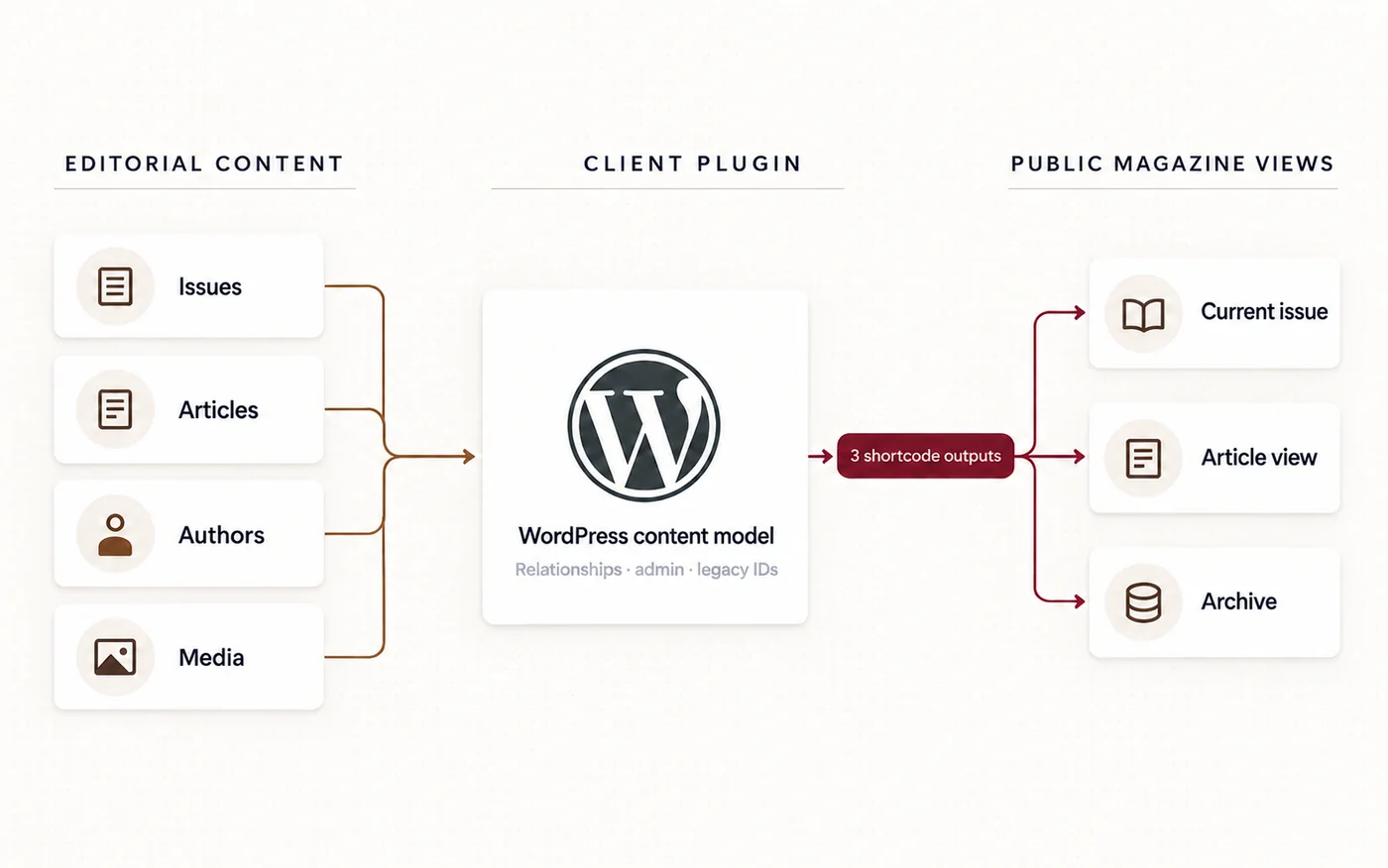
Fig 1 - Client owned WordPress magazine architecture linking editorial content types to theme independent issue, article and archive views
Delivery ran across five stages, each closing with a defined artifact or acceptance point. Within those stages, three architecture decisions shaped the rendering boundary, the migration environment, and the treatment of legacy identifiers. The implementation then grouped into four workstreams: content ownership, archive preservation, rebuild compatibility, and delivery within the client’s controls.
Clixlogix inspected the magazine inside the source plugin, mapped its custom post types and taxonomies against the editorial model the team used in practice, confirmed the client’s engineering and access constraints, and surfaced the compatibility requirements created by the parallel public website rebuild. The output was a shared definition of the source model, target model, and migration obligations.
At the end of this stage, the client had a documented source to target schema map, an inventory of the access controls governing delivery, and a written definition of the theme compatibility obligation.
Clixlogix defined the plugin’s rendering boundary, migration staging strategy, identifier preservation approach, and validation sequence. WordPress shortcodes kept public rendering outside the active theme’s PHP templates. The migration was rehearsed on a controlled mirror before reaching the client’s development environment, so it did not collide with the internal rebuild. Legacy identifiers were retained as reconciliation data wherever original WordPress IDs could not be preserved.
At the end of this stage, the client had an architecture note covering the rendering boundary, staging approach, identifier strategy, and validation responsibilities, with each choice recorded against its alternatives.
Clixlogix engineered the content plugin against the architecture note. The plugin registered custom post types for issues, articles, and authors, exposed native WordPress admin screens for the editorial workflow, and rendered the magazine’s public surfaces through three prefixed shortcode tokens. It shipped as a standard plugin bundle installable through WordPress.
At the end of this stage, the client had a working plugin build, native editorial admin surfaces, and documentation covering the shortcode tokens and their intended placements.
Clixlogix carried the plugin through a compatibility pass against the page builder adopted for the public site rebuild. The work scoped the plugin’s selectors, reduced class name collisions, and checked that template level styles did not override the article and issue views. The same views were also checked against a standard WordPress theme.
At the end of this stage, the client had a page builder compatible plugin build and documentation describing the CSS boundary future theme work would need to respect.
Clixlogix ran the migration end to end on the controlled mirror, compared the result with source records across issue groupings, author bylines, article content, identifiers, and media references, and then promoted the result to the client’s development environment for engineering sign off. The client controlled the production cutover.
At the end of this stage, the client had the migrated archive in its own environment, a validation note describing the checks performed, and a handover package for its production release.
The public website environment was in motion during the plugin build. The rendering boundary had to remain outside the active theme’s implementation so the editorial surface could work with the page builder selected for launch and could be integrated with a later theme without rewriting the content model.
Theme template functions would have bound rendering to templates that were still being rebuilt. Gutenberg blocks were available, but the selected page builder did not depend on the standard block editing experience. Shortcodes carried the editorial surfaces as text tokens editors could place in a page or template context without calling plugin specific PHP functions from the theme.
The WordPress Shortcode API documents this as a supported pattern and recommends returning the output instead of printing it directly, prefixing names to avoid collisions, sanitizing input, and escaping output (WordPress Plugin Handbook, Shortcodes). The shortcode boundary did not remove the need for styling integration, but it kept the magazine’s content model and query logic inside the plugin while the compatibility pass concentrated on CSS and placement.
The migration could not block the internal engineering team, and its rehearsal environment had to resemble the client’s development configuration closely enough for validation to be meaningful.
Migrating directly on the client’s development system risked creating a changing database state while its engineers were using the same environment for the wider rebuild. Production was not an appropriate place to discover mapping or sequencing errors. A controlled mirror allowed the migration to be rehearsed without competing with active development work. Promotion to the client’s own environment then gave its engineering team a validated migration artifact to review before any production decision.
The client’s engineering team needed to be able to trace a source record to its migrated equivalent without running a second migration. Link continuity also had to remain testable through permalink, redirect, and URL validation instead of being inferred from database IDs alone.
Allocating fresh IDs without keeping a mapping would have made later reconciliation unnecessarily difficult. Attempting to preserve original IDs only when convenient would have produced an incomplete mapping whose gaps were hard to diagnose. The migration therefore retained original IDs where the target allowed and stored the source value in native WordPress post metadata when a new ID was required.
That created a durable lookup surface the client’s engineers could query without depending on Clixlogix. It did not, on its own, guarantee that an old public URL would resolve: that outcome also depends on permalink structure, routing or redirects, and URL level validation. The case study therefore treats record traceability and link preservation as related but distinct concerns.
Clixlogix moved the editorial content model onto the client’s own stack by registering issues, articles, and authors as native WordPress content types inside a plugin the client’s engineers controlled. Relationships between articles and issues, and between articles and contributors, were represented explicitly so the editorial model used in practice became a first class part of the system.
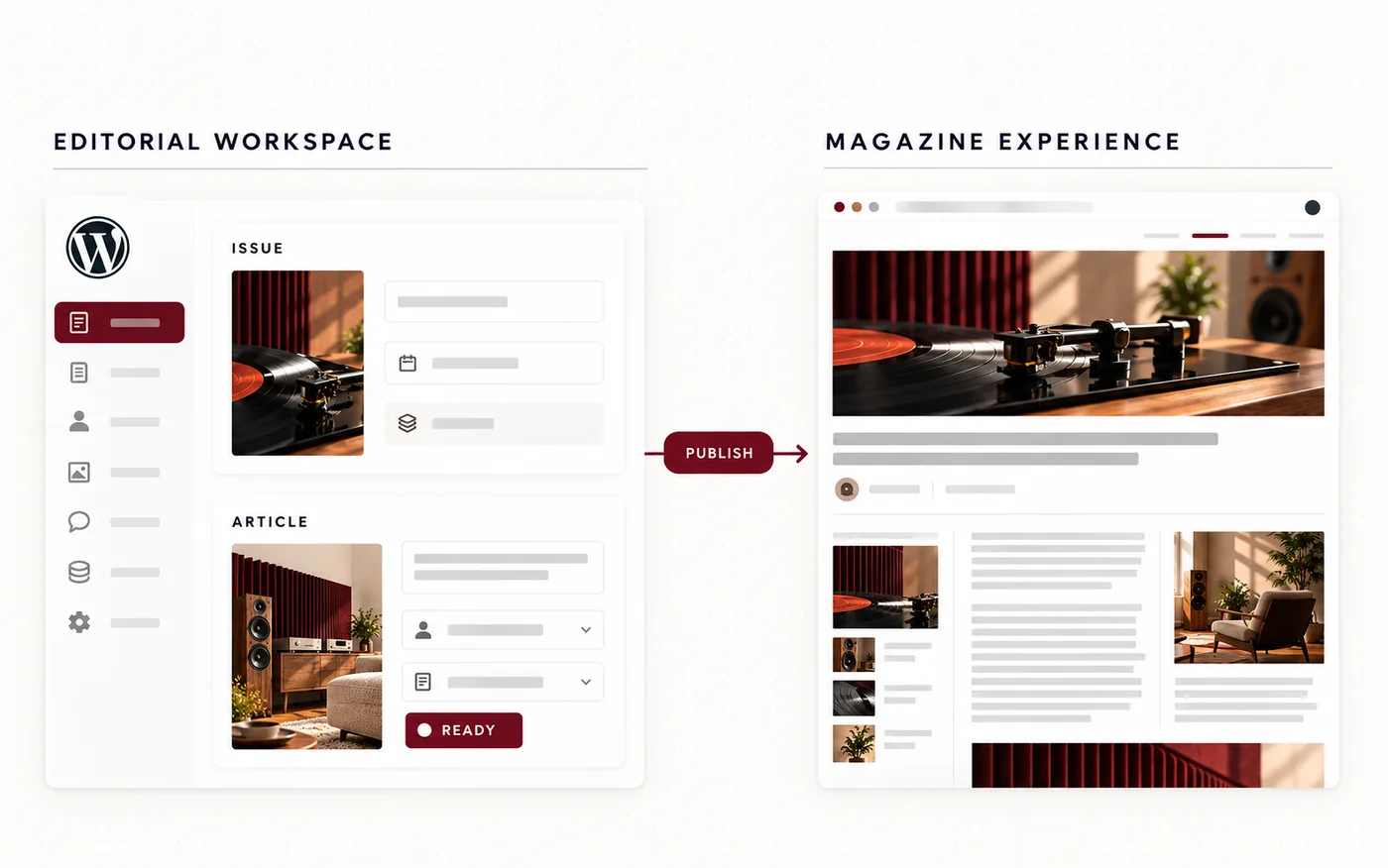
Issue, article, and author management appeared as native WordPress admin menus alongside the client’s other content operations. Public magazine pages rendered through three prefixed shortcode tokens registered by the plugin. Each token returned its rendered HTML to WordPress for placement in the selected page or template context. This kept routine publishing inside the editorial team’s established admin workflow while moving structural changes to the client’s own engineering backlog.
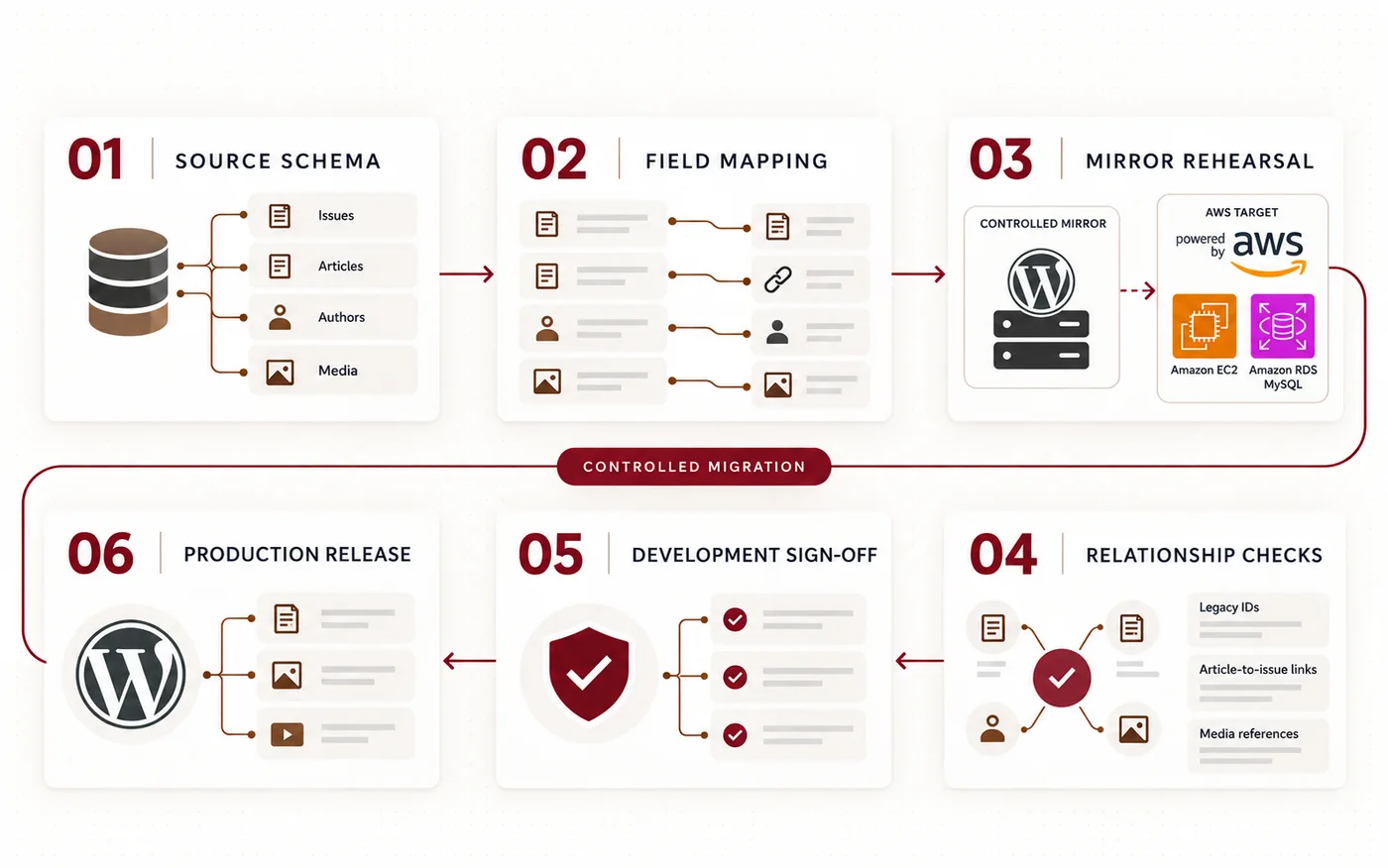
Clixlogix inspected the source schema and documented a field by field mapping before the migration wrote any target records. The first end to end run took place on a controlled mirror so mapping and sequencing problems could be corrected without changing the client’s active development or production data.
The write ran in ordered passes: issues first, followed by articles and their issue associations, then contributor records and their article relationships. Media references were carried into the target model without duplicating the underlying library unnecessarily. Original identifiers were retained where possible, while replacement IDs were paired with legacy values in post metadata for reconciliation.
Validation compared the migrated output with the source across issue membership, bylines, article content, identifiers, and media references. Clixlogix then promoted the migration to the client’s own development environment, where the internal engineering team reviewed the archive before controlling the production cutover.
Fig 2 - Controlled archive migration workflow from source schema inspection and field mapping through an AWS matched mirror rehearsal, relationship validation, development sign off and production release
The plugin first rendered against a standard WordPress theme, giving the team a stable baseline while the public rebuild continued on the client’s schedule. Once the page builder templates settled, Clixlogix completed a compatibility pass that scoped plugin selectors, reduced class name collisions, and prevented template level styles from unintentionally overriding article and issue output.
The shortcode boundary carried the structural work: the content model, queries, and generated markup stayed in the plugin, while the page builder controlled where those views appeared. A future theme change would still require presentation testing, but it would not require moving the editorial schema into a new theme or rewriting the publishing workflow.
Clixlogix worked through the client’s existing access control model without introducing a separate deployment platform or production agent. Access was restricted by approved identity, source network, service, and environment. Staging email remained isolated from customer delivery, and file and database work used the engineering surfaces already approved for development.
The client retained production authority throughout. At handover, its engineers received the plugin package, migration artifacts, and documentation through the same release workflow they already governed. The engagement did not require the client to adopt a new long lived operations platform in order to maintain the result.
Fig 3 - Delivered editorial workflow connecting brand owned WordPress issue and article management to the finished online magazine experience
Author relationship surfaces - Aggregate each contributor’s byline across the archive on a dedicated author page, giving returning readers another navigation path through the publication.
Archive search - Add a purpose built search layer as the archive grows, reducing broad database queries and giving readers a clearer way to find material by title, author, issue, or topic.
Automated regression testing - Cover the three shortcode outputs, content type registration, and migration utilities so WordPress core and plugin upgrades can be checked before production.
Role based editorial access - Extend the native WordPress capability model if the publication later introduces gated content, additional editorial roles, or a separate approval workflow.
Reconcile source and target records - Engineers can query retained legacy identifiers to trace a source article to its migrated record without rerunning the migration.
Retire the previous plugin after acceptance - Once the client verifies production data, URLs, and operational workflows, the former issue management plugin no longer needs to remain the editorial system of record.
Extend the content model internally - Issues, articles, authors, and their relationships are implemented in code the client’s engineers control. Any API exposure remains an explicit implementation choice instead of an automatic consequence of custom post type registration.
| Area on this engagement | Technologies and tools |
|---|---|
| Content platform | WordPress with a custom plugin covering issues, articles, authors, and the archive view |
| Legacy content source | A third party WordPress plugin for digital issue management, migrated through a field by field schema map |
| Plugin rendering | WordPress Shortcode API (Plugin Handbook, Shortcodes), returning rendered HTML to any WordPress page or template that embeds the shortcode token |
| Plugin admin surfaces | WordPress custom post types for issues, articles, and authors, with native WordPress admin screens for the editorial workflow |
| Theme compatibility | Standard WordPress theme baseline followed by a page builder compatibility pass and scoped CSS |
| Infrastructure | Amazon EC2 for the application tier and Amazon RDS for MySQL as the managed database service, inside the brand’s own AWS account |
| Access architecture | Client approved, allowlisted development access with isolated staging behavior and client controlled production release |
| Staging strategy | Controlled mirror matched to the AWS target for migration rehearsal, promotion to the client’s development environment for sign off, and production release on the client’s decision |
Table 2 - Technologies and tools across the engagement, grouped by the area each one served
Our team can share client references, scope your project, and answer any question about your delivery.
More engagements where our delivery teams shipped similar outcomes for clients across industries. Read on for context on the patterns we reused, the trade offs we navigated, and the metrics that landed in production.