WhatsApp DM Us 🇮🇳 +91-(120)-4137067 🇺🇸 +1-(315) 215-3533
Clixlogix
About
About
Why Clixlogix
Why fast-growing brands trust Clixlogix for digital success.
How We Work
Focused but flexible, explore our agile & collaborative approach.
Culture & Diversity
We bring diverse people together to drive growth-oriented culture.
Client Security
See how we ensure your intellectual property safety to protect you.
Our Team
Make some noise for our talented team powering your digital journey!
Partnership
Looking for a true end-to-end partner to drive growth?
Mission, Vision & Values
The fuel! What keeps us going?
Reviews & Testimonials
Clients love us. We stay humble. See what they have to say?
Know More About Us
Case Studies
Services
Services
All Services
One partner for all things AI & digital.
Digital Engineering
Custom web, mobile, cloud. Precision at AI assisted velocity.
Digital Marketing
AI assisted acquisition that earns its budget.
AI & ML
Agents, models, and RAG built for growth and production load.
QA & Testing
AI Assisted testing & defect catching before you ship.
Enterprise Software
Faster close, cleaner data, lower ops cost.
Creative & Design
Higher conversion, stronger recall, less friction.
Emerging Technologies
Blockchain, IoT, AR, and edge systems your roadmap can absorb.
Consulting Service
Defensible roadmaps, lower risk, sharper ROI math.
More About Services
Solutions
Solutions
Agritech
Intelligent farm management built for real acreage.
Fintech
Payments, lending, and wallets that clear an audit.
Video Calling
Scalable, crisp video calling built for real load.
Grocery Delivery
Lightning fast grocery delivery that scales cleanly.
E-Learning
Teaching and assessment with AI in the loop.
Telehealth
Secure patient care with AI for predictive outcomes.
Fitness Tracking
Goal tracking and coaching that keeps clients active.
EV Charging
Charging networks with reliability and predictive AI.
IoT & Automation
Connected automation with near zero defects on site.
View All Solutions
Industries
Industries
Agriculture
Smart farming and supply chain tech built for scale.
Automotive & Mobility
Connected vehicle and mobility software that scales.
Energy
Grid, asset, and consumption software for providers.
Finance
Secure, compliant fintech for regulated markets.
Healthcare
HIPAA ready software for providers and health tech.
Manufacturing
Industry 4.0 systems linking shop floor to decisions.
Real Estate
Property management and PropTech built for scale.
Retail
Omnichannel commerce and inventory for modern retail.
Travel & Leisure
Booking and guest experience for travel brands.
View All Industries
Careers
Blogs
Contact Us
  • View all About › Why ClixlogixHow We WorkCulture & DiversityClient SecurityOur TeamPartnershipMission, Vision & ValuesReviews & Testimonials
  • Case Studies ›
  • View all Services › Digital EngineeringDigital MarketingAI & MLQA & TestingEnterprise SoftwareCreative & DesignEmerging TechnologiesConsulting Service
  • View all Solutions › AgritechFintechVideo CallingGrocery DeliveryE-LearningTelehealthFitness TrackingEV ChargingIoT & Automation
  • View all Industries › AgricultureAutomotive & MobilityEnergyFinanceHealthcareManufacturingReal EstateRetailTravel & Leisure
  • Careers ›
  • Blogs ›
  • Contact Us ›
Contact Us →
WhatsApp Us Call Us
Clixlogix
  • About
    • Why Clixlogix
    • How We Work
    • Culture & Diversity
    • Client Security
    • Our Team
    • Partnership
    • Mission, Vision & Values
    • Reviews & Testimonials
  • Case Studies
  • Services
    • Digital Engineering
    • Digital Marketing
    • AI & ML
    • QA & Testing
    • Enterprise Software
    • Creative & Design
    • Emerging Technologies
    • Consulting Service
  • Solutions
    • Agritech
    • Fintech
    • Video Calling
    • Grocery Delivery
    • E-Learning
    • Telehealth
    • Fitness Tracking
    • EV Charging
    • IoT & Automation
  • Industries
    • Agriculture
    • Automotive & Mobility
    • Energy
    • Finance
    • Healthcare
    • Manufacturing
    • Real Estate
    • Retail
    • Travel & Leisure
  • Careers
  • Blogs
  • Contact Us
We are available 24/ 7. Call Now.

+1-315-215-3533

info@clixlogix.com

Contact information

c-84, sector 65, Noida
AI Transliteration for Hebrew Scripture via OpenAI

A Hebrew Scripture publisher moved from manual database uploads to an AI pipeline generating transliteration via OpenAI across English and Spanish verses.

Glassmorphic Hebrew Scripture publishing workflow with an authoritative Hebrew source, OpenAI assisted transliteration, English and Spanish outputs, editorial review, and a published reading surface over a softly faded Jerusalem and open book background
Home / Case Studies / AI Transliteration for Hebrew Scripture via OpenAI

AI Transliteration for Hebrew Scripture via OpenAI

Industry
Education & eLearning
Geography
Ohio, United States
Cooperation Period
5 months

Executive outcome

The Client publishes a complete Hebrew Scripture canon to an English and Spanish reading audience worldwide, with phonetic transliteration that lets readers unfamiliar with the Hebrew alphabet follow the original pronunciation on the page. The engagement sits in a thin field. Programmatic Hebrew to Latin transliteration at the scale of a complete canon, generated through an AI model under a Client authored rule set and shipped on a reading surface for a lay audience, has few comparable precedents in Hebrew Scripture publishing. At engagement open, every verse update to the live reading surface began with a database statement assembled by hand and routed through engineering before it reached a reader, which placed the publishing cadence on engineering turnaround and held the editorial team one step removed from the reader. Clixlogix worked directly with the Client’s technology head across the engagement and designed an editorial pipeline that moved publishing control onto a workflow the Client’s team runs from the admin, with the full pipeline sitting on an OpenAI integration for the Hebrew transliteration leg and later for the Spanish translation leg. The engagement ran across 5 stages of design and build and closed with a complete canon live in English and Spanish, chapter level audio on every chapter page, and a Client editorial team that publishes new content without engineering intervention on each change.

About the client

The Client is a multilingual publisher of Hebrew Scripture content, headquartered in the United States and reaching readers worldwide. The reading audience spans denominational traditions, and now includes Spanish readers reached through the Spanish surface shipped in the final stage of the engagement.

The Client’s publishing mission anchors on the authoritative Hebrew source text. Each verse carries phonetic transliteration prepared so readers who do not read Hebrew letters can follow the original pronunciation on the page, which places the Client’s reading surface as a point of entry into the Hebrew canon for an audience without Hebrew literacy. The transliteration rule set is a Client authored specification held and iterated inside the admin, so wording decisions on how the pronunciation renders in Latin script sit with the Client’s editorial team, outside the cataloguing standards or a vendor product. The combination of an authoritative Hebrew source, an AI model generating reader facing transliteration against a Client specification, and a full canon shipped bilingually from one editorial pipeline places the Client’s platform in a thin corner of Hebrew Scripture publishing.

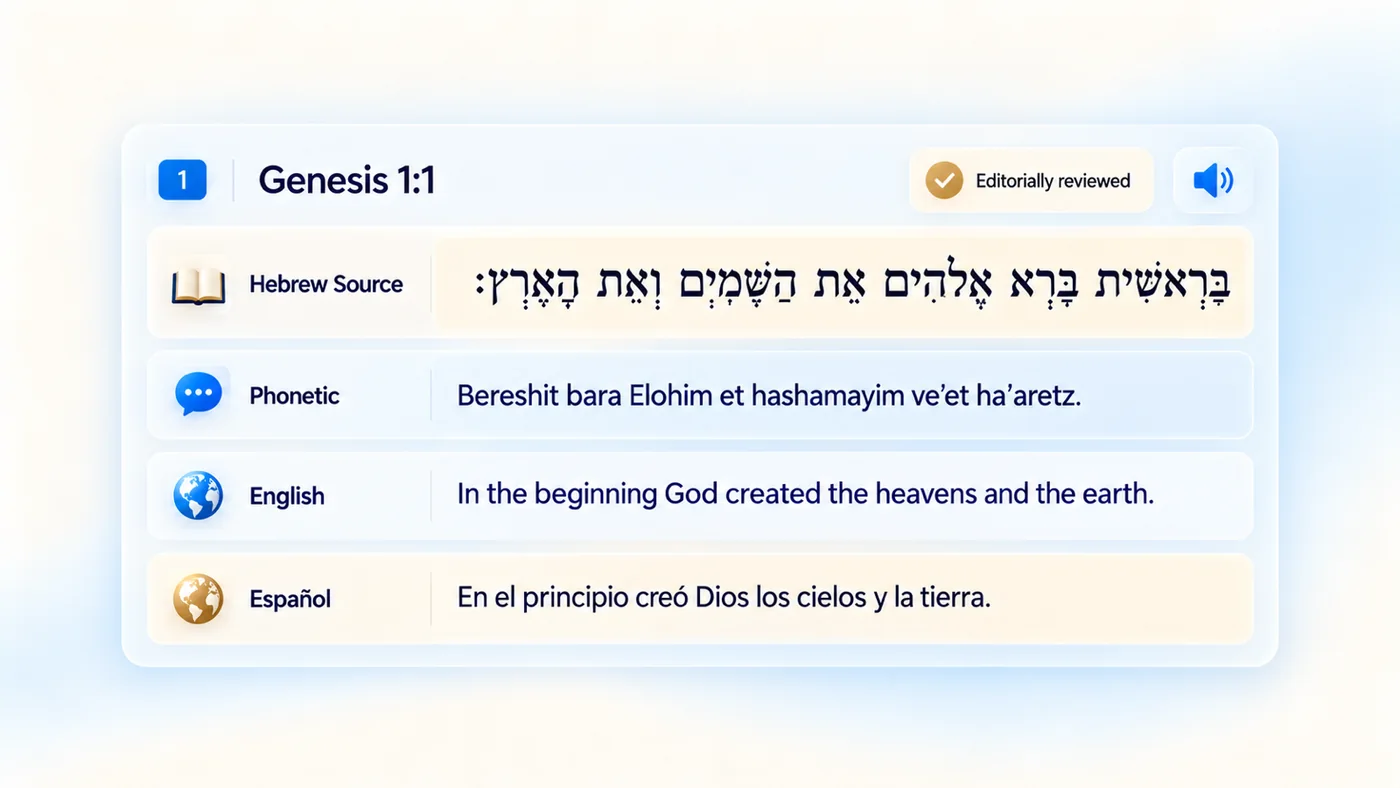
Genesis 1:1 displayed in a glassmorphic reading panel with four labelled rows: the Hebrew source text, phonetic Latin transliteration, English translation, and Spanish translation, plus an editorially reviewed status and audio control

Fig 1 - The reading surface output for a single verse across four content lines

Design discipline on the reading surface runs on a system the Client defined in Figma and holds under its own stewardship. The verse page, the chapter listing, the breadcrumb, the side navigation, and the search surface sit inside one visual language the Client controls directly. Latin script headings and Hebrew text sit alongside each other on the page under a defined typography treatment.

The Client’s technology head, working from Haifa, Israel, owned the technical direction across the engagement and was the Clixlogix counterpart on every architectural and operational call. The engagement ran as a long form, 5 stage programme of design and build, which signals a durable platform investment on the Client’s side and places the publishing surface as a strategic asset the Client will carry forward over years.

Diagnosis

The Client had access to the raw ingredients of a modern scripture publishing system. The authoritative Hebrew text was available through an open scripture API. An AI model was available to generate transliteration under a Client authored rule set. A WordPress reading surface already existed. The problem was not a missing ingredient. The problem was that nothing connected the ingredients into a workflow the Client’s editorial team could run on its own.

Three architectural problems defined the engagement.

Editorial control sat outside the editorial team - Every content update began with a database statement assembled by hand and routed through engineering before it reached the reader. The Client’s technology head described the workflow in these words.

The client’s technology head, on the workflow at engagement open

“I have direct access to the database so I can send you an SQL which you can update and then I can manually upload back into the website.”

The workflow cost engineering hours on every content change and kept the publishing cadence inside the database, outside the editorial calendar.

No single pipeline connected source to published surface - The Hebrew source API, the AI model, and the production database each existed as separate reachable systems. No component owned the loop that reads the source for a given verse, calls the model for the transliteration, writes the record into the correct taxonomy, and surfaces the operation to the editor who triggered it. The absence of that owning component is what forced the manual workflow in the first place.

No tenancy model for additional reading languages - The content programme ran in one language. A second language variant with its own URL namespace, taxonomy mapping, and language switcher had no architectural path. Reaching a second reading audience would have required a second content programme at engagement open, because the existing one could not be configured to carry it.

The engagement opened on these three problems and defined the architectural response against them.

Before and after

Operational axisBefore engagement openAfter engagement close
Content ingestion into the live reading surfaceDatabase statements assembled by hand, routed through engineering, uploaded to production on every changeEditorial pipeline triggered from the admin, iterating books, chapters, and verses programmatically
Hebrew source retrievalExternal to the production surface, reached by hand for individual updatesQueried verse by verse inside the pipeline, bound to the production record on write
Transliteration generationNot operational at canon scaleAI model called per verse against a Client authored rule set, output written to the publication record
Reading languages live on the surfaceOne, with partial coverageTwo, with the complete canon live in English transliteration and Spanish translation
Multilingual URL structureNot present/es/ URL namespace with language switcher mapping each English record to its Spanish counterpart
Chapter level audioNot available on the reading surfaceAudio reads integrated on every chapter page across the canon
Hosting arrangementPrior host with configuration friction on long running operationsManaged hosting partner carrying the production environment and the database engine upgrade path

Table 1 - Operational axes that transformed across the engagement

Engagement model

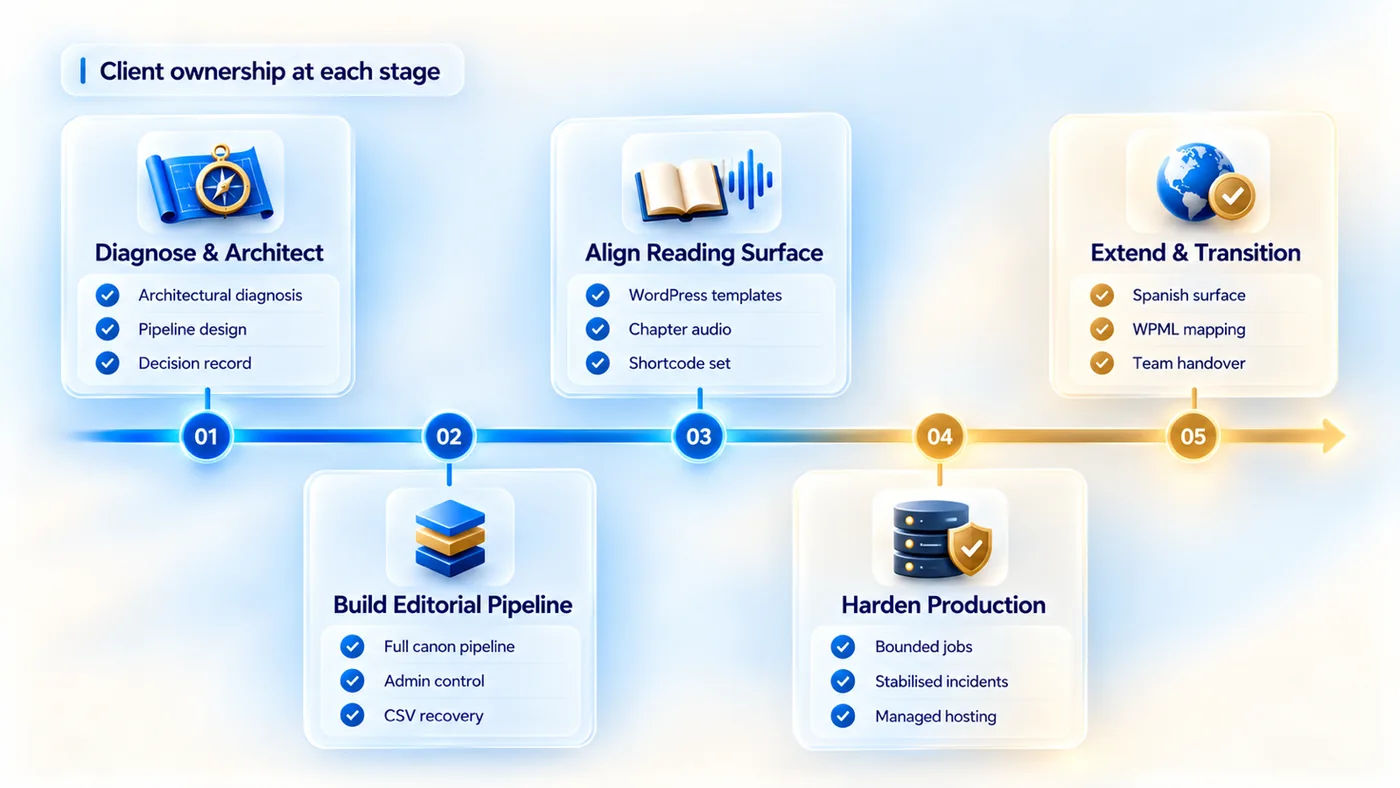
The engagement ran across 5 consultative stages. Each stage closed on a deliverable set the Client could use before the next stage opened.

Stage 1 - Diagnose and architect

Clixlogix opened the engagement with working sessions on what the Client’s editorial team actually needed to do and what the system had to carry. The sessions converted a general description of a “plugin” into a named set of pipeline responsibilities, a data flow, an admin surface, and a failure model. The architecture decisions on pipeline ownership, transliteration generation, multilingual URL structure, and hosting all landed during this stage.

At the end of this stage the Client owned an architectural diagnosis naming the three problems, a pipeline design naming the responsibilities and their data flows, and a decision record naming the alternatives considered on each architectural call.

Stage 2 - Build the editorial pipeline

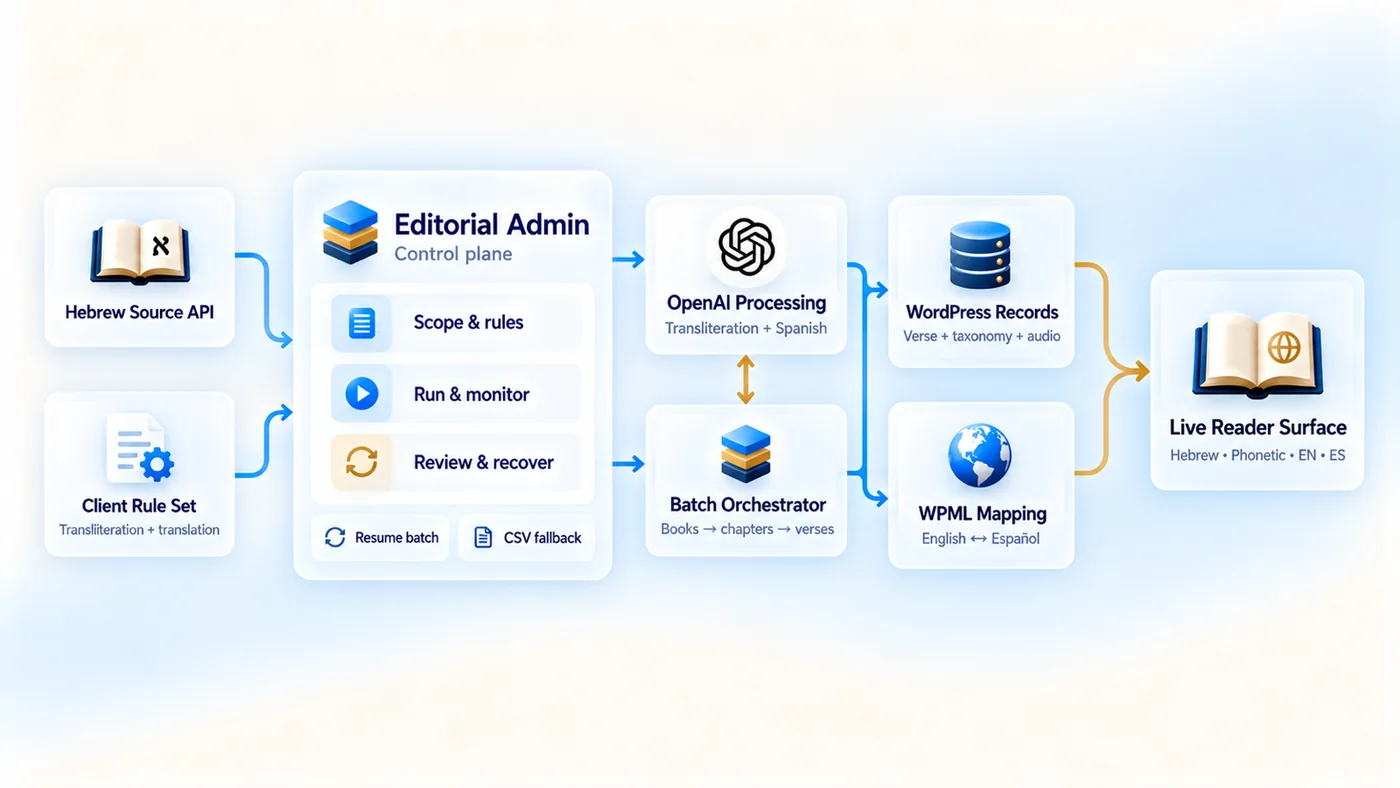
Clixlogix built the pipeline that reads Hebrew source text for a given verse, generates the English transliteration through the AI model under the Client authored rule set, writes the result into the correct publication tables with the correct taxonomy relationships, and surfaces the operation state to the editor through the admin. The stage shipped a CSV export fallback so the Client’s team could review and reinsert content if a batch failed in the middle of a run. The pipeline closed with a run across the full Old Testament canon.

At the end of this stage the Client owned a working editorial pipeline across the full canon in English, an admin surface for triggering and recovering runs, and a CSV export fallback as a second recovery path.

AI assisted Scripture publishing system diagram: the Hebrew Source API and Client Rule Set feed an Editorial Admin control plane, which directs OpenAI Processing and the Batch Orchestrator into WordPress Records and WPML Mapping before publication to the multilingual Live Reader Surface

Fig 2 - System architecture with the editorial admin as the control plane for AI assisted Scripture publishing

Stage 3 - Align the reading surface

The Client supplied a design system covering the verse page, the chapter listing, breadcrumbs, side navigation, button states, and verse level typography. Clixlogix implemented the design system in WordPress templates, bound each template to the pipeline’s data model, and added shortcodes for verse rendering, in site search, and collection pages. Latin script headings and Hebrew text rendering landed in the typography layout. Chapter level audio uploads landed during this stage and the plugin surfaced the audio reads on the chapter page template.

At the end of this stage the Client owned a reading surface aligned to the design system, a chapter page carrying integrated audio, and the shortcode set for the verse, search, and collection pages.

Stage 4 - Harden production

Clixlogix moved the production environment to a managed hosting partner and stabilised the operational issues the Client was carrying. Clixlogix resolved the taxonomy mapping drift during content writes by moving the taxonomy write to run only after the verse record is confirmed. Clixlogix addressed the server side execution limits on long running ingestion batches by splitting the pipeline’s work into bounded jobs with persisted state between runs. Clixlogix hardened the image handler against malformed source responses. A database engine version upgrade on the hosting side blocked content updates for a period during this stage. Clixlogix reconciled the pipeline’s database access path and the hosting partner reconciled the host side configuration against the upgraded engine, after which content updates resumed.

At the end of this stage the Client owned a hardened production surface, an incident log naming each stabilised issue with its resolution, and a hosting arrangement that isolates engine upgrades from the pipeline work.

Stage 5 - Extend to a second language and transition

Clixlogix extended the pipeline to Spanish. The Client reviewed existing Spanish language Jewish Bible translations and found them insufficient for the reading surface. Clixlogix added an AI translation path that reads the English verse and writes the Spanish verse into the publication record under a Spanish language variant. WPML carried the /es/ URL namespace, the language switcher on each verse page, and the taxonomy mapping between the English and Spanish records. The engagement closed with transition sessions handing the admin workflow and the recovery paths to the Client’s editorial team.

At the end of this stage the Client owned a complete Hebrew Scripture canon live in English and Spanish, a multilingual URL structure served by WPML, and the operating knowledge to run the pipeline, edit the transliteration rule set, and recover from a partial batch failure without engineering support.

Architecture decisions

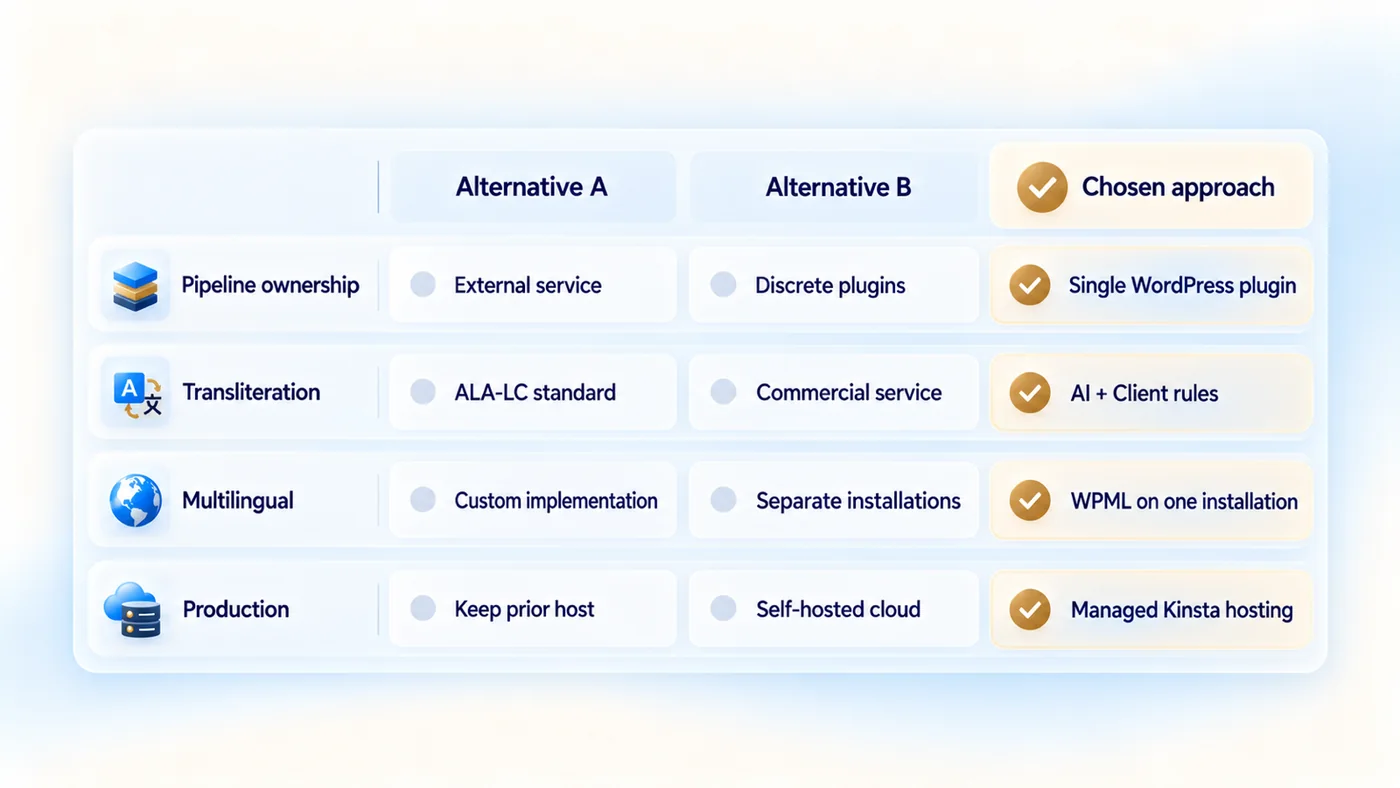
Four row architecture decision matrix comparing three alternatives for pipeline ownership, transliteration, multilingual delivery, and production hosting, with the selected single WordPress plugin, AI plus Client rules, WPML, and managed Kinsta hosting highlighted in gold

Fig 3 - The alternatives Clixlogix evaluated across the four architecture decisions

Decision 1. One plugin owns the full publishing pipeline

Alternatives Clixlogix evaluated

  • A thin WordPress plugin that consumes a separate external service running the heavy pipeline work on an application server outside the WordPress host
  • A set of discrete WordPress plugins, each owning one responsibility, communicating through the database
  • A single custom WordPress plugin owning the full pipeline across all responsibilities

Decision criterion

The decision had to minimise the number of surfaces the Client’s editorial team touches to run and recover a pipeline operation, and had to keep failure recovery inside the environment the Client already uses.

Rationale

The single plugin option placed the pipeline inside the surface the Client’s team already uses for every other content operation. The thin plugin plus external service option split the operating surface across two environments and created a second failure mode on the integration between them. The discrete plugins option fragmented ownership of responsibilities that only make sense together. The single plugin design kept the operating surface and the failure recovery surface inside one environment and preserved the CSV export as a second recovery path.

Decision 2. Transliteration generates through an AI model under a Client authored rule set

Alternatives Clixlogix evaluated

  • Apply the Library of Congress ALA-LC Hebrew romanization table directly to the pipeline output
  • License a commercial transliteration service and pipe its output into the publication record
  • Generate transliteration through an AI model with a Client authored rule set the Client’s team edits over time

Decision criterion

The decision had to produce a Latin script form a lay reader can pronounce without diacritics and had to keep the rule set editable by the Client without a code release on every revision.

Rationale

The ALA-LC Hebrew and Yiddish romanization table approved by the Library of Congress and the American Library Association is engineered for reversibility back to the Hebrew source for scholarly cataloguing. A reading surface that targets an audience without Hebrew literacy carries a different design constraint; the transliteration must approximate pronunciation on the page without requiring the reader to interpret ḥet, qoph, or shewa marks. The commercial transliteration option kept the rule set locked inside the vendor’s product. The AI model option under a Client authored rule set kept the specification inside the Client’s control and allowed the Client’s team to iterate wording without a code release.

Transliteration Standards

The ALA-LC Hebrew and Yiddish romanization table approved by the Library of Congress and the American Library Association is the dominant Latin script convention for Hebrew in library cataloguing worldwide. Its 2011 revision (ALA-LC Romanization Tables at loc.gov) is engineered for reversibility back to the Hebrew source for scholarly search, which places diacritics and consonantal mappings that a lay reader finds unfamiliar. A reading surface that targets an audience without Hebrew literacy carries a different design constraint. The engagement treated the Client authored rule set as a reader facing specification, which positions the output outside the cataloguing standard and inside a reading specification the Client owns and iterates.

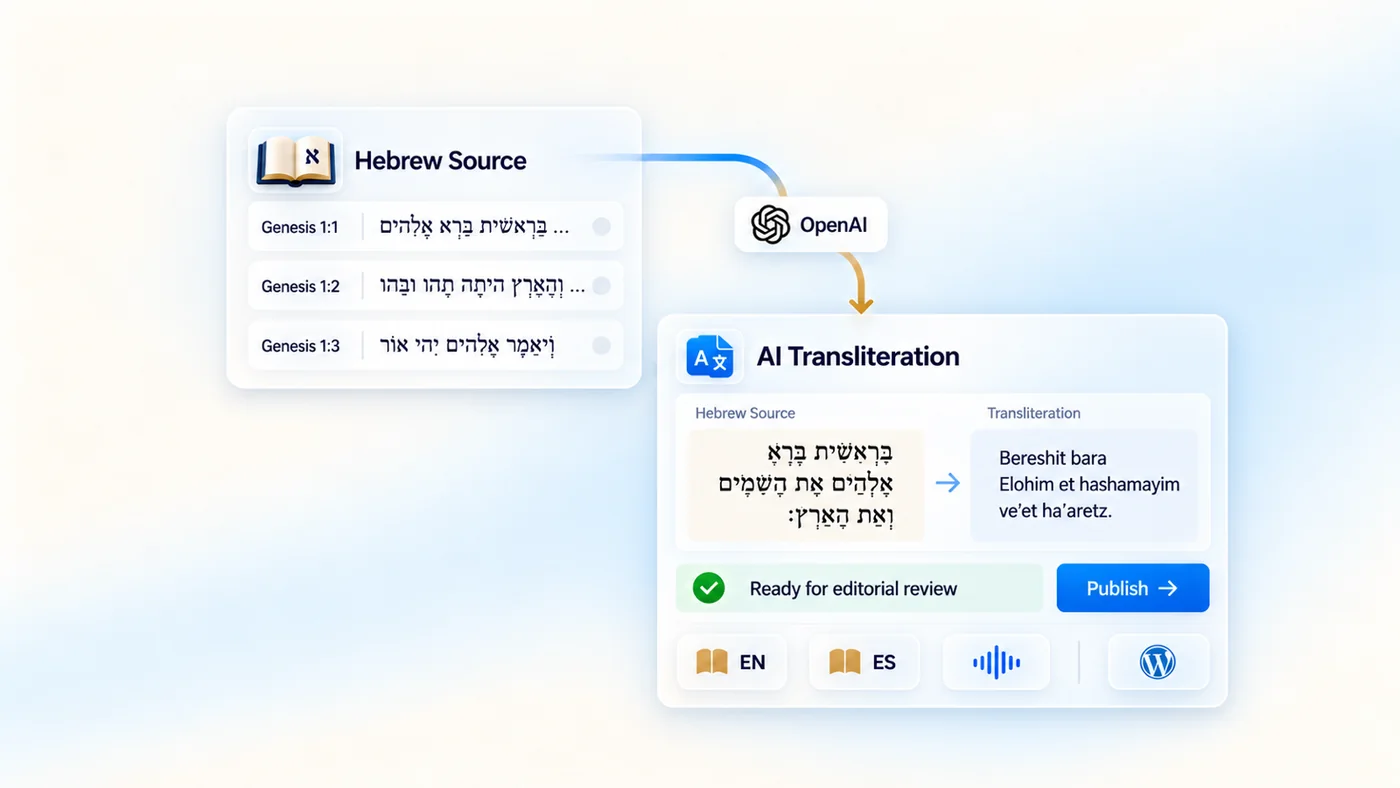
An authoritative Hebrew source card sends verse data through OpenAI into an AI transliteration panel where Hebrew text becomes phonetic Latin text, receives editorial review, and is prepared for English, Spanish, audio, and WordPress publication

Fig 4 - The content pipeline from authoritative Hebrew source to published verse page

Decision 3. WPML carries the multilingual URL structure

Alternatives Clixlogix evaluated

  • A custom multilingual implementation inside the plugin, with the plugin owning URL rewriting, the language switcher, and the record mapping
  • A separate WordPress installation per language, with each installation running its own copy of the pipeline
  • WPML carrying the URL namespace, the language switcher, and the taxonomy mapping between language records

Decision criterion

The decision had to carry the Spanish surface on the same canonical URL rules the pipeline already enforced on English and had to preserve search engine resolution of each language variant.

Rationale

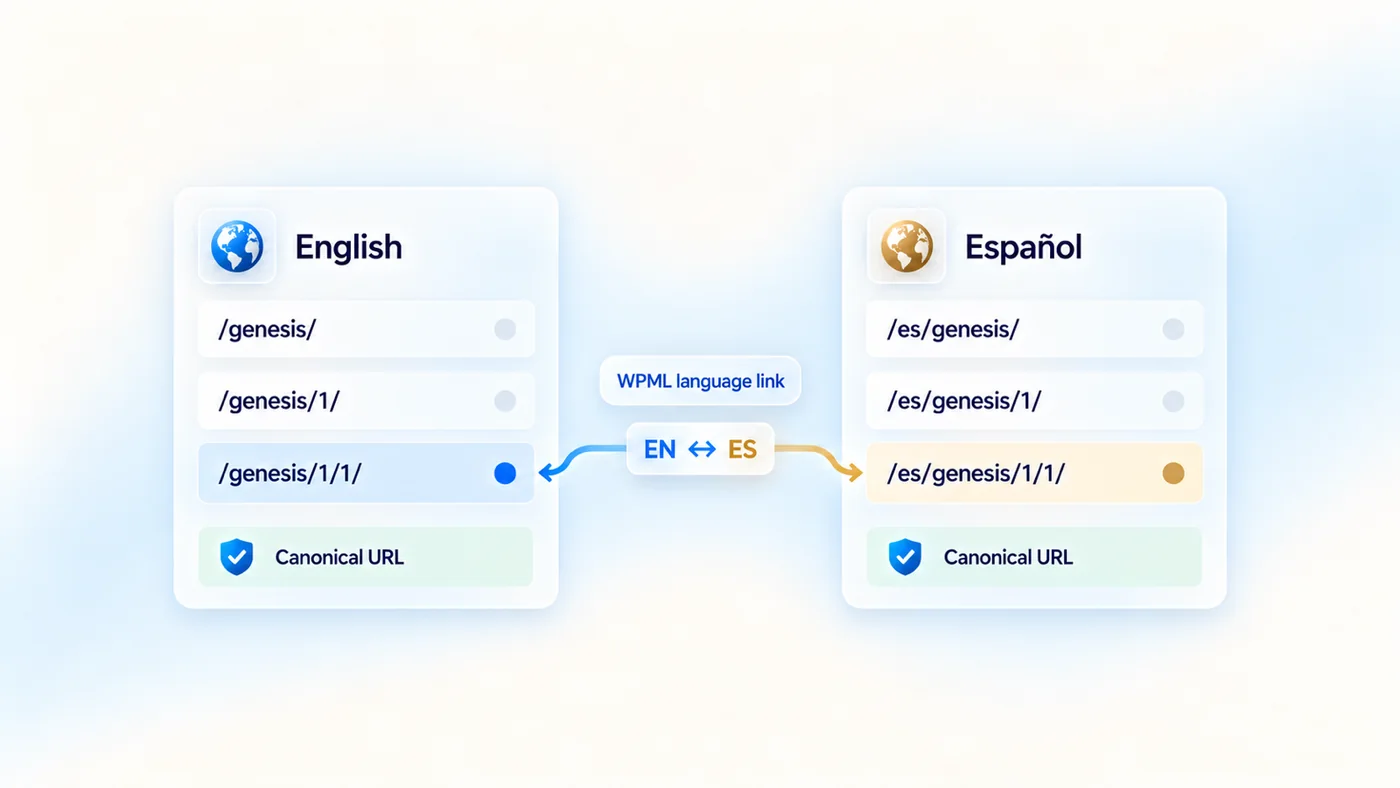
The custom implementation would have reinvented a problem a mature tool already solves and would have placed URL rewriting on the pipeline’s maintenance surface. The separate installation per language would have duplicated the operating surface and forced the Client’s team to maintain two environments. WPML kept the Spanish surface on the same installation, mapped each English record to its Spanish counterpart, and preserved the plugin’s canonical URL rules so search engines resolve each language variant correctly.

Side by side English and Spanish canonical URL cards showing Genesis book, chapter, and verse paths, with the Spanish records under the slash es namespace and corresponding verse URLs connected by a WPML language link

Fig 5 - The multilingual URL structure under WPML

Decision 4. A managed hosting partner owns production

Alternatives Clixlogix evaluated

  • Keep the prior host and work around the configuration friction on long running operations
  • Self host on a cloud provider with full control over PHP runtime, database engine, and asset delivery
  • Managed hosting partner on Kinsta carrying the production environment and the engine upgrade path

Decision criterion

The decision had to isolate database engine upgrades, PHP runtime management, and asset delivery from the pipeline work, so the two operational tracks could run on separate cadences.

Rationale

The prior host left the Client inside the configuration friction the engagement was trying to retire. The self hosted option gave full control but moved runtime management onto the Client’s own operations. The managed hosting option placed runtime management on a partner whose job is runtime management, which freed the pipeline work from the hosting work on an ongoing cadence.

Delivery narrative

Content automation and editorial control

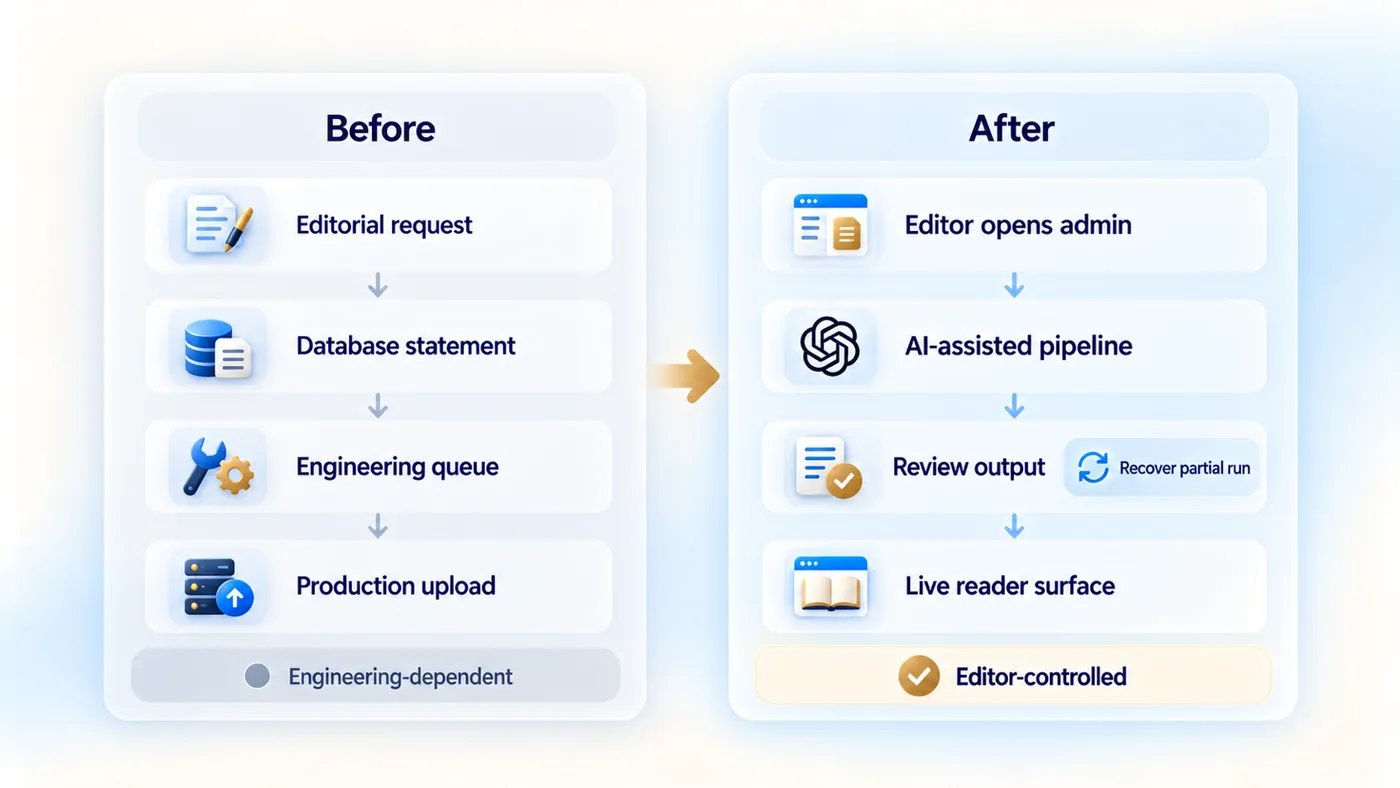
The editorial team began the engagement outside the publishing path. Every content update required an engineering intervention, which placed the cadence of the reading surface on engineering turnaround and the quality of the content behind a serialised review step. Clixlogix built the pipeline so the editor who initiates an update is the operator who runs the pipeline, reviews the output, and sees the result on the live surface, with the recovery path from a partial failure available on the same admin screen. The admin now carries full publishing capability and the Client’s editorial team operates the pipeline on its own cadence.

Before and after workflow comparison: editorial requests previously passed through database statements, an engineering queue, and production uploads; the new process lets an editor run an AI assisted pipeline, review or recover the output, and publish directly to the live reader surface

Fig 6 - The publishing workflow before and after the engagement

Reading surface design alignment

The reading surface at engagement open did not reflect a design system. The Client’s design system defined the verse page, the chapter listing, breadcrumbs, side navigation, button states, and verse level typography, and specified how Hebrew and Latin scripts render alongside each other. Clixlogix implemented the design system in WordPress templates, bound each template to the pipeline’s data model, and added shortcodes for verse rendering, in site search, and collection pages. The reader now meets a surface that respects the Client’s design system across every verse, every chapter, and every collection.

Production stability and audio integration

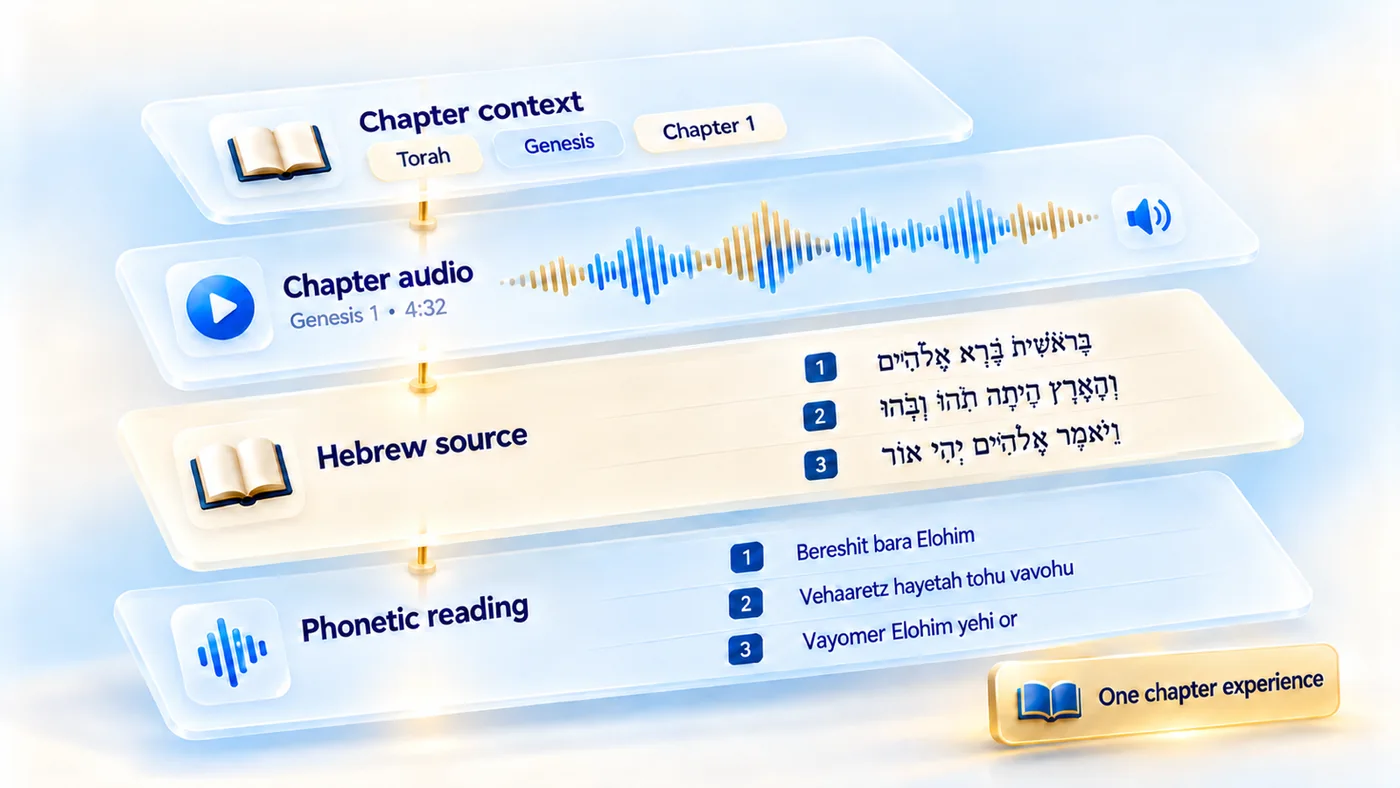
The Client was carrying three production issues when the engagement opened the production stabilisation stage. Verse pages intermittently returned 404 when a write failed partway through a chapter and the taxonomy mapping drifted from the verse record. Long running ingestion batches hit server side execution limits before the chapter completed. The image handler threw JSON parsing errors on malformed source responses, which affected article images on specific pages. Clixlogix moved the taxonomy write to run after the verse record is confirmed, split the pipeline’s work into bounded jobs with persisted state between runs, and hardened the image handler against malformed source responses. Chapter level audio uploads landed during the design alignment stage and the plugin surfaced the audio reads on the chapter page. The reader now meets a hardened reading surface with audio on every chapter page.

Conceptual exploded view of a Scripture chapter formed from four aligned layers: Torah, Genesis, and chapter context; a blue and gold chapter audio waveform; numbered Hebrew source fragments; and corresponding phonetic readings combining into one chapter experience

Fig 7 - The chapter reading experience as four integrated layers of context, audio, Hebrew source, and phonetic reading

Second language audience expansion

The Client reached one language community at engagement open. A second language variant with its own URL namespace, taxonomy mapping, and language switcher had no architectural path on the existing system. The Client reviewed existing Spanish language Jewish Bible translations and found them insufficient for the reading surface. Clixlogix added a Spanish translation path that reads the English verse and writes the Spanish verse into the publication record under a Spanish language variant, with WPML carrying the URL namespace and the taxonomy mapping. The reading surface now serves the Spanish community on the same canon through the same pipeline.

Linguistic Reach

Instituto Cervantes publishes an annual report on the global demographics of the Spanish language through its Global Observatory of Spanish. The 2025 edition (Spanish, a language to the world 2025 at observatoriodelespanol.cervantes.org, Table 4) records 519,115,258 native speakers and 635,743,644 total potential speakers, counting native, limited competence, and learners. The current market context for the Client’s Spanish surface is a global reading community of this scale. The publishing economics of a second language variant settle at the ongoing cost of running the pipeline once per language. A second content programme is not required.

Five stage engagement timeline showing the Client owned deliverables accumulated across Diagnose and Architect, Build Editorial Pipeline, Align Reading Surface, Harden Production, and Extend and Transition

Fig 8 - The engagement stage sequence from Diagnose through Transition

Post launch results

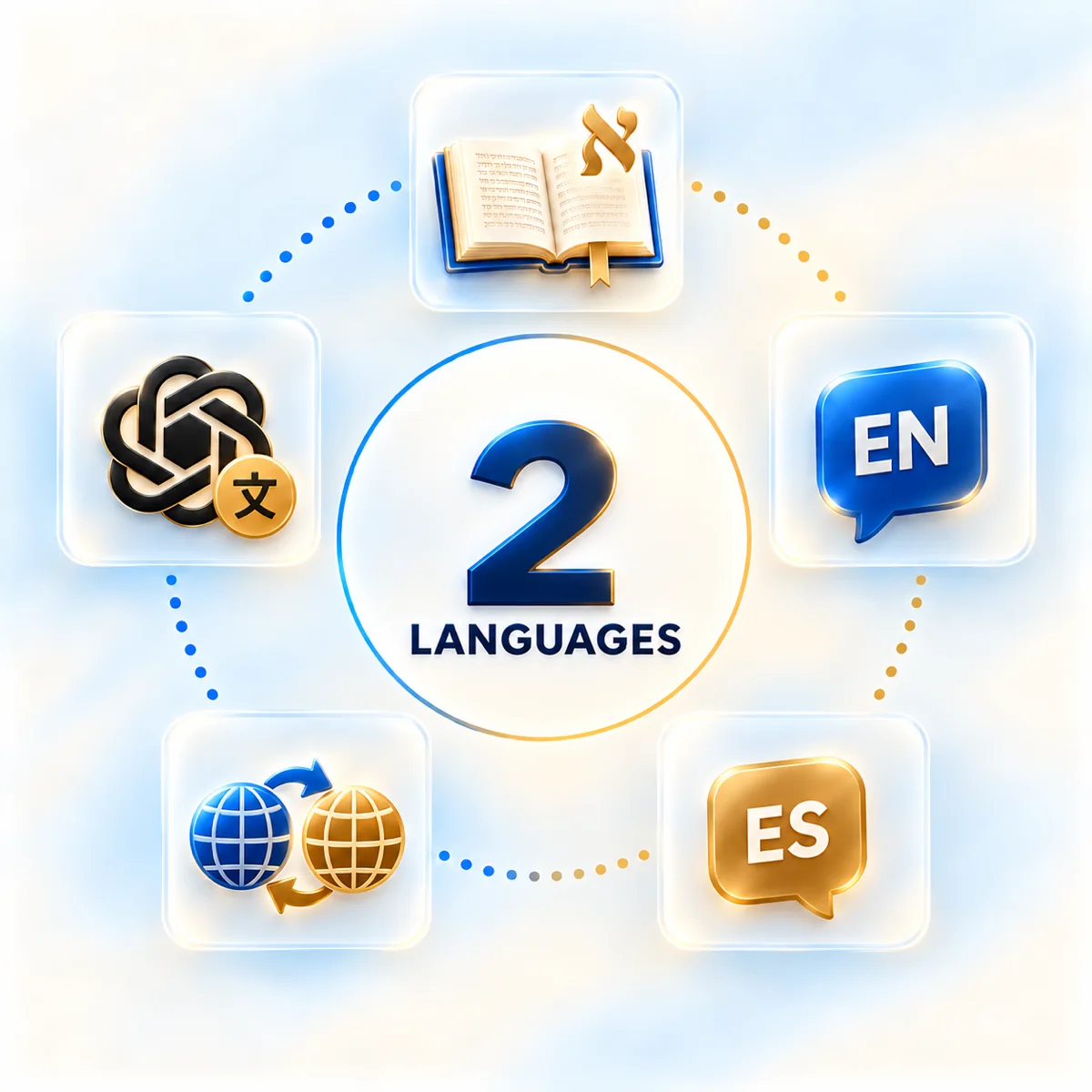
39 Books Live Across the Full Canon

39 Books Live Across the Full Canon

All 39 books of the Old Testament now publish through one automated pipeline that connects source retrieval, transliteration, record creation, taxonomy mapping, and delivery. The same canon wide process gives the editorial team one consistent path for reviewing and publishing every book.
2 Language Surfaces Delivered

2 Language Surfaces Delivered

English phonetic transliteration and Spanish translation now ship across the complete canon through the same publishing pipeline. WPML connects the paired language records and canonical URLs, giving both audiences a consistent reading structure without operating separate content programmes.
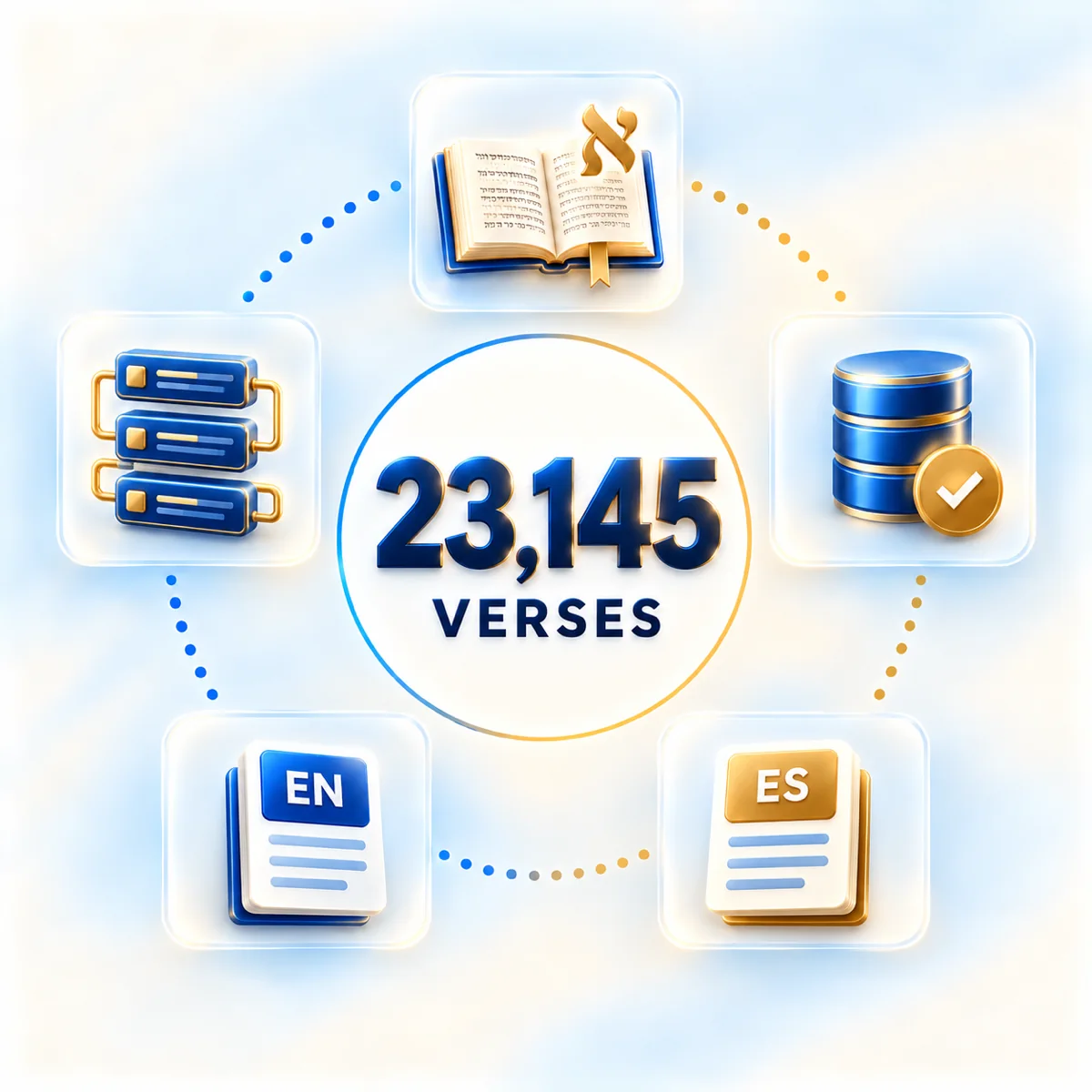
23,145 Verses Through the Pipeline

23,145 Verses Through the Pipeline

23,145 Hebrew verses move through the publishing pipeline into English and Spanish records. Each verse retains its authoritative source, transliteration, translation, taxonomy, and canonical page relationship, keeping the full corpus structurally consistent at publication scale.
Chapter Level Audio Across the Site

Chapter Level Audio Across the Site

Chapter level audio is available throughout the Old Testament reading surface and sits alongside the chapter context and verse list. Readers can listen while following the Hebrew and phonetic text, so audio sits inside the core reading experience as one more reading layer.
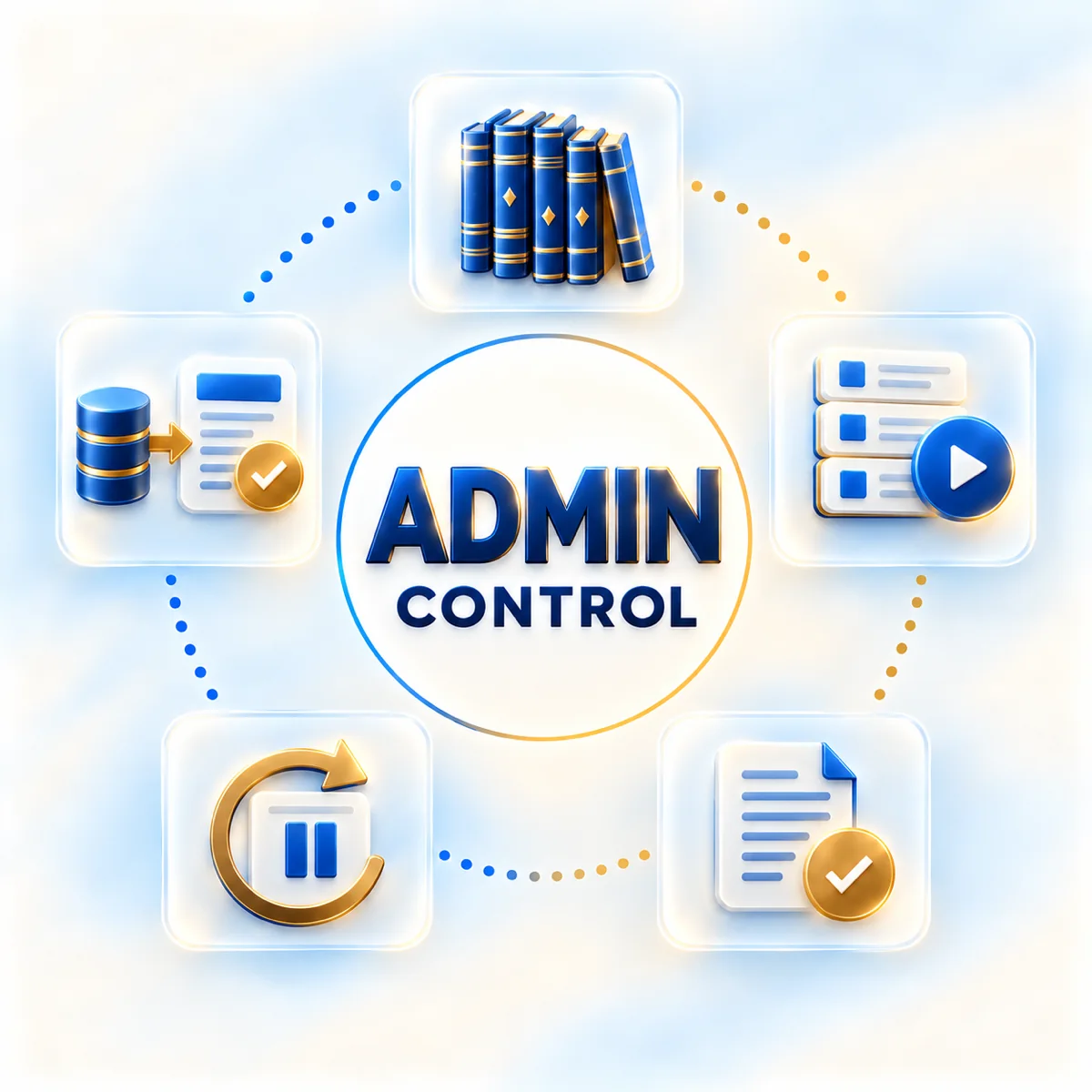
Admin Workflow Replaces SQL Uploads

Admin Workflow Replaces SQL Uploads

The Client's editorial team now publishes from the admin instead of routing SQL uploads through engineering. Editors can trigger scoped runs, review generated content, recover partial failures, and republish changes on the editorial calendar without engineering intervention on every release.

Forward looking recommendation

  • Instrument the Spanish surface - measure Spanish organic traffic and reader engagement against the English baseline so the Client can read the audience reach the second language was built for and tune the Spanish rule set over time.
  • Review the transliteration rule set on a cadence - the Client’s team can revise rules against reader feedback over quarters, and the pipeline republishes the surface without a code release on each revision.
  • Prepare a third reading language variant - the multilingual URL structure and the AI translation path reuse per language, so a Portuguese or French variant can enter the pipeline on the same architecture.
  • Open a first party reader account surface - a reader account on the same admin lets the Client capture email and reading preferences and move beyond anonymous session data on the reading surface.

What the client can do now

  • Trigger a full canon or single book re ingestion - the Client’s team runs any ingestion scope from the admin with no engineering support required.
  • Edit the transliteration rule set and republish - rule changes feed back through the pipeline without a plugin release on each revision.
  • Add Spanish content for new or revised English content - the Spanish path runs through the same pipeline the English surface uses.
  • Publish chapter level audio - the Client uploads to the media library and the plugin surfaces the audio on the chapter page.
  • Recover from a partial batch failure - the admin job state surface and the CSV export fallback together carry the two recovery paths.
  • Extend the pipeline to a third reading language - the multilingual URL approach and the AI translation path reuse per language with no architectural change required.

Technologies and tools

Area on this engagementTechnologyRole across the engagement
Authoritative Hebrew source retrievalOpen scripture APIHebrew source text pulled verse by verse during pipeline runs
AI processing path for transliteration and translationAI chat completions APIEnglish transliteration generation in stages 2 through 4, Spanish translation generation in stage 5
Content management and reading surfaceWordPressReading surface, admin workflow, template rendering, and shortcode library
Full publishing pipeline runtimeCustom WordPress plugin authored by ClixlogixCanon iteration, Hebrew source retrieval, transliteration and translation generation, publication record writes, taxonomy enforcement, retry handling, admin surfacing
Multilingual delivery across language variantsWPML/es/ URL namespace, language switcher, taxonomy mapping between English and Spanish records
Managed hosting partner carrying productionKinsta managed hostingProduction environment from stage 4 onward, database engine upgrade path, PHP runtime management, asset delivery
Typography across Latin and Hebrew scriptsProxima Nova, adobe-hebrewLatin script headings and Hebrew text rendering across the reading surface
Design system supplied by the ClientFigmaDesign system defining the verse page, chapter listing, breadcrumb, side navigation, and search surfaces

Table 2 - Technologies and tools across the engagement

Services Delivered
AI Integration Services, AI Workflow Automation, WordPress Plugin Development, Web Development, Multilingual Implementation, Editorial Workflow Automation
Team Composition
Solution Architect, WordPress Developer, QA Analyst, Project Manager

Have a question for our team or need help with your project?

Our team can share client references, scope your project, and answer any question about your delivery.

File should not exceed more than 20MB
🔒 SECURE SSL ENCRYPTION

Related Case Studies

More engagements where our delivery teams shipped similar outcomes for clients across industries. Read on for context on the patterns we reused, the trade offs we navigated, and the metrics that landed in production.

Florida ground transportation operations supported by Zoho CRM, Zoom Phone, Zoho Catalyst and OpenAI

Zoho CRM Setup For a Florida Ground Transportation Company With Zoom Phone & ChatGPT MCP for AI Call Quality Evaluation

Digital Engineering Zoho Generative AI & ML Consulting Service Transportation & Logistics AI
Zoho CRM and multimodal AI stack for a New York independent home insurance agency

Zoho CRM Workflow and Multimodal AI Stack for a New York Independent Home Insurance Agency

Digital Engineering Zoho Generative AI & ML Consulting Service Enterprise Software
View All AI Integration Services Case Studies
Company
  • About Us
  • Our Team
  • How We Work
  • Culture & Diversity
  • Mission, Vision & Values
  • Security & Compliance
Explore
  • Case Studies
  • Solutions
  • Reviews
  • Partner With Us
  • Careers
  • Contact Us
  • Blogs
  • Latest Zoho Updates
Services
  • AI Software Development
  • AI Eval Framework
  • Vibe Coding Development
  • Vibe Coding Cleanup
  • ERP Services
  • CRM Services
  • Zoho Services
  • Zoho Consulting
  • Low Code Development
  • Ecommerce Development
  • SEO Services
  • SEO Reseller
  • SEO Guarantee
  • Marketing Automation
  • AI Video Production
  • All Services
Industries
  • Healthcare
  • Banking & FinTech
  • Retail
  • Manufacturing
  • Energy & Utilities
  • Automotive
  • Real Estate
  • Agriculture
  • Beauty & Wellness
  • Sports & Fitness
  • All Industries
Follow Us
  • 12,272 Likes
  • 2,831 Followers
  • 4.2 Rated on Google
  • 22,526 Followers
  • 4.5 Rated on Clutch
© 2026 Clixlogix Technologies Pvt. Ltd. All rights reserved. DMCA Protected GSTIN : 09AAECC5421E1ZZ CIN : U74140UP2011PTC129448
Privacy PolicyTerms of ServiceSitemapRefund PolicyDelivery PolicyDisclaimer