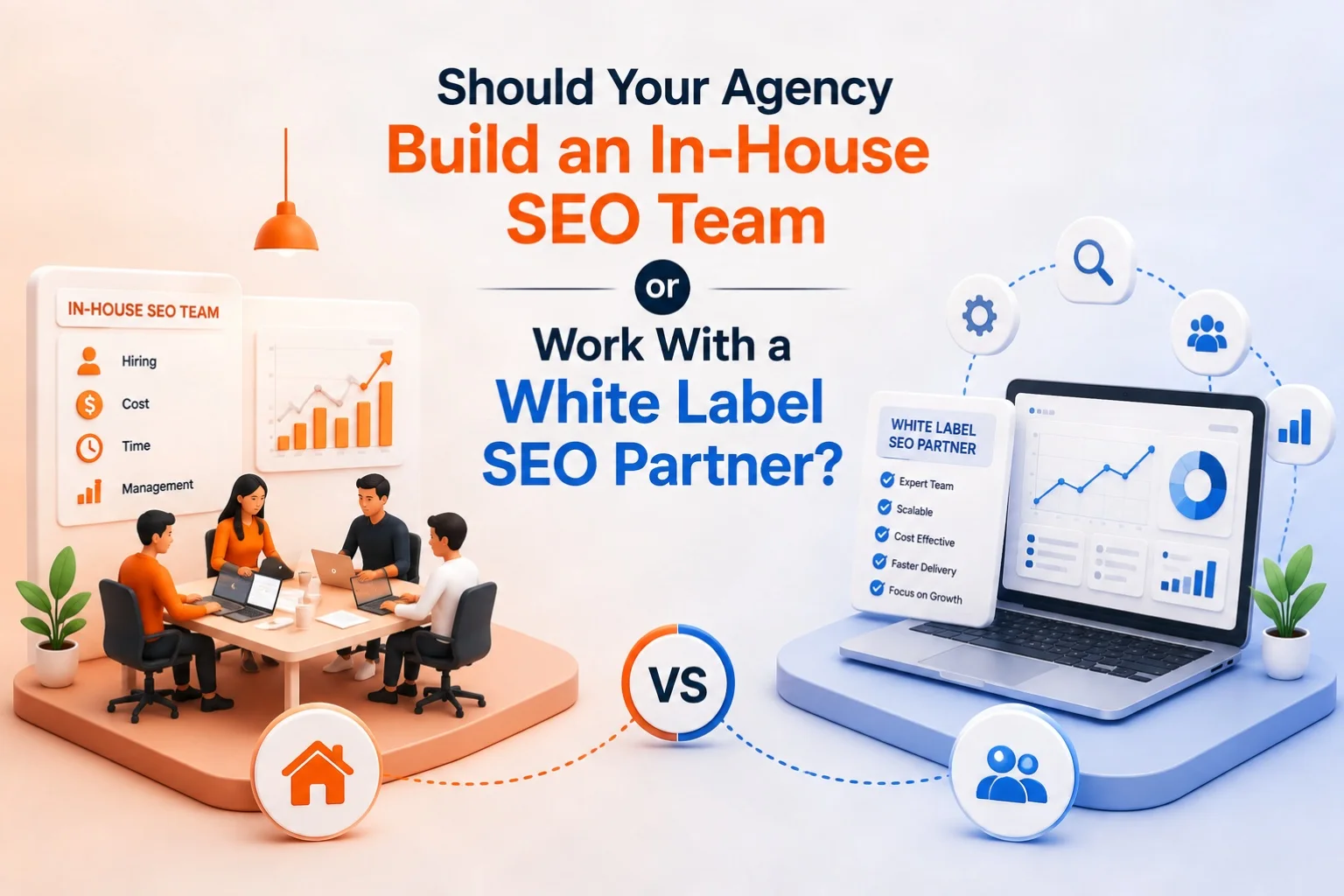
An in house SEO team gives you direct control over quality, and caps expertise at the skills you can afford to hire
A white label SEO partner gives you access to full specialist teams (technical SEO, content, link building, GEO, AEO) without building a department
Quality depends on the partner you choose. Bad hires and bad partners both destroy client retention
Building a 3 person in house SEO team in the US costs $280K to $380K per year. White label SEO packages start at $249 per month per client account, with agencies earning 40 to 60% gross margins
Large agencies often outsource specific parts like link building or content production. Small and mid size agencies can outsource the entire SEO function from strategy to execution
Modern white label SEO in 2026 treats GEO (Generative Engine Optimization) and AEO (AI Answer Engine Optimization) as standard practice. Tactics from 2020 have fallen behind
The right model depends on your client volume, revenue stage, and what your agency is actually best at
We had a call last month with an agency owner in New Jersey. Four people on the team. Good at Google Ads, solid at web design, and starting to get more clients asking about SEO. He told us, “We keep saying yes to SEO projects, and then we scramble to figure out how to deliver them.”
That conversation happens more often than you would think. We hear versions of it every week from agency owners at different stages.
Some are just getting started. They want to offer SEO as a service from day one, and they have no plans to hire an SEO team. They would rather focus on sales and client relationships and let a white label SEO partner handle the actual work behind their brand. The agency sells, supports, and keeps the margin. The partner does the execution and stays invisible.
Others already have a small team handling SEO, and it works up to a point. As the client list grows, certain pieces get too expensive or too specialized to keep in house. Link building that needs publisher relationships across 30 verticals is one common breaking point. So they outsource those specific pieces and keep the strategy work internal.
And then there are agencies with a full in house department that is running well. They have enough volume, enough revenue, and enough team depth to justify the overhead.
All three of these are valid models. The question is which one fits where you are right now and where you want to be in 12 months. In this post, we break it down honestly. We start with what matters most, the quality of the work itself, and then we get into the cost, the hybrid setups, and how AI powered SEO is changing the picture in 2026.
The Case for Building an In House SEO Team
Where In House Wins
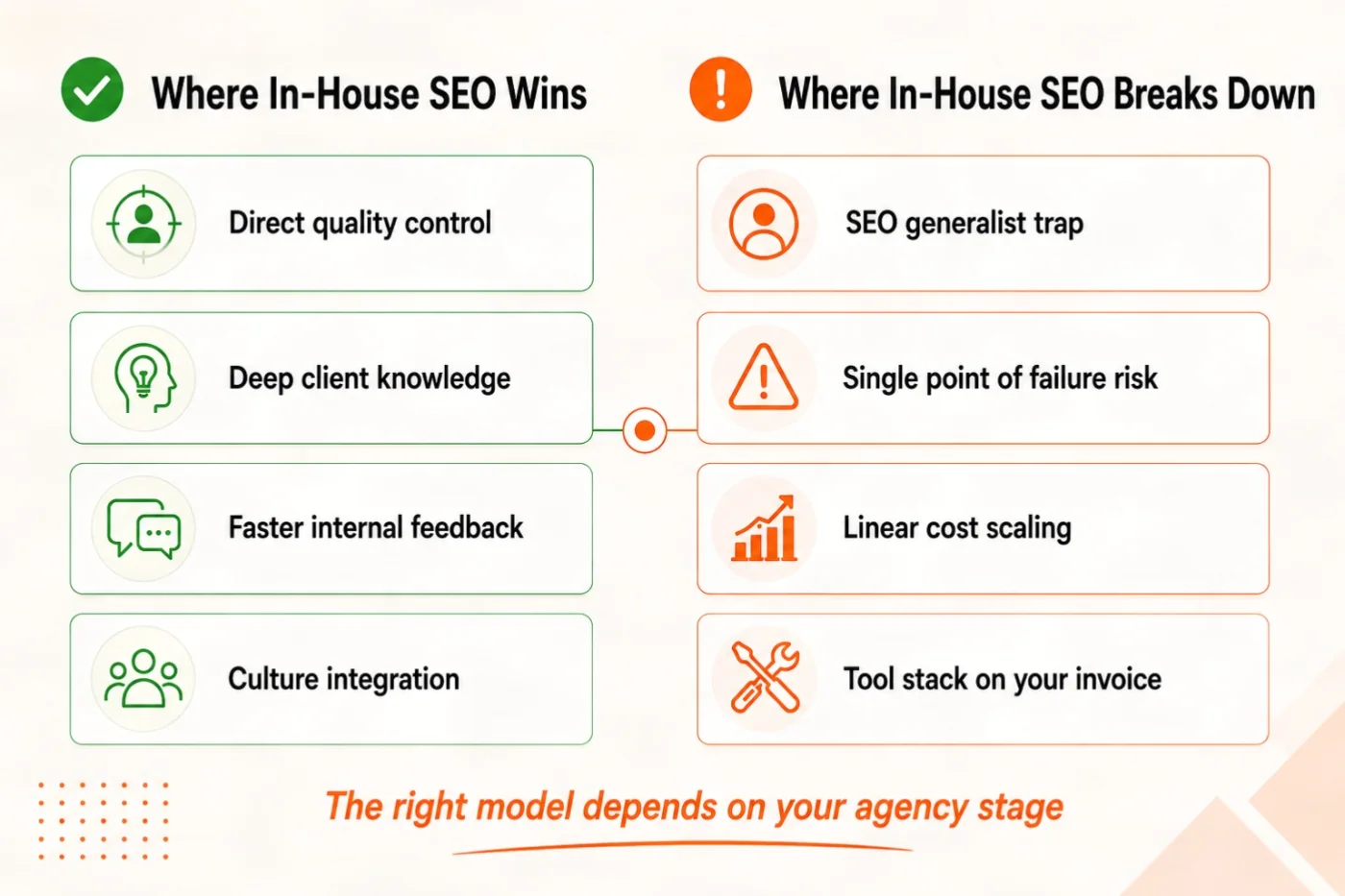
If you have ever worked with an outside vendor and thought, “I wish I could just do this myself,” that feeling is the core argument for going in house. You control the process. You pick the tools. You decide who works on which client and how the work gets reviewed. There is no handoff delay, no ticket queue.
Your team absorbs your agency culture over time. They learn your clients deeply. They pick up on things that do not show up in a brief, like a client who hates bullet points in reports or a business owner who tracks only phone calls.
Institutional knowledge stays with you. When a team member grows inside your agency for two or three years, they carry context about every client they have touched.
Internal feedback loops are faster. If something needs to change, you walk over to someone’s desk or jump on a quick call.
Where In House Breaks Down
Here is what we see happen a lot. An agency hires one SEO person and expects them to cover technical audits, content strategy, link building, local SEO, and monthly reporting for 10 clients. That is five different specialties in one role. Even a talented person is going to be strong in two or three of those and weaker in the rest. And the areas where they are weaker tend to be the ones the client notices first.
If that person quits, you lose the delivery capacity and the client knowledge on the same day. Backfilling takes 60 to 90 days. During that gap, work quality drops and clients notice.
SEO changes faster than most agencies can train for. Google released multiple core updates through August 2026 alone. AI Overviews now appear in roughly 30% of informational queries. GEO and AEO are real disciplines now. Calling them buzzwords is a 2022 read that costs client rankings. An isolated team of one or two people working on 10 accounts falls behind faster than a team of 20 specialists working across hundreds of campaigns.
Scaling is linear. Every new client adds proportional workload. Costs rise account by account with no dilution. And your tool set (Ahrefs, Semrush, Screaming Frog, schema generators, AEO tracking platforms) sits on your invoice.
Where in house SEO wins and where it breaks down for growing agencies.
The Case for Working With a White Label SEO Partner
Where White Label Wins on Quality
Think about what it would cost to hire a technical SEO specialist, a content strategist, a link builder, a local SEO manager, and a GEO/AEO analyst. That is five salaries, five sets of benefits, five people to manage. With a white label SEO provider, you get access to that entire team through a single per account cost. You do not hire any of them individually. They work on your client accounts under your brand, and you pay for the output.
Partners working across 50 to 100 or more accounts see more algorithm behaviors, more recovery scenarios, and more edge cases than a team working on 10. That accumulated experience translates directly into better recommendations for your clients.
Your agency stays focused on what it does best. If you are great at sales, client management, and strategy, you keep doing that. The partner handles execution. If you are starting a new agency and want to offer SEO from day one without hiring anyone, a white label partner makes that possible. You sell, you support, the partner delivers under your brand.
In 2026, the best white label SEO services for agencies include GEO and AEO as standard. That means your clients get visibility tracking across Google AI Overviews, ChatGPT search, Perplexity, and Gemini. Most in house teams do not have this capability yet because the tools and processes are still new.
Where White Label Has Risk
The biggest concern agencies have, and it is a fair one, is that you are trusting someone else with your client’s results. Your client does not know the partner exists. If something goes wrong, they are looking at your agency while the partner stays invisible, which is why working with a good provider is very important.
There is also a communication handoff to manage. Your team needs to pass clear briefs and feedback to the fulfillment team. When that handoff is sloppy, the output suffers. It takes a few weeks to get the rhythm right with any new partner.
And the quality range across providers is wide. A good white label partner produces work that keeps clients renewing for years. A bad one produces generic, templated output that clients see through quickly. The partner you choose matters more than the model itself.
What Separates a Good Partner from a Bad One
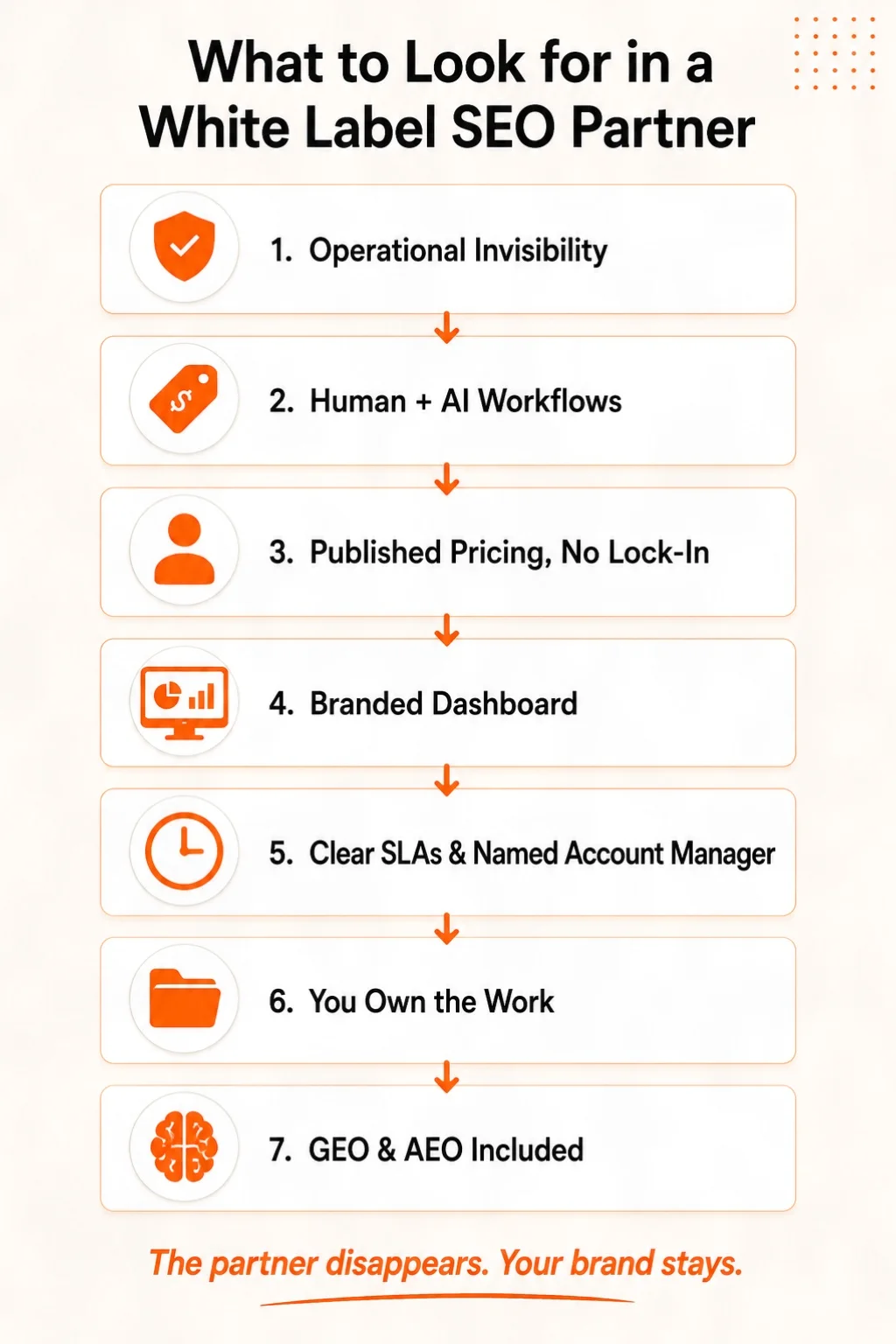
Operational invisibility. Your brand on everything, NDA signed before anyone touches your client’s data
Human strategists steering AI workflows, with automation kept in a support role
Published pricing with no long term contracts
A branded dashboard your clients log into at your own domain
Clear SLAs with documented turnaround times and a named account manager
You own the work if you leave the partnership. Content, audits, keyword research, link assets, everything
GEO and AEO included in standard campaigns at no extra charge
Seven things to look for before you sign with a white label SEO provider.
The Real Cost of Building an In House SEO Team
US Salary Breakdown
Here is what it actually costs to staff a capable in house SEO team in the United States. These are 2026 figures from ZipRecruiter and Glassdoor.
Role
US Salary Range (Annual)
Source
SEO Specialist
$67,000 to $75,000
ZipRecruiter 2026
Content Writer/Strategist
$50,000 to $65,000
Glassdoor 2026
Link Building Specialist
$55,000 to $70,000
Glassdoor 2026
SEO Manager (Senior)
$85,000 to $110,000
ZipRecruiter 2026
European Salary Comparison
Agencies serving European clients or considering nearshore options will see different numbers. These are approximate annual figures converted to USD.
Role
UK (GBP to USD)
Germany (EUR to USD)
Netherlands (EUR to USD)
SEO Specialist
$52,000 to $65,000
$50,000 to $62,000
$48,000 to $60,000
Content Writer
$42,000 to $55,000
$40,000 to $52,000
$38,000 to $50,000
SEO Manager
$72,000 to $95,000
$68,000 to $88,000
$65,000 to $85,000
The Costs Nobody Talks About
Salaries are only the starting point. The real number is higher.
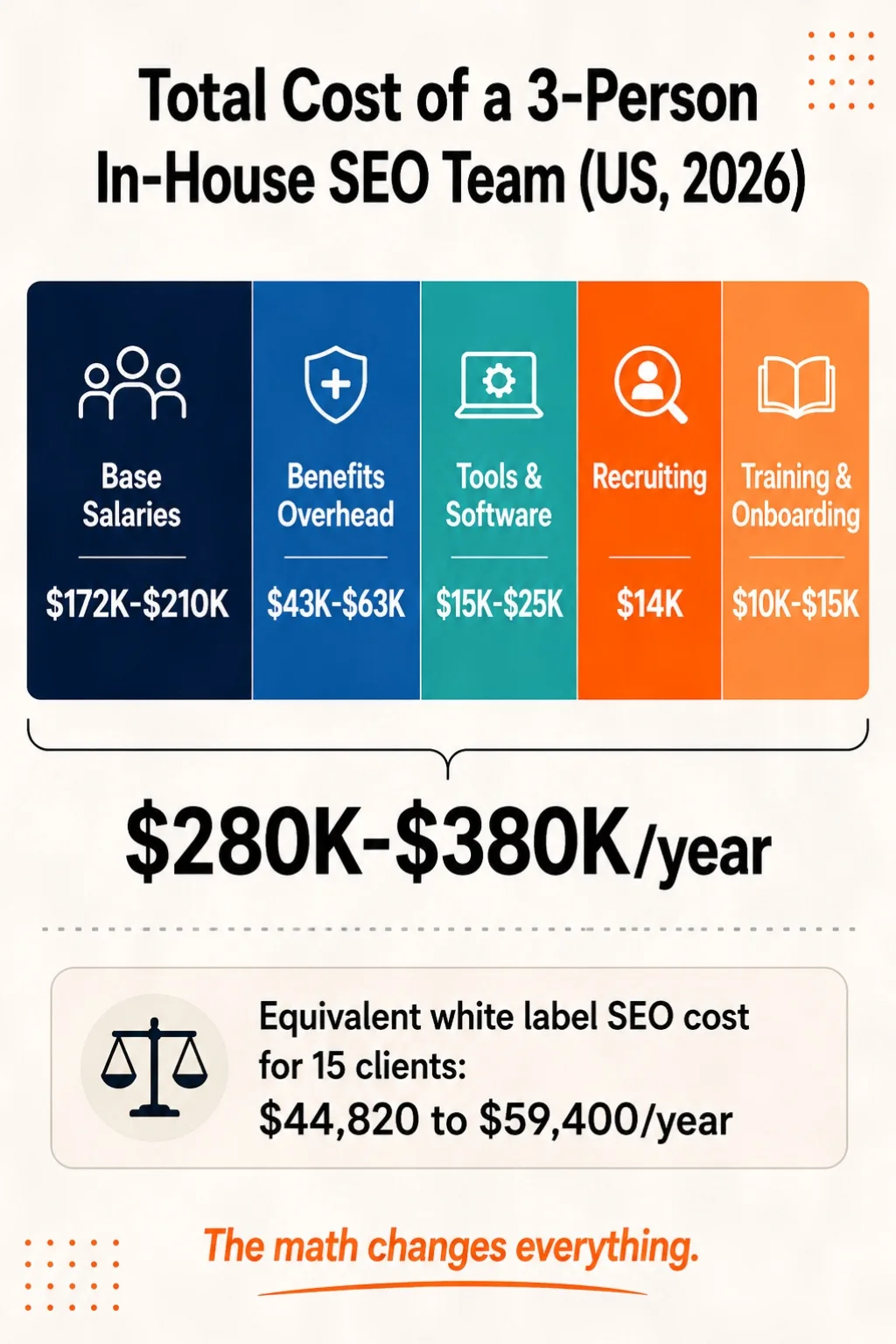
Tools. $15,000 to $25,000 per year. Ahrefs or Semrush alone runs $200 to $500 per month. Add Screaming Frog, schema tools, AEO tracking platforms, and reporting dashboards
Recruiting. $4,700 per hire on average
Onboarding. 60 to 90 days before a new hire is fully productive. During that time, you are paying full salary for partial output
Benefits overhead. 25% to 30% on top of base salary for health insurance, PTO, and payroll taxes
Training. SEO changes constantly. Your team needs ongoing education to stay current with algorithm updates, GEO strategies, and AEO best practices
Total realistic cost for a 3 person in house team: $280,000 to $380,000 per year. That is before anyone takes a sick day, goes on parental leave, or quits and needs replacing.
The real annual cost of an in house SEO team goes well beyond salaries.
What a White Label SEO Partner Actually Costs
How White Label SEO Pricing Works
The model is simple. You buy SEO services at wholesale from the provider. You sell them to your clients at retail. You keep the margin. The provider does all the work under your brand. Your client never knows the provider exists.
Most white label SEO packages use monthly retainers tiered by scope. Local SEO for a single location business costs less than national SEO for a multi region company. The scope drives the price. Flat fees do not fit this model.
Real Pricing Tiers
Here is what the actual pricing looks like for a white label SEO services provider in India. These are Clixlogix’s published rates.
Tier
Account Volume
Cost Per Account/Month
What Is Included
Per Account
1+ accounts
$249
Pay per campaign. Floor pricing on every service. Cancel any time. Tools included on our side.
Starting at $2,499/month total (~$125 per account effective)
Reserved team. SLA contracts. API access. Quarterly business reviews.
No setup fees. No long term contracts. You set your own retail price and keep the margin.
The Margin Math
This is the part that makes agency owners pay attention.
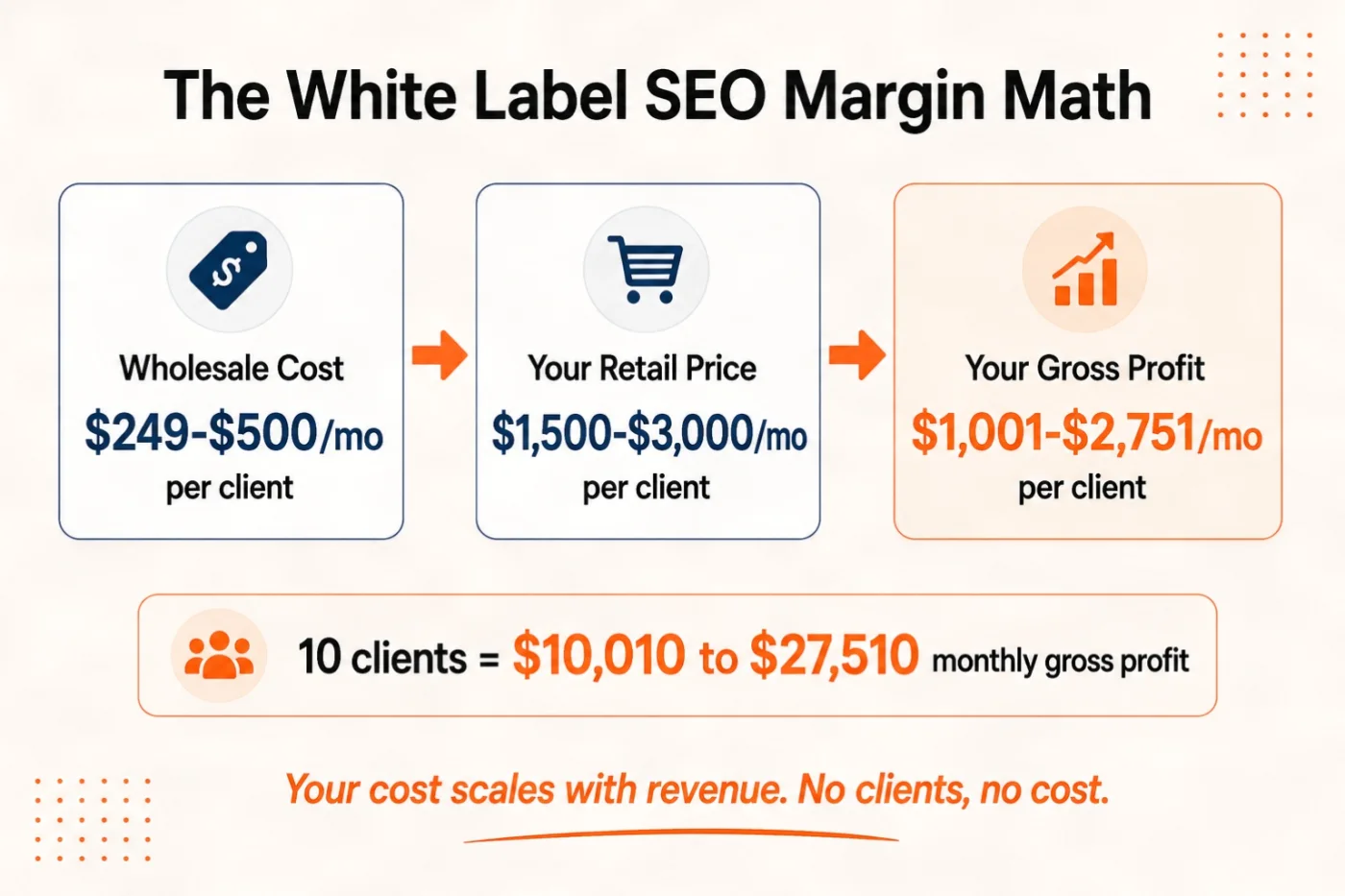
If you charge your clients $1,500 to $3,000 per month for SEO and your wholesale cost is $249 to $500, your gross margins are 50% to 83%. At 10 client accounts, that looks like this.
Metric
Low End
High End
Monthly client revenue (10 accounts)
$15,000
$30,000
Monthly wholesale cost
$2,490
$5,000
Monthly gross profit
$12,510
$25,000
Gross margin
83%
83%
Compare that to the in house model where your costs are fixed at $280K to $380K per year regardless of how many clients you have. With white label, cost scales with revenue. No clients, no cost. 30 clients, you pay for 30 accounts and your margin improves because the per account cost drops at volume.
How the margin math works when you use a white label SEO partner.
Side by Side: In House SEO vs White Label SEO
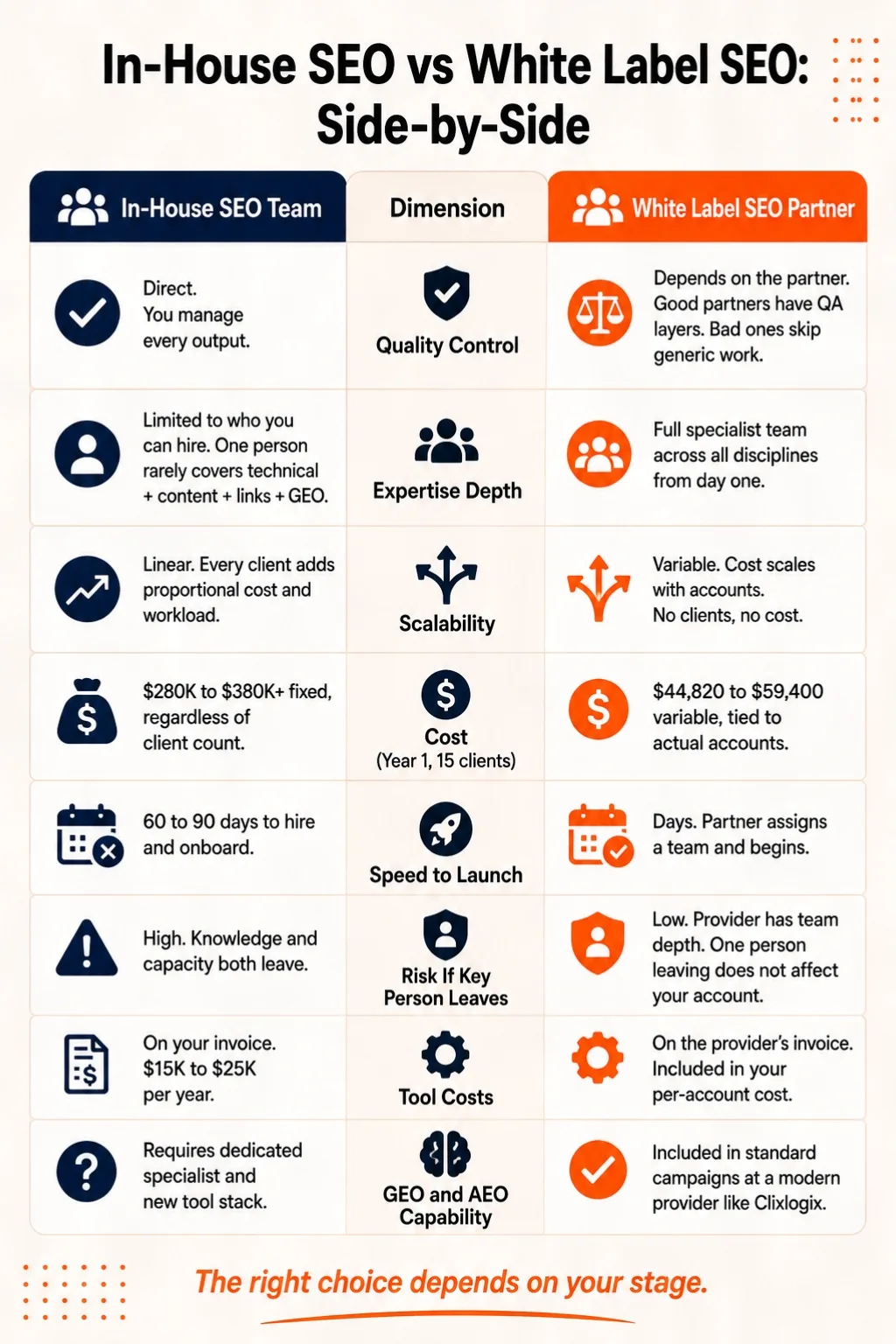
Here is how the two models compare across the dimensions that actually matter to agency owners.
Dimension
In House SEO Team
White Label SEO Partner
Quality control
Direct. You manage every output.
Depends on the partner. Good partners run QA reviews. Bad ones ship generic work.
Expertise depth
Limited to who you can hire. One person rarely covers technical, content, links, and GEO.
Full specialist team across all disciplines from day one.
Scalability
Linear. Every client adds proportional cost and workload.
Variable. Cost scales with accounts. No clients, no cost.
Cost (Year 1, 15 clients)
$280K to $380K+ fixed, regardless of client count.
$44,820 to $59,400 variable, tied to actual accounts.
Speed to launch
60 to 90 days to hire and onboard.
Days. Partner assigns a team and begins.
Risk if key person leaves
High. Knowledge and capacity both leave.
Low. Provider has team depth. One person leaving does not affect your account.
Tool costs
On your invoice. $15K to $25K per year.
On the provider’s invoice. Included in your per account cost.
GEO and AEO capability
Requires dedicated specialist and additional tooling.
Included in standard campaigns at a modern provider like Clixlogix.
The honest verdict is straightforward. In house wins on direct control and culture integration. White label wins on cost, speed, expertise breadth, scalability, and access to modern SEO disciplines like GEO and AEO.
How in house and white label SEO compare across quality, cost, scalability, and more.
The Hybrid Model: Why Big Agencies Outsource Parts
One thing worth knowing is that white label SEO extends well beyond small agencies. Some of the largest digital marketing agencies in the US and Europe use the exact same model. They just use it differently.
They keep senior strategists in house. These are the people who set the direction, run client calls, review performance, and make the judgment calls. They outsource the execution heavy work to a white label partner.
Common services agencies outsource while keeping strategy internal:
Link building at scale (requires publisher relationships across dozens of verticals)
Content production for 15 to 30 clients simultaneously
Technical audits on complex sites (JavaScript rendering, faceted navigation, large ecommerce catalogs)
GEO and AEO tracking across Google AI Overviews, ChatGPT, Perplexity, and Gemini
Local SEO services for multi location clients where each location needs its own Google Business Profile management, citations, and local content
This gives them strategic control without the linear cost of building a full department. A senior strategist at $100K per year directing a white label team that costs $199 per account per month produces better results than four in house generalists at $70K each trying to do everything.
Clixlogix handles both models. We can run the entire SEO operation from strategy to execution, or we can take on specific service lines while your internal team handles the rest.
How Agencies Are Using AI Powered White Label SEO in 2026
SEO looks very different in 2026 compared to even a couple of years ago. Google AI Overviews show up in a growing share of search results. Clients are asking about ChatGPT visibility, Perplexity citations, and whether their business shows up when someone asks an AI a question. If your white label provider is still working from a 2020 playbook, that gap is going to show up in your client results.
The agencies winning right now have two things working together. A white label SEO partner handling fulfillment, and agentic AI workflows handling the operational overhead that used to eat their margins.
AI chatbot on your agency website that qualifies inbound leads in under 2 minutes and feeds scored leads into your CRM
Automated white labeled SEO audits generated in 12 minutes, replacing 4 to 6 hours of manual work, branded with your agency logo
Proposal builder that takes the audit data and meeting transcript, then drafts a margin protected proposal your team reviews in 30 minutes
Content and production quality workflows:
AI video creation from blog posts (turns written content into branded short form video for social channels)
Local content strategy agent that scans local news, events, and Google Trends to generate content ideas with genuine local relevance
Brand voice review agent that scores every piece of content against the client’s voice profile before it ships
Social media content auto generation from published blog posts across LinkedIn, Instagram, X, and Facebook
Intelligence and reporting workflows:
Partner performance scorecards that track your white label provider’s delivery timelines, quality scores, and SEO impact monthly
Competitor monitoring that runs weekly scans and monthly deep analysis, so you know when a client’s competitor makes a move before the ranking damage is done
Automated monthly digest emails and quarterly interactive business impact reports that translate SEO into money language the business owner actually understands
The math for a 15 client agency running all 10 workflows works out to 127 to 180 hours of existing work displaced per month, plus 64 to 111 hours of new capability added. That is the difference between an agency stuck at 15 clients and one scaling to 30 without doubling headcount.
Want to See the Margin Math for Your Agency?
We run a free white label audit under your brand within 12 hours. No long term contracts. No setup fee. Your brand on the report.
A white label SEO partner is a company that delivers SEO services on behalf of your agency, under your brand. Your client never knows the partner exists. Every report, dashboard, email, and deliverable carries your agency’s name and logo. You own the client relationship, set the retail price, and keep the margin. The partner handles execution work such as keyword research, content production, link building, technical audits, local SEO, GEO, and AEO. It is different from hiring a freelancer. A freelancer covers one specialty. A white label partner gives you an entire team of specialists.
The main benefits are cost efficiency, access to specialist expertise, and the ability to scale without hiring. You can offer full service SEO, including modern disciplines like GEO and AEO, from day one. Your costs are variable, tied to the number of client accounts. In house salaries stay fixed regardless of client count. You can add or remove accounts without restructuring your team. And you can focus your time on sales, strategy, and client relationships while delegating production work.
A capable 3 person in house SEO team in the US costs $280,000 to $380,000 per year when you include salaries, benefits, tools, recruiting, and training. An SEO reseller like Clixlogix starts at $249 per account per month, dropping to $199 at 5 or more accounts and roughly $125 per account effective at 20 or more on reserved capacity. For a 15 client agency, the in house model costs $280K to $380K fixed. The white label model costs roughly $44,820 to $59,400 variable. The gap is significant, especially for agencies in their first few years.
You sign up with a white label SEO provider. They assign a team to your accounts. You send them client briefs (or they help build the strategy). They deliver the work such as audits, content, link building, technical fixes, and reporting. Everything is branded with your agency’s name. You send the deliverables to your client as if your team produced them. The provider stays invisible. Pricing is typically per account per month, with volume discounts as you add more clients.
Yes, and many do. Large agencies often keep senior strategists in house for planning, client communication, and quality oversight. They outsource execution work like link building, content production at scale, technical audits, and GEO/AEO tracking to a white label partner. This hybrid model gives them strategic control without the full cost of building every specialty in house. The partner fills the gaps. The agency keeps the relationship.
AI has changed what is possible at scale. Agentic workflows now handle work that used to take hours of manual effort, from presale audits in 12 minutes to content briefs with local relevance, brand voice scoring, competitor monitoring, and client reporting in business language. White label providers running these AI workflows deliver faster, at lower cost, and with more consistency than most in house teams can match. The gap is widening because the tooling and processes required to run AI powered SEO at scale cost more to build internally than to access through a partner.
Five things matter most. Genuine operational invisibility comes first, which means an NDA before access, your brand on every deliverable, and the provider never appearing in client facing materials. Transparent pricing with published floors and no long term contracts sits alongside that. Human strategists must guide the AI workflows, keeping fully automated content mills out of the pipeline. Your clients should log into a branded dashboard under your agency’s own domain with live task visibility. Clear SLAs and a named account manager close the list. Also confirm the provider includes GEO and AEO in standard campaigns, because any provider still running SEO playbooks from 2020 will cost you clients in 2026.
Share this blog
Summarise this with AIOpen this article in your AI assistant with a summary prompt ready to send.
Abdullah Habib is a digital marketing specialist with expertise in SEO, content marketing, social media, digital advertising, and data analysis. He excels in creating strategic, data-driven campaigns that boost organic traffic, enhance brand visibility, and drive growth for clients.