TL;DR
- Zoho MCP gives Claude authenticated tools for reading and acting on Zoho CRM data.
- Consistent answers also require agreed business definitions, verified fields, record relationships, source selection rules and tests.
- The same word can point to several fields across CRM, Creator, Books, Desk and Analytics.
- Large queries need filtering inside the source. Sending pages of records into the conversation increases latency, cost and answer drift.
- Live CRM data and synchronized Analytics data serve different questions. A reliable system routes each request to the source suited to the question.
- The venture capital firm described near the end reached 1 to 3 second company profiles and 1 to 2 second live searches after adding governed query services.
When the first answer appears, the room moves quickly. Claude finds the account. The contact record is correct. A follow up question returns the expected deal. The connection works, and the team starts listing every report it wants to replace.
Then someone asks a question that sounds simple. "What is current revenue across active customers?"
CRM has the deal amount. Books has the invoice total. Creator has a monthly revenue field. Analytics has a synchronized summary. Claude can retrieve every value. Each one belongs to a real operating process. The connection has no business rule that identifies which value governs this question. The implementation has reached its real test. A reliable answer now depends on definitions, record relationships, source selection rules and verification. Revenue is one example. The same issue appears with active, current, latest, closed and customer. It appears in every industry that has adapted Zoho around the way the business operates.
These problems appear inside a single application and multiply across several. A team running only Zoho CRM meets most of them. A team running the wider suite meets all of them.
The first response proves access. The revenue question defines the work required for dependable answers.
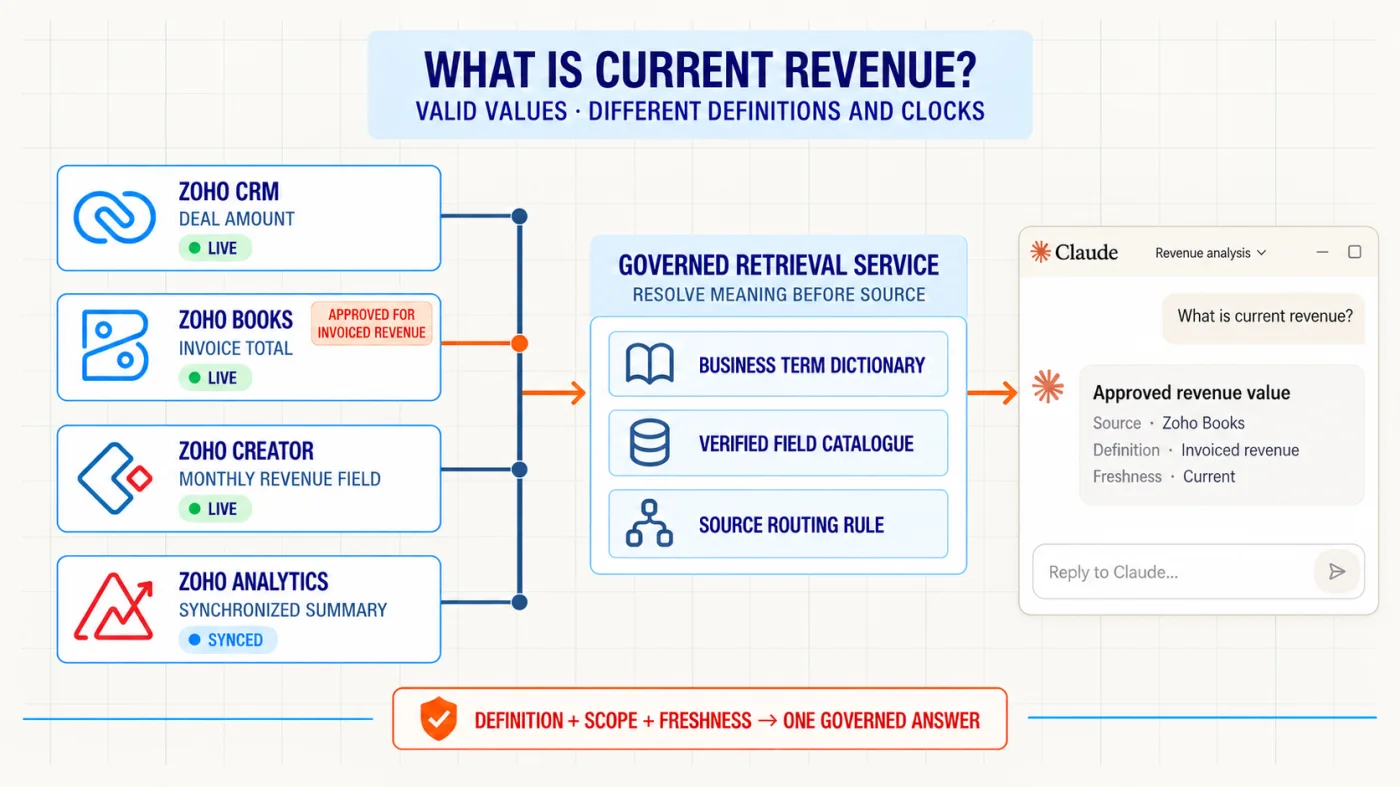
Fig 1 - Zoho apps can hold valid measures for different definitions and clocks. Governance defines the question before selecting Books as the approved source for invoiced revenue.
Sales teams have several amount fields. Clinic groups have several definitions of an active patient. Property businesses hold status across properties, units and leases. Service firms track booked revenue and billed revenue. Support teams split account health across CRM and Desk. Zoho MCP solves the connection to the tools. Production use requires a governed method for deciding what to query, how to join it, where to filter it and how to verify the result.
Where a Working Connection Stops Being Enough
Zoho CRM MCP servers give Claude authenticated access to records, modules and field schemas. Zoho states that an MCP server cannot operate beyond the permissions of the user who authenticates, so user and role design is part of the deployment from the first day. Our Zoho MCP and Claude setup guide covers the connection itself, the server types and the actions available.
A connected setup answers a large class of questions well. One record, one condition, one period, where the field that counts is obvious, the records sit in one app and no historical values need interpreting.
This article is about the questions that lose those 3 properties. The rest of it begins after the tools are working.
5 Signs Your Zoho MCP Setup Is Ready for the Next Layer
If 2 or more of these sound familiar, the team has outgrown raw access.
- The same question gets different answers - Rephrase it and Claude picks a different field, a different date or a different definition of revenue.
- Simple questions take minutes - Claude reads hundreds or thousands of records page by page to find the handful that match.
- Answers span several apps - A question about one company needs data from CRM, Creator and Analytics, and Claude makes a long chain of calls to assemble it.
- Your data carries history - Old and new field layouts sit side by side, dropdown values have several spellings, and some summary fields disagree with the detailed records.
- People check the answers by hand - The team double checks the numbers in Zoho before using them, which cancels most of the time saved.
Why Claude Returns Different Answers From Zoho MCP Data
1. Business terms point to several fields
CRM systems accumulate fields as the business changes. A term such as revenue may refer to a deal amount, expected revenue, annual revenue on an account, a custom monthly figure, an invoice total or a calculated Analytics column. Claude sees field names, descriptions and values. It does not inherit the private decision that tells the finance team which field governs a board report. A request for revenue can therefore use a plausible field and return a number that belongs to another reporting context.
Revenue is simply the most expensive example. The same ambiguity sits under almost every word a business uses casually in a question, and each one has a defensible reading that produces a different number.
Table 1 - One casual word, several defensible fields inside Zoho.
Reliable answers start with one written definition for each term used in recurring questions. The definition names the field, source, date rule, exclusions and fallback behavior.
Skipping this step produces a pair of answers that are each correct under a different reading, delivered with equal confidence, to 2 people who then disagree in a meeting.
Nobody can tell which figure governs, both get checked by hand, and the time the assistant saved is spent again.
2. One business answer spans several Zoho apps
A company profile may require an Account in CRM, contacts attached to it, invoices in Books, tickets in Desk, project work in Projects and custom operational records in Creator. The apps hold valid parts of the answer. The relationships among those records may use different identifiers and naming conventions. MCP can call more than one tool. The assistant needs a known join path. Company name matching creates errors when names vary, subsidiaries share a parent name or a record was renamed. Stable Zoho record identifiers, external identifiers and verified lookup fields produce safer joins.
The risk sits in joins that return no matched record without an error. A name match that finds nothing returns an empty result, and an empty result reads as a confident zero. A profile assembled that way reads as complete and omits an entire app.
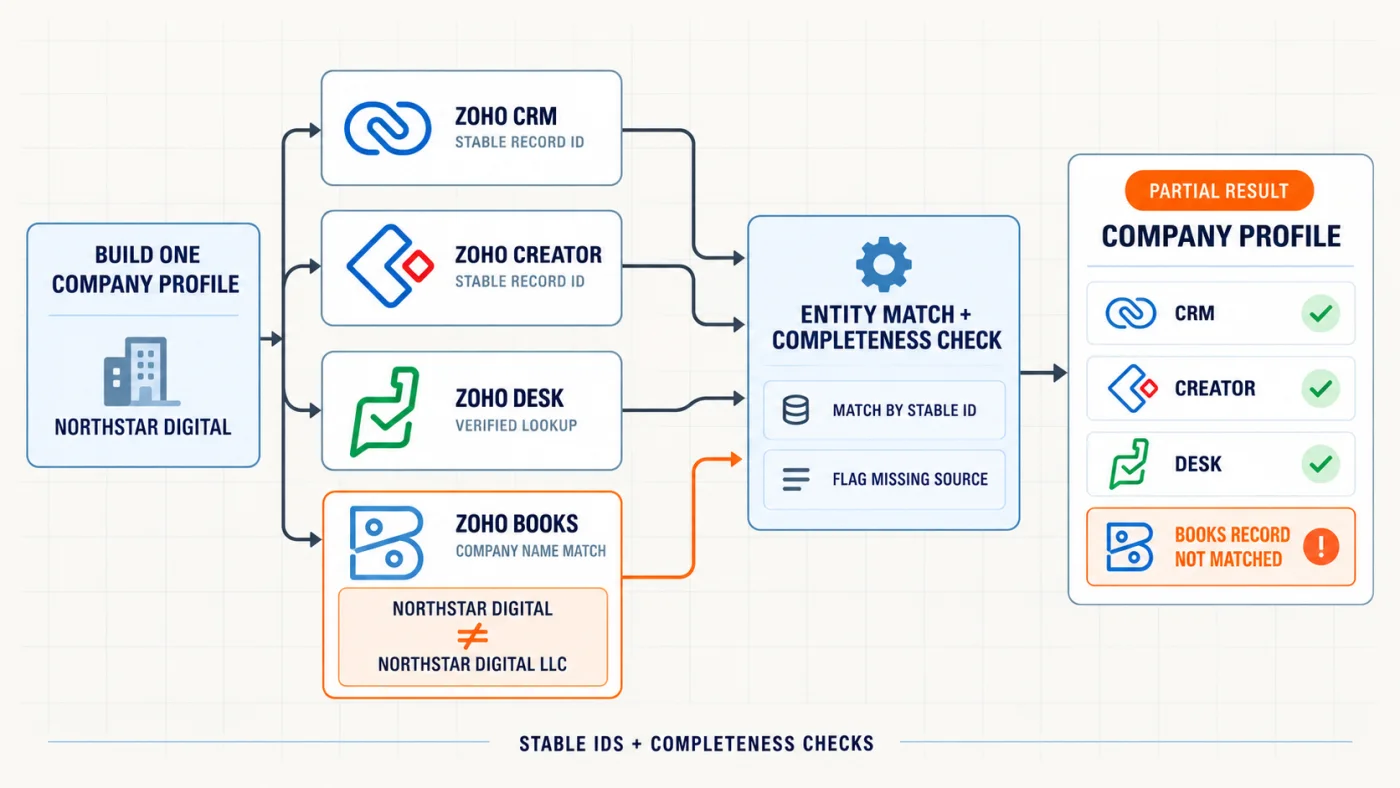
Fig 2 - Stable identifiers complete 3 Zoho joins, while a Books company name mismatch is flagged before the profile can be treated as complete.
3. Historical records keep old schemas alive
Zoho environments rarely begin with a clean schema and stay unchanged. Teams rename fields, replace modules, change dropdown values, import data from another CRM and add custom applications. Old records retain values created under the previous design. An AI assistant may encounter both Enterprise and Ent, 2 status fields with similar names, or an old amount column that stopped receiving updates after a migration. The current field description does not explain every historical value.
A canonical map should document equivalent fields, accepted historical values and periods where no equivalent exists. When a valid comparison cannot be made, the answer should state the boundary. Teams tend to leave the boundary unstated, and stating it is what protects the answer. A query spanning a migration either excludes the older records, which is defensible once declared, or treats a missing value as a non match, which understates every historical total and gives no sign of having done so.
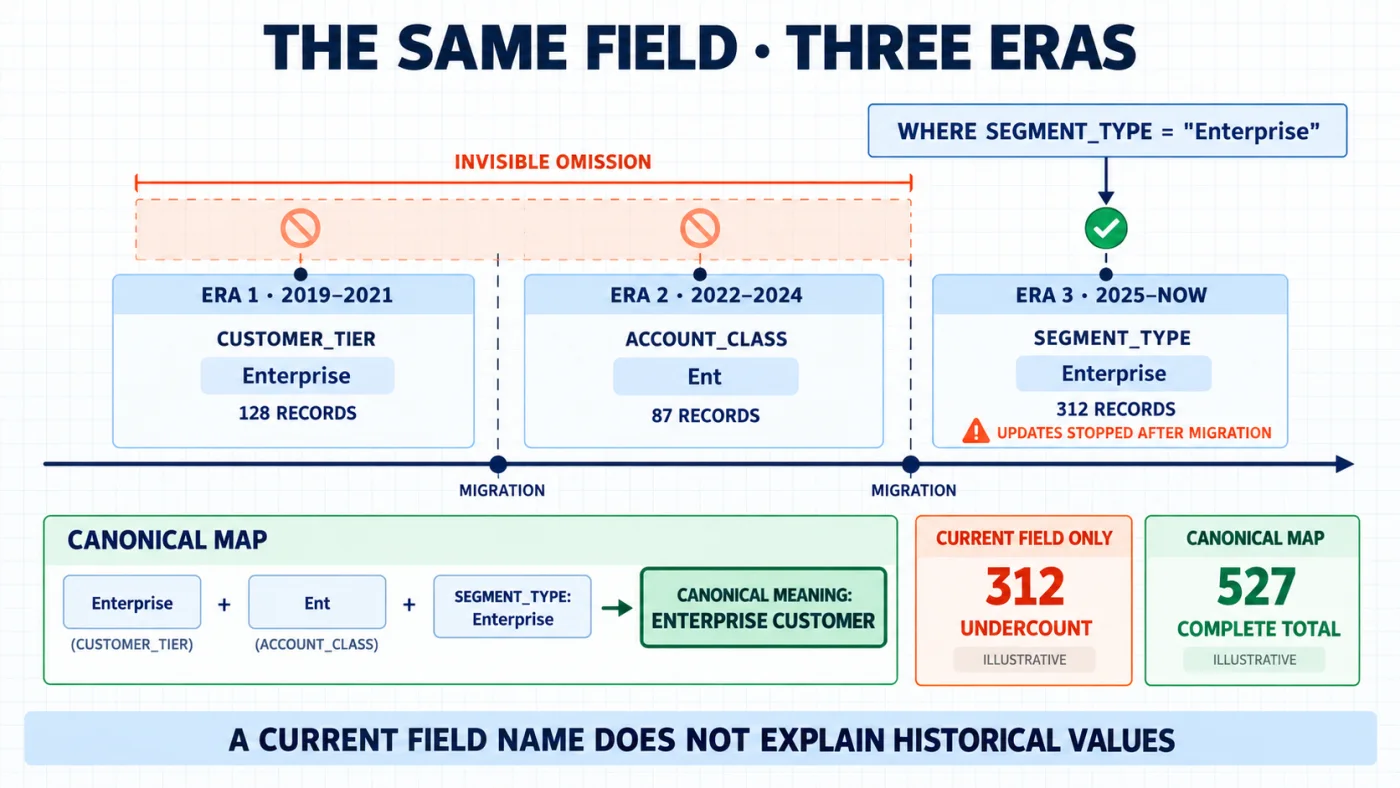
Fig 3 - A current field query matches only the newest schema and returns an illustrative undercount. The canonical map reconciles all 3 eras into the complete total.
4. Query volume changes the job
A request for one account is a record lookup. A request for every account with revenue above a threshold, recent activity and an unresolved support issue is a database query. Zoho CRM Data Insights supports filtering and grouping. Complex retrieval may also use COQL, which supports criteria, related module lookups, sorting, grouping, aggregation and pagination. Filtering inside CRM returns the matching records. Filtering inside the conversation sends more records to the model and asks it to perform database work in text.
The division of labour that follows is straightforward. Each system in the stack should perform the operation it is actually built for, and the model should perform the one it is uniquely good at.
- CRM performs live record filtering and counts
- Books provides accounting records
- Desk provides ticket history
- Creator provides custom application records
- Analytics performs historical joins, calculated views and portfolio wide aggregation
- Claude interprets the request, chooses an approved service and explains the returned result
Moving database work into the conversation carries a measurable cost. On a live portfolio, one pipeline search took 21 tool calls across 4,000 records to return 7 matches. The same search through a query service returned those 7 directly. The bottleneck was the location of the filtering.
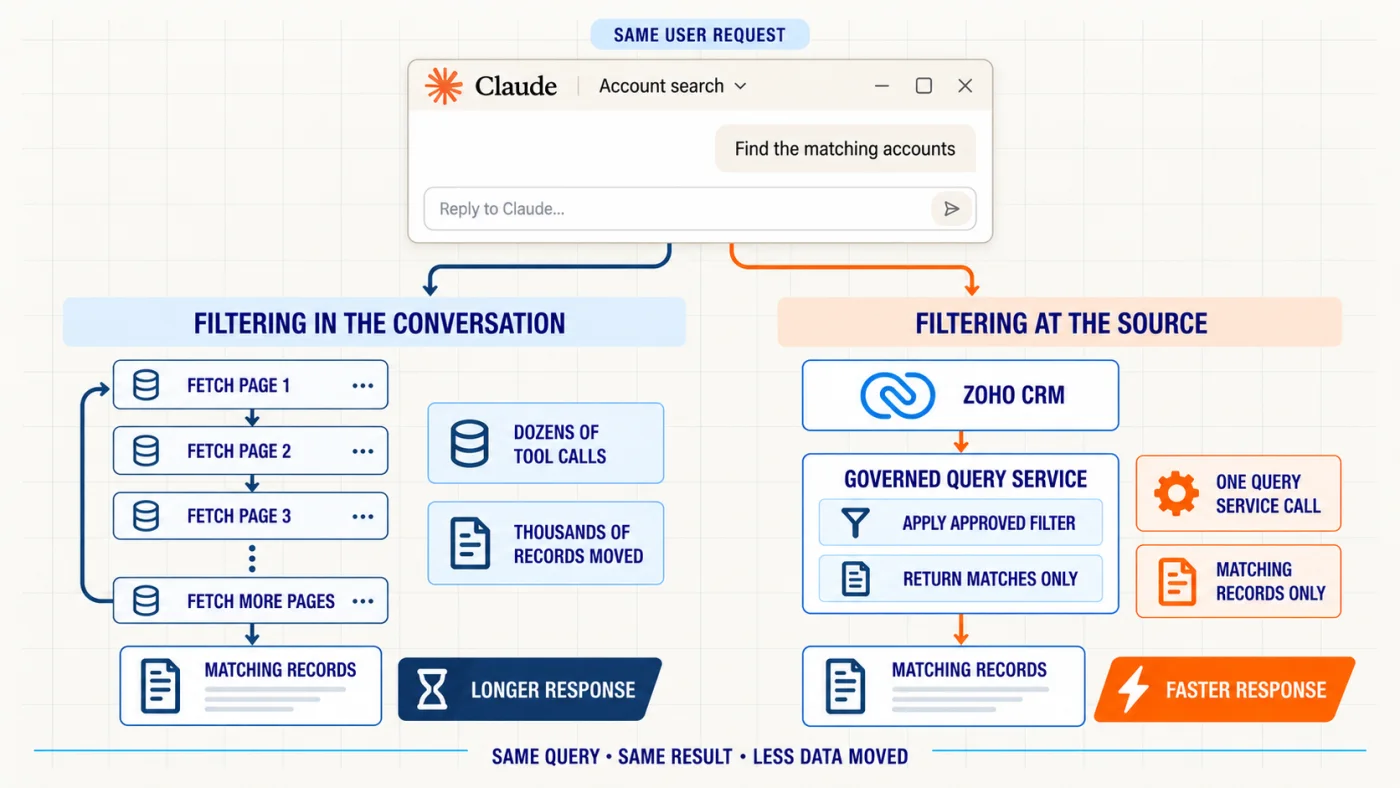
Fig 4 - Both routes begin in Claude. Filtering inside Zoho returns the same matching records with fewer tool calls, less data transfer and a faster response.
5. Live records and synchronized records have different clocks
Zoho Analytics commonly receives data through scheduled synchronization. CRM, Creator, Books and Desk hold the current operational records. A question about an account updated 5 minutes ago needs a live source. A question spanning several years may need an Analytics view built for historical computation. The response should identify the source and its freshness. A user should be able to tell whether an answer came from live CRM data or a synchronized analytical view.
Without that label, the 2 clocks are indistinguishable at the point of use. An answer drawn from a scheduled analytical view can look like one read from a live record. The source label and retrieval time show the difference before anyone acts on the figure.
Zoho Analytics also processes queries as background jobs in a shared queue, so a busy sync or a heavy report can add a wait. Reading CRM and Creator directly for focused lookups keeps that queue off the critical path, and the history questions that stay on Analytics need explicit retry guidance.
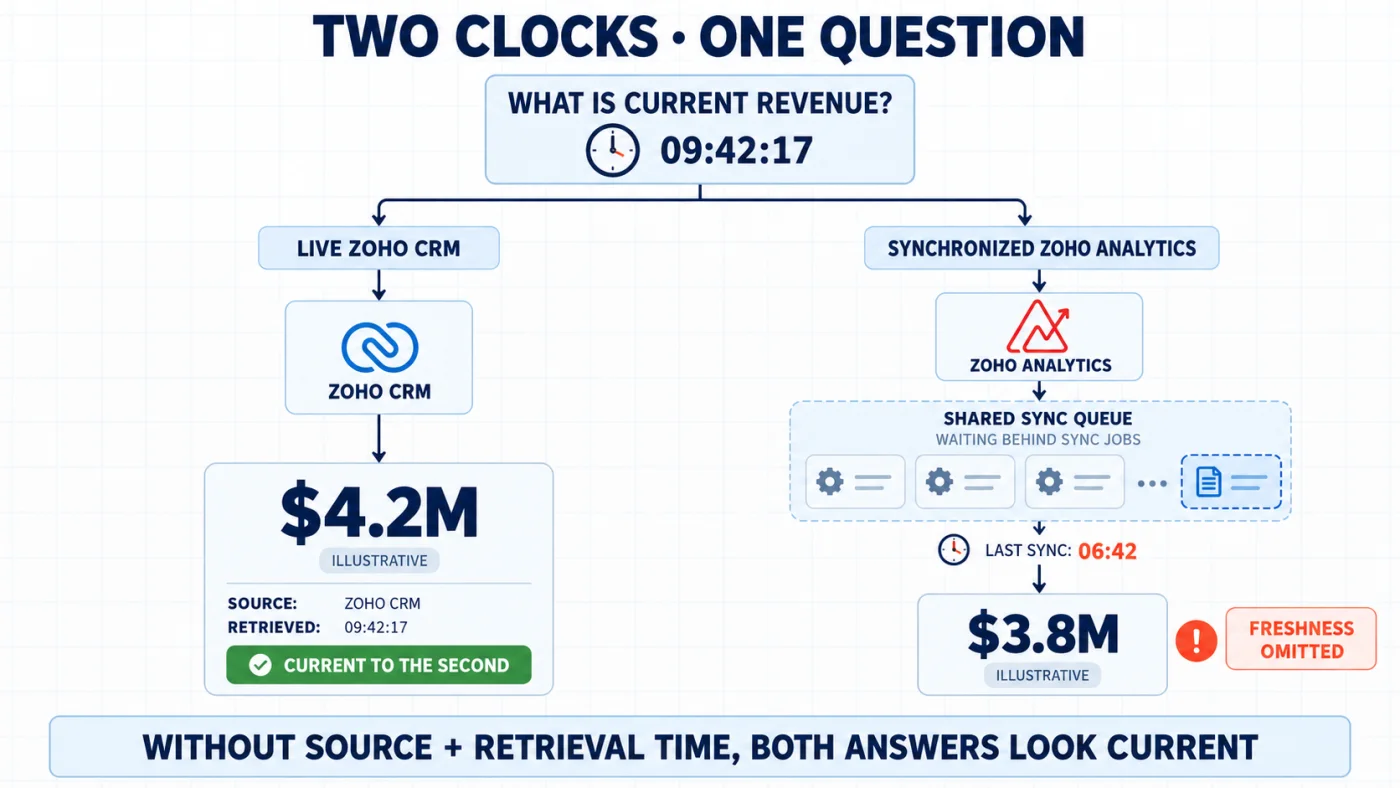
Fig 5 - The same question reaches a live CRM read and a synchronized Analytics view. Source and retrieval time distinguish a current answer from one delayed by synchronization and shared queue timing.
Claude maps a request to the tools and descriptions available in the conversation. A pair of phrasings can lead to different tools when several tools appear suitable. One tool may search CRM. Another may query Analytics. A third may retrieve a prepared summary. Governed tool descriptions reduce this variability. Each service should state the questions it handles, the fields it accepts, the definitions it follows and the situations it rejects.
The rejection clause does as much work as the rest. A service that declines a question outside its range makes that limit visible to the user at the moment it applies. Narrowing what each tool accepts is what removes phrasing as a variable.
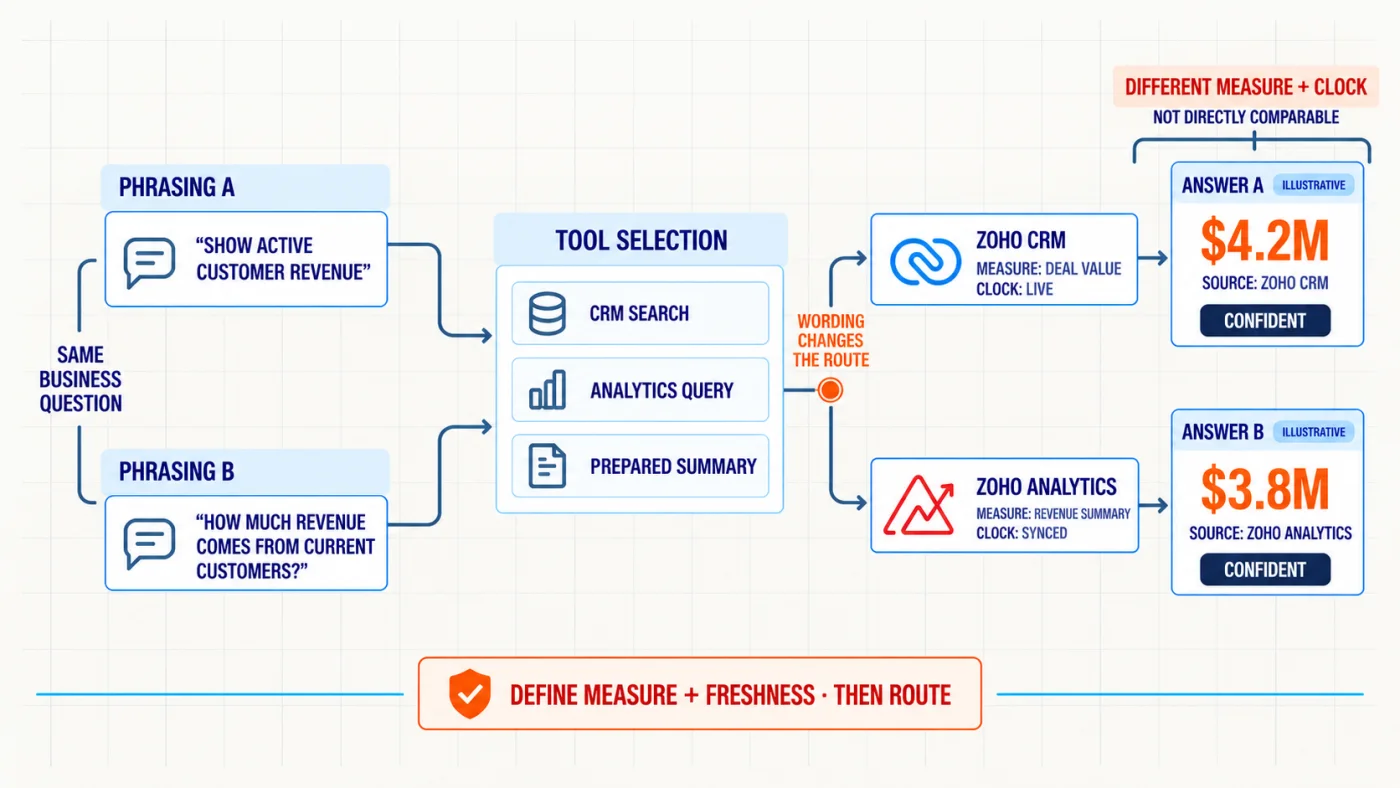
Fig 6 - Equivalent prompts can route to a live deal value or a synchronized revenue summary. Defining the measure and freshness before tool selection keeps wording from changing the route.
How the Same Problem Appears Across Industries
Across industries, teams face the same operating problem with different records. Each team must settle a definition before the answer means anything.
Table 2 - 6 teams, 6 record sets, and one definition each that the business has to settle first.
These definitions belong to the teams that own the numbers. Engineering records the rules and turns them into query behavior. The AI assistant uses that behavior on every request.
Why Project Instructions Lose Control at Scale
Claude project instructions are useful for terminology, tool guidance and response format. They become hard to govern when they carry hundreds of field names, changing dropdown values, complex joins and source selection rules. Instructions are a document, and they describe live systems that change without updating the document. That gap widens on its own.
- Field definitions go out of date after administrators change CRM
- Similar rules appear in several places and drift apart
- A prompt cannot create a missing relationship between records
- A prompt cannot make a large query efficient
- A prompt cannot confirm that the underlying data is complete
- A prompt does not provide a durable request log by itself
Read the list again and the division is clear. The first 2 items are maintenance problems. The remaining 4 sit outside what a prompt can do at any length. An instruction can name the field that counts as revenue. Building a missing relationship between records, and making a scan of thousands of records efficient, both require changes to the system underneath. Stable business guidance can sit in a maintained knowledge source. Structured Zoho queries need additional controls because the answer depends on records, joins, filters and dates.
How to Make Zoho MCP Answers Agree
A reliable Claude AI integration with Zoho usually needs 6 components. They are listed in build order, because each depends on the one before it. Verified fields come first, agreed definitions next, and query services once both exist.
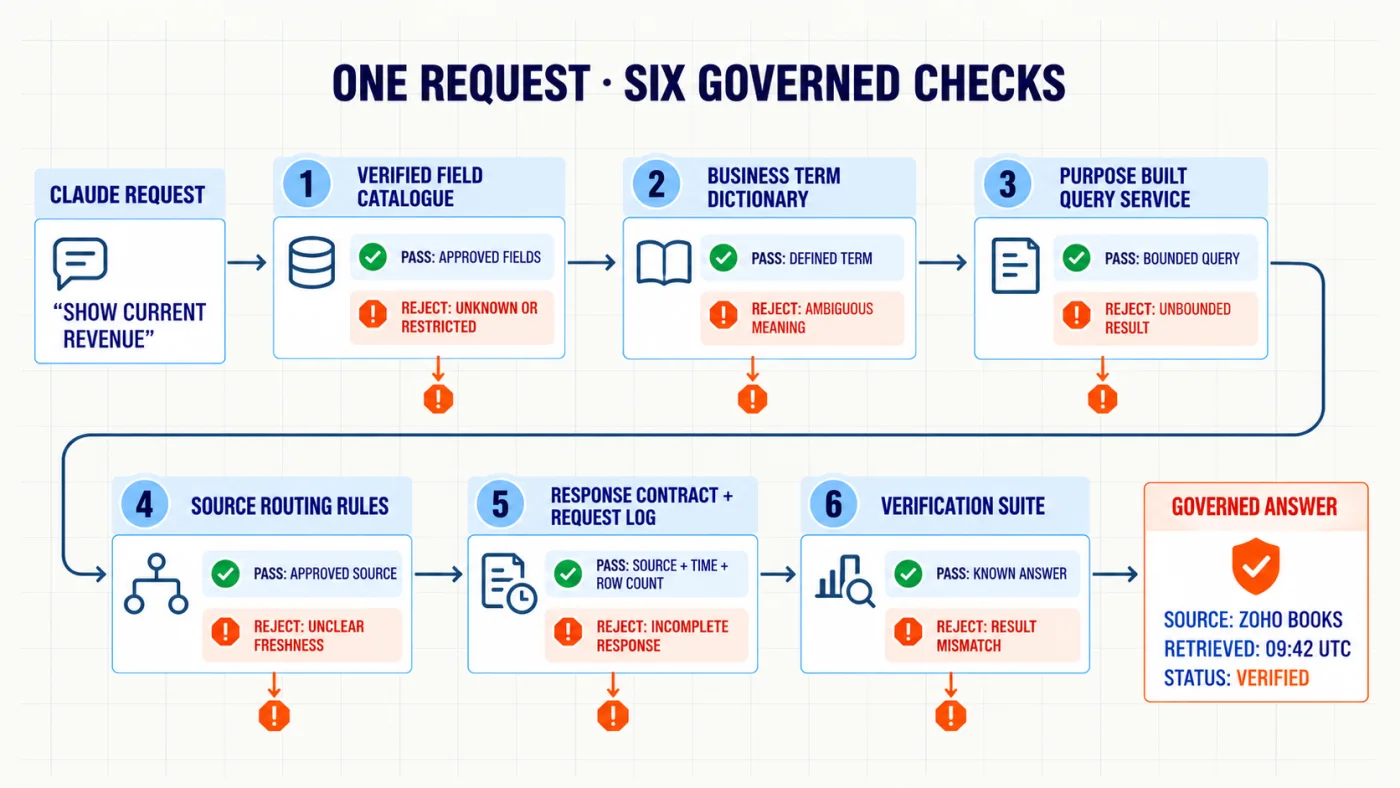
Fig 7 - The 6 governed checks validate the request, reject unsupported conditions and return an answer with its source, retrieval time and verification status.
1. A verified field catalogue
The catalogue records each approved field, its Zoho API name, data type, source module, allowed operators, accepted values and business description. Every entry is checked against the live application. The catalogue should also identify restricted fields. Claude receives only the fields required for the approved questions.
Checking against the live application is the step that cannot be skipped. Documentation describes the intended design. Live application checks confirm the fields available to current questions. On one engagement several hundred field definitions were confirmed, corrected or retired in this pass.
2. A business term dictionary
The dictionary turns terms such as revenue, latest, active and customer into executable rules. Each definition includes its owner, source, date rule, exclusions and fallback. The owner matters. Engineering can identify candidate fields. Finance decides which revenue field governs a finance question. Sales operations decides which stages belong in pipeline. Support leadership decides which ticket conditions require escalation.
3. Purpose built query services
Recurring questions deserve services designed for their result shape. Examples include a company profile, an account risk summary, an invoice search, a contact search and a project profitability view. A query service accepts a small structured request, validates the fields and operators, runs the filter in the source and returns a bounded response. Claude spends its time interpreting the request and explaining the result.
The word bounded carries weight here. A service that can return an unlimited result set recreates the volume problem inside the service, so each one should declare what it returns and refuse requests outside that shape. That constraint is what makes a response time predictable enough to quote. Zoho Catalyst Functions can host these services inside the Zoho environment. Catalyst provides server functions, API routing, authentication, logs and performance monitoring. Another secure server environment can serve the same role when the organization has an established platform.
In practice these services settle into 3 levels. Level 1 handles quick lookups through MCP as before. Level 2 screens across thousands of records with the business rules built in. Level 3 returns everything about 1 to 5 records in a single call. Levels 2 and 3 run on Catalyst and read CRM and Creator live, using Analytics only for portfolio wide history.
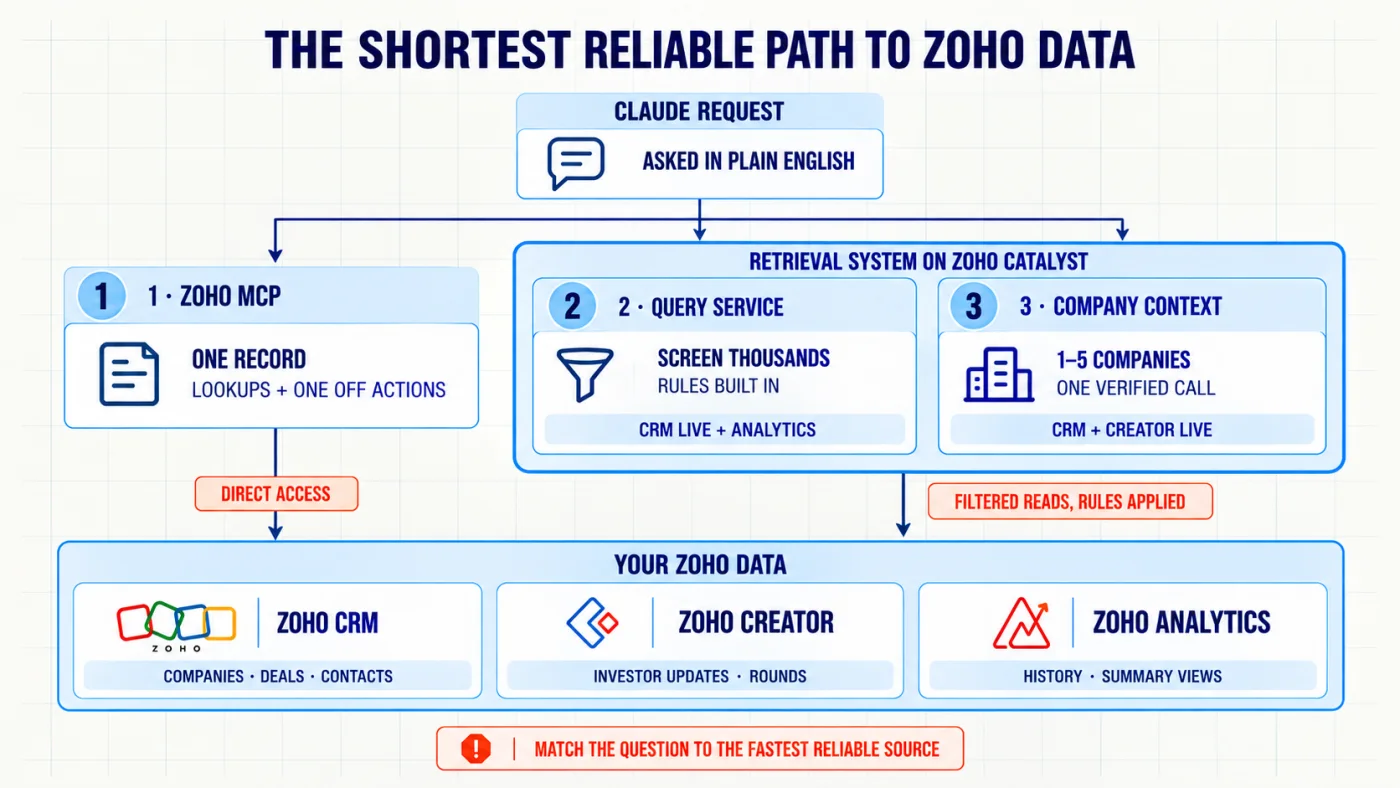
Fig 8 - The retrieval system settles into 3 levels over Zoho CRM, Creator and Analytics, each taking the questions it answers fastest.
4. Source routing rules
Each question type should have a preferred source, chosen before anyone writes a query.
Writing the choice down keeps it independent of who asked and how they phrased it.
Table 3 - The preferred source for each question type, written down before anyone opens a query editor.
Zoho Analytics supports SQL queries through CloudSQL. It is well suited to prepared historical computation. Live operational questions should state their freshness requirement before source selection.
5. A response contract and request log
Every query service should return a consistent response structure. Useful fields include the source, retrieval time, row count, applied filters, warnings, partial result status and record identifiers. Request logs should capture the tool, parameters, source, response time, row count and outcome. Logs turn user reports into evidence that engineering can inspect.
Logs change what a complaint looks like. A report that the assistant seemed slow yesterday becomes a timestamped request carrying its parameters, its source and its queue wait, which engineering can then inspect.
6. A verification suite
The system needs known questions with approved answers. Tests should cover several phrasings of the same question, empty results, missing fields, old records, special characters, permission boundaries and source outages. The deployment is ready when equivalent phrasings reach the same approved definition and the returned records reconcile with the source.
Verification also finds defects that predate the assistant. Tests should cover empty filter results, blank errors and mismatches between summary totals and underlying records.
These checks keep existing data defects from reaching users as AI answers.
Keep connections and permissions in one home. Live reads from CRM and Creator run on authorized connections. Keeping the build work, the connections and the data access on a single account with read only scopes avoids the most common cause of connections that stop working, which is access split across several accounts.
Direct Zoho MCP or a Governed Retrieval System
Both approaches have a useful operating range. Plenty of production deployments belong in the left column permanently, because the questions they answer never acquire the properties that make the right column worth its cost.
Table 4 - 7 conditions that decide whether a direct connection is enough.
A direct setup may cover the first production use cases. More governed services can be added around questions that carry financial, operational or compliance consequences. This sequencing fits a broader agentic AI strategy built on existing business systems. Start with named outcomes, identify the systems that own the evidence and add controls in proportion to the consequence of an incorrect action or answer.
What This Looked Like in One Zoho Implementation
These controls apply across industries. The following implementation shows how they were combined in one live Zoho environment.
Clixlogix applied this design for a California venture capital firm using Zoho CRM, Zoho Creator and Zoho Analytics. The firm needed questions that crossed applications, portfolio companies, investments, contacts, funding rounds and company updates.
The build began with a Zoho ecosystem audit and a verified field catalogue. A canonical map reconciled legacy and current application fields. A custom CRM module restored the relationship between an application and the portfolio company it became. Catalyst services handled live retrieval and request routing. Analytics remained the source for historical joins and calculated portfolio views.
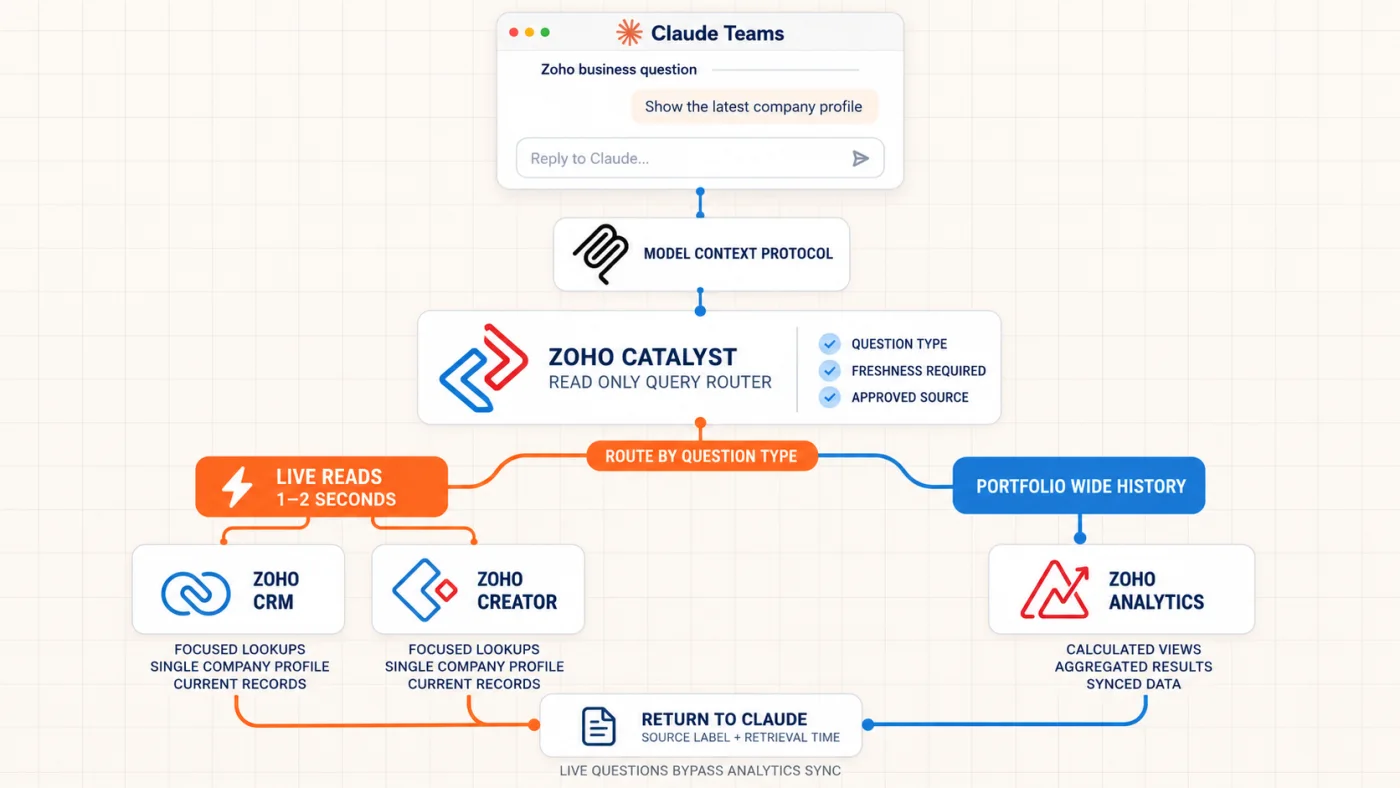
Fig 9 - Zoho Catalyst routes each Claude question by purpose and freshness, using live CRM or Creator reads for focused lookups and Analytics for synchronized portfolio history.
Every figure below was measured on the live system.
- A complete company profile returned in approximately 1 to 3 seconds
- Live searches returned in 1 to 2 seconds
- One request returned the company record, investments, contacts, funding history, recent updates, status and original application
- Equivalent phrasings returned the same governed result
- Every answer identified its data source
The last 2 lines changed how the team worked. Phrasing independence and a named source are what let an analyst put a figure in front of a partner, and that is the threshold a deployment has to clear to become infrastructure. The full architecture, delivery phases and result cards are available in the Zoho CRM and Claude AI case study.
An Eight Step Implementation Sequence
The order matters as much as the content. Steps 1 to 3 are business work, steps 4 to 6 are engineering work, and steps 7 and 8 produce the evidence. Teams that start at step 6 build services against definitions nobody agreed, then discover it during step 7.
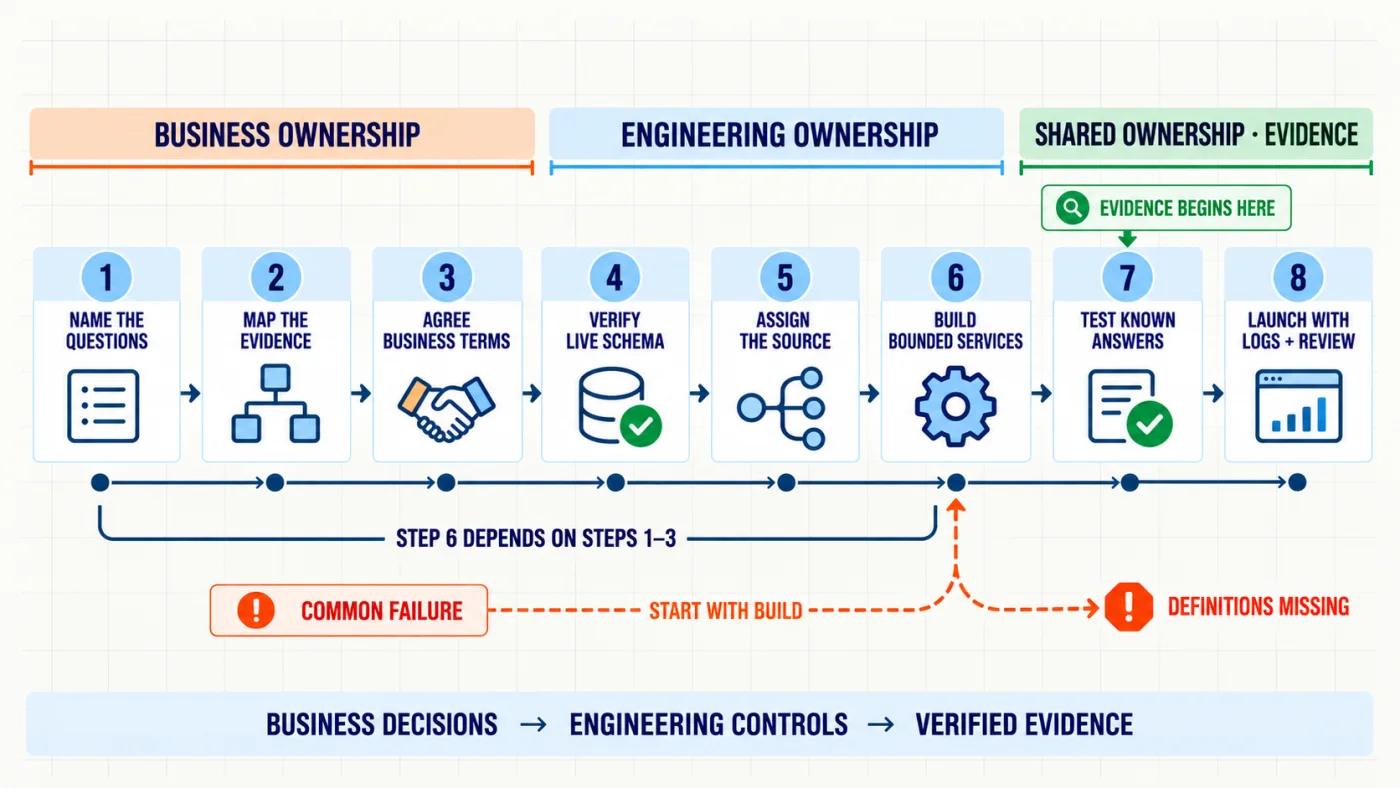
Fig 10 - The sequence moves from business decisions to engineering controls and verified evidence. Starting at the build step exposes missing definitions during testing.
Step 1. Name the questions
Collect the 10 questions that people repeatedly answer through exports, dashboards and manual record checks. Record who uses each answer and what decision follows.
Step 2. Map the evidence
For each question, identify the Zoho apps, modules, fields, related records and dates required to answer it. Confirm the record identifiers used across apps.
Step 3. Agree the business terms
Ask the owner of each number to define the terms in writing. Record exclusions, fallbacks and the date used to determine current or latest.
Step 4. Verify the live schema
Check the API name, type, values and permissions of every approved field. Include old values that remain in historical records.
Step 5. Assign the source
Choose the preferred source for each question type. Record the freshness requirement and the approved fallback.
Step 6. Build bounded services
Build services around recurring result shapes. Validate every field, operator and value before running the query. Limit the response to the records and fields the question requires.
Step 7. Test with known answers
Run equivalent phrasings, edge cases and permission checks. Reconcile returned totals and identifiers with the source applications.
Step 8. Launch with logs and review
Begin with read only questions. Review logs, failed requests, slow queries and fallback use. Extend the system after the first questions remain stable under daily use.
Can your team defend the answer Claude returned from Zoho?
A production answer should survive 5 follow up questions. Which field defined the number? Which app owned it? How current was the source? Which records were excluded? Would another phrasing return the same result?
A gap in any answer can point to a different problem shape. The cause may sit in business definitions, record joins, source routing, sync timing, permissions, pagination or the retrieval service itself.
Start with the 3 Zoho questions your team most needs to trust. Our Zoho consulting team traces each one from Claude through MCP to the fields, joins and source systems behind the answer. The assessment identifies where confidence breaks and converts those findings into an implementation sequence our Zoho development team delivers.
The resulting plan includes:
- A verified map of fields, relationships and record identifiers
- Written business definitions with owners, exclusions and date rules
- Source and freshness rules for each question type
- Delivery priorities for the questions carrying the greatest business consequence
Ask Clixlogix to trace your Claude and Zoho answer path
Frequently Asked Questions