c-84, sector 65, Noida
Clixlogix automated review solicitation through Epic for 12 Chicago orthopedic clinics, raising the average Google rating to 4.4 and appointment requests 43%.
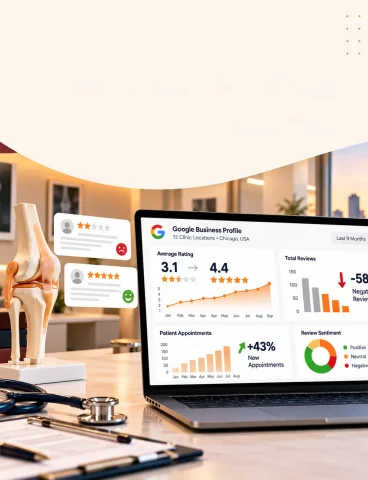
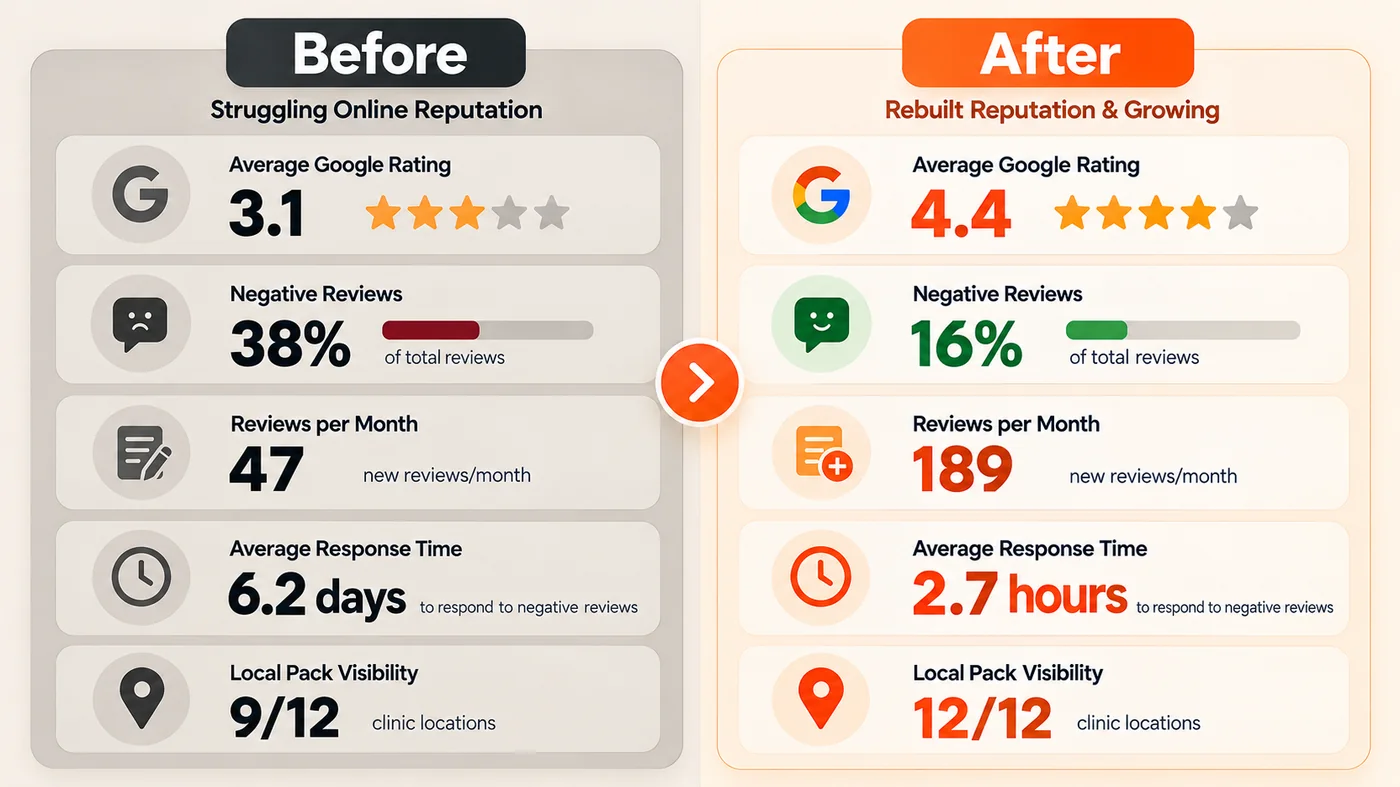
A 12 clinic orthopedic practice group in the greater Chicago metro was watching new patient volume slip month over month. The average Google rating had fallen to 3.1 stars. 1 in 4 reviews surfaced the same 2 complaints. Long wait times and billing confusion. 3 of the locations had dropped out of local pack results entirely, ceding ground to smaller competitors with fewer surgeons and worse clinical outcomes. We deployed an automated review solicitation system wired into the existing EHR, built a response protocol that caught every negative review within 4 hours, and stood up a real time sentiment dashboard covering Google, Healthgrades, and Vitals. 8 months in, the average rating reached 4.4 stars, negative reviews fell by 58%, and new patient appointment requests sourced from Google rose 43%. The practice set the standard in its market.
The Client is an established orthopedic practice group that has been serving the greater Chicago metropolitan area for over 2 decades. 12 clinics. 90 physicians across subspecialties covering sports medicine, joint replacement, spine, hand and wrist, foot and ankle, and pediatric orthopedics. Roughly 60,000 patient visits a year.
They are the kind of practice that does the work right. Board certified surgeons, fellowship trained specialists, relationships with every major hospital system in Chicagoland. Clinical outcomes were strong. Patient satisfaction scores on internal surveys consistently hovered around 87%. The physicians were publishing, presenting at conferences, training residents.
None of that showed up when someone searched “orthopedic doctor near me” on Google.
What showed up was a 3.1 star rating, a string of angry reviews about 90 minute waits, and billing complaints that read like they were written by the same frustrated patient over and over. The practice’s marketing director summarized the problem during our first call.
The practice’s marketing director, on the first call
“We have 90 doctors doing excellent work. And the internet makes us look like a place you’d avoid.”
When we ran the initial reputation audit across all 12 locations, the picture was worse than the headline number suggested.
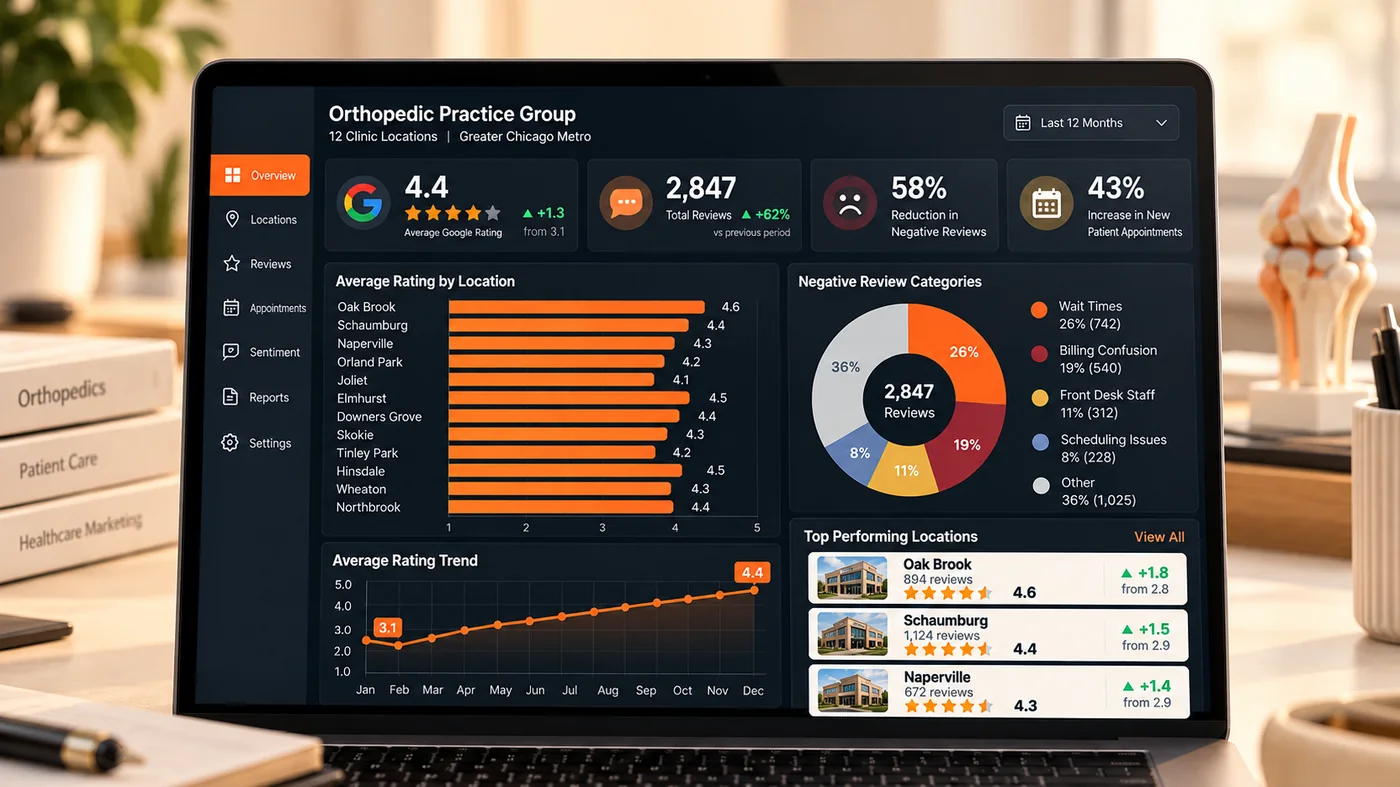
The 3.1 star average was actually generous. 4 clinics sat below 3.0. The flagship location in Oak Brook, the one that handled the most complex surgical cases, had a 2.8. The Schaumburg clinic, which served the highest patient volume at roughly 8,200 visits per year, was at 2.9.
We pulled and categorized 2,847 Google reviews across all locations from the previous 18 months. Here is what we found.
The competitive damage was tangible. 3 clinics (Naperville, Orland Park, and Joliet) had fallen entirely out of the Google Local Pack for their primary service keywords. A solo practice orthopedic surgeon with 47 Google reviews and a 4.7 star rating was outranking a 90 physician group in Naperville. In Orland Park, a physical therapy chain was appearing in AI Overview answers for “best orthopedic care near Orland Park” ahead of a practice with 4 fellowship trained surgeons.
The practice was also losing the narrative on Healthgrades and Vitals. The Healthgrades profile showed a 3.4 out of 5 patient satisfaction score, with 67% of patients saying they would recommend the practice, against a platform average of 81% for orthopedic groups in Illinois.
We estimated the revenue impact at between $1.8M and $2.4M annually in lost new patient acquisition, based on the practice’s average revenue per new patient of $3,100 and the appointment volume gap between the highest rated and lowest rated clinics.
We told the practice group something they did not want to hear. The reviews were largely accurate.
Patients were waiting too long. Billing was confusing. Front desk staff at several locations were undertrained. A reputation management campaign that only asked happy patients to post reviews would be a bandage on a wound that needed stitches.
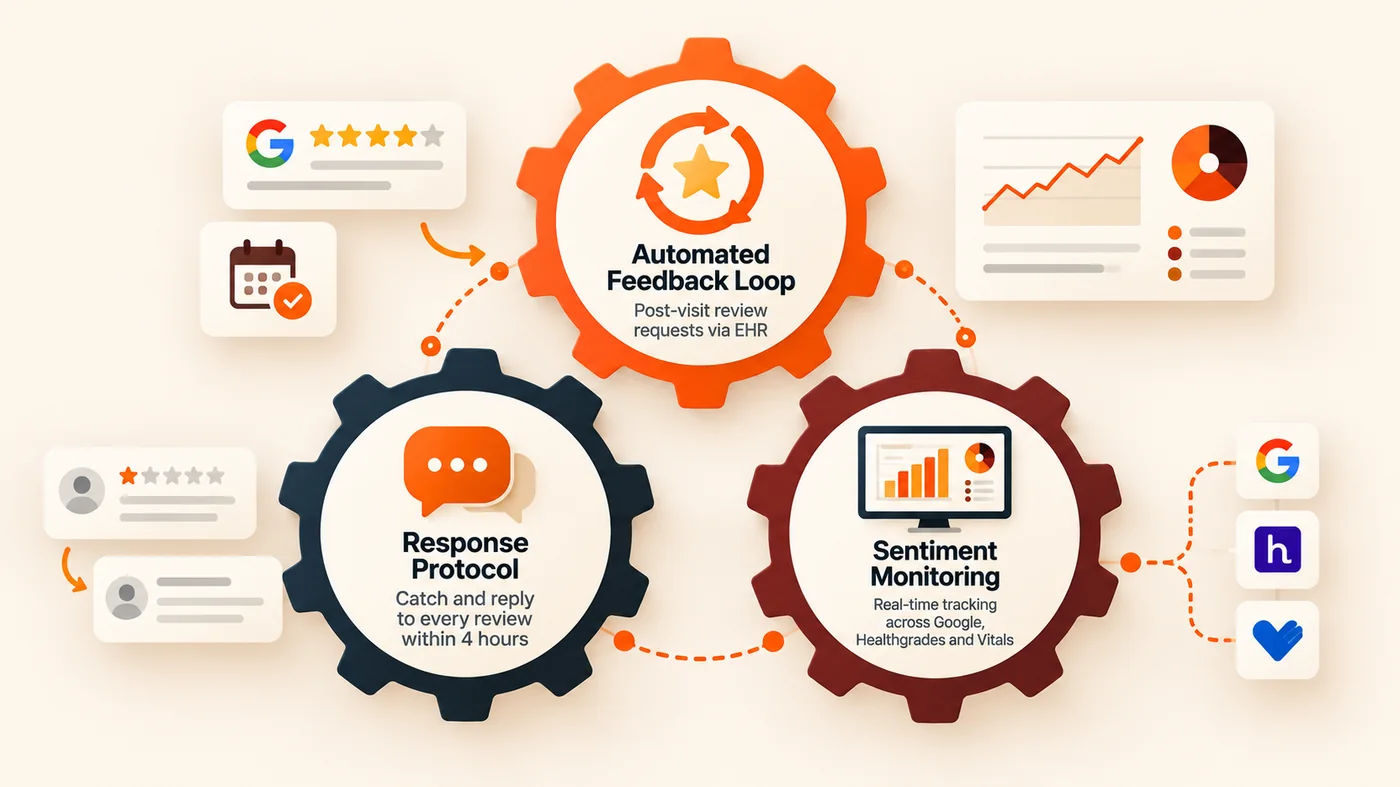
So we proposed a 3 track approach.
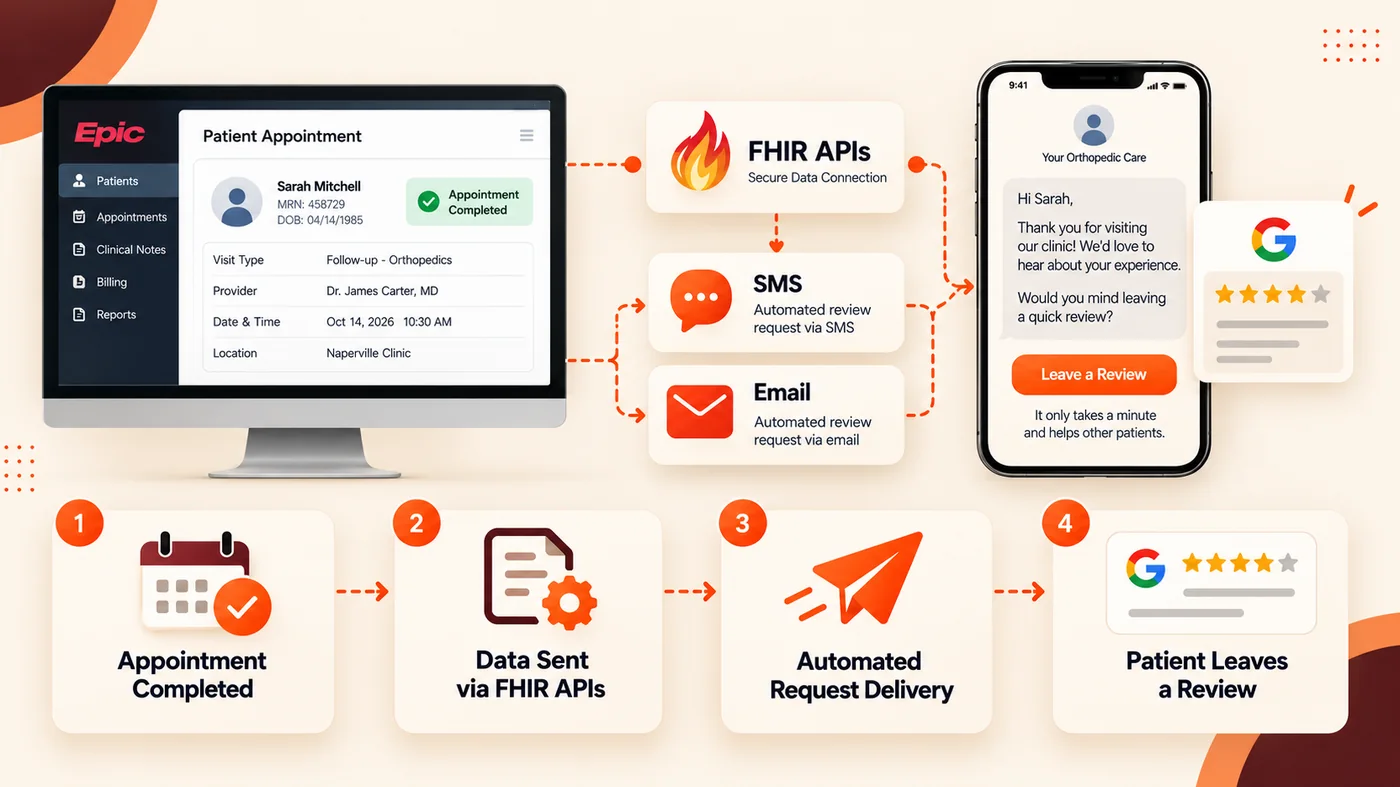
Track 1 - Fix the feedback loop - We built an automated post visit review solicitation system integrated directly with the practice’s Epic EHR instance. Every patient who completed a visit received a satisfaction prompt within 2 hours. Patients who rated the experience 4 or 5 stars received a Google review prompt. Patients who rated 3 or below received an internal feedback form that went straight to the clinic manager. The goal was to capture the 87% of satisfied patients who were walking out the door without saying a word online.
Track 2 - Own the conversation - Every negative review, every single one, across Google, Healthgrades, and Vitals, received a personalized response within 4 hours. We drafted a response protocol with templates tailored to the 5 most common complaint categories. The practice’s compliance team reviewed and approved the templates to satisfy HIPAA requirements. Responses acknowledged the concern, avoided defensive language, and offered a direct contact for resolution.
Track 3 - See the full picture - We built a custom sentiment monitoring dashboard that aggregated patient feedback from Google (all 12 locations), Healthgrades (9 listed profiles), and Vitals (7 listed profiles), plus the practice’s internal patient satisfaction surveys. The dashboard tracked sentiment trends by location, by complaint category, and by physician, giving leadership the ability to spot problems before they became review patterns.
We scoped the engagement at 9 months, following our delivery methodology. The first 3 for system build out and process implementation, months 4 through 6 for optimization and staff training reinforcement, and months 7 through 9 for sustained execution and measurement.
Fig 1 - The 3 track ORM strategy across the feedback loop, the conversation and the full picture
The EHR integration was the first hurdle. The practice ran Epic, and its IT team had locked down API access after a data incident the previous year. It took us 2 weeks of back and forth with the practice’s CISO to open a sandbox environment. Our dev team built the initial integration using Epic’s FHIR R4 APIs for appointment completion triggers, but the test environment kept timing out on high volume clinics. We refactored the queue architecture to handle the Schaumburg location’s 40+ daily appointments without clogging the pipeline.
The bigger problem was human. 3 clinic managers pushed back hard on the review solicitation idea. One of them told our account lead point blank.
A clinic manager, on the review solicitation plan
“You are going to make angry patients angrier by asking them to rate us.”
We ran a 2 week pilot at the Elmhurst location, a moderate performer at 3.3 stars, and shared the results. Of 847 patients prompted, 312 left Google reviews. The average rating of those new reviews was 4.6. That ended the debate.
Fig 2 - The automated solicitation system integrated with Epic through FHIR R4, triggering review requests within 2 hours of visit completion
Drafting review responses in healthcare is a minefield. HIPAA permits acknowledging a patient’s frustration. It forbids confirming the person was a patient or referencing any specifics of their visit. The practice’s legal counsel rejected our first round of response templates as “too specific.” Our second version was too generic and read like a chatbot wrote it.
We brought in a healthcare communications consultant for a single working session. 2 hours. She rewrote 6 templates in language that was warm, specific enough to feel personal, and compliant under HIPAA. That $1,200 consulting fee was the highest ROI line item in the engagement.
By end of month 2, we had a trained team of 2 dedicated review responders (one from our side, one from the practice’s patient experience office) operating on a shared queue with a 4 hour SLA.
This is where the data got uncomfortable. The sentiment dashboard was live, and it was doing exactly what it was supposed to do. It was surfacing the kind of feedback the practice had been able to ignore when complaints were scattered across platforms.
The billing complaint category spiked 34% in month 3. More patients were not complaining. The new solicitation system was capturing complaints from patients who previously would have switched providers quietly. The practice’s CFO called an emergency meeting. Our team presented the data. 73% of billing complaints referenced “surprise charges” tied to a specific imaging package that the practice had restructured 6 months prior, but front desk staff were still quoting the old pricing.
The practice fixed the pricing communication within a week. By month 5, billing complaints in new reviews dropped 41%.
Fig 3 - The real time sentiment dashboard aggregating feedback across Google, Healthgrades and Vitals for all 12 locations
We ran monthly training sessions with front desk staff at all 12 locations. Each session was a working walkthrough of anonymized negative reviews. We walked through what happened, what the patient expected, and what could have gone differently. The Schaumburg clinic manager, who had been our loudest skeptic, started running the sessions on her own by month 5.
We also tuned the solicitation timing. Our initial 2 hour post visit window worked well for routine visits, but surgical patients were still groggy or in pain. We shifted surgical follow ups to 48 hours post discharge and saw their response rate reach 28% against the 11% baseline.
By this point, the system was largely running itself. Review solicitation was automated. Response times averaged 2.7 hours, well under the 4 hour SLA. 8 of the 12 clinic managers checked the dashboard daily without any prompt from our team. We shifted our focus to local SEO reinforcement. We hardened Google Business Profiles across all locations, enforced consistent NAP data across directories, and added structured review markup for rich snippet eligibility.
Fig 4 - Every core reputation metric at baseline and at month 8
The Client’s director of patient experience, on the engagement
“I was skeptical. I thought reputation management meant burying bad reviews or gaming the algorithm. What you guys actually did was force us to look at the real problems, and then gave us the tools to fix them and the system to show patients we had. The dashboard alone changed how our clinic managers think about patient experience. It went from ‘that’s a marketing problem’ to ‘that’s my problem’ almost overnight.”
The engagement produced measurable results across reputation recovery, patient acquisition, and local search visibility within 8 months.
| Category | Tool or Platform | Purpose |
|---|---|---|
| EHR Integration | Epic FHIR R4 APIs | Appointment completion triggers for review solicitation |
| Review Solicitation | Birdeye | Automated post visit review request delivery via SMS and email |
| Review Monitoring | Reputation.com | Aggregated review tracking across Google, Healthgrades, Vitals |
| Sentiment Analysis | MonkeyLearn (custom model) | NLP based categorization of review themes and complaint types |
| Dashboard and Reporting | Google Looker Studio | Custom sentiment monitoring dashboard for clinic managers |
| Local SEO | BrightLocal | Local Pack tracking, citation management, NAP consistency audits |
| Google Business Profile | Google Business Profile Manager | Profile optimization, post scheduling, Q&A management |
| Project Management | Zoho Projects | Sprint planning, task tracking, client reporting cadence |
| Communication | Slack (shared channel) | Real time coordination between Clixlogix and practice teams |
| Data Pipeline | Google BigQuery | Centralized data warehouse for cross platform review analytics |
| Review Response | Custom built response queue | HIPAA compliant review triage and response management system |
Table 1 - ORM delivery stack
Our team can share client references, scope your project, and answer any question about your delivery.
More engagements where our delivery teams shipped similar outcomes for clients across industries. Read on for context on the patterns we reused, the trade offs we navigated, and the metrics that landed in production.