WhatsApp DM Us 🇮🇳 +91-(120)-4137067 🇺🇸 +1-(315) 215-3533
Clixlogix
About
About
Why Clixlogix
Why fast-growing brands trust Clixlogix for digital success.
How We Work
Focused but flexible, explore our agile & collaborative approach.
Culture & Diversity
We bring diverse people together to drive growth-oriented culture.
Client Security
See how we ensure your intellectual property safety to protect you.
Our Team
Make some noise for our talented team powering your digital journey!
Partnership
Looking for a true end-to-end partner to drive growth?
Mission, Vision & Values
The fuel! What keeps us going?
Reviews & Testimonials
Clients love us. We stay humble. See what they have to say?
Know More About Us
Case Studies
Services
Services
All Services
One partner for all things AI & digital.
Digital Engineering
Custom web, mobile, cloud. Precision at AI assisted velocity.
Digital Marketing
AI assisted acquisition that earns its budget.
AI & ML
Agents, models, and RAG built for growth and production load.
QA & Testing
AI Assisted testing & defect catching before you ship.
Enterprise Software
Faster close, cleaner data, lower ops cost.
Creative & Design
Higher conversion, stronger recall, less friction.
Emerging Technologies
Blockchain, IoT, AR, and edge systems your roadmap can absorb.
Consulting Service
Defensible roadmaps, lower risk, sharper ROI math.
More About Services
Solutions
Solutions
Agritech
Intelligent farm management built for real acreage.
Fintech
Payments, lending, and wallets that clear an audit.
Video Calling
Scalable, crisp video calling built for real load.
Grocery Delivery
Lightning fast grocery delivery that scales cleanly.
E-Learning
Teaching and assessment with AI in the loop.
Telehealth
Secure patient care with AI for predictive outcomes.
Fitness Tracking
Goal tracking and coaching that keeps clients active.
EV Charging
Charging networks with reliability and predictive AI.
IoT & Automation
Connected automation with near zero defects on site.
View All Solutions
Industries
Industries
Agriculture
Smart farming and supply chain tech built for scale.
Automotive & Mobility
Connected vehicle and mobility software that scales.
Energy
Grid, asset, and consumption software for providers.
Finance
Secure, compliant fintech for regulated markets.
Healthcare
HIPAA ready software for providers and health tech.
Manufacturing
Industry 4.0 systems linking shop floor to decisions.
Real Estate
Property management and PropTech built for scale.
Retail
Omnichannel commerce and inventory for modern retail.
Travel & Leisure
Booking and guest experience for travel brands.
View All Industries
Careers
Blogs
Contact Us
  • View all About › Why ClixlogixHow We WorkCulture & DiversityClient SecurityOur TeamPartnershipMission, Vision & ValuesReviews & Testimonials
  • Case Studies ›
  • View all Services › Digital EngineeringDigital MarketingAI & MLQA & TestingEnterprise SoftwareCreative & DesignEmerging TechnologiesConsulting Service
  • View all Solutions › AgritechFintechVideo CallingGrocery DeliveryE-LearningTelehealthFitness TrackingEV ChargingIoT & Automation
  • View all Industries › AgricultureAutomotive & MobilityEnergyFinanceHealthcareManufacturingReal EstateRetailTravel & Leisure
  • Careers ›
  • Blogs ›
  • Contact Us ›
Contact Us →
WhatsApp Us Call Us
Clixlogix
  • About
    • Why Clixlogix
    • How We Work
    • Culture & Diversity
    • Client Security
    • Our Team
    • Partnership
    • Mission, Vision & Values
    • Reviews & Testimonials
  • Case Studies
  • Services
    • Digital Engineering
    • Digital Marketing
    • AI & ML
    • QA & Testing
    • Enterprise Software
    • Creative & Design
    • Emerging Technologies
    • Consulting Service
  • Solutions
    • Agritech
    • Fintech
    • Video Calling
    • Grocery Delivery
    • E-Learning
    • Telehealth
    • Fitness Tracking
    • EV Charging
    • IoT & Automation
  • Industries
    • Agriculture
    • Automotive & Mobility
    • Energy
    • Finance
    • Healthcare
    • Manufacturing
    • Real Estate
    • Retail
    • Travel & Leisure
  • Careers
  • Blogs
  • Contact Us
We are available 24/ 7. Call Now.

+1-315-215-3533

info@clixlogix.com

Contact information

c-84, sector 65, Noida
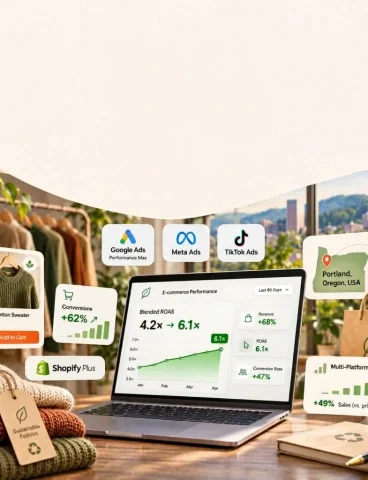
Lifted ROAS 6.1x via Multi Platform PPC for Eco Fashion D2C

A Portland D2C sustainable fashion brand broke past flatlined 4.2x ROAS. Multi platform PPC across Google, Meta, and TikTok hit 6.1x blended ROAS.

Multi platform paid media engine for a sustainable fashion D2C brand spanning Google Ads Performance Max, Meta Ads video, and TikTok Spark Ads
Home / Case Studies / Multi Platform PPC Strategy That Lifted a Portland Sustainable Fashion Brand to 6.1x Blended ROAS

Multi Platform PPC Strategy That Lifted a Portland Sustainable Fashion Brand to 6.1x Blended ROAS

Industry
Retail & E-Commerce
Geography
Portland, Oregon, USA
Cooperation Period
8 months (ongoing)

Summary

A D2C sustainable fashion brand based in Portland, Oregon had hit a wall. Their Google Shopping campaigns were generating a 4.2x ROAS on $18,000 in monthly ad spend, and that number had not moved for two consecutive quarters. Customer acquisition cost was climbing because every competitor in the eco fashion space was bidding on the same terms. Clixlogix restructured the brand’s entire paid media strategy across Google Ads, Meta Ads, and TikTok Ads, shifting a single channel dependency into a three platform media mix built around margin tiered campaigns, AI generated video creatives, and creator led Spark Ads. Within five months of the restructure going live, blended ROAS across all three platforms reached 6.1x, CPA dropped 34%, and TikTok became the source of 22% of all new customer acquisitions.

About the Client

This brand launched as a two person operation selling organic cotton basics at a weekend market in Portland’s Pearl District. The founders had a clear thesis. Everyday wardrobe staples, $85 to $160 price point, made from deadstock fabrics and plant derived dyes, manufactured in a single certified factory in Portugal. By the time the engagement opened, the business had grown into a proper D2C operation with a Shopify Plus storefront, a small warehouse in Southeast Portland, and B Corp certification pending.

The customer base leaned heavily toward women aged 28 to 45, mostly on the West Coast and in the Northeast corridor. Average order value sat around $127. Repeat purchase rate was strong, well above the apparel industry average. The product was good. The brand carried genuine credibility in the sustainable fashion space, with organic search traffic growing steadily and a loyal email list of about 22k subscribers.

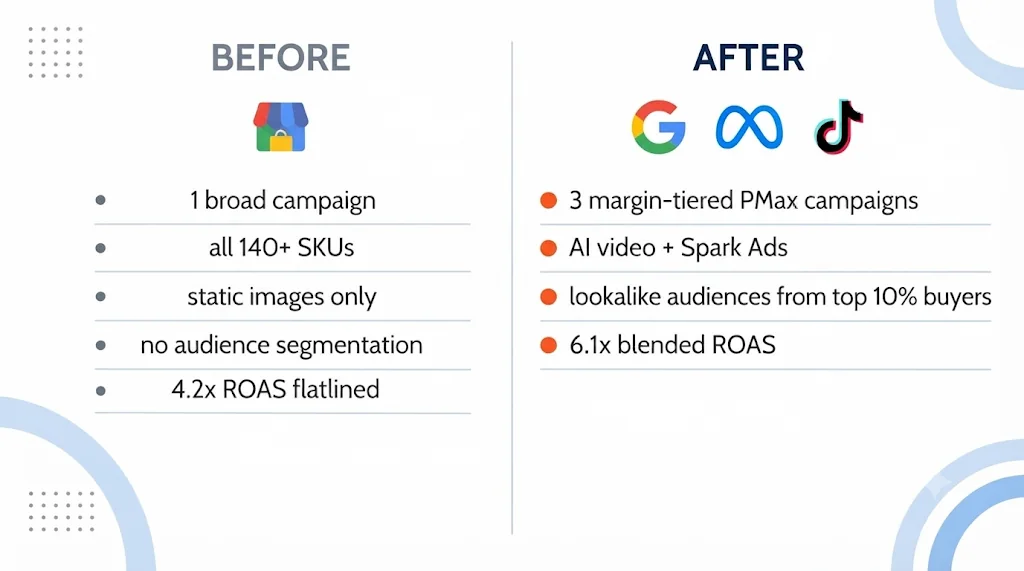
Paid acquisition had not kept up with the rest of the business. The brand had run Google Shopping campaigns for three years, managed by a freelancer who had since moved on. The account carried a single, broad Shopping campaign covering all 140+ SKUs, with no segmentation by margin, product category, or audience intent. The team had tested Meta Ads twice, both times with static image carousels that underperformed and paused within three weeks. TikTok had never been considered. The brand’s entire paid media presence was one Google Shopping campaign, and it had stopped growing.

Before and after comparison of PPC strategy changes for sustainable fashion brand

Fig 1 - From single channel Shopping dependency to a three platform acquisition engine

The Challenge

The brand came to Clixlogix with a problem that looked simple on the surface but had four problems underneath it.

Every competitor was bidding on the same Google Shopping terms - The sustainable fashion space in the US had grown from a niche into a $2.34 billion market, and the paid search auctions reflected it. Terms like “organic cotton t shirt,” “sustainable basics,” and “eco friendly clothing” had become crowded. The brand’s Google Shopping CPC had risen from $0.48 to $0.71 over twelve months, above the ecommerce Shopping average of $0.66. More money was going in, and the same revenue was coming out.

The account structure was hiding margin problems - All 140+ SKUs sat in one Shopping campaign with a single target ROAS bid. The brand’s $89 organic cotton tees (45% gross margin) were competing for budget against their $156 linen trousers (62% gross margin). The algorithm was optimizing for conversion volume, and profitability came second. Some products were technically “converting” at a ROAS that looked fine on the dashboard but ran below breakeven after shipping and returns.

Two previous Meta Ads attempts had failed, creating internal skepticism - Both tests used static product carousels with lifestyle photography. Neither lasted more than three weeks. The brand’s founder had concluded that “Meta doesn’t work for us,” which is a conclusion a lot of D2C founders reach after testing the wrong creative format at the wrong budget for too short a window. The real issue traced to the creative format. Static carousels in a feed full of video content get scrolled past. Fashion and apparel CPC on Meta runs around $0.45, among the cheapest on the platform, and that efficiency shows up only when the creative earns the click.

TikTok was an unknown - The brand’s core customer was 28 to 45 year old women. The team assumed TikTok was a Gen Z platform and nothing else. That assumption was two years out of date. The sustainability conversation on TikTok had matured well past that demographic. The bigger issue was that the brand had zero TikTok presence, no creator relationships, and no short form video assets. Starting from scratch on a platform where the brand had no organic presence carries real risk. Clixlogix flagged that openly at the kickoff.

The Solution

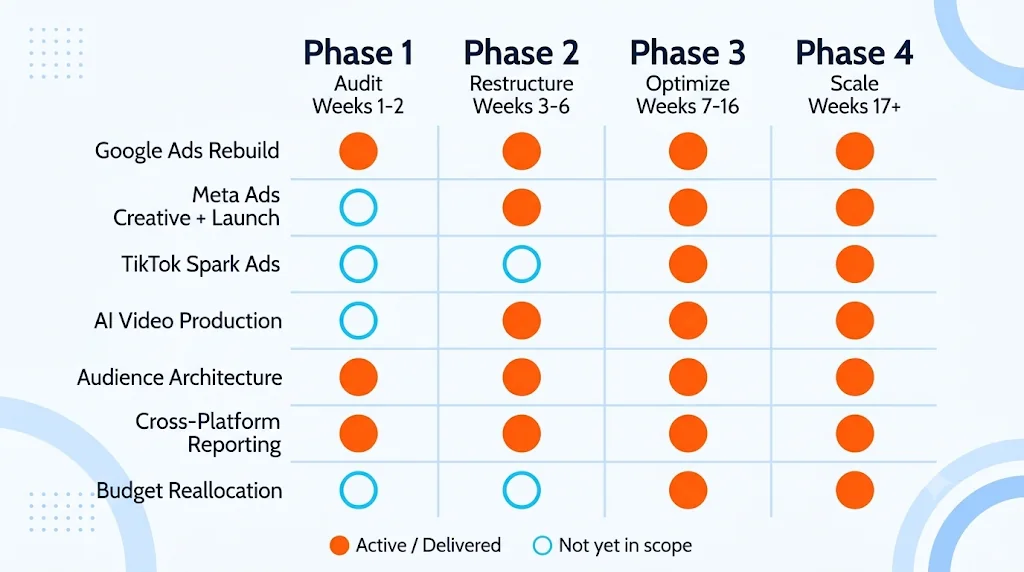
Clixlogix structured the engagement in three work tracks that ran in parallel after an initial two week audit. The team included a Digital Advertising Specialist, a Media Buying Executive, a Video Editor, and a Project Manager. All three channels launched within the same 30 day window. The reasoning was practical. Cross platform attribution gets messier the longer the gap between channel launches, and the brand needed blended results across the three to make budget decisions.

Phase matrix showing delivery of PPC strategy across audit, restructure, and scale phases

Fig 2 - Three parallel work tracks after a shared two week audit

Phase 1. Audit and Margin Mapping (Weeks 1-2)

Before touching a single campaign, the team pulled twelve months of Google Ads data alongside the brand’s Shopify product catalog. The goal was practical. Map every SKU against its gross margin after shipping and returns, then sort them into three tiers.

TierMargin bandSKUsWhat the tier could carry
Tier 155%+31Mostly linen and hemp blend products priced above $120. These could sustain aggressive bidding and still stay profitable at a 3x ROAS.
Tier 240 to 55%74The core organic cotton basics line. The bread and butter. Needed a 4x ROAS minimum to stay above breakeven.
Tier 3Below 40%37Mostly accessories and sale items. These were actively losing money in the existing campaign structure because the algorithm was spending on them the same way it spent on everything else.

Table 1 - Margin tiers mapped from the Shopify catalogue

This margin mapping became the foundation for everything that followed. It is not a glamorous piece of work. Nobody puts “we built a spreadsheet” on a case study highlight reel. Without it, the Google restructure would have been rearranging deck chairs.

The audit also surfaced a smaller annoyance. The brand’s Google Merchant Center feed carried 14 products with mismatched availability data (showing “in stock” for variants that were actually sold out), which was burning ad spend on clicks that led to dead ends.

Phase 2. Google Ads Restructure (Weeks 3-6)

The team replaced the single broad Shopping campaign with three Performance Max campaigns, each mapped to one of the margin tiers identified in the audit.

CampaignTarget ROASBudget shareMonthly budgetRole on the account
Tier 1 Performance Max350%40%$7,200The logic was simple. These products could absorb higher CPCs and still produce profit. Performance Max’s asset group structure let the team feed in product specific lifestyle imagery and AI generated short video clips alongside the Shopping feed.
Tier 2 Performance Max450%45%$8,100This was the volume driver. The team set up tighter asset groups by product category (tees, pants, dresses).
Tier 3 Performance Max550%15%$2,700The team considered cutting Tier 3 products from paid entirely and kept them running because some of these lower margin items were the brand’s top sellers by unit volume and functioned as entry points for first time buyers.

Table 2 - Three margin tiered Performance Max campaigns replacing one broad Shopping campaign

The team fixed the Merchant Center feed issues in the first week. Fourteen products were corrected, and the team set up a weekly Shopify to Merchant Center inventory sync to prevent the problem from recurring. A small fix, and one that stopped roughly $400/month in wasted spend.

Why this track mattered

One unexpected complication. Performance Max campaigns need a learning period of about two weeks before they stabilize. During that window, ROAS on the Google account actually dipped to 3.6x, below where it had been. The brand’s founder sent a concerned email on day 10 asking if the team had broken something. The team had anticipated this and had flagged it in the kickoff call, and it still required a direct conversation explaining that a temporary dip during algorithm relearning is normal. It is not a sign of failure. That moment builds or loses client trust, and it is worth mentioning because a lot of agencies do not prepare their clients for it.

Phase 3. Meta Ads Creative Overhaul (Weeks 3-6, Parallel)

The two previous Meta Ads tests had used static product carousels. They failed because the format was wrong for the platform, and the audience was there all along.

The Clixlogix team built the Meta strategy around three changes.

Creative format shift - All new ad units were short form video. AI video creation workflow generated UGC style Reels, between 15 and 30 seconds each, designed to look like something a real customer would post. The videos showed product close ups, fabric texture shots, and “what I am wearing today” formats. No scripts. No voiceovers. Just product and movement. This was a deliberate choice. In the sustainable fashion D2C space, authenticity carries real weight. It marks the difference between a 0.8% and a 2.1% click through rate.

Audience architecture - The Media Buying Executive built lookalike audiences from the brand’s top 10% repeat customers by lifetime value, and avoided seeding from the full customer list. Most brands build lookalikes from “all purchasers,” which dilutes the signal with one time bargain hunters. Narrowing the seed to high LTV repeat buyers produced a smaller, better qualified lookalike. The team also layered interest targeting around sustainability, ethical fashion, and slow living, as a secondary signal.

Budget and pacing - Meta received $6,500/month initially, roughly 23% of total ad spend. The team started with a Conversions objective using a broad targeting structure, then layered in the lookalikes after week two once the pixel had enough conversion data to optimize. Apparel brands on Meta typically see a CPA around $31. The target was to beat that benchmark within 60 days.

Why this track mattered

A note on something that did not go as planned. The first batch of AI generated videos had a subtle problem. The lighting in the clips was too even, too “studio perfect.” Real UGC carries slightly inconsistent lighting, minor camera shake, and backgrounds that are clearly someone’s apartment. No sets. The second round of video production deliberately introduced these imperfections. That batch outperformed the first by a 40% higher CTR. Perfection was the enemy of performance here.

Phase 4. TikTok Ads from Zero (Weeks 4-8)

Launching paid ads on a platform where the brand had no organic presence was the highest risk piece of the engagement. The team was upfront about this with the client. TikTok might not work, and if the platform did not produce results by week eight, Clixlogix would pull back and reallocate budget to the other two channels.

The strategy was built entirely around Spark Ads, TikTok’s native ad format that boosts organic creator content. The team identified eight micro creators in the sustainable fashion space, each with followings between 8,000 and 35,000, and had them produce the content directly. The brand creating TikTok ads from scratch almost always looks like an ad and gets scrolled past.

The process worked like this. The brand shipped product directly from their Portland warehouse to each creator. No scripts. No shot lists. No creative direction beyond “show the product in your daily life.” The creators posted organically on their own accounts, and the Clixlogix team then boosted the highest performing posts as Spark Ads.

TikTok received $3,500/month in budget, about 13% of total spend. Small enough that underperformance would not damage the overall numbers, large enough to generate real data.

Industry benchmarks put the typical TikTok Ads CPA for apparel around $17. The target was to land within 20% of that number within the first eight weeks.

Here is the thing nobody tells you about TikTok Spark Ads. The conversion path runs longer. A user sees a Spark Ad, might visit the profile, watch two more videos, then come back three days later through a Google brand search to actually purchase. Attribution looks messy if you are only looking at last click. The team set up a post view attribution window of 7 days alongside last click to capture this behavior, and that changed the picture entirely. First click data showed TikTok underperforming. Post view attribution showed it was driving 22% of new customer sessions that eventually converted on Google or direct.

One creator, a Portland based ceramicist with 12,000 followers who also sewed her own clothes, posted a 22 second video showing the brand’s linen trousers while she was glazing pottery in her studio. No mention of sustainability, no sales pitch, just the product in context. That single video generated 340,000 organic views before any paid boost. When the team put $180 behind it as a Spark Ad, it drove 127 first time site visits in 48 hours at a CPA of $11.40.

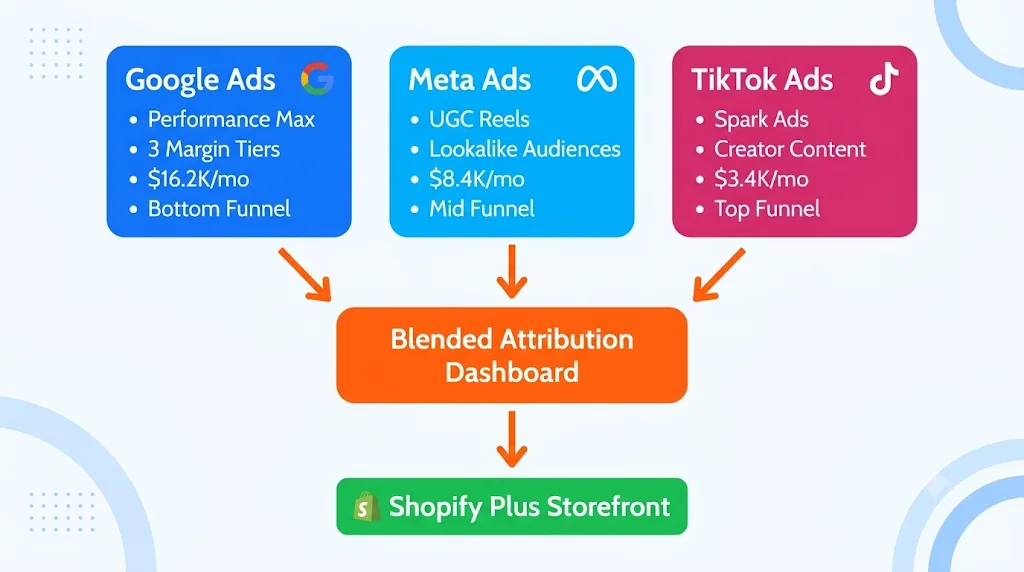
Diagram showing three platform PPC architecture across Google, Meta, and TikTok

Fig 3 - Budget allocation and role of each platform in the acquisition funnel

Phase 5. Cross Platform Optimization and Budget Reallocation (Weeks 7-16)

Once all three platforms had at least four weeks of conversion data, the real work started. The Digital Advertising Specialist ran a weekly budget reallocation cycle based on marginal ROAS by platform.

The logic was simple. If Google Tier 1 Performance Max was returning 7.2x ROAS and Meta lookalike campaigns were returning 3.8x, the next dollar should go to Meta, where there was more room to grow. Google’s returns were already high and had less upside. Most brands do the opposite. They pile money into whatever has the highest ROAS, which is exactly how you hit diminishing returns.

Budget shifted over the 10 week optimization period.

PlatformStartedSettledShare of total
Google Ads$18,000/month$16,200/month58%
Meta Ads$6,500/month$8,400/month30%
TikTok Ads$3,500/month$3,400/month12%

Table 3 - Budget reallocation across the 10 week optimization period

Total monthly ad spend across all platforms, approximately $28,000/month.

The TikTok budget barely moved, and its contribution to new customer acquisition kept climbing because the organic reach of Spark Ads meant each dollar went further than the equivalent on Google or Meta. The team also started repurposing the highest performing TikTok creator videos as Meta Reels ads, which created a content loop. Creators make content for TikTok, the best content gets boosted there, and then gets a second life on Meta.

Results

Five months after the restructure went live, the brand’s paid acquisition looked nothing like it had at the start. The blended ROAS across all three platforms hit 6.1x, above the ecommerce Google Ads ROAS benchmark range and well above the Meta ecommerce average.

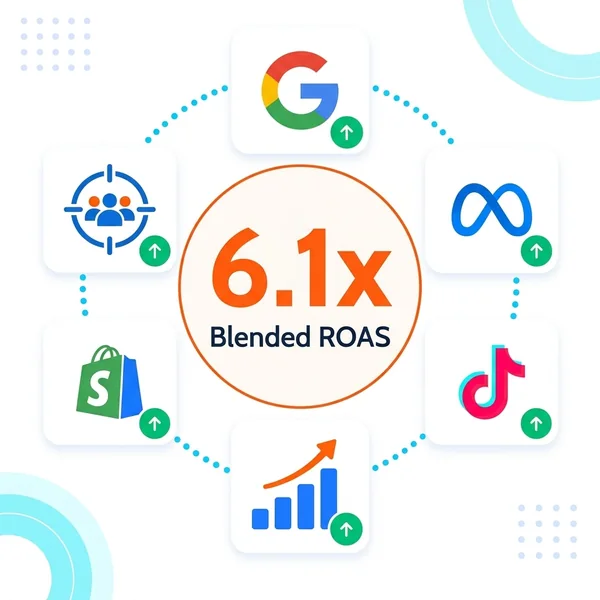
6.1x Blended ROAS Across Three Platforms

6.1x Blended ROAS Across Three Platforms

The brand lifted its blended ROAS to 6.1x across Google, Meta, and TikTok within five months, compared with a flatlined 4.2x on single platform Google Shopping before the restructure. The median ecommerce ROAS on Google Ads sits around 3.5x to 4x. Landing at 6.1x blended puts this account comfortably in the top quartile of ecommerce advertisers.
34% CPA Reduction in Blended Customer Acquisition Cost

34% CPA Reduction in Blended Customer Acquisition Cost

Blended CPA dropped 34% over the engagement period. The margin tiered Google structure stopped wasting spend on below breakeven products, and the introduction of Meta and TikTok brought in new customers at a lower cost per acquisition than Google Shopping alone. The brand's Meta CPA settled at $26.80 after optimization, beating the industry benchmark of roughly $31 for fashion and apparel.
22% of New Customers Acquired Through TikTok

22% of New Customers Acquired Through TikTok

TikTok went from zero presence to the source of 22% of all new customer acquisitions within five months. This was measured through post view attribution (7 day window) combined with first touch analysis. Last click alone would have missed it. The platform's role was top of funnel discovery. Many of these customers eventually converted through a Google brand search or direct visit, and TikTok was where they first encountered the brand.
3 Margin Tiered Performance Max Campaigns Replaced 1 Broad Shopping Campaign

3 Margin Tiered Performance Max Campaigns Replaced 1 Broad Shopping Campaign

The restructure from a single broad Shopping campaign to three margin tiered Performance Max campaigns was the foundation of the Google Ads improvement. Tier 1 (high margin products) produced a 7.2x ROAS. Tier 2 (mid margin) hit 5.4x. Tier 3 (low margin, entry point products) ran at 3.1x, above breakeven for those SKUs for the first time.
8 Micro Creators Produced Content That Outperformed Brand Creative by 40% CTR

8 Micro Creators Produced Content That Outperformed Brand Creative by 40% CTR

The eight micro creators in the sustainable fashion space produced organic content that, when boosted as Spark Ads, delivered a 40% higher CTR than the brand's own AI generated video ads. The winning formula was authenticity. Product in real life, no scripts, no studio lighting. The highest performing single video (the ceramicist in Portland) generated 340,000 organic views before any paid spend.

Market context

The US sustainable fashion market is projected to grow at 8.2% CAGR through 2035, reaching $5.15 billion. In a category where digital native brands are competing for the same search terms, multi platform paid media diversification is now baseline survival.

Technologies and Tools

CategoryTools and Platforms
Ad PlatformsGoogle Ads (Performance Max), Meta Ads Manager (Instagram Reels, Facebook), TikTok Ads Manager (Spark Ads)
E-commerceShopify Plus, Google Merchant Center
Creative ProductionClaude + Higgsfield
AnalyticsGoogle Analytics 4, TikTok Pixel, Meta Conversions API
Project ManagementZoho Projects

Table 4 - Technologies and tools used across the engagement

Services Delivered
PPC and Paid Media, Social Media, AI Video Production, Creative and Design, Digital Marketing, Creator Led Spark Ads, Cross Platform Attribution
Team Composition
Digital Advertising Specialist, Media Buying Executive, Video Editor, Project Manager

Have a question for our team or need help with your project?

Our team can share client references, scope your project, and answer any question about your delivery.

File should not exceed more than 20MB
🔒 SECURE SSL ENCRYPTION

Related Case Studies

More engagements where our delivery teams shipped similar outcomes for clients across industries. Read on for context on the patterns we reused, the trade offs we navigated, and the metrics that landed in production.

PPC rebuild across Google, YouTube and Meta for a luxury adventure travel operator in Switzerland

4.8x ROAS and 61% Lower Booking Cost via Google, YouTube and Meta Ads for a Luxury Adventure Travel Operator in Switzerland

Digital Marketing PPC Creative & Design Travel, Tourism & Hospitality
Abu Dhabi real estate paid media audit and lead quality case study featured image

Paid Media Audit and Lead Quality Rebuild for an Abu Dhabi Real Estate Agency

Digital Marketing PPC Real Estate
View All PPC & Paid Media Case Studies
Company
  • About Us
  • Our Team
  • How We Work
  • Culture & Diversity
  • Mission, Vision & Values
  • Security & Compliance
Explore
  • Case Studies
  • Solutions
  • Reviews
  • Partner With Us
  • Careers
  • Contact Us
  • Blogs
  • Latest Zoho Updates
Services
  • AI Software Development
  • AI Eval Framework
  • Vibe Coding Development
  • Vibe Coding Cleanup
  • ERP Services
  • CRM Services
  • Zoho Services
  • Zoho Consulting
  • Low Code Development
  • Ecommerce Development
  • SEO Services
  • SEO Reseller
  • SEO Guarantee
  • Marketing Automation
  • AI Video Production
  • All Services
Industries
  • Healthcare
  • Banking & FinTech
  • Retail
  • Manufacturing
  • Energy & Utilities
  • Automotive
  • Real Estate
  • Agriculture
  • Beauty & Wellness
  • Sports & Fitness
  • All Industries
Follow Us
  • 12,272 Likes
  • 2,831 Followers
  • 4.2 Rated on Google
  • 22,526 Followers
  • 4.5 Rated on Clutch
© 2026 Clixlogix Technologies Pvt. Ltd. All rights reserved. DMCA Protected GSTIN : 09AAECC5421E1ZZ CIN : U74140UP2011PTC129448
Privacy PolicyTerms of ServiceSitemapRefund PolicyDelivery PolicyDisclaimer