WhatsApp DM Us 🇮🇳 +91-(120)-4137067 🇺🇸 +1-(315) 215-3533
Clixlogix
About
About
Why Clixlogix
Why fast-growing brands trust Clixlogix for digital success.
How We Work
Focused but flexible, explore our agile & collaborative approach.
Culture & Diversity
We bring diverse people together to drive growth-oriented culture.
Client Security
See how we ensure your intellectual property safety to protect you.
Our Team
Make some noise for our talented team powering your digital journey!
Partnership
Looking for a true end-to-end partner to drive growth?
Mission, Vision & Values
The fuel! What keeps us going?
Reviews & Testimonials
Clients love us. We stay humble. See what they have to say?
Know More About Us
Case Studies
Services
Services
All Services
One partner for all things AI & digital.
Digital Engineering
Custom web, mobile, cloud. Precision at AI assisted velocity.
Digital Marketing
AI assisted acquisition that earns its budget.
AI & ML
Agents, models, and RAG built for growth and production load.
QA & Testing
AI Assisted testing & defect catching before you ship.
Enterprise Software
Faster close, cleaner data, lower ops cost.
Creative & Design
Higher conversion, stronger recall, less friction.
Emerging Technologies
Blockchain, IoT, AR, and edge systems your roadmap can absorb.
Consulting Service
Defensible roadmaps, lower risk, sharper ROI math.
More About Services
Solutions
Solutions
Agritech
Intelligent farm management built for real acreage.
Fintech
Payments, lending, and wallets that clear an audit.
Video Calling
Scalable, crisp video calling built for real load.
Grocery Delivery
Lightning fast grocery delivery that scales cleanly.
E-Learning
Teaching and assessment with AI in the loop.
Telehealth
Secure patient care with AI for predictive outcomes.
Fitness Tracking
Goal tracking and coaching that keeps clients active.
EV Charging
Charging networks with reliability and predictive AI.
IoT & Automation
Connected automation with near zero defects on site.
View All Solutions
Industries
Industries
Agriculture
Smart farming and supply chain tech built for scale.
Automotive & Mobility
Connected vehicle and mobility software that scales.
Energy
Grid, asset, and consumption software for providers.
Finance
Secure, compliant fintech for regulated markets.
Healthcare
HIPAA ready software for providers and health tech.
Manufacturing
Industry 4.0 systems linking shop floor to decisions.
Real Estate
Property management and PropTech built for scale.
Retail
Omnichannel commerce and inventory for modern retail.
Travel & Leisure
Booking and guest experience for travel brands.
View All Industries
Careers
Blogs
Contact Us
  • View all About › Why ClixlogixHow We WorkCulture & DiversityClient SecurityOur TeamPartnershipMission, Vision & ValuesReviews & Testimonials
  • Case Studies ›
  • View all Services › Digital EngineeringDigital MarketingAI & MLQA & TestingEnterprise SoftwareCreative & DesignEmerging TechnologiesConsulting Service
  • View all Solutions › AgritechFintechVideo CallingGrocery DeliveryE-LearningTelehealthFitness TrackingEV ChargingIoT & Automation
  • View all Industries › AgricultureAutomotive & MobilityEnergyFinanceHealthcareManufacturingReal EstateRetailTravel & Leisure
  • Careers ›
  • Blogs ›
  • Contact Us ›
Contact Us →
WhatsApp Us Call Us
Clixlogix
  • About
    • Why Clixlogix
    • How We Work
    • Culture & Diversity
    • Client Security
    • Our Team
    • Partnership
    • Mission, Vision & Values
    • Reviews & Testimonials
  • Case Studies
  • Services
    • Digital Engineering
    • Digital Marketing
    • AI & ML
    • QA & Testing
    • Enterprise Software
    • Creative & Design
    • Emerging Technologies
    • Consulting Service
  • Solutions
    • Agritech
    • Fintech
    • Video Calling
    • Grocery Delivery
    • E-Learning
    • Telehealth
    • Fitness Tracking
    • EV Charging
    • IoT & Automation
  • Industries
    • Agriculture
    • Automotive & Mobility
    • Energy
    • Finance
    • Healthcare
    • Manufacturing
    • Real Estate
    • Retail
    • Travel & Leisure
  • Careers
  • Blogs
  • Contact Us
We are available 24/ 7. Call Now.

+1-315-215-3533

info@clixlogix.com

Contact information

c-84, sector 65, Noida
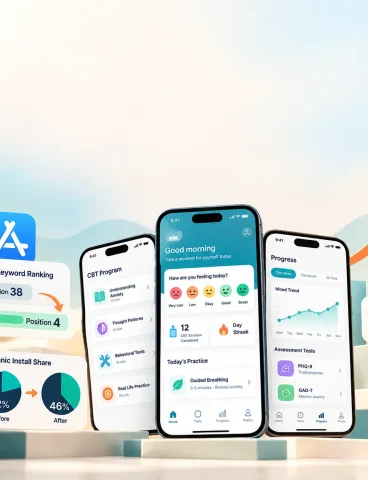
187% More App Installs for a Mental Health Startup via ASO

A Boston mental health app climbed from rank 38 to 4 on the App Store. Organic installs grew 187%, CPA dropped 33%, and AI search citations increased.

Mental health app ASO case study showing CBT app screens, App Store ranking growth from 38 to 4, and 46% organic install share
Home / Case Studies / App Store Optimization and AI Visibility Strategy for a Boston Based Mental Health Startup

App Store Optimization and AI Visibility Strategy for a Boston Based Mental Health Startup

Industry
Healthcare & Life Sciences
Geography
Boston, MA, United States
Cooperation Period
6 months

Overview

A Boston based digital health startup had built a clinical therapy companion app rooted in cognitive behavioral therapy (CBT), serving over 200,000 monthly active users across the United States. The app stood apart from the broader wellness category because it used validated clinical assessment tools, structured 12 week programs designed by licensed psychologists, and generated progress reports users could share directly with their therapists. The app had lost organic visibility on the iOS App Store, falling to position 38 for its primary search term and watching organic installs decline 41% year over year. Clixlogix conducted a full App Store Optimization audit, restructured keyword targeting across 127 tracked search terms, redesigned screenshot creatives with conversion tested messaging, and deployed a localized listing strategy across 8 additional English speaking markets. Within the initial 6 month period, the app reached position 4 for its primary keyword cluster, organic installs grew 187%, cost per acquisition from paid channels fell 33%, and AI powered search platforms began surfacing the app in recommendation responses.

About the Client

The Client is a digital health company headquartered in Boston, Massachusetts, operating a mobile app that delivers structured cognitive behavioral therapy programs to users dealing with anxiety, depression, and stress related conditions.

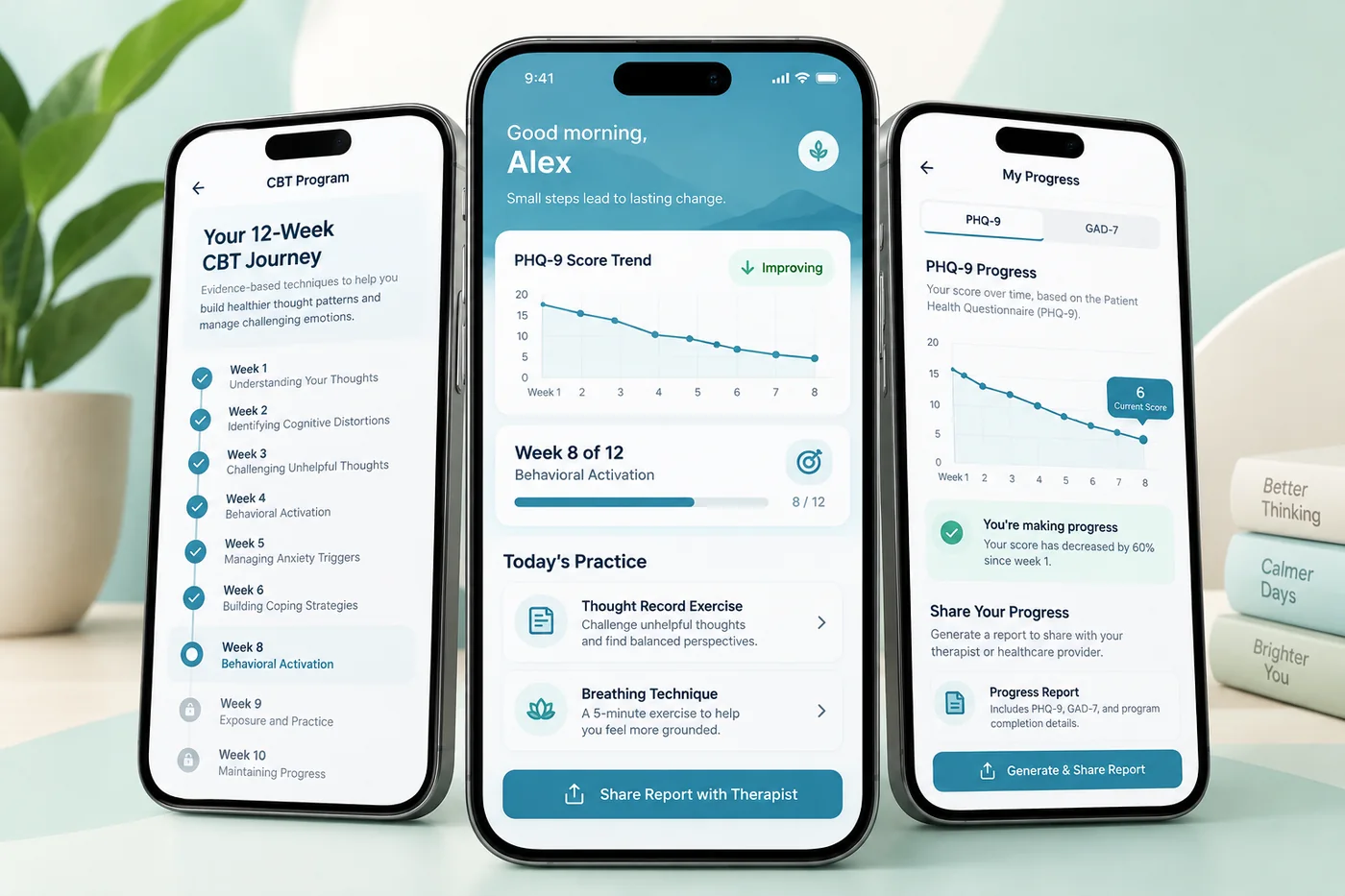
The app differed from the wellness and meditation tools on the App Store through its clinical architecture. The app delivered structured 12 week CBT programs designed by licensed psychologists, built around the same therapeutic techniques used in clinical settings. Users worked through thought records to challenge cognitive distortions, behavioral activation plans to break avoidance cycles, and graded exposure hierarchies for anxiety management. The app measured therapeutic progress using the PHQ-9 (Patient Health Questionnaire) for depression and the GAD-7 (Generalized Anxiety Disorder scale), both validated clinical instruments used across clinical practice and research settings. At the end of each program cycle, the app generated a sharable progress report that users could bring to sessions with their therapist or primary care provider.

This clinical rigor showed up in the retention data. The app maintained a 60 day retention rate of 38%, more than 10 times category norms for health and fitness apps. Users who completed at least 3 CBT modules stayed active for an average of 4.7 months. The product worked. The App Store had stopped telling people it existed.

iPhone mockup of the CBT therapy app showing PHQ-9 progress tracking and structured session interface

Fig 1 - The app delivered structured CBT programs built on validated clinical measurement

The Challenge

The Client’s app faced 5 connected problems, each feeding the next.

Organic visibility had collapsed over 12 months - Across the prior year, the app dropped from position 11 to position 38 for “anxiety therapy app” on the iOS App Store. Competitive analysis showed that apps with fresher metadata and higher conversion rates from listing views to installs had moved into the positions the Client previously held. The Client had not updated the listing in 14 months. Organic installs fell 41% year over year during a period when the broader mental health app category was still growing.

The listing creative was clinically accurate but commercially invisible - The Client’s product team had designed the screenshot set, and it showed the interface clearly. The screenshots used clinical language like “CBT Module Library” and “Mood Tracking Dashboard,” terms that mean something to therapists and little to someone searching “help with anxiety” at 2 AM. The listing conversion rate from view to install sat at 14%, well below top performing apps in the health category.

Paid acquisition costs were climbing with no organic floor underneath them - Because organic installs were declining, the Client was spending more on Apple Search Ads and Meta campaigns to maintain install volume. Cost per acquisition had risen from $4.20 to $6.80 over 12 months, a 62% increase. Without a strong organic channel, every new user was a paid user. The unit economics worsened each quarter.

The app was invisible in AI powered search recommendations - A growing number of potential users were finding apps through conversational AI platforms like ChatGPT, Google AI Overviews, and Perplexity. When users asked these tools for “best apps for anxiety” or “CBT therapy app recommendations,” the Client’s app did not appear in any of the responses. The app had no structured content strategy outside the App Store listing, which left AI models with no verifiable publicly available content to reference when generating recommendations.

The clinical differentiator was buried in the listing - The single biggest competitive advantage the app had, its validated CBT methodology with PHQ-9 and GAD-7 tracking, carried no visibility in the App Store listing. The app looked like every other wellness tool in the category. A user scanning search results had no way to tell that this app offered structured clinical programs where the next one offered a breathing timer with ambient sounds. That distinction mattered clinically, and it mattered commercially because users searching for “CBT therapy app” or “anxiety treatment app” were looking for exactly what this product delivered.

Why this mattered

The Client had built a product that users genuinely valued, with retention numbers that proved it. Without organic visibility, growth depended entirely on paid spend, and that spend was becoming less efficient by the month. If the trend continued, the company would need to either raise its acquisition budget or accept a shrinking user base. Neither option was sustainable for a clinically validated product that users were not finding.

The Solution

Clixlogix structured the engagement in 4 parallel work tracks. All 4 started within the first 2 weeks because the problems were interconnected. Fixing keywords without fixing creatives would not move the conversion rate, and fixing creatives without fixing keywords would not move search rank. The clinical differentiator, the app’s validated CBT methodology and clinical assessment tools, became the strategic center of every track. The engagement combined ASO strategy, conversion rate optimization, creative design, and content strategy focused on AI visibility.

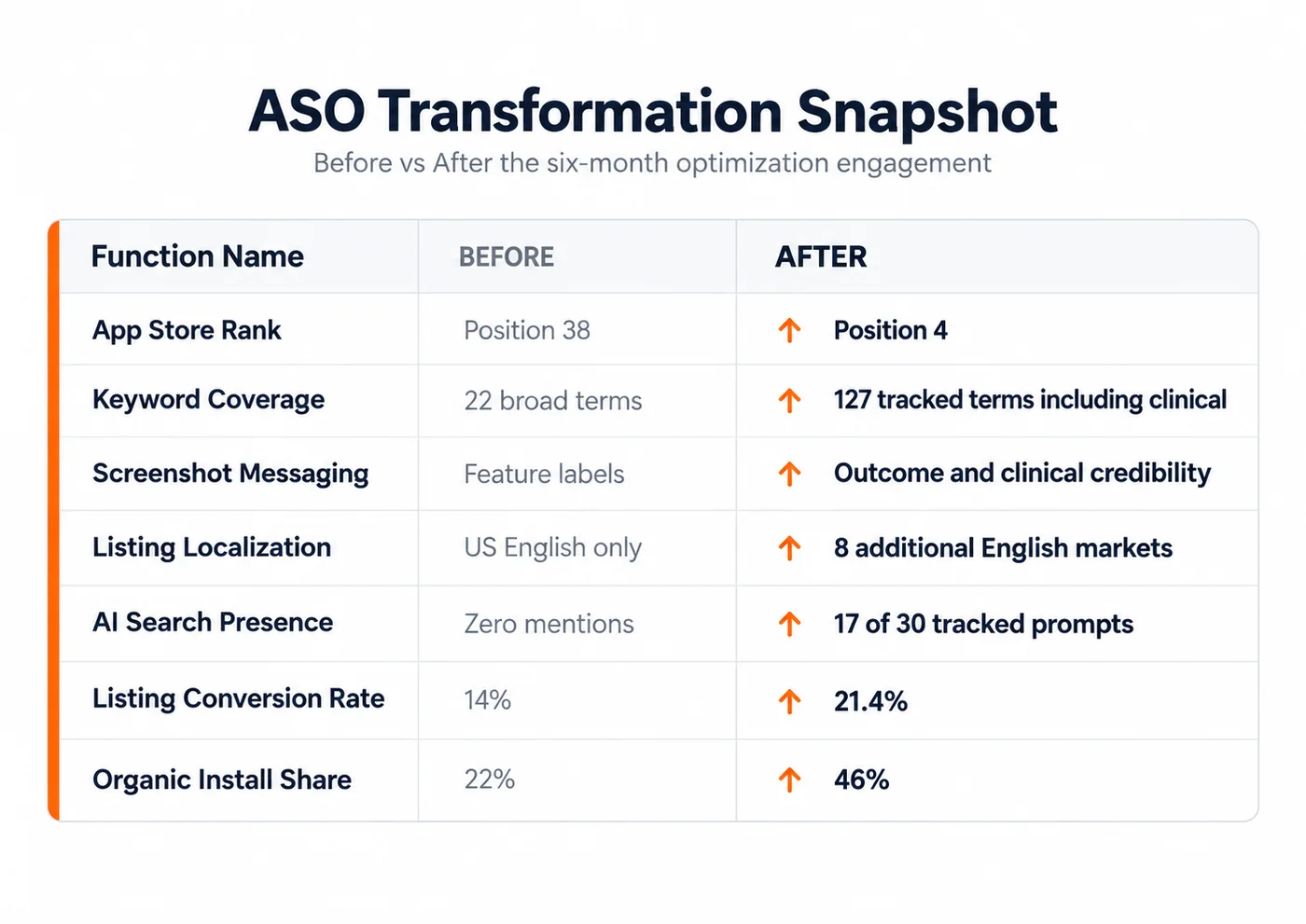
Before and after table showing 7 ASO metrics improving across the 6 month engagement period

Fig 2 - The engagement touched every dimension of the app’s public visibility, from keyword coverage to AI search presence

Track 1. Keyword Strategy and Metadata Restructuring

The existing keyword strategy covered 22 terms, most of them too broad to compete - Terms like “mental health” and “therapy app” carried search volume, and the top 5 positions for each belonged to apps with millions of installs and multi year listing histories. The Client’s app could not win on pure authority for those head terms.

Clixlogix ran a full keyword audit using data.ai, Sensor Tower, and Apple Search Ads keyword intelligence. The team mapped 340 candidate terms, scored them by search volume, competition density, and relevance to the app’s core value, and selected 127 terms for active tracking and optimization.

A note on how App Store keyword optimization works. Apple provides a 100 character keyword field per localization, plus the app title, subtitle, and category. The 127 figure represents the total number of search terms the team actively tracked and optimized for across all metadata fields and all localized listings. It is not 127 keywords entered into a single field.

The strategy prioritized mid tail terms where the app could realistically compete and where its clinical methodology gave it a credibility advantage. The team moved away from head terms like “therapy app” (dominated by BetterHelp and Talkspace) and targeted terms like “CBT thought journal,” “anxiety coping exercises,” “panic attack breathing app,” and “therapy between sessions.” The app’s clinical foundation opened a keyword cluster that pure wellness apps could not credibly claim, including “PHQ-9 tracker,” “CBT worksheets app,” and “cognitive distortion exercises.” These clinical terms carried lower individual volume and attracted users with high intent and almost no competition from meditation or general wellness apps.

The team deployed subtitle and keyword field updates in 3 staged rounds, each followed by a 10 day observation window to measure rank movement and isolate the effect of each change before the next round went live.

Why this track mattered

The app’s tracked keyword coverage went from 22 to 127 terms. Within 8 weeks, the app ranked in the top 10 for 34 of those terms and in the top 25 for 71. The clinical keyword cluster, terms that only a validated CBT app could credibly target, accounted for 11 of the 34 top 10 positions.

Track 2. Screenshot Creative Redesign

The original screenshots described features. The new ones described feelings and clinical credibility - That is the single biggest change that moved conversion.

Clixlogix ran a competitive analysis of the top 15 apps in the mental health category across the App Store and Google Play. The finding was consistent. The top converting listings led with emotional outcomes in their first 2 screenshots and not interface tours. Users searching for help with anxiety at 2 AM do not care about a module library. They care about whether the app will make tonight easier than last night.

Emotional messaging alone would have made the app look like every other wellness tool. The team leaned into the clinical differentiator as a trust signal. The redesigned creative set told 2 stories at once. The first story read “this will help you feel better” and the second read “this is built on real clinical science.”

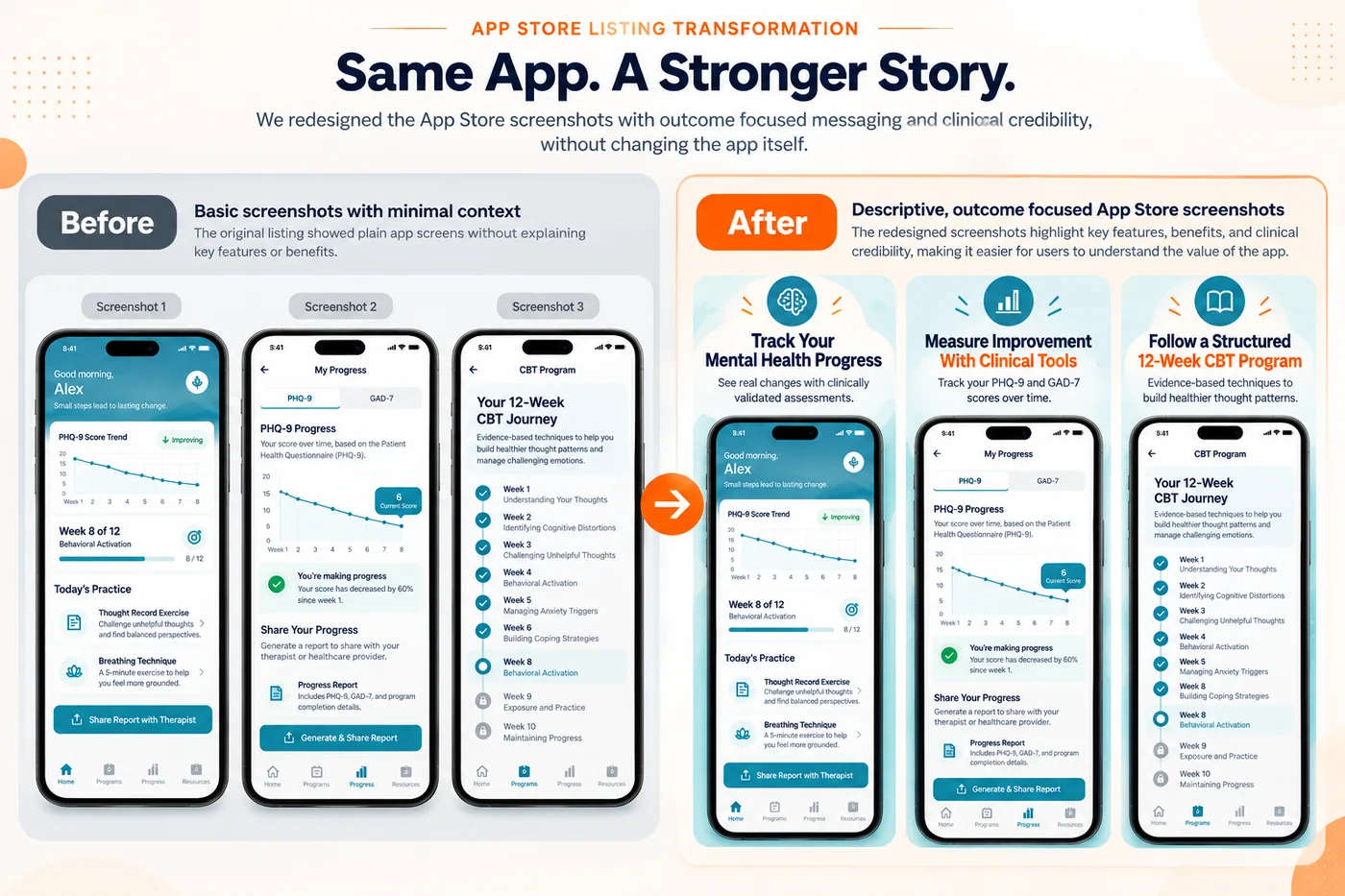
The team redesigned all 10 screenshot slots. The first screenshot led with “Calm your mind in 5 minutes” over a blurred background of the breathing exercise screen, and the remaining slots paired outcome oriented captions with specific clinical features such as the PHQ-9 improvement graph, the GAD-7 trend, and the therapist report sharing screen. The final 2 slots carried the app rating with a clinical credibility badge and a progress report preview with the “Used by 200,000+ people monthly” statement.

The team A/B tested the redesigned creative set using Apple’s product page optimization tool over a 21 day test window. The controlled test showed a 31% higher conversion rate for the new set compared to the original. Over the full 6 month engagement period, the overall conversion rate rose from 14% to 21.4%, a 53% relative improvement. The A/B test isolated the creative contribution, and the 53% reflects the combined effect of all 4 work tracks.

Side by side comparison of app store screenshots before and after the conversion focused redesign

Fig 3 - The new creatives led with emotional outcomes and clinical credibility

Why this track mattered

The controlled A/B test showed a 31% conversion lift from the creative redesign alone. Combined with improved keyword targeting across the full engagement, the overall listing conversion rate rose from 14% to 21.4%. Every user who saw the listing became more likely to download the app, amplifying the impact of every other track.

Track 3. Localized Listing Strategy

The app had a single listing, targeting a US audience in US English - That left a missed opportunity in a category with global search demand.

The mental health app category sees meaningful search volume in the United Kingdom, Canada, Australia, Ireland, New Zealand, South Africa, Singapore, and the Philippines, all markets where English is a primary or dominant language. Each of these App Store territories has its own search index, which means an app can rank for different terms in different countries using localized metadata.

Clixlogix created 8 additional localized versions of the listing (the US listing remained the primary), each tailored to regional search behavior. In the UK, “CBT” is a more commonly searched standalone term than in the US, where users tend to search for the full phrase “cognitive behavioral therapy.” In Australia, “mental wellbeing app” outperforms “mental health app” in volume. These small differences matter when an app is trying to rank in the top 10.

Each localized listing received its own keyword metadata, subtitle, and description. The team adjusted screenshot captions for regional spelling (colour vs. color, practise vs. practice) where appropriate. The team localized promotional text to match regional messaging conventions, which supported listing conversion rates in each market. Promotional text does not directly influence App Store search rankings, so the team focused these updates on conversion support and not on search optimization.

Why this track mattered

The 8 additional market listings contributed 23% of total organic impressions by month 5 of the engagement. The UK market alone accounted for 14% of new organic installs during that period. These were users the app had been invisible to, at zero additional acquisition spend.

Track 4. AI Visibility and Structured Content Strategy

This track sat outside the standard ASO agency playbook - Most app store optimization work focuses entirely on the App Store and Google Play search algorithms. Clixlogix added a parallel strategy for AI powered search and recommendation engines, which represent a growing share of how users find apps.

The Client’s clinical differentiator mattered here more than anywhere else. AI recommendation engines favor apps with verifiable clinical claims when users ask health related questions. An AI engine surfaces a meditation timer with no clinical backing less often in response to “what is the best app for treating anxiety” than an app with documented CBT methodology and validated assessment tools. The strategy gave AI models the right information to make that distinction.

The approach had 3 components.

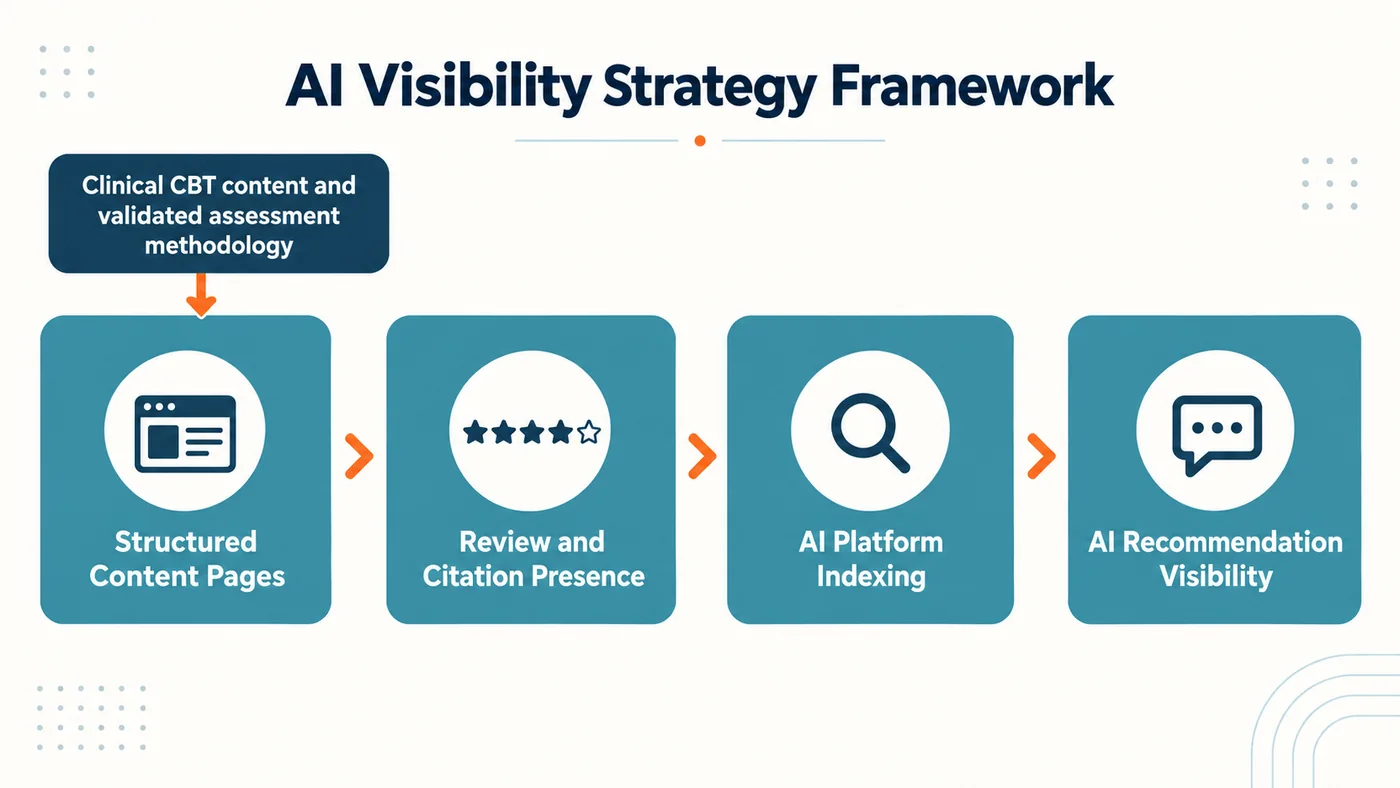
Structured web presence for AI crawling - The Client’s website had a basic landing page for the app, and it lacked the detailed, structured content that AI models pull from when generating responses. Clixlogix built out a set of pages that described the app’s clinical methodology, its CBT framework, the conditions it addresses, how PHQ-9 and GAD-7 scoring works within the app, user outcomes, and a comparison page (without naming competitors) that positioned the app against category alternatives. Each page carried clear H2 and H3 headings, FAQ sections using schema markup, and concise answer paragraphs that matched the structure AI models tend to extract when generating recommendation responses.

Review and citation presence - The team worked with the Client’s customer success group to encourage detailed app reviews on the App Store and Google Play that mentioned specific use cases such as anxiety management, panic attack relief, structured CBT programs, and progress tracking. These reviews and their content are publicly accessible data that AI platforms may reference. The team also placed the app in credible health technology directories and listicle articles on established wellness publications, each with a description that matched the natural language queries users ask AI tools.

Prompt testing and monitoring - Clixlogix built an internal test framework that ran a set of 30 natural language prompts through ChatGPT, Google AI Overviews, Perplexity, and Claude on a weekly basis. Prompts included “best app for anxiety relief,” “CBT therapy app recommendations,” “apps for managing panic attacks,” and similar queries. The team tracked whether the Client’s app appeared in responses, what position it held, and what language the platform used to describe it. This exercise tracked visibility, and it was not a direct measure of installs from AI sources, since attribution from AI platforms to app installations is not yet reliably measurable.

Within 4 months, the app appeared in responses for 9 of the 30 tracked prompts. By the end of the initial 6 month period, that number had reached 17 of 30, with Google AI Overviews and Perplexity the most consistent in surfacing the app.

4 stage AI visibility strategy from structured clinical content to AI recommendation output

Fig 4 - The AI visibility strategy used the app’s clinical foundation as the content anchor for recommendation engines

Why this track mattered

Projections place traditional search engine volume declining by 25% as users shift to AI chatbots and virtual agents. Getting the app into AI powered responses now, while most competitors in the mental health category ignore this channel entirely, gives the Client a structural advantage that strengthens as AI search adoption grows.

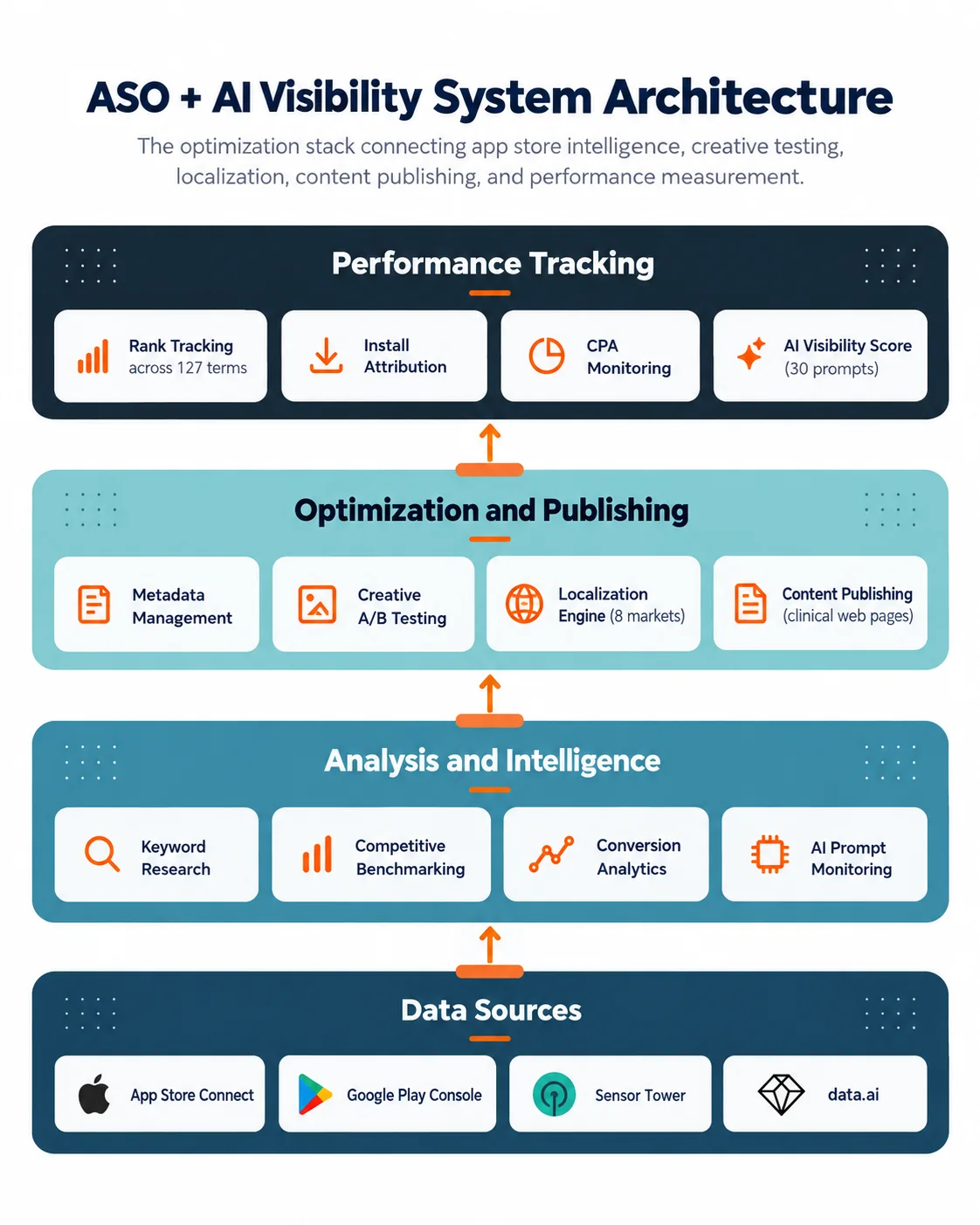
System architecture showing the 4 layer ASO and AI visibility optimization stack

Fig 5 - The full optimization stack connected App Store intelligence, AI search monitoring, and clinical content publishing

Results

The initial 6 month engagement produced measurable outcomes across every tracked metric. Work continues under a retainer model.

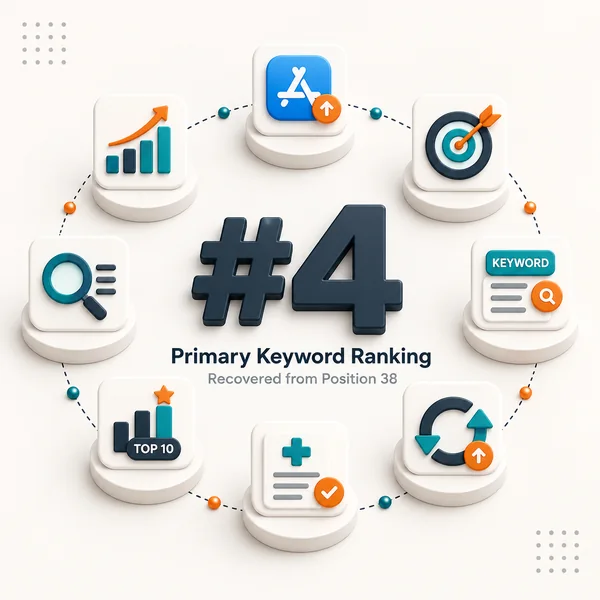
#4 Primary Keyword Ranking Recovered from Position 38

#4 Primary Keyword Ranking Recovered from Position 38

The app climbed from position 38 to position 4 for "anxiety therapy app" on the iOS App Store within the initial 6 month period. The app also reached the top 10 for 34 tracked terms across the primary keyword cluster, up from 3 at the start. Of those 34 top 10 rankings, 11 were clinical terms (such as "CBT worksheets app" and "PHQ-9 tracker") where the app faced almost no competition from general wellness tools.
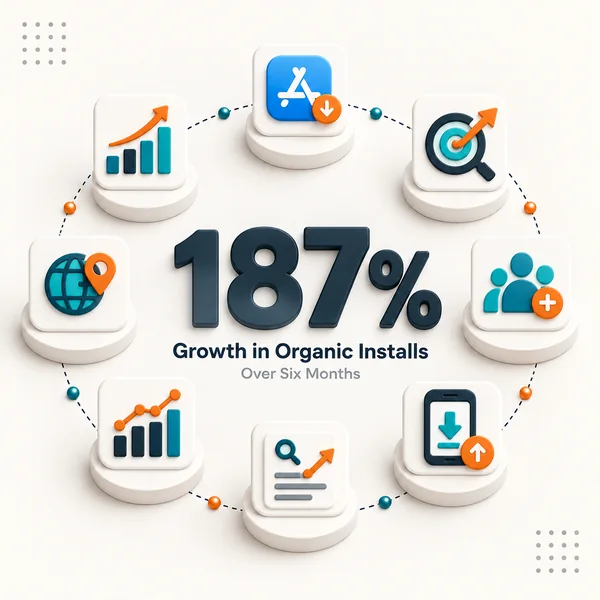
187% Growth in Organic Installs Over Six Months

187% Growth in Organic Installs Over Six Months

Monthly organic installs grew from approximately 8,400 to 24,100 over the initial 6 month period. This reversed a 41% year over year decline and put organic growth ahead of the Client's internal projections. The growth came from the combined effect of restructured keyword targeting, the redesigned screenshot set, and the 8 new localized market listings.
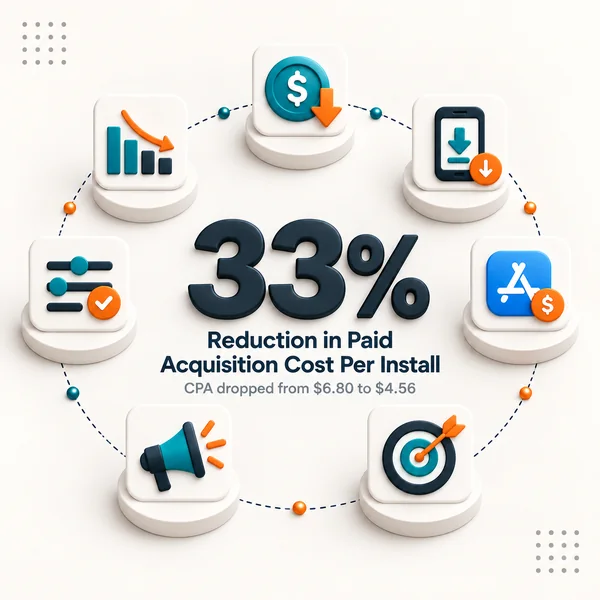
33% Reduction in Paid Acquisition Cost Per Install

33% Reduction in Paid Acquisition Cost Per Install

As organic installs picked up, the Client reduced Apple Search Ads and Meta spend without losing total install volume. CPA dropped from $6.80 to $4.56 across paid channels, reversing a 62% rise that had built up over the prior 12 months. Every install the organic channel absorbed was one the paid budget no longer had to buy.
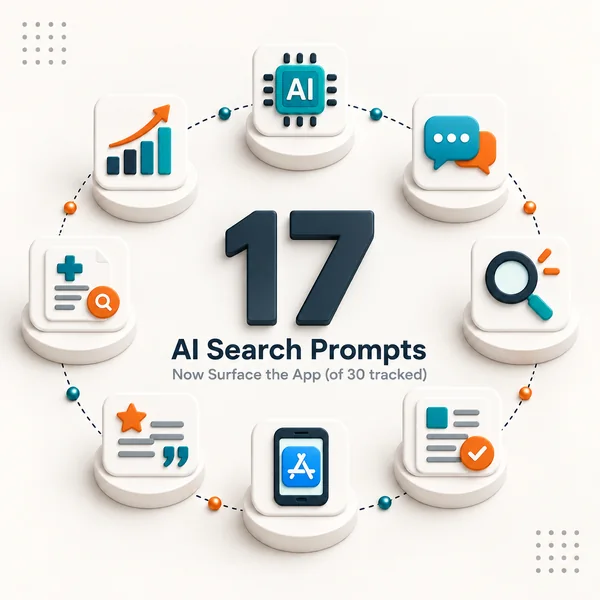
17 AI Search Prompts Now Surface the App (of 30 Tracked)

17 AI Search Prompts Now Surface the App (of 30 Tracked)

The app went from appearing in zero AI generated search responses to appearing in 17 of 30 tracked prompts across ChatGPT, Google AI Overviews, Perplexity, and Claude. AI generated descriptions consistently cited the app's clinical CBT methodology and validated assessment tools, which distinguished it from general wellness recommendations.
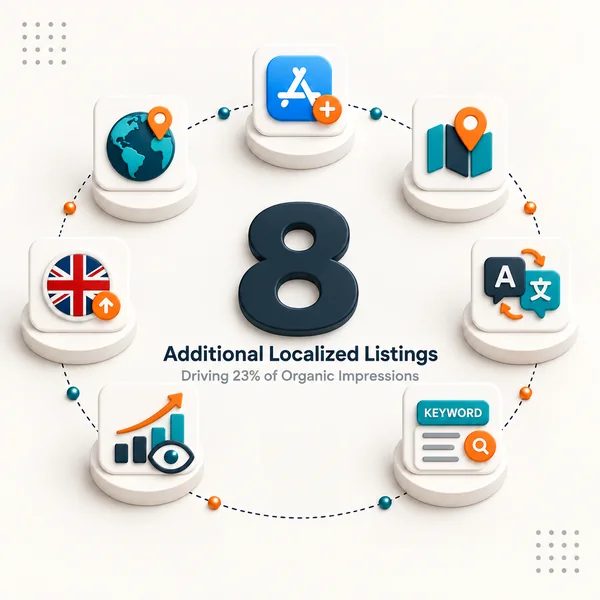
8 Additional Localized Listings Driving 23% of Impressions

8 Additional Localized Listings Driving 23% of Impressions

The team created 8 additional English speaking market listings alongside the primary US listing, each with localized keyword metadata and region specific messaging. By month 5, these listings accounted for 23% of total organic impressions, with the United Kingdom contributing 14% of new organic installs, all at zero additional acquisition spend.
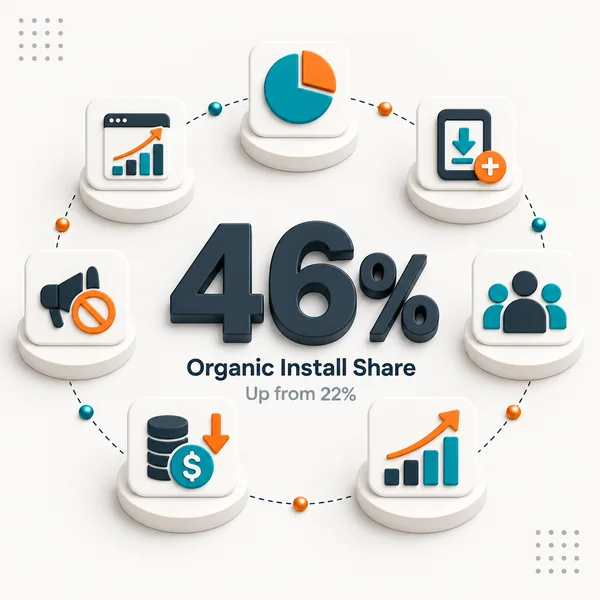
46% Organic Install Share, Up from 22%

46% Organic Install Share, Up from 22%

At the start of the engagement, organic installs made up 22% of total monthly installations, with the remaining 78% coming from paid channels. By the end of the initial 6 month period, organic installs accounted for 46% of total volume. This shift reduced the Client's dependence on paid acquisition spend and improved unit economics across the entire install base.

Market context

The Client’s end state CPA of $4.56 sits below the typical blended cost per install range for health and fitness apps on iOS in North America, which runs from $4 to $7 depending on channel mix and campaign type.

Technologies and Tools

AreaTechnologies and tools
App Store Intelligencedata.ai, Sensor Tower, AppTweak
A/B TestingApple Product Page Optimization
AnalyticsApp Store Connect, Google Play Console, Mixpanel (in-app events)
Creative ProductionFigma, Adobe Illustrator
AI Visibility MonitoringInternal prompt testing framework across ChatGPT, Google AI Overviews, Perplexity, Claude
Content PublishingWordPress (clinical web content), Ahrefs (web SEO tracking)
Project ManagementZoho Projects, Slack
Engagement ScopeASO strategy, conversion rate optimization, creative design, content strategy, delivery management

Table 1 - Technologies and tools used across the engagement

Services Delivered
Digital Marketing, App Store Optimization, Creative & Design, Content Marketing
Team Composition
ASO Strategist, Conversion Rate Optimization Specialist, Creative Designer, Content Strategist, Delivery Manager

Have a question for our team or need help with your project?

Our team can share client references, scope your project, and answer any question about your delivery.

File should not exceed more than 20MB
🔒 SECURE SSL ENCRYPTION

Related Case Studies

More engagements where our delivery teams shipped similar outcomes for clients across industries. Read on for context on the patterns we reused, the trade offs we navigated, and the metrics that landed in production.

Cargoz Champion React Native workflow app case study

Workflow App For UAE Warehouse Consumer Marketplace

Mobile App Development Digital Engineering Transportation & Logistics
Featured image for the AI marketing automation fleet management SaaS case study portfolio card

AI Marketing Automation and Predictive Lead Scoring for a Fleet Management SaaS Company in Paris

Digital Marketing Marketing Automation Consulting Service AI
View All App Store Optimization Case Studies
Company
  • About Us
  • Our Team
  • How We Work
  • Culture & Diversity
  • Mission, Vision & Values
  • Security & Compliance
Explore
  • Case Studies
  • Solutions
  • Reviews
  • Partner With Us
  • Careers
  • Contact Us
  • Blogs
  • Latest Zoho Updates
Services
  • AI Software Development
  • AI Eval Framework
  • Vibe Coding Development
  • Vibe Coding Cleanup
  • ERP Services
  • CRM Services
  • Zoho Services
  • Zoho Consulting
  • Low Code Development
  • Ecommerce Development
  • SEO Services
  • SEO Reseller
  • SEO Guarantee
  • Marketing Automation
  • AI Video Production
  • All Services
Industries
  • Healthcare
  • Banking & FinTech
  • Retail
  • Manufacturing
  • Energy & Utilities
  • Automotive
  • Real Estate
  • Agriculture
  • Beauty & Wellness
  • Sports & Fitness
  • All Industries
Follow Us
  • 12,272 Likes
  • 2,831 Followers
  • 4.2 Rated on Google
  • 22,526 Followers
  • 4.5 Rated on Clutch
© 2026 Clixlogix Technologies Pvt. Ltd. All rights reserved. DMCA Protected GSTIN : 09AAECC5421E1ZZ CIN : U74140UP2011PTC129448
Privacy PolicyTerms of ServiceSitemapRefund PolicyDelivery PolicyDisclaimer