TL;DR
- The latency to reasoning tradeoff that defined enterprise voice AI for five years is over. Base model responses benchmark at approximately two seconds for phone agent scenarios.
- Gemini 3.8 Live keeps the conversation moving while backend tool calls resolve, so users do not sit through dead air during database lookups or clinical calculations.
- Five verticals carry the clearest ROI math in the first six months after the September 15 rollout: utilities, healthcare, insurance, wealth management, and fleet logistics. Each one ties the technology to a specific operational metric that moves.
- Five production edge cases separate a working demo from a deployment that holds up at scale. Session lifetime, tool call cancellation, mobile session resumption, instruction economics, and observability gaps each have a known mitigation pattern.
- Context caching is not currently supported on the Live API. Context window compression and ruthless instruction minimization are the practical substitutes, and they can decide whether a multi language deployment is profitable or losing.
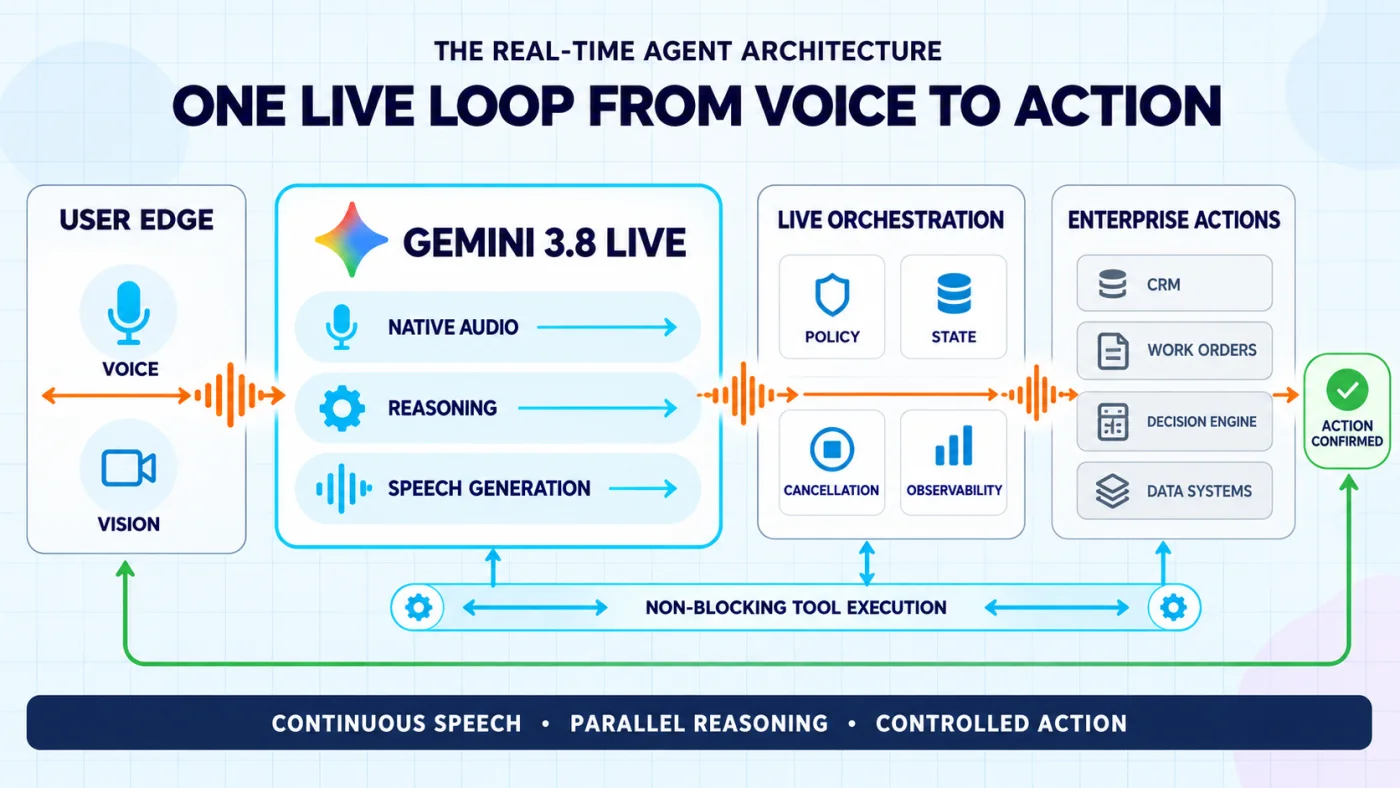
Fig 1 – Gemini 3.8 Live orchestrates native speech, reasoning, and tool execution in a single real time loop, removing the handoffs that made legacy voice agents feel robotic
The latency to reasoning tradeoff has shaped every enterprise voice agent deployment of the last five years. Operations teams building conversational AI faced a difficult choice. A fast voice bot responded in under a second, with reasoning that stopped at a decision tree. A multi step reasoning AI agent handled complex workflows and left users listening to four to eight seconds of silence during each reasoning step. In commercial environments, that silence breaks user trust, degrades customer satisfaction scores, and makes hands free industrial use cases unworkable.
Google’s September 15, 2026 release of Gemini 3.8 Live collapsed that tradeoff. The new Multimodal Live API couples native speech to speech processing with non blocking asynchronous tool execution, allowing a voice agent to think deeply, query enterprise systems, and run deterministic calculations while sustaining continuous spoken dialogue.
In the weeks since release, our team has been testing production integration patterns across utilities, healthcare, insurance, financial services, and logistics workflows. The architectural shift is real. The commercial implications are significant for any operation that depends on voice interaction. This piece covers what changed, where the ROI math is clearest, and what operations buyers should expect from a serious integration partner.
The paradigm the rollout retired
Legacy voice systems rely on a cascaded pipeline. Speech to text transcribes audio, a large language model processes the text and queries databases, and text to speech synthesizes a response. Every handoff adds network latency and serialization overhead. More damaging, the model has to finish reasoning before the TTS can begin generating audio. If an agent needs to look up a customer’s policy, verify a parts inventory, or calculate a clinical dosage, the user hears silence. Teams have tried to mask that silence with filler audio. The experience stayed robotic.
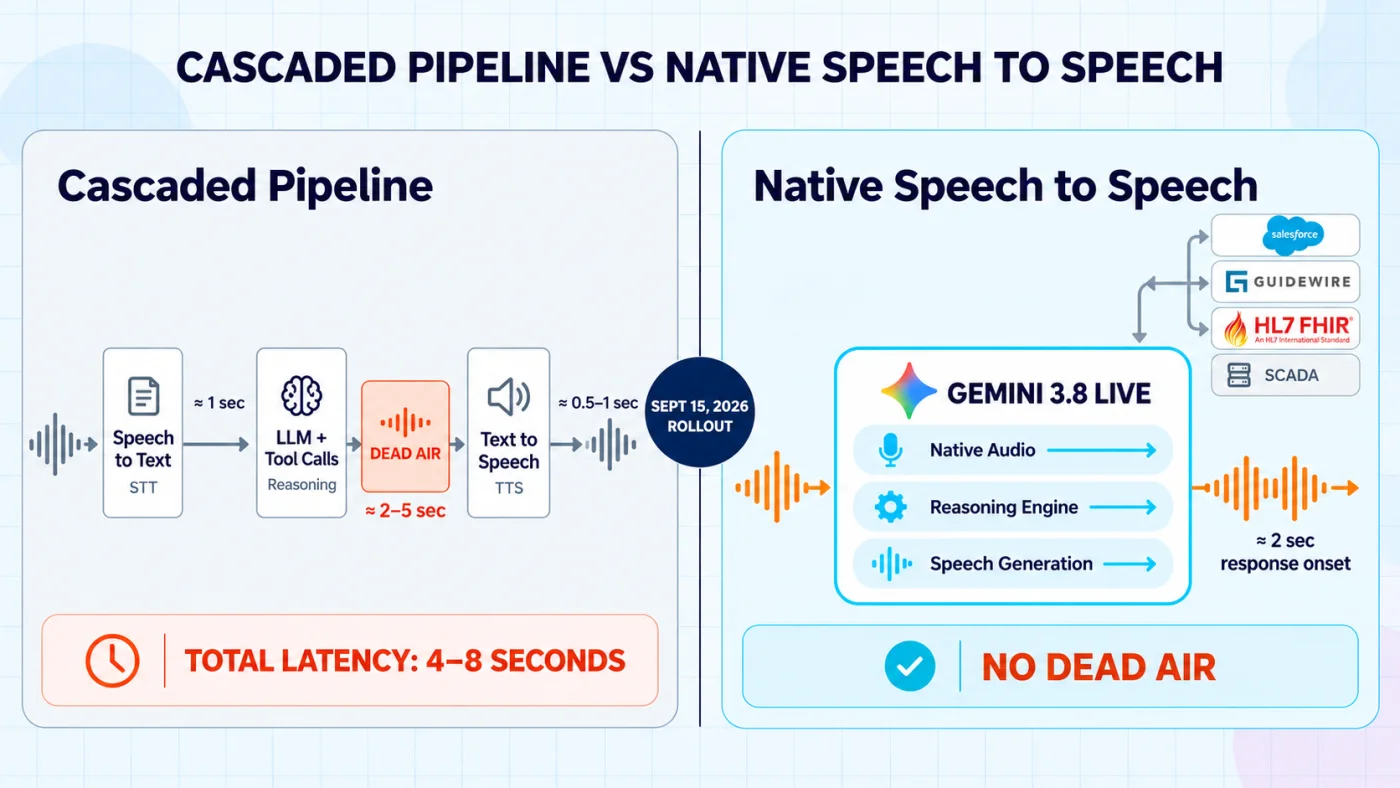
Fig 2 – Legacy voice systems chain speech to text, language model reasoning, and text to speech synthesis in sequence. Gemini 3.8 Live processes audio natively at the neural level, eliminating the handoffs and the latency they introduce
Gemini 3.8 Live eliminates the handoffs. Audio is processed natively at the neural level, and the reasoning engine is decoupled from the speech generation engine. In our early integration work with the API, the behavior holds up: the conversation keeps moving even when the model is executing backend tool calls. Benchmarks published in the first weeks of the rollout show the base model responding in approximately two seconds for phone agent scenarios. Gemini 3.8 Live Extended Thinking adds time for deeper reasoning while narrating its progress aloud, so users do not sit through dead air during multi step workflows.
The Five Clocks Behind Zero Latency
Voice agent latency is not one measurement. A deployment can begin speaking quickly while completing the underlying task slowly, or execute a tool quickly while leaving the user in silence. Production teams need to measure five separate clocks.
Table 1 – The 5 latency clocks a zero latency voice deployment measures separately, and what each one reveals
A zero latency experience depends on the response onset and conversation continuity clocks staying ahead of the user’s perception. The remaining work can proceed safely in the background without affecting how fast the system feels.
Core architectural enablers
Three capabilities make the shift commercially usable.
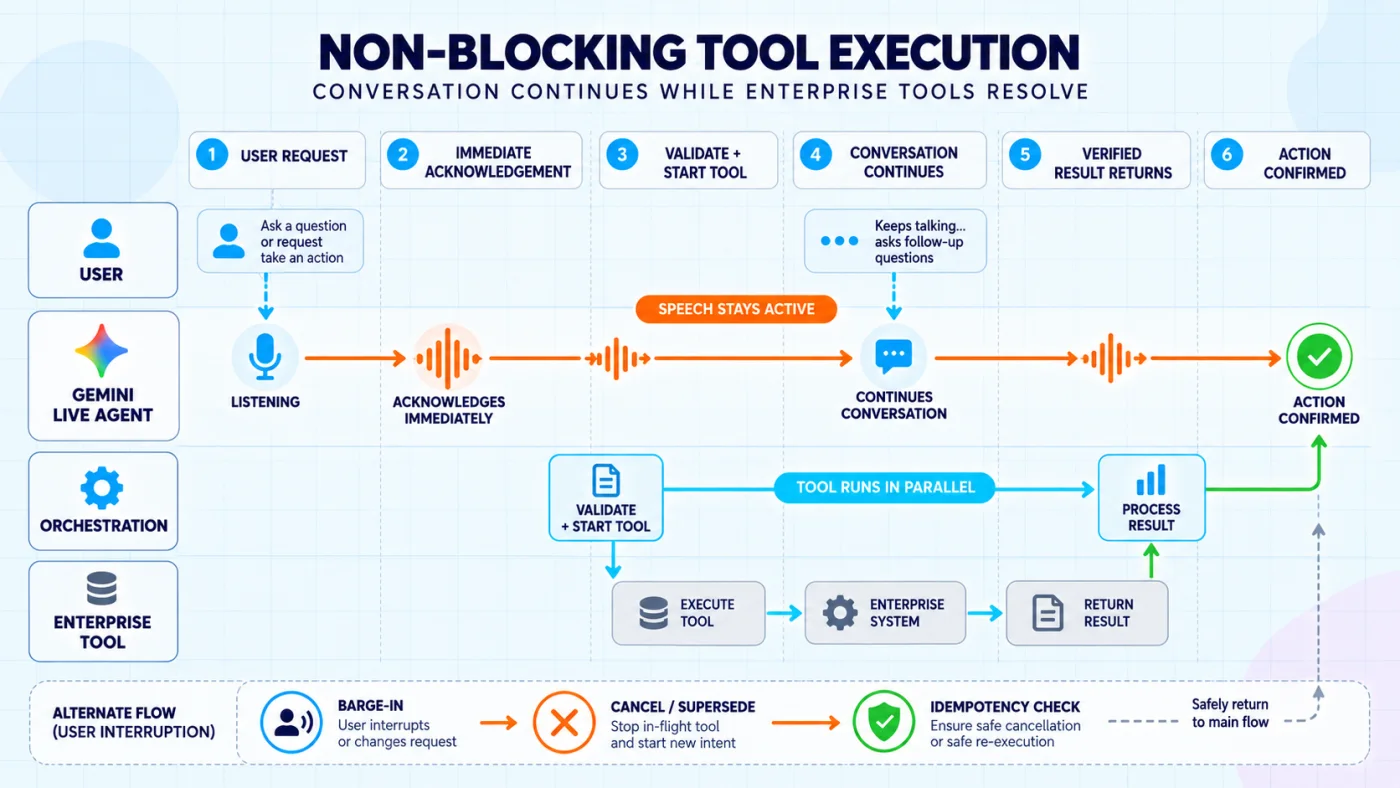
Fig 3 – In a non blocking configuration, the agent continues speaking while backend tool calls resolve. Database lookups, enterprise API queries, and clinical engine calculations complete in parallel with ongoing conversation
In cascaded systems, when an AI triggers a tool call to Salesforce, a vector database, or a core banking platform, the model freezes until data returns. Gemini 3.8 Live keeps generating speech during that wait. The agent narrates its action in natural language (“I am pulling your policy details now”) and integrates the result into its next sentence when the data arrives. The commercial effect is a conversation that moves at human pace even when it is reaching across six enterprise systems. Gemini 3.8 Live Extended Thinking enforces this pattern strictly. The API throws a hard error if a tool is registered with a blocking configuration, which forces engineering teams to design every integration as non blocking from day one.
Barge in with voice activity detection
Natural conversation is interruption heavy. If a voice agent cannot handle interruptions gracefully, users disengage within the first exchange. Gemini 3.8 Live stops speaking the moment a user interrupts and retains the context of the thought it was expressing. It then processes the new directive and pivots. In our testing across customer intake workflows, the barge in behavior is clean enough that users rarely notice the agent is non human.
Multimodal context at the neural level
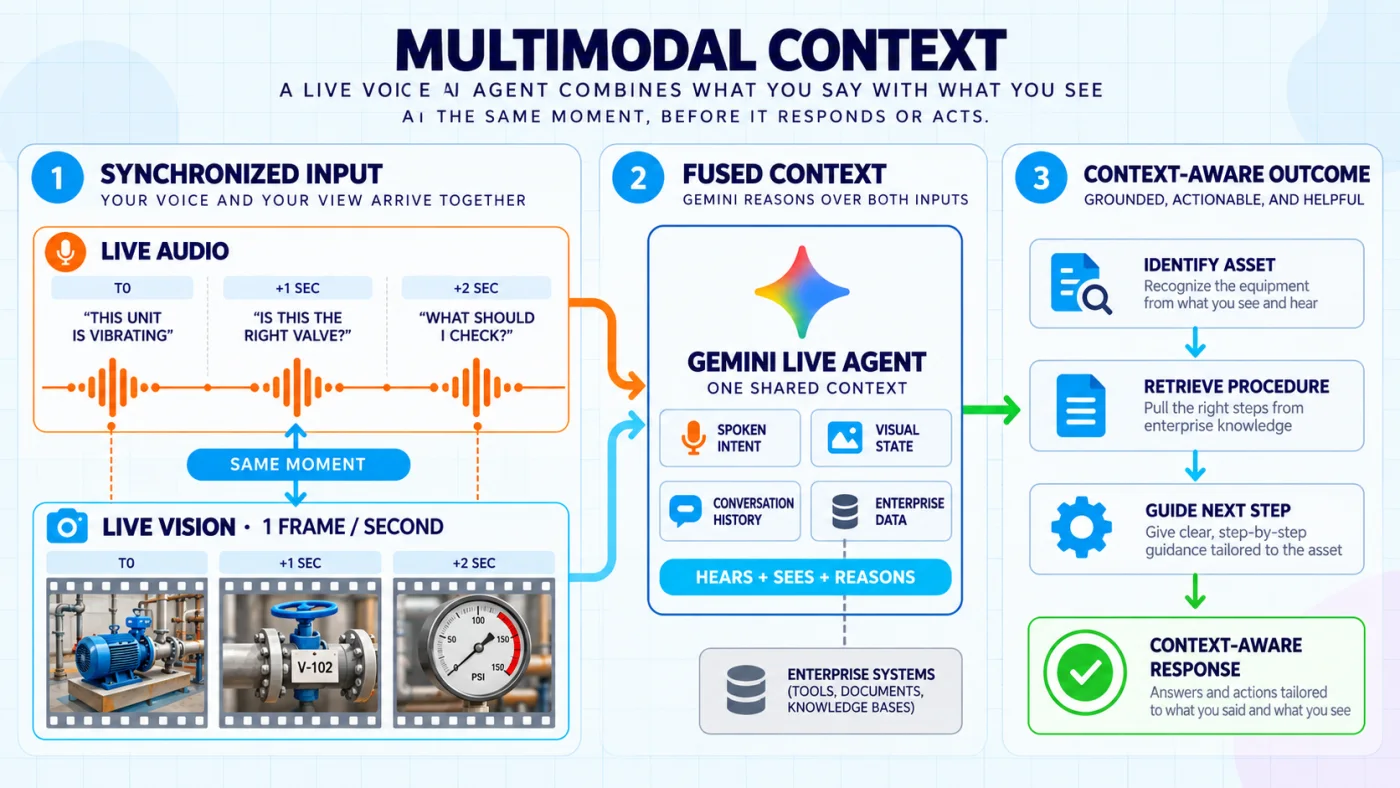
Fig 4 – The model ingests one frame per second of live video alongside the conversational audio and text context, letting the agent reason over what the user is looking at and talking about simultaneously
The model ingests live video frames at one frame per second alongside its large context window. For operations teams, this bridges digital knowledge and physical environments. An adjuster at a storm site, a technician at a substation, or a clinician at a patient bedside can share what they are looking at, and the agent reasons over the visual input and the conversational history together.
High ROI industry applications
Five verticals where the economic case is clearest in the first six months after the release.
Energy and Utilities Field Operations
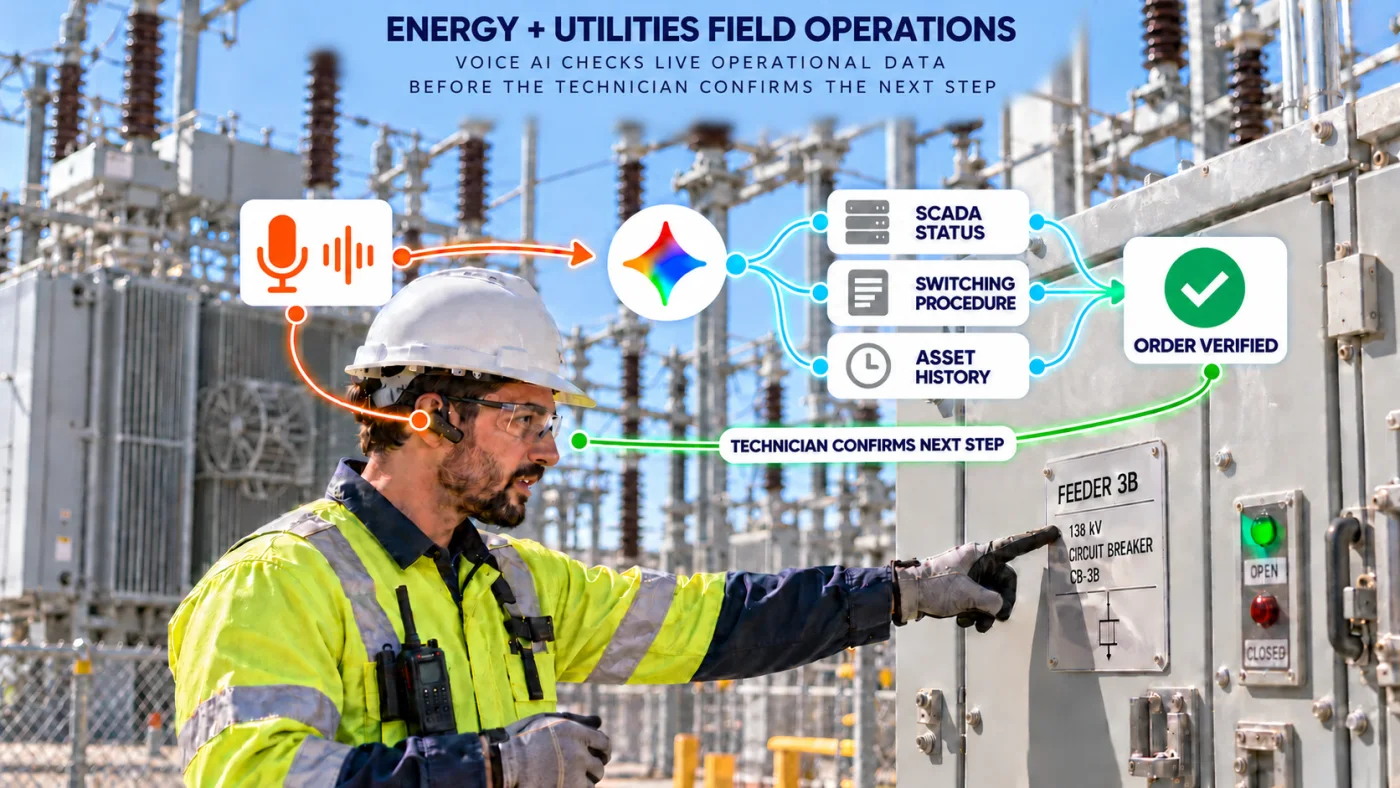
Fig 5 – A substation technician verifies a switching order verbally through safety eyewear while the agent cross references SCADA telemetry and NERC CIP documentation in the background
Grid reliability leaders carry visible operational metrics: SAIDI, SAIFI, and the regulatory penalties attached to extended outages. The economics of voice AI in field operations tie directly to those metrics. Faster switching verification, cleaner audit evidence, and reduced incident rates each translate to lower regulatory exposure and higher customer satisfaction scores at scale.
- The business challenge - Substation technicians, linemen, and pipeline inspectors operate in environments where touching a screen is slow, awkward under protective gear, and sometimes dangerous. Switching order verification and lockout/tagout protocols demand rigorous procedural adherence. Technicians need their hands free for tooling and their eyes on the equipment they are working on.
- The solution - A voice native agent integrated with IEC 61850 substation automation architectures, geographic information system asset databases, and work order management platforms. The agent verifies switching orders against live SCADA telemetry, retrieves equipment fault history through non blocking tool calls, and walks technicians through lockout/tagout procedures step by step. Visual input from a chest mounted camera or safety eyewear lets the agent confirm the technician is working on the correct asset before any switching action.
- The ROI - Measurable reduction in safety incidents, faster mean time to restoration during grid outages, and an auditable compliance log that satisfies NERC CIP reliability standards. For an investor owned utility running a thousand field crews, a one percent improvement in restoration time translates to millions in avoided customer minutes of interruption penalties.
Clinical Healthcare and Surgical Triage
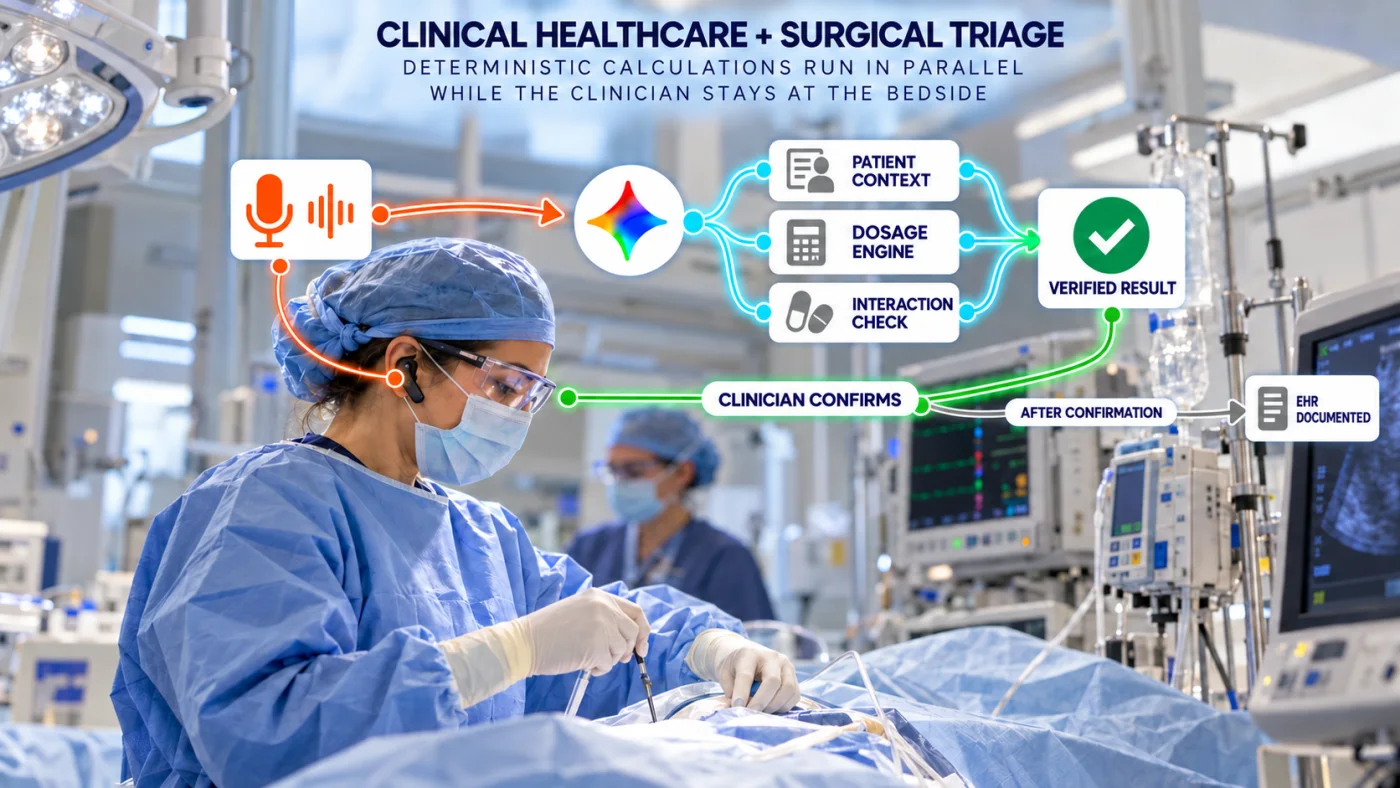
Fig 6 – In a sterile procedure suite, a clinician queries patient data and dosage calculations by voice. The agent routes the math to a deterministic clinical engine and documents the result in the EHR
Clinical leaders weigh every automation initiative against patient safety, documentation burden, and the reality that physician and nursing time is the most expensive line in the operating budget. Voice AI that keeps clinicians at the bedside, reduces manual EHR entry, and routes safety critical calculations to deterministic engines addresses all three constraints at once. For hospital systems operating at a one percent clinical margin, the ROI math shows up quickly.
- The business challenge - Sterile environments like operating rooms, procedure suites, and ICU bays prevent clinicians from touching screens to retrieve patient data, verify medication histories, or calculate dosages. The alternative, calling a colleague to pull data at a workstation, breaks focus and introduces delay at moments where seconds matter.
- The solution - A voice native assistant integrated with HL7 FHIR electronic health record systems and clinical decision support engines. Because medical calculations require zero hallucinations, the agent routes dosage math and interaction checks to deterministic clinical engines through non blocking tool calls, speaks the result conversationally, and documents the action in the EHR. For deployments subject to HIPAA, Clixlogix implements the voice stack on Vertex AI under a signed BAA, with zero data retention configured at the project level and OAuth based service credentials scoped to each deployment.
- The ROI - Improved surgical focus, reduced cognitive load on clinicians, and tighter adherence to clinical safety protocols. Hospital systems running this pattern across procedure suites report shorter case times and lower documentation burden for operating staff.
Insurance Claims and Field Adjuster Operations
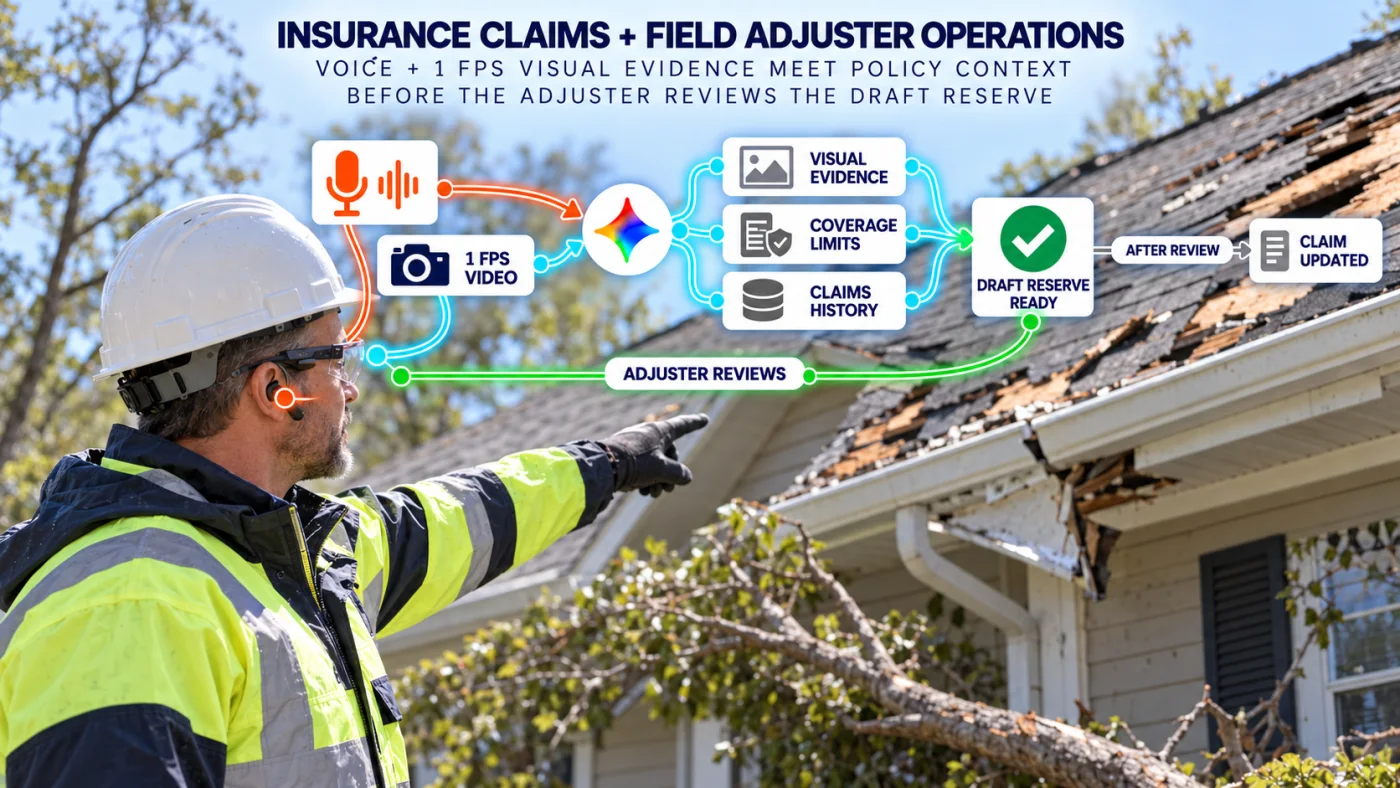
Fig 7 – A field adjuster at a storm damaged property narrates the loss assessment. The agent ingests one frame per second video of the damage and pulls coverage limits from the carrier’s core claims platform
Claims leaders at property and casualty carriers run businesses where cycle time is a revenue driver, reserve accuracy is a regulatory concern, and claimant experience is a retention lever. Catastrophe seasons stress all three at once. Voice AI that lets adjusters document, triage, and set reserves from the loss site without opening a laptop changes the operating economics across every one of them.
- The business challenge - Property and casualty adjusters inspecting loss sites, roof collapses, storm damage, fire losses, and auto accidents, have to document physical evidence, cross reference policy coverage, and set initial reserves under difficult field conditions. A clipboard or laptop mid interview slows cycle times and erodes claimant trust during the moments that matter most for retention.
- The solution - A multimodal voice agent on mobile devices or safety eyewear. The agent ingests one frame per second video of property damage, parses the adjuster’s spoken assessment, and triggers non blocking queries against core claims platforms like Guidewire or Duck Creek using ACORD data standards. The agent cross references coverage limits in real time. It drafts initial reserve recommendations the adjuster can review before leaving the site.
- The ROI - Compressed cycle time from first notice of loss to settlement, narrower reserve variance across catastrophic events, and higher net promoter scores at the point of claim. Deployed well, this moves settlement timelines from weeks to days and gives claims leaders in insurance and financial services earlier visibility into total loss exposure.
Wealth Management and High Stakes Advisory
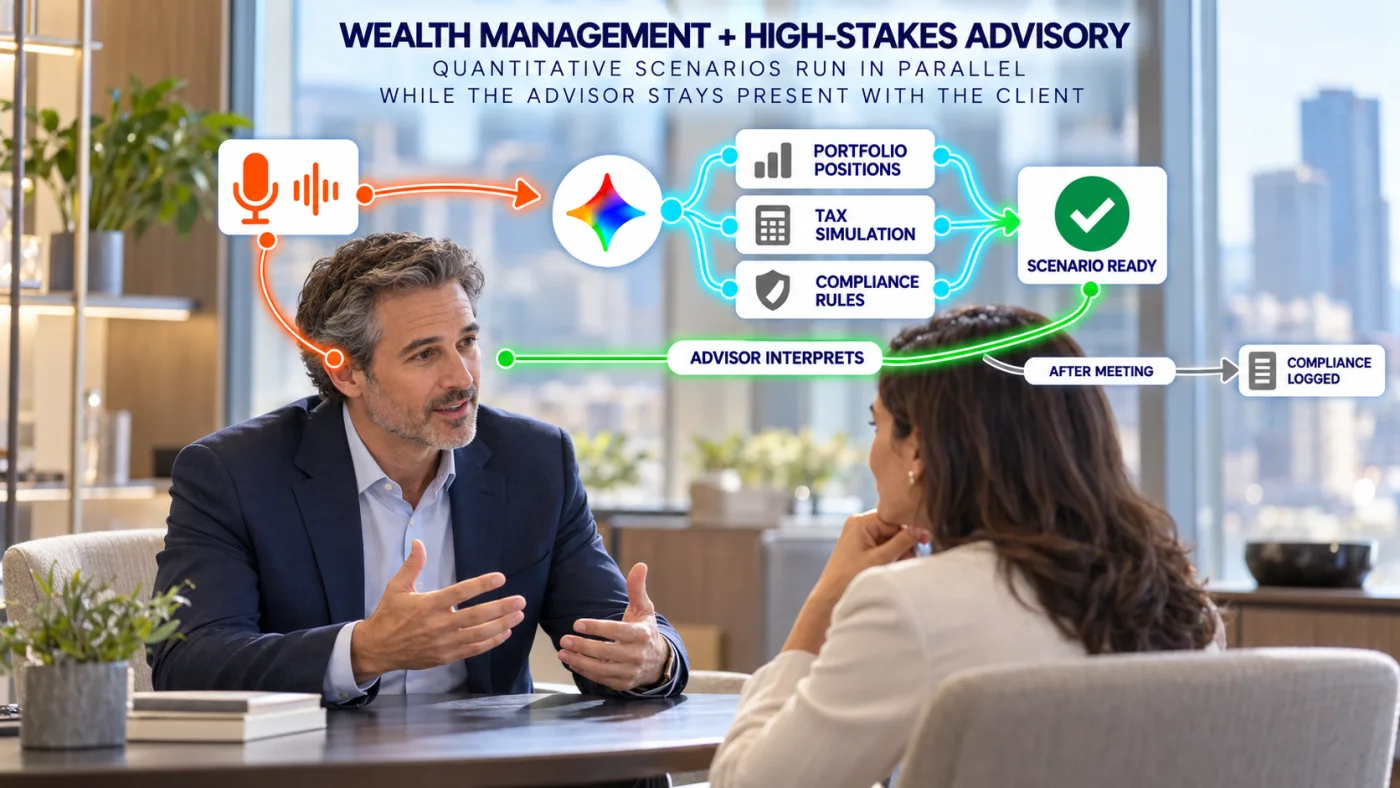
Fig 8 – During a live client meeting, an ambient voice agent runs quantitative simulations in the background and surfaces the strategic outcome conversationally, letting the advisor stay present with the client
Wealth management firms compete on advisor productivity and the depth of the client relationship. The gap between a mediocre advisor meeting and a great one is often measured in whether the advisor stayed present or stepped out to run analytics. Voice AI that executes quantitative work in the background during the meeting itself gives firms a measurable lever on both advisor capacity and client retention.
- The business challenge - Wealth managers model tax implications, portfolio drift, and liquidity scenarios during live client consultations. Breaking out of the conversation to run a Monte Carlo simulation or query the custodian for intraday positions interrupts the trust that makes the meeting valuable.
- The solution - An ambient voice agent that participates in the consultation and executes parallel microservices against the firm’s quantitative stack. When an advisor asks what the tax consequence of liquidating forty percent of a concentrated holding would be, the agent runs the simulation in the background and delivers the strategic outcome conversationally within seconds. The agent also logs the exchange against the firm’s compliance archive, satisfying FINRA record keeping obligations without additional advisor effort.
- The ROI - Faster decision cycles in client meetings, measurable improvement in cross sell during live consultations, and a defensible compliance trail. For a financial services firm with two hundred advisors, every additional five minutes of productive client time per meeting translates to meaningful fee revenue over the year.
Fleet Logistics and Supply Chain
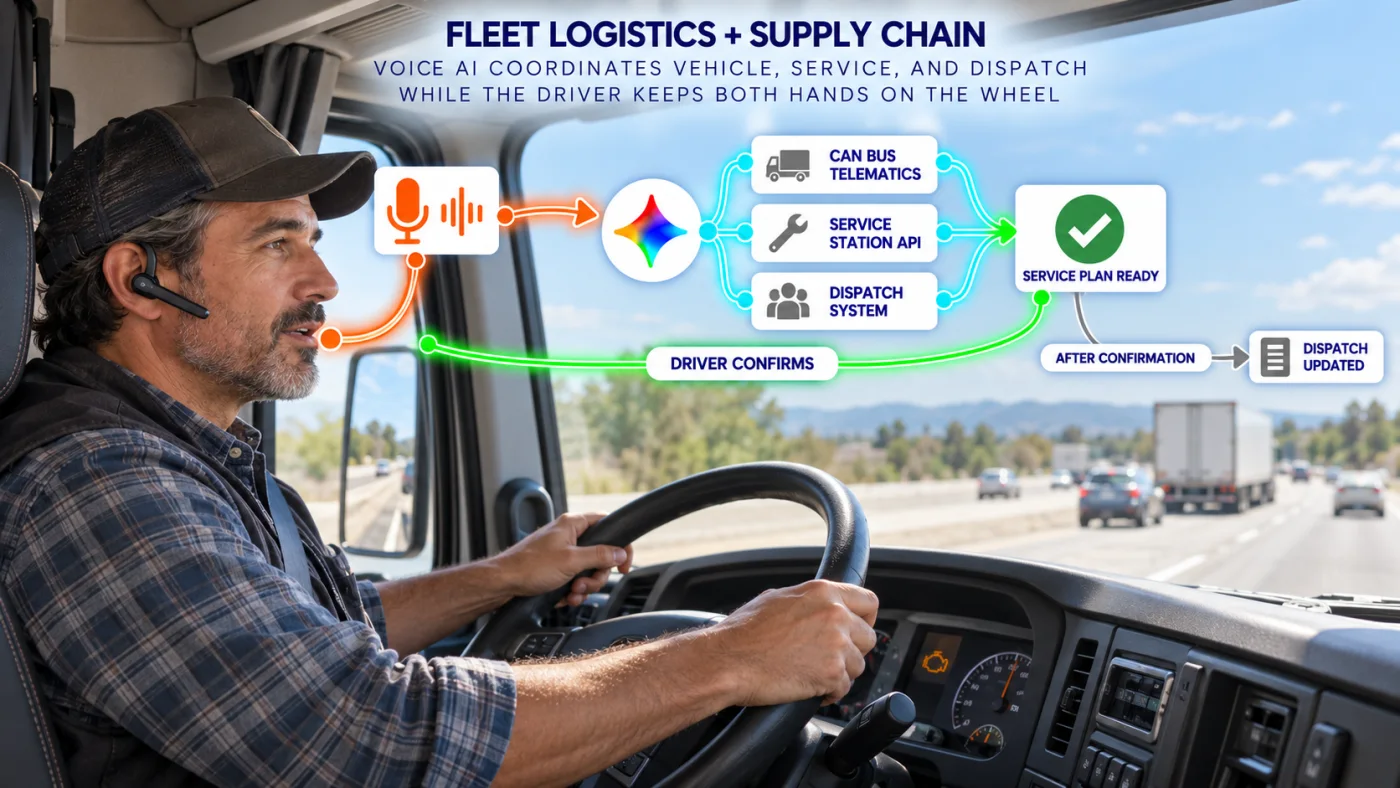
Fig 9 – A driver consults the voice agent about an engine fault code. The agent queries CAN bus telematics, service station APIs, and the carrier dispatch system without the driver taking hands off the wheel
Fleet operators run businesses where fuel, equipment uptime, driver retention, and insurance exposure sit on a single P&L. Each of those lines is sensitive to decisions made in the cab, often under time pressure and often alone. Voice AI that gives drivers a competent operations partner they can speak to while keeping their hands on the wheel directly affects every line on that P&L.
- The business challenge - Commercial drivers and dispatchers operate in noisy, high throughput acoustic environments where looking at a routing tablet is dangerous and keyboard input is impractical. Equipment faults, dispatch changes, and compliance checks all compete for attention in the cab.
- The solution - A voice agent integrated with the vehicle’s CAN bus telematics, routing APIs, and the carrier’s dispatch system. The agent monitors engine fault codes in real time. When a warning light triggers, the driver asks what it means. The agent diagnoses the issue, queries weather and routing APIs to find the nearest certified service station, and coordinates with dispatch to adjust the manifest. Because mobile networks lose packets, the voice stack runs on top of a WebRTC media gateway at the edge, which absorbs cellular jitter and keeps the session alive across tower handoffs.
- The ROI - Prevention of catastrophic equipment failure, lower fuel burn through dynamic rerouting, and improved driver hours of service compliance. For fleet operators across automotive and mobility, a mid sized carrier of five hundred tractors sees a two percent fuel economy improvement and a measurable reduction in roadside breakdowns that pays for the deployment within the first operating quarter.
Reliability notes for operations buyers
The deployment story in September 2026 is not entirely frictionless. Online feedback from engineering teams building with the Live API in its first weeks has surfaced several production edge cases that any serious operations buyer should expect their integration partner to address. Our team has observed the same patterns in internal integration testing. Each one has a known mitigation.
Session lifetime
Online feedback from engineering teams building with the API in the first weeks of rollout has described sessions closing near fifty eight minutes, with an advance warning signal before the connection ends. The behavior comes from early developer reports and remains undocumented at the platform level. Either way, for long customer calls, extended patient interviews, or multi step field service procedures, the agent needs graceful reconnect with full state restoration. Clixlogix builds voice agents to carry their conversational state in an application controlled store, so a server initiated close becomes invisible to the user.
When a user interrupts a long running tool call, the model does not reliably signal cancellation to the application layer. For irreversible actions like payments, dispatch, or patient medication records, this creates a risk of duplicate execution. Clixlogix implements application level idempotency keys on every tool invocation, so a cancelled or retried call cannot double process.
Mobile session resumption
On cellular networks, silent packet loss can leave the Live API session in a state where resumption attempts fail for extended periods. This directly impacts field service, in cab, and mobile first voice agents. Clixlogix front ends the Live API with a WebRTC media gateway that terminates the mobile connection, performs jitter buffering, and reconnects transparently when the underlying network recovers.
Instruction economics
Engineering teams reporting production cost structures have noted that repeated system instructions can be re billed on every conversational turn, in some cases consuming the majority of per minute spend. For a seventeen language deployment with heavy instruction overhead, this is the difference between a profitable deployment and a losing one. Because Gemini 3.8 Live does not currently support context caching, Clixlogix uses context window compression and minimizes repeated instruction tokens to keep per minute cost predictable.
Observability gaps
The Live API does not currently return grounding metadata for search tool calls, which creates audit and citation gaps for regulated industries. Clixlogix wraps every tool invocation in an application level telemetry layer so cost attribution, citations, and audit trails survive gaps in platform logging.
These are the specific engineering details and CI/CD evaluation gates that separate a working demo from a production deployment.
The execution gap
Gemini 3.8 Live is a significant architectural advance. Building a production grade voice application on top of it requires engineering disciplines that most product teams do not have in house. Three gaps consistently separate a successful deployment from a stalled one.
WebRTC to WebSocket bridging
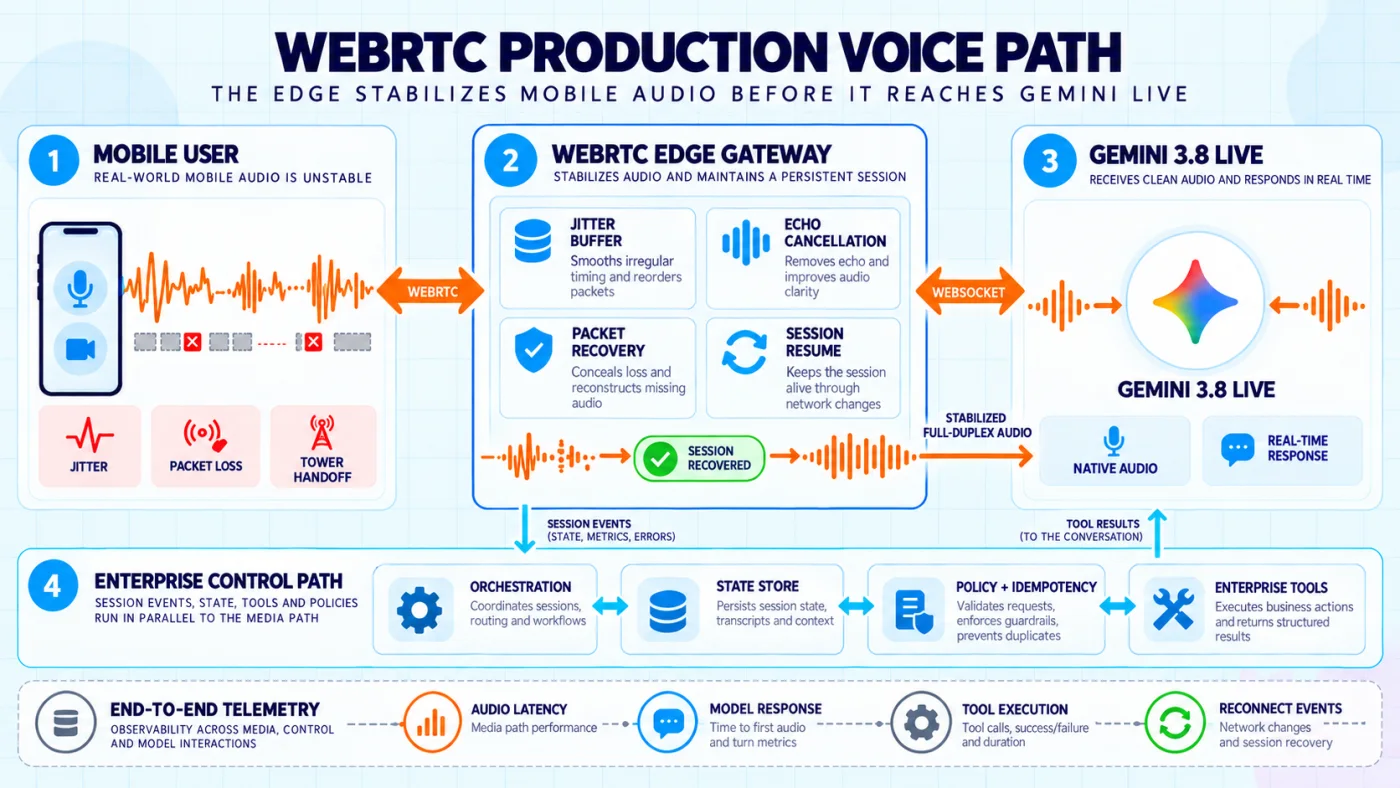
Fig 10 – Mobile audio terminates at a WebRTC media gateway at the edge, which handles jitter buffering, echo cancellation, and reconnection. The clean media stream reaches the Live API only after the edge layer has stabilized the connection
Mobile networks lose packets. A smartphone on a 5G link routing raw audio to the Live API over a TCP WebSocket experiences stuttering, latency spikes, and session failures under realistic conditions. Serious deployments terminate the mobile link at a WebRTC media gateway that handles jitter buffering, echo cancellation on the client, and reconnection logic. The clean media stream reaches the Live API only after this edge layer has done its job.
State management across asynchronous lifecycles
The Live API speaks, pauses, resolves tool calls, and speaks again across a conversational turn. Legacy bot architectures that rely on simple turn complete flags break. Developers now have to track the interaction_status field (IN_PROGRESS versus IDLE) that the API emits to reflect the model’s current state, because the single turn flag no longer captures what the agent is actually doing. Production middleware has to track an interleaved state machine of model audio, tool invocations, user interruptions, and reconnection events, and recover cleanly when any of them fail.
Enterprise security posture
Operations buyers in regulated industries require zero data retention configured at the Vertex AI project level, OAuth based service credentials for backend deployments or ephemeral tokens for direct client to server connections, and audit evidence that proprietary audio and visual streams never enter model training pipelines. These are separate authentication patterns for different deployment shapes. Each one needs explicit implementation at the Vertex AI project level.
Building voice infrastructure that performs across these three axes requires a specific intersection of skills: AI orchestration, distributed backend systems, and real time audio video streaming protocol expertise. Few in house teams carry all three at depth.
Partnering with Clixlogix on voice AI
Clixlogix engineers production voice systems for operations teams across utilities, healthcare, insurance, financial services, and logistics. We specialize in the gap between the Live API and a deployment that holds up at scale: WebRTC edge infrastructure, asynchronous state management, zero data retention compliance, and the instrumentation that lets operations leaders see what their voice agents are actually doing in production.
We work in three engagement patterns. A thirty day feasibility study maps your highest value voice use cases and the systems they need to integrate with. A production ready proof of concept delivers a single working workflow end to end, instrumented and documented, in six to ten weeks. A managed deployment partnership covers architecture, build, launch, and continuous production reliability over multi year horizons.
If voice is part of your 2027 operations roadmap, the first step is a working demo tailored to your actual workflow. See a working demo tailored to your workflow. Our solutions engineering team will walk through the integration points, the latency profile, and the economic model for your specific environment, then build you a demonstrator you can share with your leadership.
Want an expert to look at your voice AI project?
A thirty minute scoping session with our solutions engineering team maps your highest value voice use cases to the Live API’s current capabilities and the mitigation patterns for its production edge cases. You leave with a clear read on fit, cost, and timeline for your environment.
Book a scoping session with Clixlogix