TL;DR
The short version
- Google launched Gemini Decisions API on 11 November 2026 under the model name Gemini Decision 1
- The official Gemini Decision 1 model page lists text, image, audio, video and PDF input, a 262,144-token context window and up to 1,000 independent questions in one request
- Google reports 150 to 250 ms end to end and 50 to 100 ms median model compute, with latency nearly flat from 1 to 100 questions in its tests of contexts up to 16K tokens
- Gemini Developer API pricing lists $0.10 per million input tokens, shared input billed once per request, $0 output and a no-cost tier for prototyping
- Three vendors now ship typed decision models with closely matching primitives, Jev at $0.042 per million input tokens, OpenAI Decisions API at $0.10 per million uncached input tokens and Gemini Decision 1 at $0.10 per million input tokens
- Teams running agents or routers have three live, priced decision models to shadow test against the same traffic with no stand in required
What Google announced on November 11, 2026
Google DeepMind announced Gemini Decisions API through the Google Developers blog on 11 November 2026, authored by Min Choi, Product Manager at Google DeepMind, and Felix Yu, Principal Scientist at Google DeepMind. The model is named Gemini Decision 1, with API identifier gemini-decision-1, documented on the model page.
The endpoint handles closed set decisions. Candidate work surfaces listed in the post include tool selection, policy checks, model routing and context grading. The model scores candidate options in a single forward pass and returns the winner, a confidence value and, for ordered rubrics, a weighted score.
This is the same operating shape Jev 1.13 shipped on OpenRouter in September 2026 and the same category OpenAI brought to general availability on 22 October 2026 through POST /v1/decisions on gpt-6-luna, after a DevDay 29 September 2026 preview and a 6 October 2026 public beta. Three vendors are now in the market with published specifications. The category question is settled. The evaluation question is which one fits a given workload.
The three question types are now category standard
The official Gemini Decisions API documentation defines three question types.
- noul, a yes or no answer. The model returns the probability that a condition holds, with optional true or false criteria attached to the question. The scalar confidence score in the response is the larger of the two class probabilities.
- choice, a single winner selection from 2 to 255 mutually exclusive options. The model returns the winner and normalised probabilities across all options that sum to 1. The scalar confidence score is the winning option's normalised probability.
- score, an ordered rubric starting at 0 with 2 to 255 levels. The model returns a weighted score, computed as the expected value across consecutive integer levels, plus per level probabilities. Google recommends 2 to 10 levels for most rubrics.
These are the three shapes TypeSafe shipped for Jev, visible in the OpenRouter Decisions request schema, and the three shapes our 21 September guide Jev AI Decision Model, A Guide for Teams Building Agents worked through in detail. OpenAI documents the same three shapes under the names predicate, choice and score, with the predicate carrying a probability, and choice and score carrying a probability plus a separate confidence value.
When three independent vendors ship the same three primitives under the same operating semantics, the shapes stop being one vendor's design choice and become the category contract.
The internal decision interface recommendation we made in the 29 September OpenAI Decisions API post just got stronger. A provider neutral interface over the three primitives is now backed by three shipped vendors. One refinement from building against all three, the interface should accept a shared context and a collection of typed questions. Written that way, the Gemini adapter can submit up to 1,000 questions in one request, the OpenAI adapter can submit up to 400, and the Jev adapter can also send multiple questions against one shared state. If a workload exceeds a provider's request limit, the adapter can split it without changing caller code. OpenAI prompt caching may reduce the cost of repeated shared input across those requests, but cache reads are discounted, they are never free, and cache writes are charged.
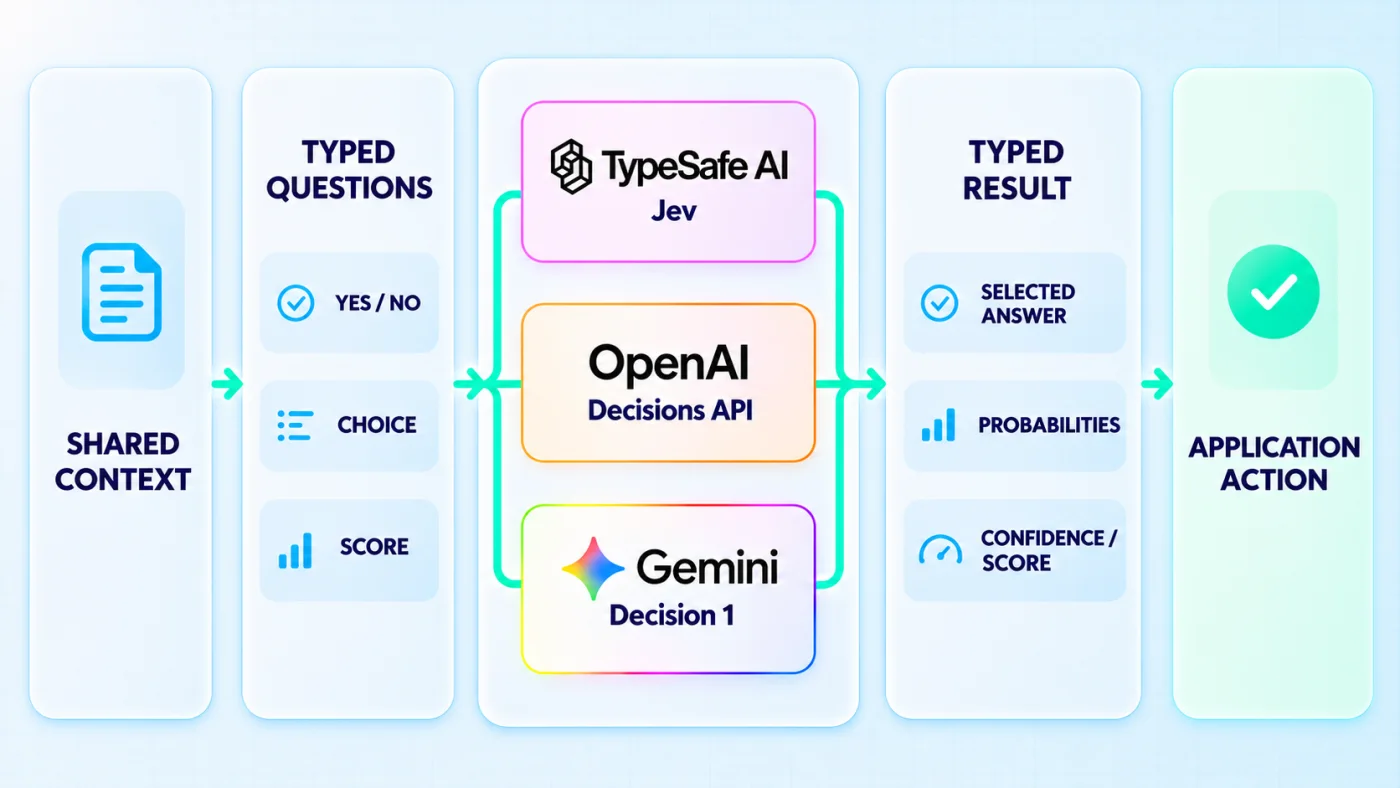
Fig 1 - Three Providers, One Decision Contract. Jev, OpenAI Decisions API, and Gemini Decision 1 expose closely matching typed decision primitives. Their schemas and limits differ, but all three accept shared context and declared questions and return bounded, probability bearing results.
Multimodal becomes the decisive axis
Gemini Decision 1 accepts text, images, audio, video and PDF inputs, up to 262,144 tokens of multimodal context per request. Up to 1,000 independent questions can ride on the same shared context in a single request. The shared context is billed once per request, independent of how many questions it answers.
The current OpenRouter listing for Jev 1.13 says it accepts text and images. The OpenAI Decisions guide documents text, images and native JSON, hosted image URLs as well as base64 data URLs, images in question instructions, and conversation history containing tool calls and outputs. Files and audio are not supported by the OpenAI endpoint. Multimodal input beyond images is the axis where the three products differ most.
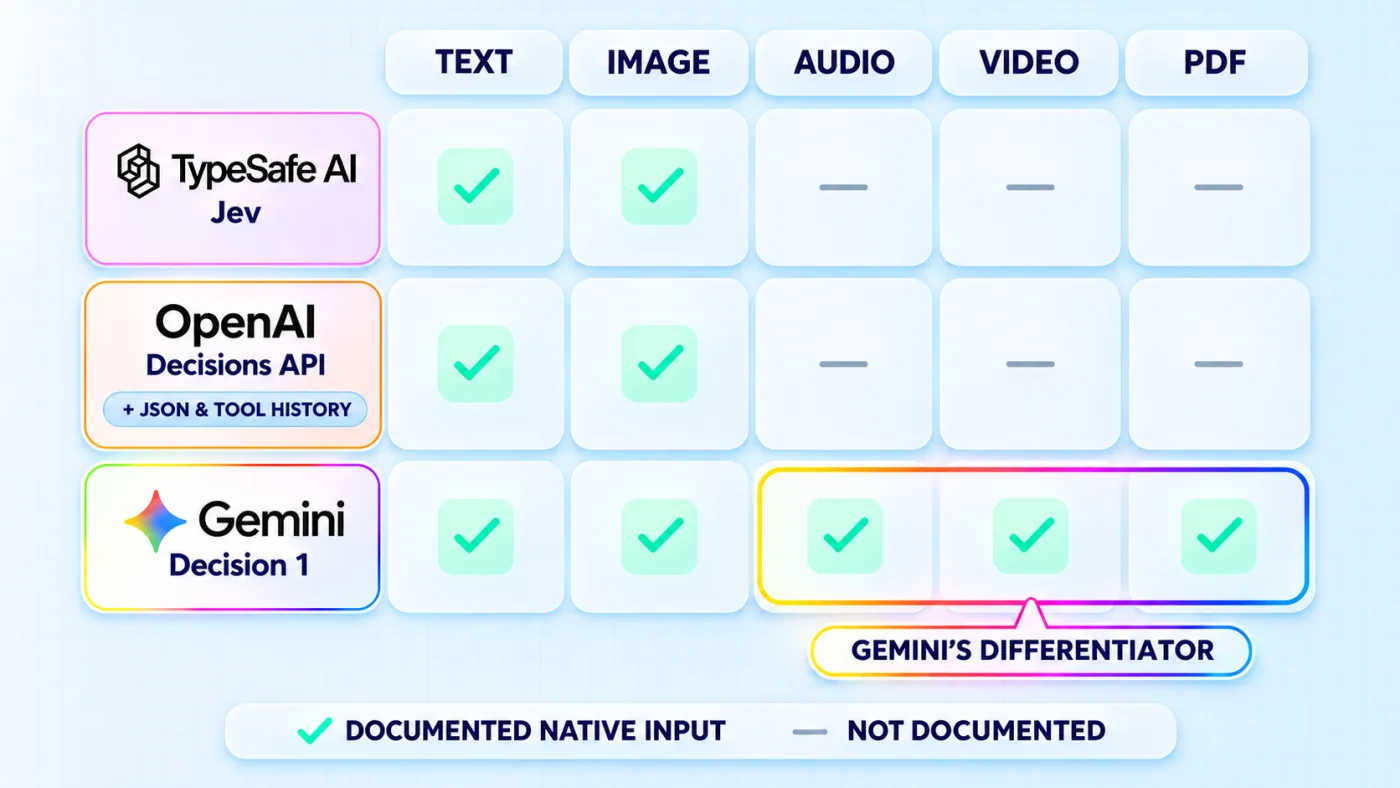
Fig 2 - The Multimodal Divide. Gemini Decision 1 is the only one of these three products currently documented to accept audio, video and PDF natively. All three support text and images, while OpenAI additionally accepts native JSON and conversation history containing tool calls and outputs.
The use cases this opens up are concrete.
- A claims triage decision that reads a PDF estimate, three damage photographs and a voice report in one request
- A content moderation decision that reads a video clip plus its caption
- A medical scribe routing decision that reads an audio consultation and patient history in one request
- A field service triage decision that reads a technician photograph and a work order PDF together
Teams whose decisions sit over structured text or images keep Jev in play on cost. Teams whose decisions mostly sit over images can test all three providers. Teams whose decisions sit over documents, audio or video now have one published option among these three that reads those formats natively, Gemini Decision 1.
For a production example of why native multimodal input changes the architecture, our case study on switching from Google Vision to Gemini for intelligent document processing covers the move from separate OCR and media pipelines to one multimodal understanding layer.
Pricing and latency, Google published what OpenAI held back
Three providers now publish pricing against the same typed decision interface.
Jev lists $0.042 per million input tokens with $0 output on OpenRouter and supports multiple typed questions against shared state in one request. OpenAI Decisions API pricing, generally available on POST /v1/decisions since 22 October 2026, lists $0.10 per million uncached input tokens and $0 output, with cached input currently priced at $0.01 per million tokens and cache writes charged under the GPT-6 Luna prompt caching schedule. It supports up to 400 questions per request. Gemini Decision 1 pricing lists $0.10 per million input tokens with $0 output, shared input billed once per request across up to 1,000 questions, plus a no-cost API tier in Google AI Studio for prototyping.
The repeat context pricing shape differs across the three. Jev and Gemini both let multiple questions share state inside a request; Google explicitly says that shared input is billed once regardless of question count. OpenAI also shares input across up to 400 questions in a request, and prompt caching can discount repeated matching input across separate requests. The mechanics are not interchangeable: OpenAI cache reads cost $0.01 per million tokens and cache writes are charged, while Gemini's benefit applies within the request. A shadow test on the team's own batching and context reuse pattern is still the only reliable cost comparison.
A simplified batched routing example makes the difference concrete. A 10,000 token context carrying 500 questions, with 50 tokens of question instructions each, gives Gemini 35,000 billed input tokens in one request, or about $0.0035. OpenAI must split the work across at least two requests because its ceiling is 400 questions. If the second request receives the cached input rate for the repeated 10,000 token context, the simplified total is about $0.0036 before any cache write, regional or long context premiums. Jev also supports multiple questions against shared state. If the selected Jev route accepts all 500 in one request, the same 35,000 token shape is about $0.00147 at its published input rate; if it requires several requests, the repeated state is billed once per request. This is why the Jev question ceiling and actual usage record belong in the shadow test and must never be assumed.
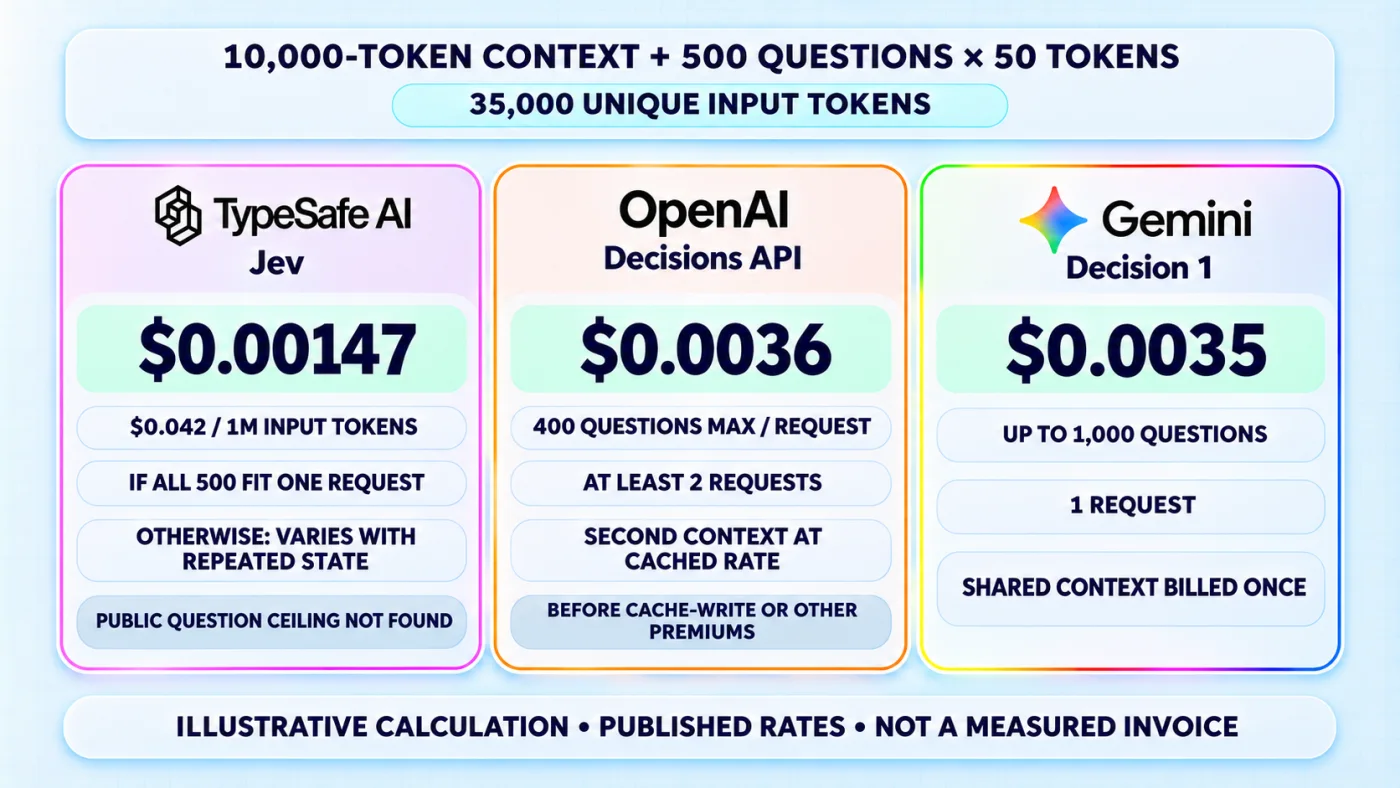
Fig 3 - Batching Changes the Cost Math. Batching mechanics can matter as much as headline token prices. This simplified example uses published rates from Gemini Decision 1 pricing, the OpenAI Decisions API pricing guide and TypeSafe's Jev pricing documentation. It is an illustrative calculation. It is not a measured invoice or production benchmark.
On latency, Google published 150 to 250 ms end to end for Gemini Decision 1, with 50 to 100 ms median model compute, flat up to 100 questions per request and 16K tokens of context. OpenAI frames Decisions API as roughly 10 times faster than GPT-6 Luna through the Responses API, with vendor demos reporting 81 ms of API processing for six decisions and 194 ms for one frame in a driving demo, both vendor numbers, neither an independent benchmark. OpenRouter's Banking77 evaluation reports 175 ms median and 270 ms p95 for Jev 1.13 through its routing path. The three figures are close enough that a production shadow test against the team's own traffic is the only honest comparison.
Calibration and confidence, the engineering details that matter
Every Gemini Decision 1 answer carries a scalar confidence score between 0 and 1. The API documentation recommends setting thresholds on labelled examples and using the score to route ambiguous answers to a fallback path or human reviewer. Google claims the lowest calibration error across its published benchmark suite, which covers agent routing, reasoning, ranking and multimodal understanding.
OpenAI Decisions API also returns probabilities, with choice and score adding a separate confidence value alongside the probabilities. OpenAI has not published a calibration claim against an external benchmark.
Jev publishes its calibration posture explicitly. All three vendors now surface probabilities on their answers. Jev and Gemini make explicit calibration claims, but Google's headline comparison comes from Google's own published benchmark suite. No independent external evaluation is involved. OpenRouter's Banking77 test found that Jev's confidence was useful for ranking predictions but was not calibrated as a probability in that evaluation.
Production decision systems need two distinct statistical properties, and both are worth separating cleanly.
Calibration asks whether the stated probability matches the empirical accuracy. A stated confidence of 0.8 is calibrated if, across a large sample, the model is right 80 percent of the time on those predictions. Expected Calibration Error is a standard summary measure discussed in the ICML paper On Calibration of Modern Neural Networks.
Discrimination, also called sharpness or resolution, asks whether the model assigns different confidence to right and wrong answers. A model that outputs 0.9 on every prediction can be perfectly calibrated at 90 percent accuracy and still be useless for threshold routing because wrong answers and right answers carry the same score. AUROC measures ranking quality; the risk coverage curve measures the tradeoff between the share of predictions accepted and their error rate.
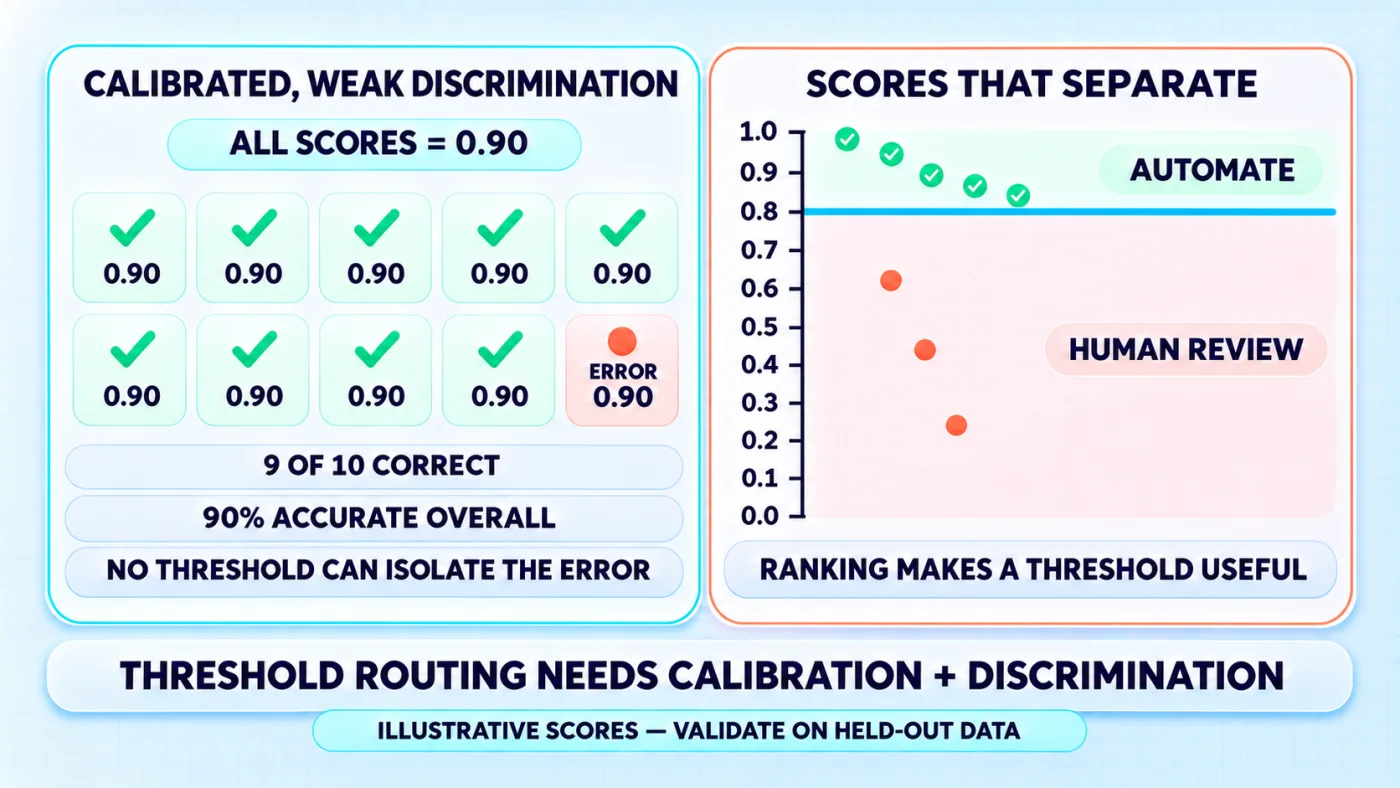
Fig 4 - Calibration Is Not Discrimination. A score can be calibrated in aggregate while still failing to separate correct and incorrect predictions. Reliable threshold automation needs both probability quality and useful ranking. See On Calibration of Modern Neural Networks and the selective classification foundation behind risk coverage analysis. Scores shown are illustrative. They are not measured provider results.
Threshold based routing needs both properties. Discrimination gives the model headroom to separate accepted from abstained decisions. Calibration makes a threshold more interpretable, but a score of 0.9 does not guarantee 90 percent accepted slice accuracy under every workload or after drift. The threshold needs to be chosen on labelled data, validated on a held out set and monitored in production.
Our 29 September post listed five abstention mechanisms a production decision system needs. All three providers now satisfy the first, a continuous probability on every answer. The remaining four, a reviewer queue, a reviewer policy, a measured review rate per decision class, and the application level fallback pathway that invokes the reviewer when the score falls below the team's threshold, remain the team's responsibility across every provider. The API returns the number. The production system is what turns the number into a decision.
The three way field at a glance
Table 1 - The three way field as of 20 November 2026
Table sources: Gemini Decisions API documentation, Gemini Decision 1 pricing, OpenAI Decisions guide, OpenAI data controls, Jev 1.13 model listing and OpenRouter's Decisions request schema.
All three vendors now ship with published specifications. The evaluation question for a Clixlogix client is workload fit, and the three way shadow test runs against three live, priced endpoints.
How to design a three way shadow test
OpenRouter hosts Jev and Gemini Decision 1 as callable models, and OpenAI serves Decisions API directly through POST /v1/decisions on gpt-6-luna. A three way shadow test runs against three live, priced endpoints with no stand in required. A router layer in front, a gold set of 500 to 2,000 labelled decisions from the team's own system, and two weeks of production shadow traffic are enough to produce real numbers. For high cardinality choice tasks, the gold set should carry at least 30 to 50 examples per answer class, with stratified sampling for skewed production distributions, since a 500 sample gold set on a 77 class routing task yields only about 6 to 7 examples per class and wide confidence intervals on per class accuracy.
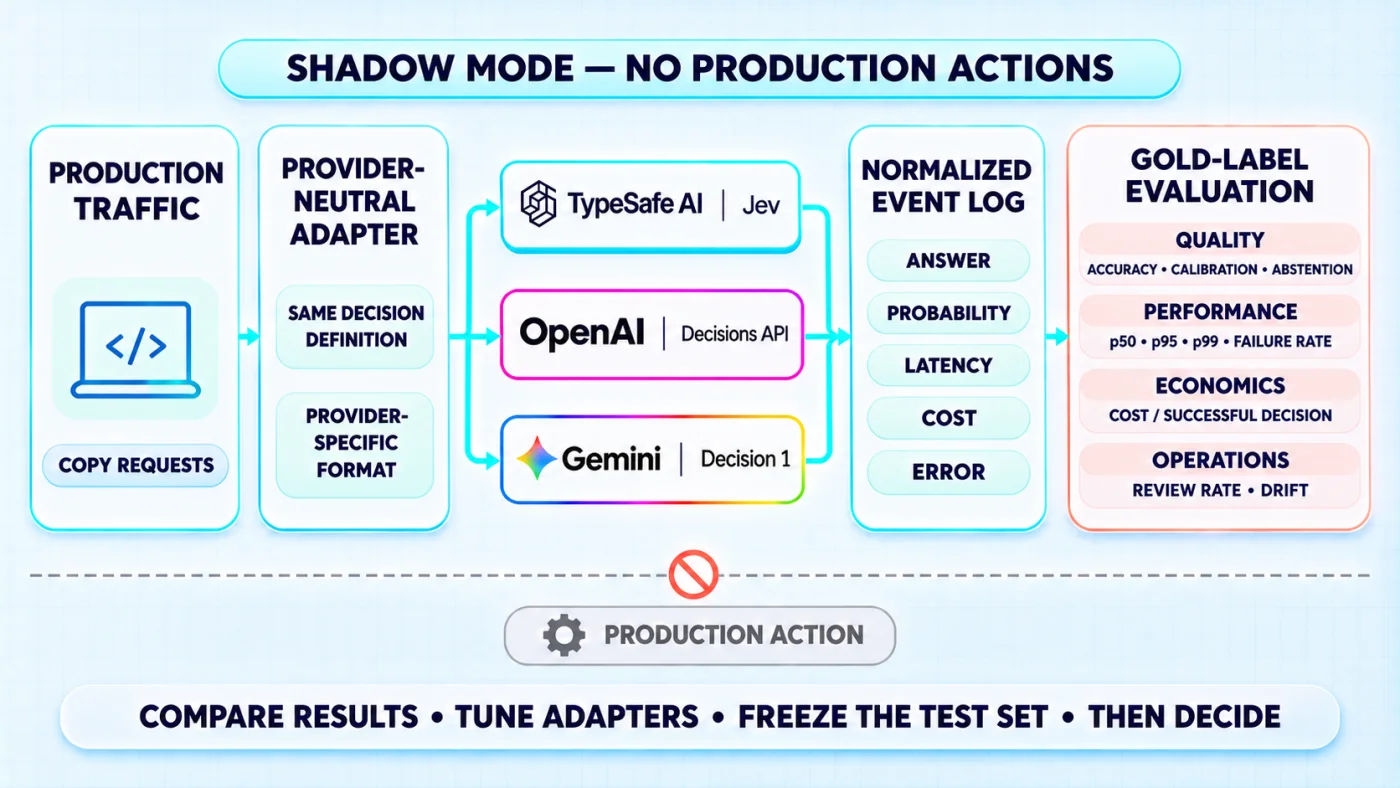
Fig 5 - Three Way Shadow Test Blueprint. A shadow test copies real production traffic through a provider neutral adapter, runs equivalent decisions across Jev, OpenAI Decisions API and Gemini Decision 1, normalizes the results and evaluates them against labelled outcomes. Provider outputs remain disconnected from production actions until the test is complete.
Two notes on the test plan. First, cost measurement needs to track each vendor's pricing mechanic separately, Gemini's shared input billed once per request, OpenAI's 400 question ceiling and discounted cache reads that are never free, and Jev's multi question request shape plus any provider specific question ceiling. Metric 5 below reflects that. Second, open weight baselines, fine tuned encoder classifiers with temperature scaling, and dedicated cost quality routers deserve a slot in the test for any team with a labelled gold set in the thousands, where self hosted options may change the economics materially. Our AI model selection framework describes the broader workload first method behind that comparison.
A ten metric evaluation list to track across the three providers.
- Accuracy against the gold set, overall and per answer class
- Expected calibration error against the gold set
- Risk coverage, the accuracy at the top k percent of the confidence distribution
- p50, p95 and p99 latency, measured across the two week shadow stream against the team's own network path
- Cost per 1,000 decisions, with each vendor's pricing mechanic modelled on the team's observed context reuse rate
- Cost per accepted decision, where the confidence threshold is pinned to a fixed target error rate on the risk coverage curve so that overconfident models do not minimise this number by assigning high scores to wrong answers
- Abstention rate, the share of decisions routed to a reviewer
- Review burden, the labour hours per 1,000 decisions implied by the abstention rate
- Error cost, the selective error rate on accepted decisions multiplied by the business cost of a wrong answer, plus any residual error rate on reviewed decisions
- Operational drift, the week over week variance of confidence distribution, abstention rate and inter provider prediction agreement across the shadow stream, as a proxy for accuracy stability when labels on live traffic are not available
Teams already on Jev for one decision class should still run this across all three providers to measure the new OpenAI and Gemini options under their own traffic. For teams new to typed decisions, this is also the test for whether the category belongs in their workflow at all.
Jev's current edge sits in the lowest published input price of the three at $0.042 per million tokens, support for multiple typed questions against shared state, calibration transparency and the fact that its interface has been live long enough for a team to find its edges. Its current OpenRouter listing also includes image input. The 21 September guide works through where Jev fails by design, which is still the honest picture.
OpenAI Decisions API's current edge sits in distribution and the depth of the OpenAI account relationship. Teams already standardised on OpenAI for agents, Structured Outputs and GPT-6 Luna adopt Decisions API through an existing contract at the account level. The endpoint supports 400 questions per request, native JSON, hosted images and conversation history, plus eligible enterprise controls including Zero Data Retention and HIPAA use. Discounted cache reads help workflows that repeat the same context across separate requests, but they are not free and cache writes are charged.
Gemini Decision 1's current edge covers multimodal input beyond images, vendor published latency boundaries and calibration results, shared context billing for high question count requests, the no-cost tier for prototyping, and 1,000 questions per request versus OpenAI's 400. Among these three products, it is the only one currently documented to read PDF, audio and video natively.
None of the three wins on every axis. Different workloads will land on different choices.
What this means for teams building agents
Four implications for teams building agents through this period. Teams newer to this architecture can start with our primer on what an AI agent is and how it differs from a chatbot.
Keep the decision interface provider neutral, and batch friendly - The three primitives, noul and predicate for yes or no, choice for single winner, and score for ordered rubrics, are now a three vendor category contract. An internal decision interface that commits to these three shapes and accepts a shared context with an array of typed questions costs very little to build and preserves optionality as the field keeps moving. A commitment to one vendor's SDK before running a shadow test costs real money to reverse later.
Update the procurement checklist - Our 21 September Jev guide listed seven vendor questions that matter, retention, training terms, SOC 2, DPA, BAA, region control and SLAs. Gemini Decision 1 adds an eighth axis worth asking about explicitly, whether the same retention, training, regional processing and regulated data controls apply to every accepted modality. Audio, video and documents can contain sensitive data that is not present in a text only routing workload, so the contract and architecture review should cover those formats directly.
Fold calibration and discrimination into the reliability engineering list - Confidence thresholds, abstention policies and reviewer queues are first class components of a decision system. A production system that accepts every answer the model returns is a production system that has decided to carry the model's error rate directly into its outcomes. Both calibration, so the threshold means what the number says, and discrimination, so right and wrong answers can be separated by the threshold at all, belong in the engineering checklist.
Read the Clixlogix series as a three post set, with the 29 September post queued for a GA refresh - The 21 September guide covers the Jev model and the economics of typed decisions. The 29 September post covers OpenAI's DevDay preview and the 6 October beta; OpenAI moved to general availability on 22 October 2026, which the current live version does not yet reflect. This third post covers Google's entry and the three way market that now exists. The 29 September post is next on the editorial queue.
Build production decision systems with Clixlogix
Clixlogix engineers build production decision systems for teams running agents, document pipelines and routing workflows. Our work covers the decision interface, the abstention policy, the reviewer queue, the evaluation harness and the production monitoring that keeps calibration honest after deployment.
If you are already on Jev and wondering whether to switch, if you are on OpenAI Decisions since general availability and wondering what Gemini changes, or if you are new to typed decisions and wondering whether the category is right for your workflow at all, our AI engineering team can help design the three way shadow test and interpret what the numbers mean for your workload.
Talk To Our AI Engineers
FAQs about the Gemini Decisions API