TL;DR
- The word “agentic” is doing heavy lifting in AI marketing right now, and most vendors misuse it. The next section draws the line between agentic workflows that actually move agency margin and AI tools that just produce output faster.
- Your senior team burns 6 hours per prospect on audits for people who have not paid a dollar yet, plus 3 hours per proposal on the deals that never close. Three sales pipeline workflows compress inbound qualification, audit delivery, and proposal building to 45 minutes of human review per prospect.
- Outsourced content fails on three specific quality dimensions before the client ever reads it. Local relevance, brand voice fit, and single format publishing. Four production workflows catch all three problems inside the pipeline, before delivery.
- Most agencies find out about white label quality drift when a client churns, and about competitor moves weeks after the ranking damage is done. Two intelligence workflows close both blind spots with automated partner scorecards and dual cadence competitor scans.
- The number one reason SEO clients leave is poor visibility into results, well ahead of the results themselves. One reporting workflow handles monthly and quarterly deliverables for a 20 client roster in under 7 hours of review time and translates SEO into money language for the business owner.
- The math for a 15 client agency running all 10 workflows. 166 to 257 hours recovered per month. $14,110 to $21,888 in labor cost recovered per month. The workflow by workflow breakdown sits in the numbers section, along with the sequence for adopting them without breaking your operation.
- Clixlogix operates two independent services. White label SEO fulfillment under your brand, and a digital engineering team that builds these workflows for agencies that want them. Either works without the other. The closing section explains where the seam sits.
You sell SEO to businesses. They trust your agency to get them ranking. They pay you every month. And behind your brand, a white label SEO partner handles the actual fulfillment. The audits, the content, the link building, the technical fixes, the reporting.
That is the model. It works well up to 10 or 15 clients. After that, cracks show.
Your team spends 4 to 5 hours per client per month building reports nobody reads past the first chart. This is not just an efficiency problem. In Fluency’s 2026 Agency AdOps Benchmark Report, 71% of agency operations teams said manual processes actively put client campaigns at risk. Proposals take 2 days to write from scratch. Competitor monitoring is whatever your strategist remembers to check between meetings. And the content your white label partner delivers sounds nothing like your client’s brand.
The bottleneck in your agency is operational. Coordination. Handoffs. Formatting. Copying between 5 tools that do not talk to each other. Every SEO workflow in your agency carries dead time, and that dead time eats your margins.
We see this constantly at Clixlogix. Agencies come to us as a white label SEO partner because the operational overhead of delivering SEO across 15, 20, 30 business clients makes the per account economics collapse. We handle the SEO fulfillment under your brand. Your client never knows we exist. Fulfillment alone does not fix the operational drag sitting on your agency’s shoulders.
That is where agentic workflows help. This article walks through 10 of them, organized by where they sit in your agency lifecycle. Each one addresses a specific operational problem, saves measurable hours, and puts more dollars back in your pocket. Every scaling SEO agency should build these. For agencies that want help building them, our digital engineering team does that too.
What Makes These Workflows “Agentic” (and Why That Word Matters)
Before the 10 workflows, a clear definition of “agentic” helps. Half the industry slaps “AI” on a chatbot and calls it automation.
An agentic workflow differs from an AI tool in one specific way. It runs a multi step process across multiple systems without you managing each step. An AI tool writes a blog post when you ask. An AI SEO workflow detects that a client’s competitor published new content, scans it against the client’s keyword targets, drafts a content brief with a local angle, runs it through a brand voice check, and drops it into your project board for approval. You did not prompt anything. You reviewed and clicked approve.
The human review points are the whole design philosophy. These systems do not run blind. They handle the 80% of each task that repeats so your strategists focus on the 20% that requires actual judgment.
Every workflow below runs through a central dashboard. One interface for your agency team. Status indicators for what is running, what is waiting for review, what shipped. No switching between 6 tabs. That is the control surface your agency keeps. The white label SEO tools and your fulfillment partner handle production underneath.
Sales Pipeline Automation Workflows
Your agency’s sales pipeline carries a dirty secret. The work that wins new business clients is the work your senior people hate doing. Building prospect audits from scratch. Formatting proposals. Qualifying inbound leads manually. Every hour your strategist spends on sales prep is an hour taken from the client campaigns that drive renewals.
These three workflows take the heaviest manual tasks out of your sales process. Your team shows up to the prospect meeting prepared. The business owner gets a branded audit within hours. The proposal writes itself from the conversation.
Workflow 1: AI Sales Chatbot on Your Agency Website
The problem it solves
A business owner visits your agency’s website. They want help getting more customers from Google. They browse your SEO services page, read a case study, hover over pricing. They see a contact form. They fill it out and wait. Someone from your team follows up 24 to 48 hours later. By then, they have already talked to 2 other agencies.
Dr. James Oldroyd’s landmark MIT Sloan and InsideSales study, published in the Harvard Business Review in 2011 as “The Short Life of Online Sales Leads,” found that contacting a lead within 5 minutes makes contact 100 times more likely than waiting 30 minutes. The metric measures dial-to-connect odds, not close rate. Your contact form does not respond in 5 minutes. A chatbot does, and it captures the lead in the 5 minute window your sales team then has to act on.
How the workflow runs
An AI chatbot (built on platforms like Zoho SalesIQ, Intercom, or similar) sits on your agency’s SEO service pages. When a visitor lingers for more than 20 seconds, it engages with a simple question. “Looking to get more customers from Google?”
The bot runs a conversational qualification flow.
- Asks what the business does and where they are located
- Asks what they have tried before (running ads, doing SEO in house, working with another agency)
- Asks what their biggest challenge is right now (not enough leads, losing to a competitor, new location launch, website redesign)
- Asks for the visitor’s name, email, business URL, and phone number
Everything feeds into your CRM automatically. The lead record includes the full conversation transcript, intent tags pulled from the answers (“local SEO interest,” “frustrated with current agency,” “opening second location”), and a qualification score.
The chatbot draws on your agency’s service offerings and case studies for its training set, so it answers questions like the ones prospects actually type.
- What does your agency do?
- How long do results take?
- What does onboarding look like?
It represents your agency. No mention of any white label partner.
Guardrails built in. The bot captures GDPR consent before storing any personal data on visitors from EU or UK IPs, and captures CCPA disclosures for California visitors. A silent bot filter drops obvious automated form-fills before they hit your CRM. And for questions the bot cannot answer confidently, such as technical SEO or pricing questions outside a defined range, it hands off to a human queue and does not guess. Hallucinated answers on your sales surface cost more than a delayed reply.
Where humans review
Your sales rep reviews the CRM lead record and conversation transcript before any outreach. The chatbot qualifies and captures. It does not close. It does not send proposals. It creates the warm lead and the context your salesperson needs to walk into a call already knowing what the prospect cares about.
For a closer look at how AI chatbot agents convert website visitors into qualified pipeline, read our guide on how Zoho SalesIQ AI agents turn visitors into leads.
Cost and operational benefit
A typical sales rep spends 15 to 20 minutes qualifying an inbound business lead through back and forth emails. With the chatbot handling qualification instantly, that drops to a 2 minute CRM review. Across 30 inbound leads per month, that saves roughly 7 to 9 hours. Response time drops from hours to seconds, which directly affects how many of those leads convert into booked calls.
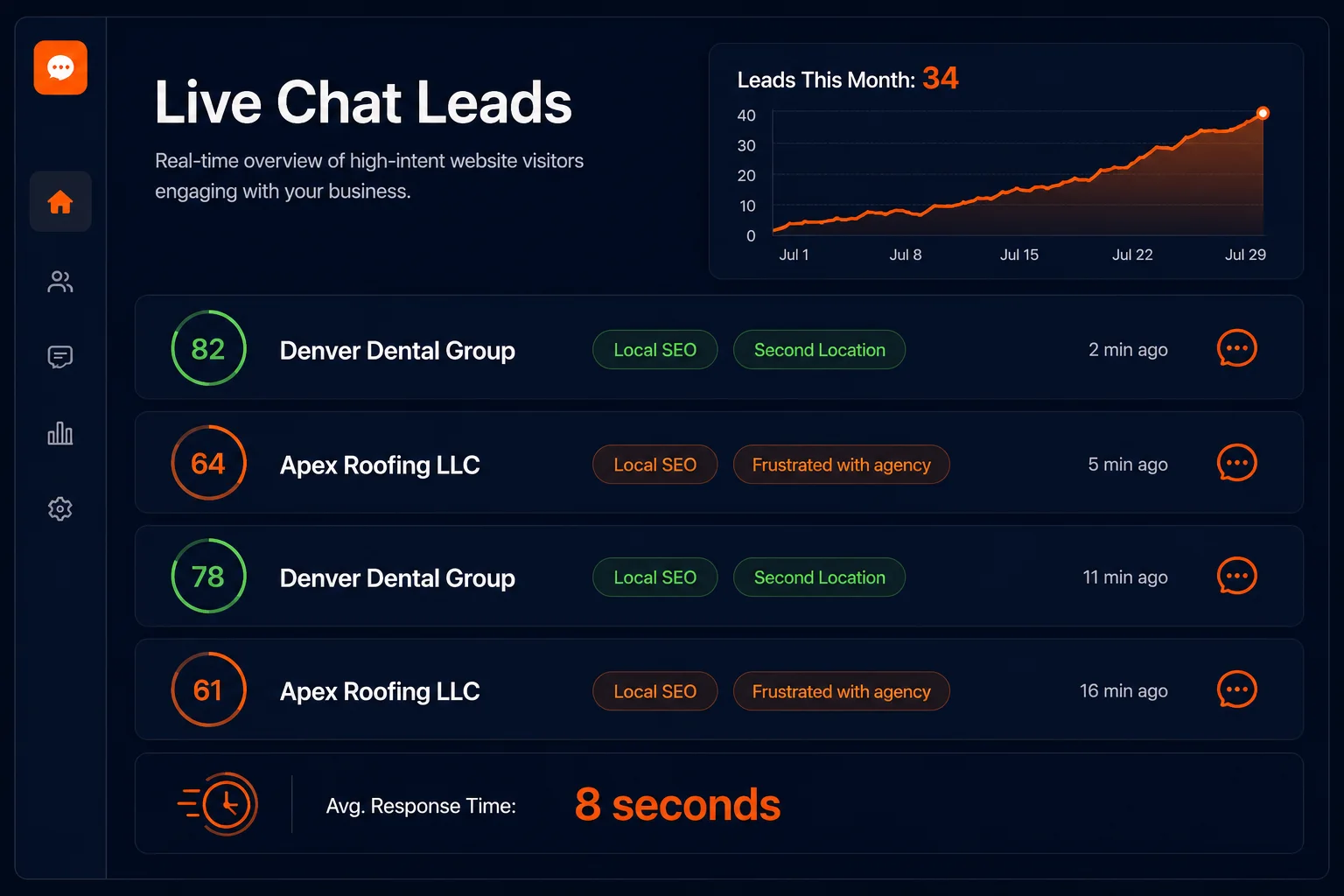
Fig 1 – Every chatbot conversation becomes a scored lead in your CRM before your sales rep even opens their inbox.
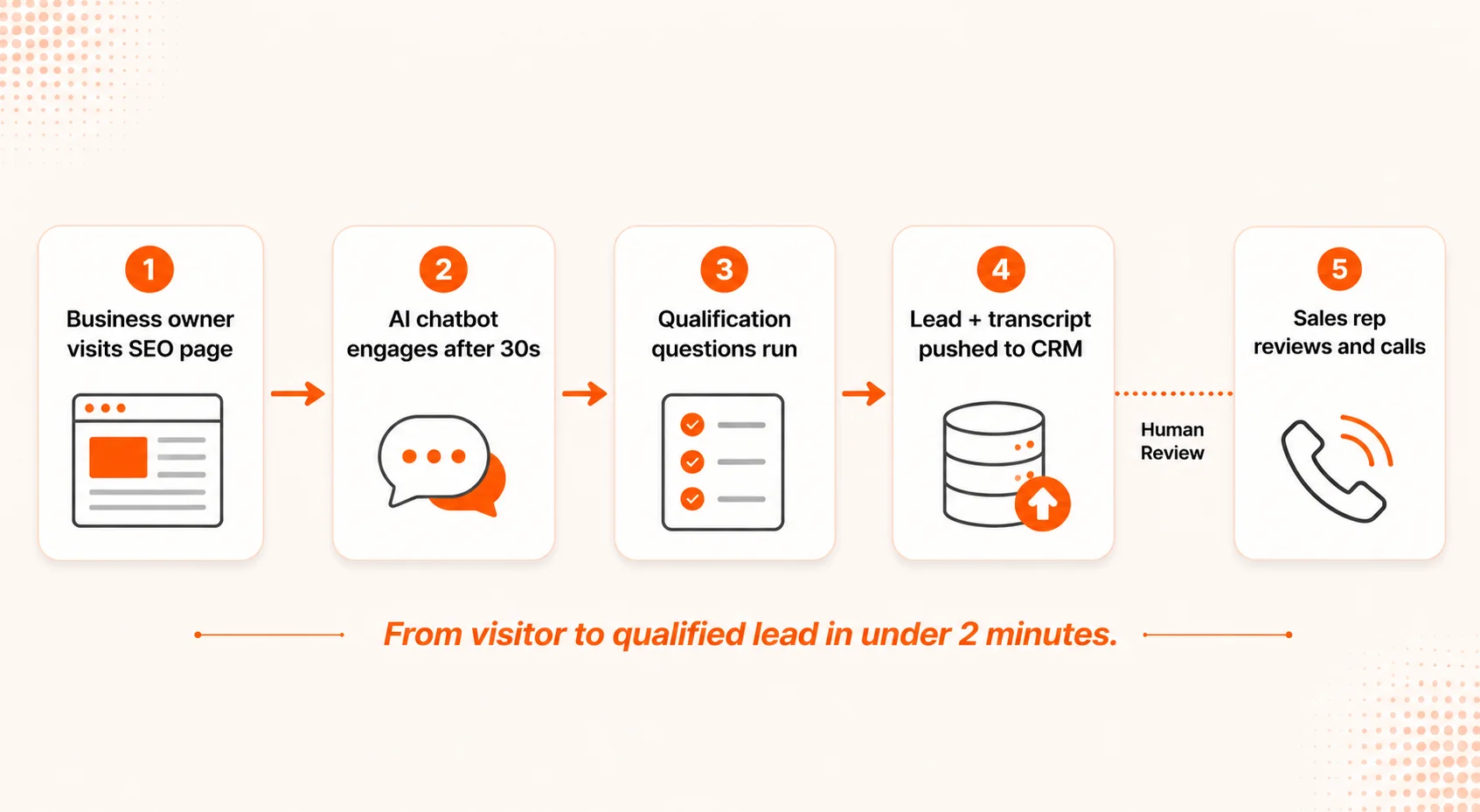
Fig 2 – From website visitor to qualified, scored CRM lead in under 2 minutes.
Workflow 2: Automated Personalized SEO Audit for Business Prospects
The problem it solves
A business owner says “can you check our website?” during a discovery call. You say yes. Then someone on your team spends 4 to 6 hours crawling their site, checking Core Web Vitals, reviewing their backlink profile, screenshotting issues, and formatting everything into a branded PDF. Multiply that by 5 prospects in a month and you have burned 20 to 30 hours on people who have not paid you a dollar yet.
That is the sales tax most agencies pay for every new client they try to win. It is also the reason many agencies either skip the audit entirely (and lose to an agency that did not) or send a generic template that does not impress anyone.
How the workflow runs
The prospect submits their website URL through an audit request form on your agency’s site. Or your sales rep enters the business URL into the dashboard after a discovery call.
The agent takes over.
- Crawls up to 50 pages on the business’s website. Checks title tags, meta descriptions, H1 structure, image alt attributes, internal linking depth, canonical tags, robots.txt, and sitemap.xml health.
- Runs Core Web Vitals (LCP, CLS, INP) through the PageSpeed Insights API.
- Pulls a backlink profile snapshot through the Semrush API. Referring domain count, anchor text distribution, spam score by domain. The “toxic link” framing is skipped because Google’s Penguin 4.0 algorithm devalues low-quality links without formally penalizing them, which makes the historical toxic-link metric a weak signal.
- Checks local SEO signals. Google Business Profile presence, NAP consistency across major directories, local schema markup. This matters because most of your business clients serve a local or regional market.
- Scans for competitor gaps. Identifies 3 to 5 businesses ranking above the prospect for their primary keyword and flags content topics where the prospect has zero coverage.
- Scores every category with red, yellow, green health indicators based on thresholds your team defines. Each finding carries a confidence level so the sales rep knows which flags are certain and which need manual verification.
- Falls back gracefully when the target site blocks crawlers through Cloudflare bot mode or aggressive robots.txt. Blocked findings get flagged in the report and do not silently drop.
- Assembles everything into a branded DOCX (editable format). Your agency’s logo, colors, contact info. No pricing. No service pitch. A clean diagnostic showing the business owner exactly where their site stands.
- Saves the report to the dashboard and pings the assigned sales rep.
Where humans review
Your sales rep opens the report on the dashboard, reviews it for accuracy, edits if any changes are needed, and clicks a button to send it to the prospect. Nothing goes out automatically. That human review takes 10 to 15 minutes against the 4 to 6 hours of building the audit manually.
Cost and operational benefit
Manual audit. 4 to 6 hours per prospect at a loaded cost of $75 to $100 per hour equals $300 to $600 per audit.
Automated audit with human review. API costs run $30 to $80 per audit at realistic Semrush usage (backlink pulls and keyword lookups are the heaviest consumers of API units and require the Semrush Business plan at $499.95 per month for API access) plus 10 to 15 minutes of sales rep review time. Total loaded cost lands at $50 to $110 per audit.
At 5 prospect audits per month, you save 18 to 26 hours and roughly $1,000 to $2,500 in labor cost after API spend. That money was previously invisible, buried in “sales support” time nobody tracked.
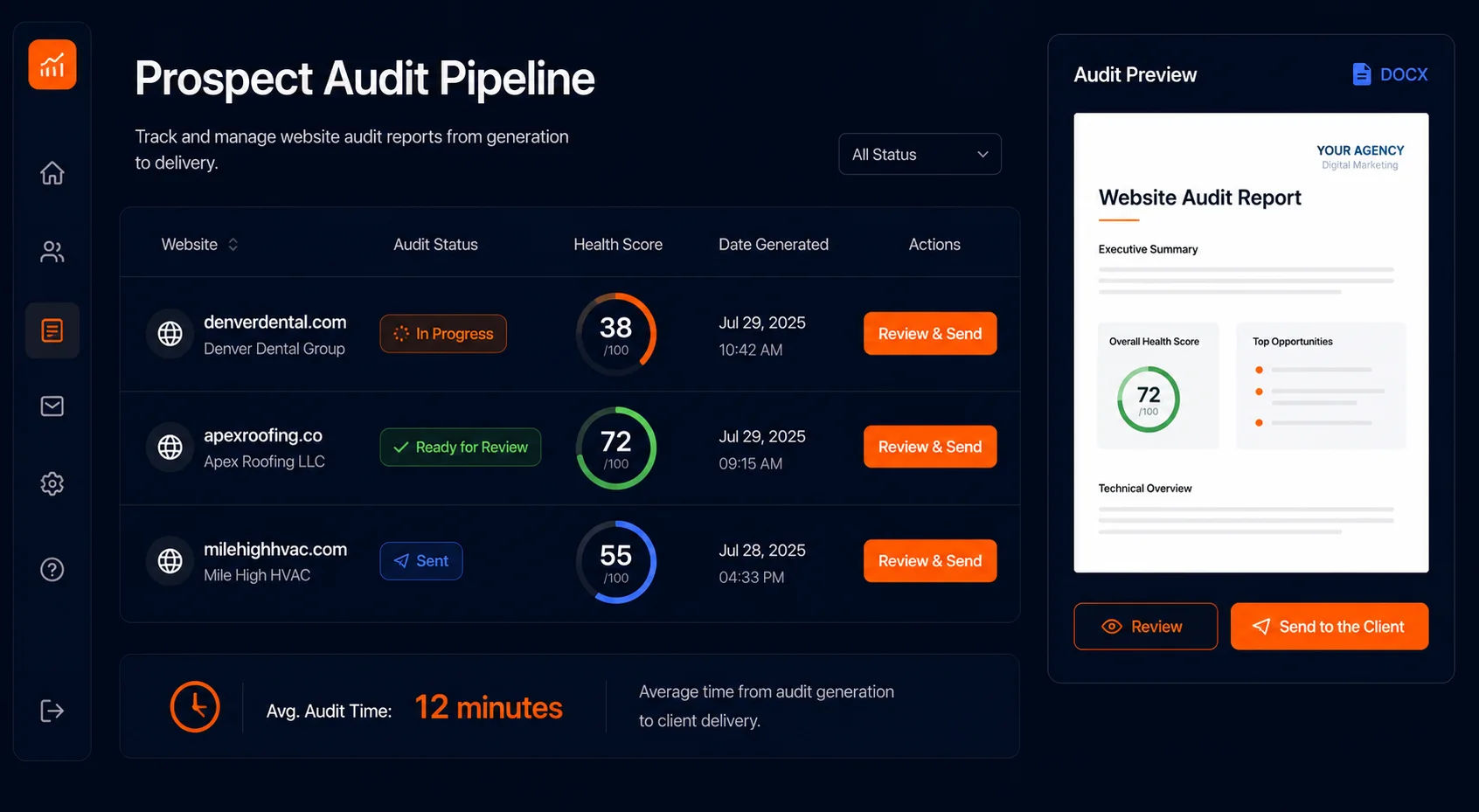
Fig 3 – Prospect audits go from hours of manual work to a 12 minute automated build plus a 10 minute human review.
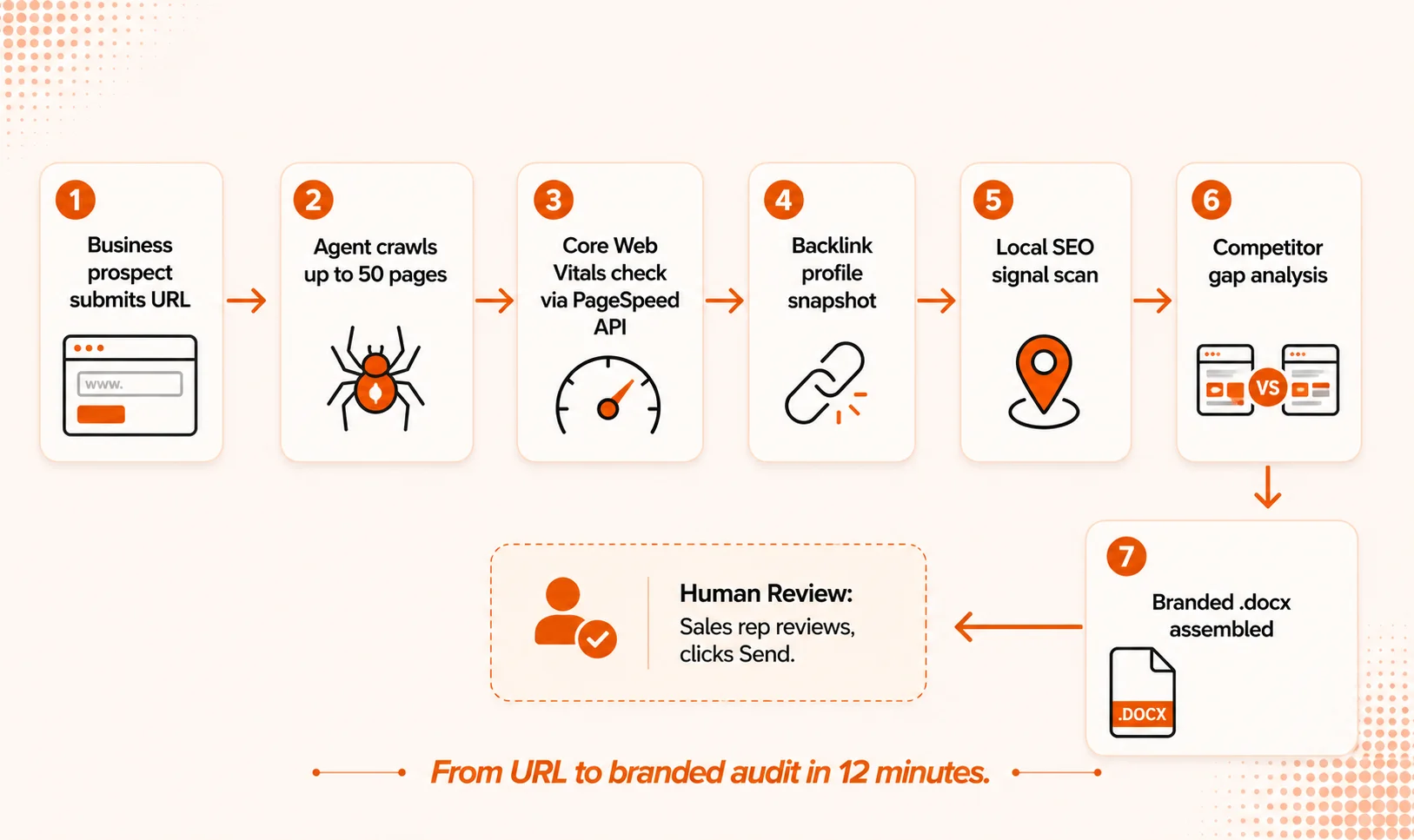
Fig 4 – Seven automated steps between a prospect’s URL and a branded audit report your sales rep reviews and sends.
Workflow 3: Automated Proposal Builder from Audit and Meeting Transcript
The problem it solves
You ran the audit. You had the discovery call with the business owner. They are interested. Now someone needs to build a proposal. That someone is usually the most expensive person in your agency. The account director or the owner.
They spend 2 to 3 hours pulling together a scope of work, matching services to the business’s pain points, building pricing tiers, finding a relevant case study, and formatting it into something professional. For every proposal that wins, 2 do not. Two thirds of proposal building time generates zero revenue.
How the workflow runs
After the sales meeting ends, the meeting transcript (from Zoom, Google Meet, Fireflies.ai, or whatever your team uses) enters the workflow along with the audit report from Workflow 2.
The agent extracts.
- The business owner’s stated priorities. “We need more walk in customers,” “Our competitor shows up above us on Google Maps,” “We are launching a new location in March”
- Services discussed. Local SEO, content marketing, link building, technical audit, Google Business Profile optimization
- Timeline and urgency signals
- Budget range if mentioned
- Competitor names the prospect referenced
- Frustrations with their previous SEO provider
Then it cross references against the audit findings. If the business owner said “we are losing to [competitor] on Google Maps” and the audit flagged weak local signals, that becomes the lead recommendation in the proposal.
The agent pulls from a pre built proposal template library (your agency creates these once during setup) and populates.
- Opening section written around the business’s specific situation and goals
- Scope of work matched to what was discussed
- Deliverables per month with plain language descriptions the business owner will actually understand
- Pricing tiers mapped to your SEO reseller plan costs plus your agency’s margin
- A relevant case study from a similar industry
- Timeline and onboarding steps
Output. A branded proposal as an editable file (.docx) or slide deck, plus a 1 page brief for the reviewer highlighting the prospect’s top priorities.
Production hardening. Three additions that separate a working proposal builder from one that scales.
- Version control on every proposal draft. Each revision saves as a numbered version with edit history. The account director can revert or diff against the original agent draft, which matters when a prospect asks “why did the scope change from what we discussed?”
- E-signature integration through DocuSign, PandaDoc, or an equivalent. The approved proposal ships with a signature block and tracks open, view, and sign events back into the CRM. Sales velocity data flows into the pipeline dashboard automatically.
- Feedback loop from won and lost deals into the template library. Every closed-won proposal tags its winning elements. Every closed-lost proposal captures the objection. The template library rebuilds monthly from actual outcome data, which stops the agent from recycling losing proposal structures.
Consent handling for meeting transcripts. Two-party consent states (California, Florida, Illinois, Maryland, Massachusetts, Montana, Nevada, New Hampshire, Pennsylvania, Washington) require both parties to consent before a call is recorded. The workflow requires an explicit recording consent captured at the start of every discovery call and refuses to ingest transcripts that lack a consent record. Non-negotiable.
Where humans review
Mandatory review. Your account director checks pricing accuracy, adjusts the scope based on conversation nuances the agent may have missed, adds a personal note, and approves before it goes out. No proposal ever reaches a business prospect without a human sign off. The workflow turns a 3 hour build into a 30 minute review.
This is where white label SEO for agencies stops being just about fulfillment and starts being about sales velocity. Your pricing maps to the reseller plan your white label partner provides. The agent knows the rate card and builds proposals that protect your margin math.
Cost and operational benefit
Manual proposal. 2 to 3 hours of senior time at $100 to $150 per hour equals $200 to $450 per proposal.
Automated draft plus human review. 30 minutes equals $50 to $75.
At 6 proposals per month, you save 9 to 15 hours and $900 to $2,250 in senior labor. The bigger number is close rate. Proposals built from actual meeting data and audit findings close better than generic templates because they speak directly to what the business owner said they care about.
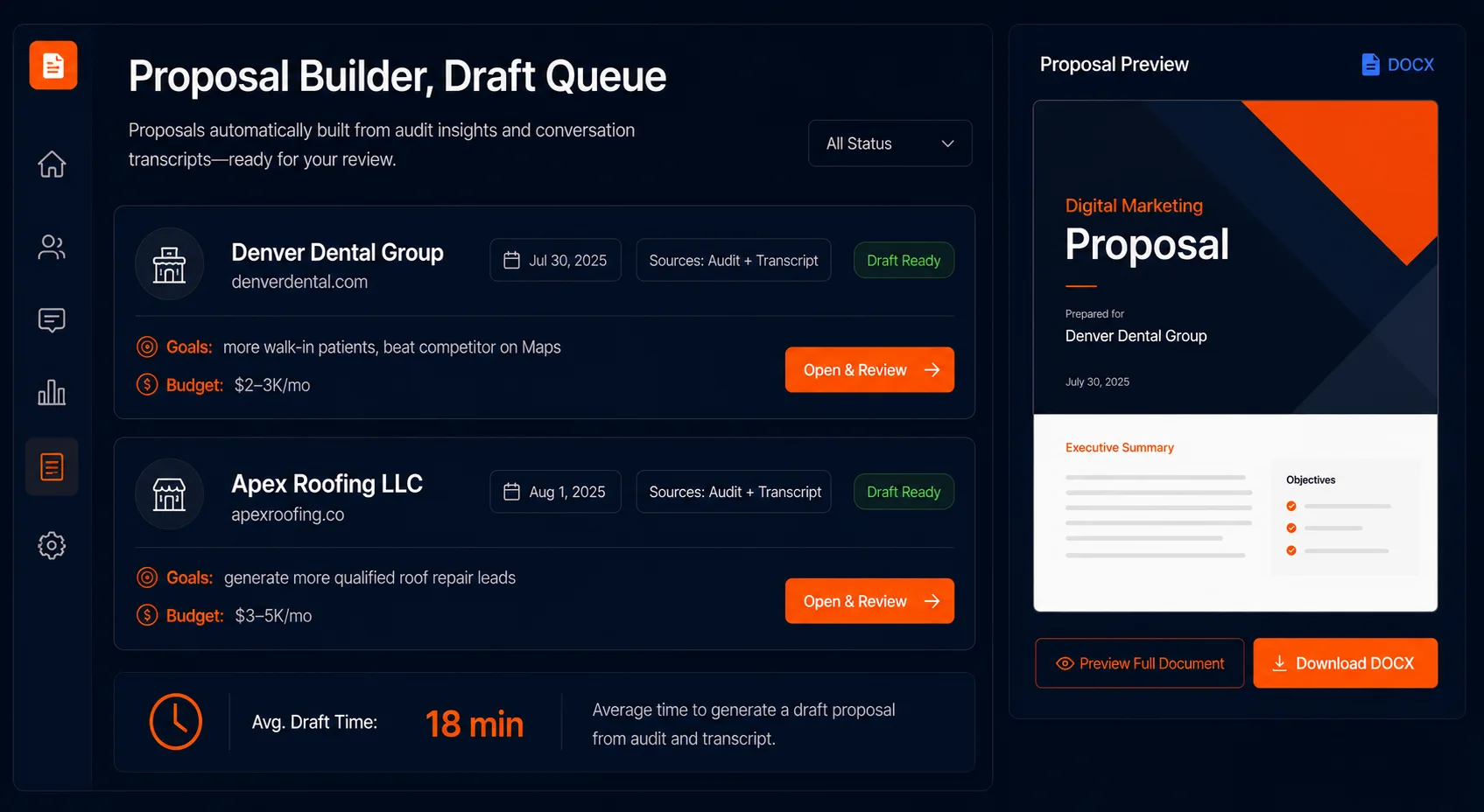
Fig 5 – Your account director reviews a pre built proposal in 30 minutes. Manual builds took 3 hours.
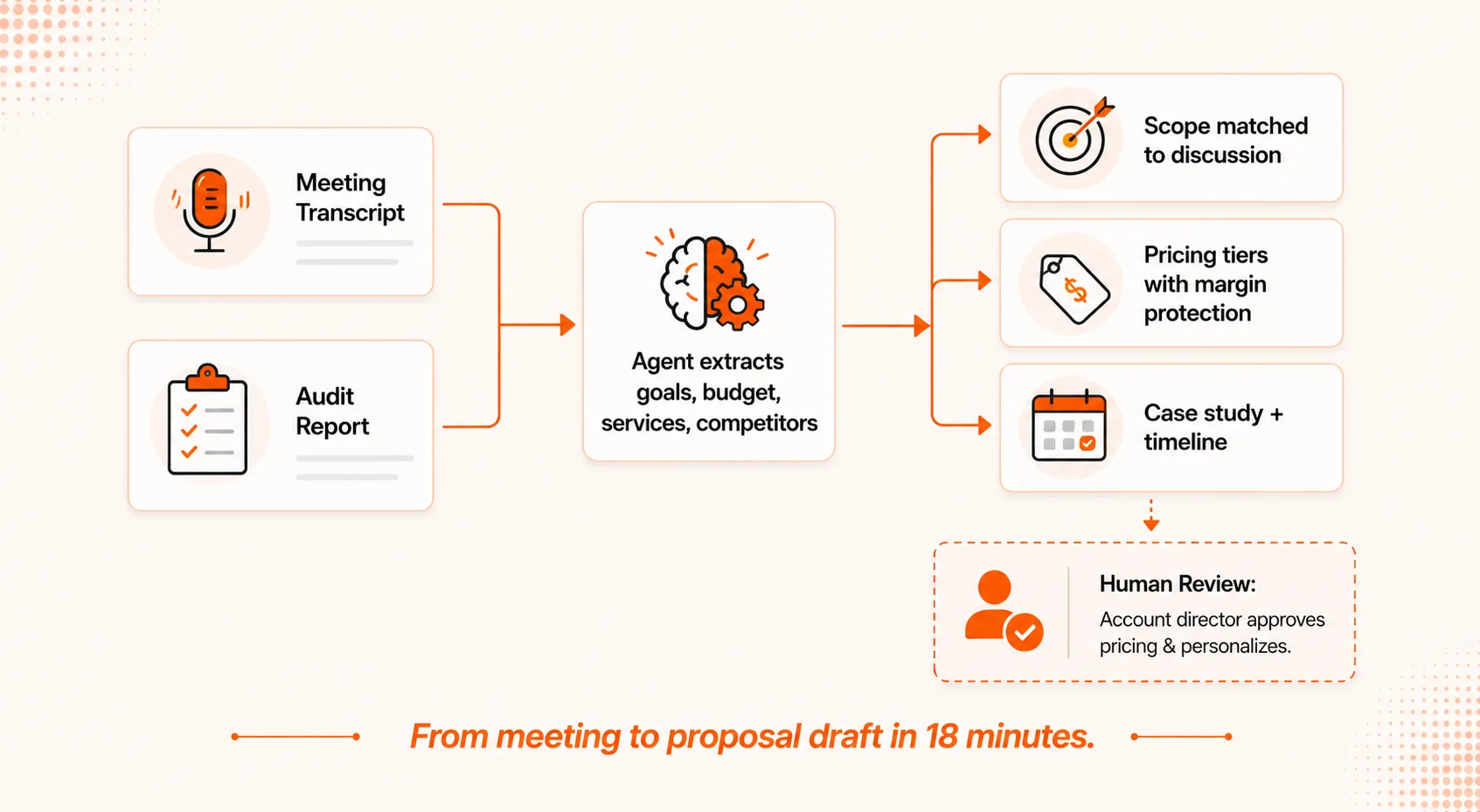
Fig 6 – Two inputs (audit plus meeting transcript) produce a margin protected proposal draft in 18 minutes.
Content and Production Quality Workflows
You signed the client. The business owner pays your agency every month. Now you need to deliver work that keeps them renewing. This is where most agency operations break. The SEO strategy is usually fine. The production pipeline leaks quality at every handoff.
Your white label partner writes a blog post for the client’s website. It is technically solid. It sounds nothing like the client’s brand voice. The content strategy misses the local event happening in the client’s city that every local customer is searching for. The blog sits as text when it could also be a video driving social engagement. And nobody catches the voice mismatch until the client emails asking why their blog reads like a stranger wrote it. Your client’s social presence is dead because they do not have a team for that.
These four workflows sit between production and delivery. They catch problems before the client sees them. They turn one content asset into multiple formats. They make outsourced content sound local. They create graphic social media posts from text content.
Workflow 4: AI Video Creation Automation via n8n
The problem it solves
Your client, a dentist in Denver, published a blog post on their website about “when to replace old dental crowns.” Good content. Solid keyword targeting. It sits as text on a page and does nothing on Instagram, LinkedIn, or YouTube, where the dentist’s potential patients scroll every day.
Every business client wants video content. Almost nobody has the budget for a production crew, and your agency does not have a video team. So blogs stay as blogs. Case studies sit as PDFs. The client’s competitors post videos on social media. Your client’s content exists in only one format. And in the era of Generative Engine Optimization, video content has become a vital part of any business’s visibility. We have seen an increase of short video recommendations on Google SERP for informational queries, which makes video content more necessary.
How the workflow runs
A new blog post, case study, or service page goes live on the client’s website. The system detects this through an RSS feed, CMS webhook, or scheduled URL check. You can also trigger it manually from the dashboard for any existing page.
The n8n automation workflow does the following.
- Pulls the published content and extracts the headline, 3 to 5 key points, any statistics, and the call to action
- Feeds extracted content into a script generator that writes a 30 to 60 second video script. Hook (first 3 seconds to grab attention), body (key insights for the viewer), and closing CTA (“Book your appointment today at denverdental.com”)
- Routes the script through AI video generation APIs (Seedance, or similar) to produce visual clips for each segment
- Adds voiceover through the ElevenLabs API using the client’s preferred voice profile
- Composites the video with the client’s brand overlay. Logo watermark, brand colors on lower thirds, end card with website URL and phone number
- Saves the finished video and notifies the account manager through the dashboard
One blog post in. One branded video out. No production crew. No editing software. No 3 week turnaround with a freelance videographer.
Where the honest limits sit. AI video in 2026 still produces occasional uncanny motion, drifted on-screen text, and mangled brand logos when logos appear inside the generated scene. This workflow handles bulk short form content well. Hero videos for the client’s homepage, brand story pieces, and testimonial cuts still need a human videographer. The account manager’s rejection triggers a re-generation, which doubles or triples the API cost per accepted clip. Budget for a 20 to 30% regeneration rate at launch, dropping to 10% as prompts stabilize.
Format and licensing details. The pipeline outputs three aspect ratios per clip. 9:16 for Instagram Reels, TikTok, and YouTube Shorts. 1:1 for feed posts. 16:9 for YouTube and LinkedIn. Music is licensed through commercial-cleared libraries only (Artlist, Epidemic Sound, or the client’s own licensed catalog). Suno and other generative music tools remain a legal grey zone for commercial use and get skipped. Captions burn in automatically because 85% of short form video plays with sound off.
Where humans review
The account manager watches the final video before it reaches the client. They check whether visuals are correct and whether the voiceover tone matches this client’s personality. Not every blog post deserves a video. The human decides which ones ship. Approved videos go through a light editing pass. Adding on screen text, logos, trimming if needed.
For the full technical walkthrough, see our guide on building AI video generation workflows with n8n and Veo. For the strategic case behind AI video production as a core service for US marketing agencies, read that one too.
Cost and operational benefit
Freelance video editor. $150 to $500 per short form video.
This workflow. Roughly $5 to $15 in API costs per video.
At 8 client videos per month across the roster, that saves $1,160 to $3,880 in production cost. Turnaround drops from 3 to 5 business days to under 30 minutes.
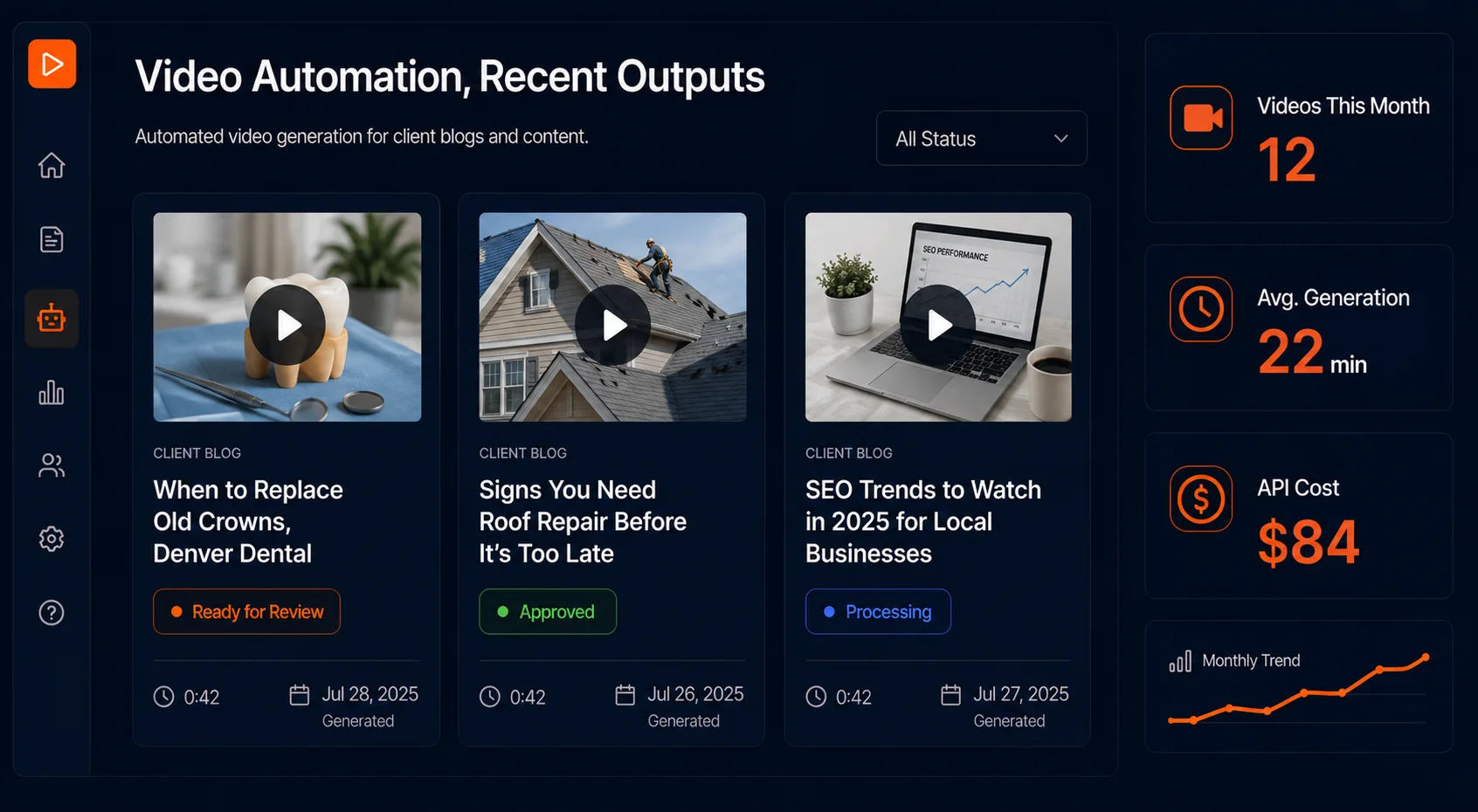
Fig 7 – Eight client videos per month at $5 to $15 each in place of $150 to $500 per freelancer edit.
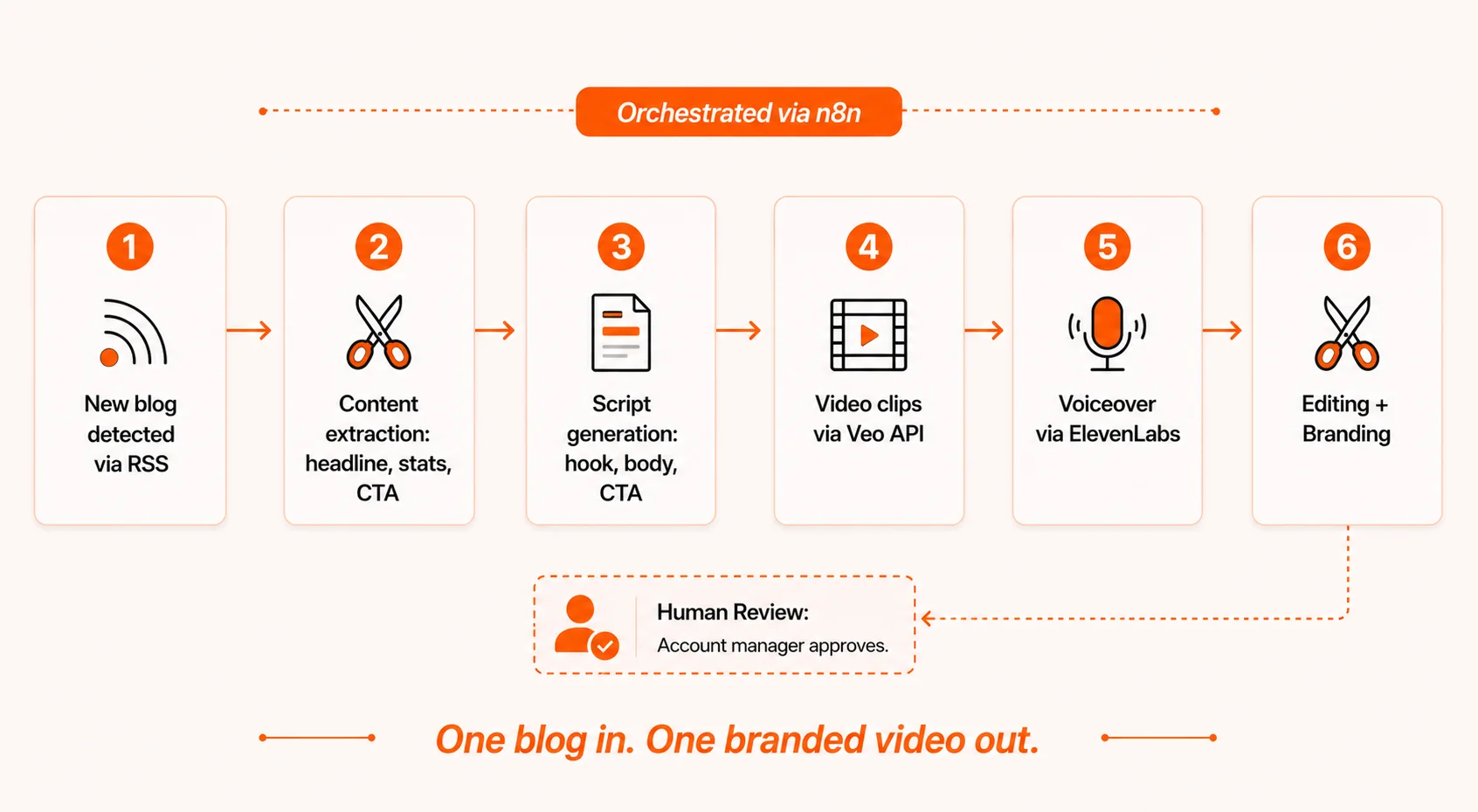
Fig 8 – One blog post published on the client’s site triggers a pipeline that outputs a branded video in 22 minutes.
Workflow 5: Content Strategy Agent Based on Local News and Culture
The problem it solves
Your client is a plumbing company in Denver. Your white label local SEO partner writes a blog about “how to prevent frozen pipes.” Fine. Last week Denver passed a new water conservation ordinance that every homeowner in the city is searching for. A blog tying the ordinance to the plumber’s winterization services would rank faster, resonate with local readers, and convert better than another generic how to.
Most outsourced SEO content sounds like it was written by someone who has never visited the client’s city. A local SEO reseller partner in another state or country does not know what is trending locally. Generic content ranks generically. Content that connects a local event to the client’s services ranks and converts because it speaks the reader’s language.
How the workflow runs
Runs weekly on a set schedule per client account. Can also trigger manually from the dashboard when planning the next month’s content calendar.
- Pulls the client’s target location and industry from the account profile
- Scans local news sources. Google News filtered by city, local newspaper RSS feeds, city subreddits, chamber of commerce event calendars
- Cross references local trends against the client’s target keywords and service offerings. “Water conservation ordinance in Denver” plus client is a plumber equals a content opportunity about how the new rules affect home plumbing and what homeowners should do.
- Validates interest through Google Trends for the specific region to confirm the topic is actually spiking and not just noise
- Produces 5 to 10 content ideas per client. Suggested title, target keyword, the local angle, estimated search opportunity, and recommended content type (blog post, FAQ page, location page update, Google Business Profile post)
- Ranks each idea by a scoring formula. Keyword relevance (40%) plus local timeliness (30%) plus competitive gap (30%)
- Drops ranked ideas into the dashboard for review
The white label on page SEO partner’s writers then receive approved briefs that already carry local context. The content reads like someone who actually lives in the area wrote it.
Where humans review
Your content strategist reviews the ideas on the dashboard, picks 3 to 4 for the month, adjusts angles based on recent client conversations, and approves briefs before writing starts. The agent surfaces opportunities. Your team picks the battles.
Cost and operational benefit
Manual content calendar research done well. 3 to 5 hours per client per month.
Automated. 20 to 30 minutes of review to select from pre scored suggestions.
At 10 business clients, that saves 25 to 45 hours monthly. Content quality goes up because ideas draw on real local data in place of whatever the strategist could think of between meetings.
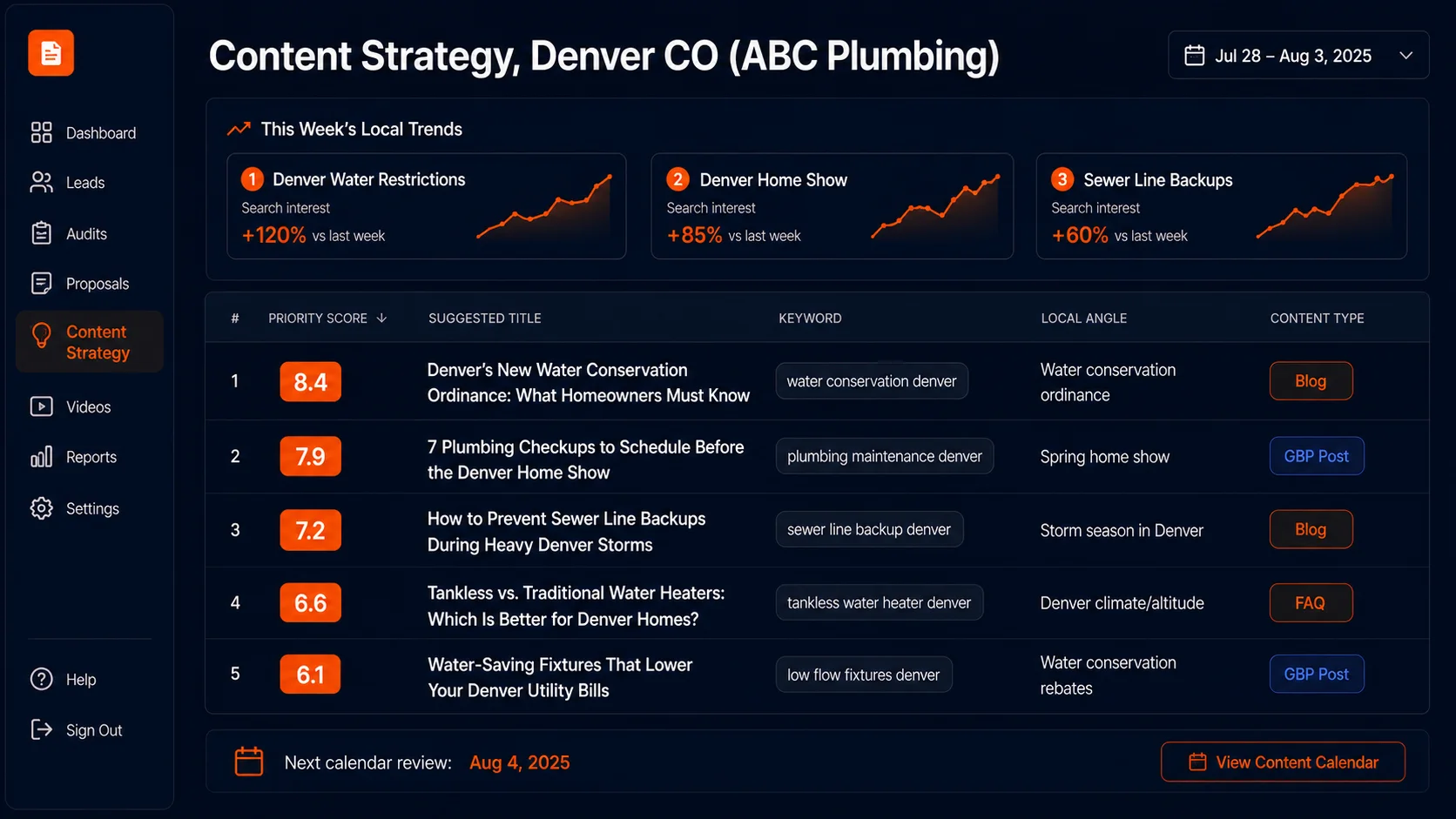
Fig 9 – Five ranked content ideas with local angles, keyword targets, and priority scores, ready for your strategist to pick from.
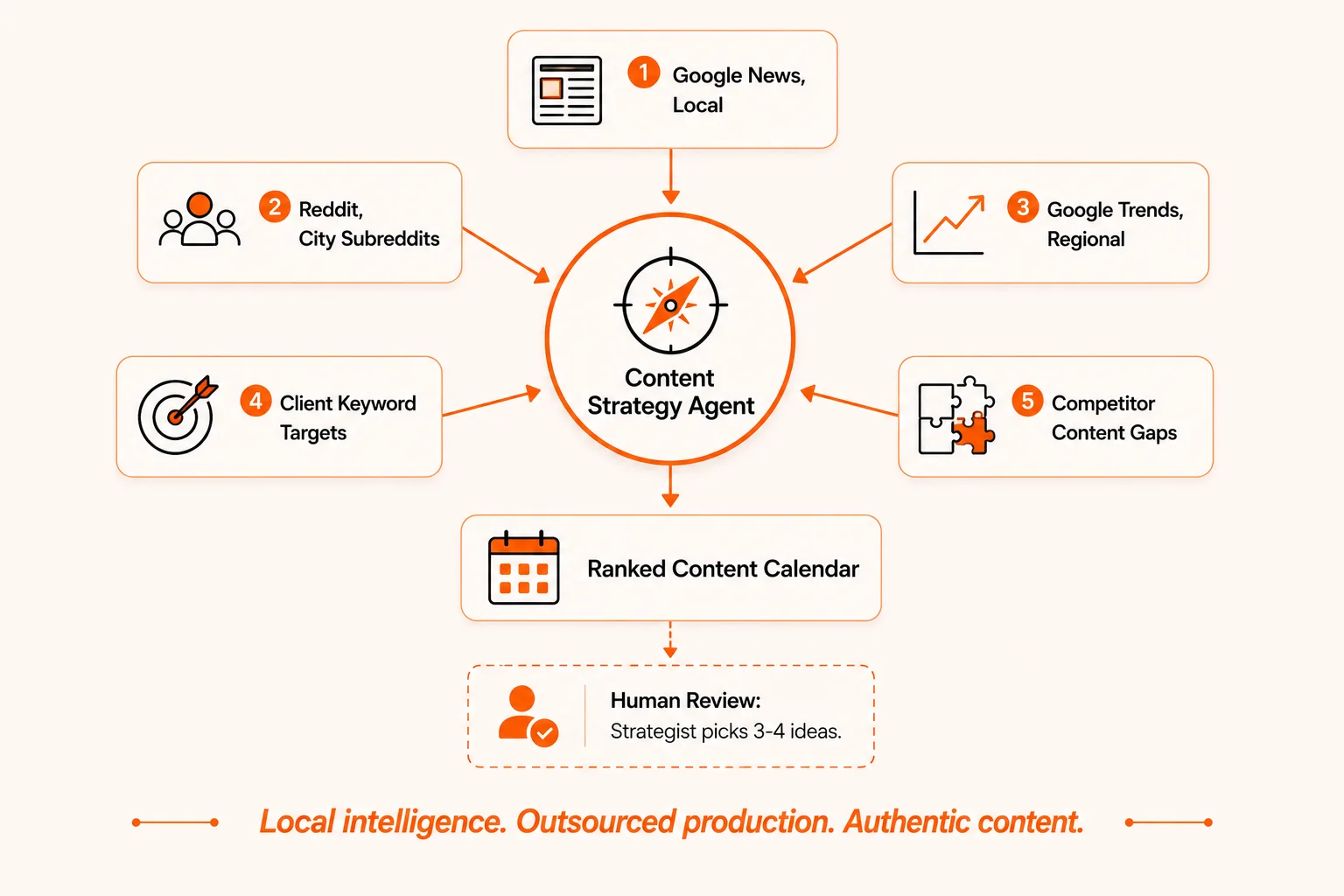
Fig 10 – Five data sources feed into one scored content calendar your strategist reviews in 20 minutes.
Workflow 6: Social Media Content Auto Generation from Client Website Content
The problem it solves
Your client, a personal injury law firm, just published a blog post on their site. “5 Steps to Take After a Car Accident in Colorado.” Good content. It will rank over time. Nobody creates the LinkedIn post that could drive 500 impressions to partners and referral sources. Nobody builds the Instagram carousel that breaks the 5 steps into shareable slides. Nobody writes the Facebook post that gets shared in the local community group.
This matters more now than it used to. Ahrefs analyzed 75,000 brands across ChatGPT, Google AI Mode, and AI Overviews in December 2025 and found that YouTube mentions carry the strongest correlation with AI search visibility (Spearman 0.737), well ahead of backlinks at 0.218. When your client’s SEO content does not reach social channels, you leave AI search visibility on the table.
For more on why social profiles are now tracked as GSC properties and what that means for GEO, that is required reading for any agency managing client SEO in 2026.
How the workflow runs
A new page publishes on the client’s website. Detection happens via CMS webhook or RSS. Manual trigger also works.
The agent analyzes content type and maps it to the right social format.
- Step by step guide or how to becomes a carousel. Each step gets 1 slide with a headline, a 1 to 2 sentence recap, and a visual direction. Full carousel script output with slide by slide copy. Example. “5 Steps After a Car Accident” becomes a 5 slide Instagram carousel the firm’s followers can save and share.
- Statistics heavy post becomes individual stat highlight posts per platform, plus a “5 stats you should know” carousel
- Case study or success story becomes a before and after comparison post with the key result as the hook
- Listicle or comparison becomes a “which applies to you?” engagement post or a ranked carousel
- Opinion or thought leadership becomes a quote card post plus a discussion thread for X, Twitter
Platform specific versions for each.
- LinkedIn. Professional angle, 150 to 200 words, insight led with a question hook
- Instagram. Visual caption with carousel structure where applicable, 80 to 120 words
- X, Twitter. 2 to 3 tweet thread, concise, data forward
- Facebook. Conversational, 100 to 150 words, engagement question at the close
Suggests relevant hashtags and posting times based on the client’s engagement history. All drafts save to the dashboard.
Where humans review
Your social media manager or account manager reviews every draft on the dashboard before scheduling. Checks tone, accuracy, visual suggestions, and client approval requirements. The agent drafts. Your team curates.
Cost and operational benefit
Manual social content from a blog post. 1 to 2 hours per post (reading, writing 4 platform versions, researching hashtags, scheduling).
Automated. 10 to 15 minutes reviewing and editing drafts.
At 8 blog posts per month across the roster, that saves 6 to 14 hours. Your team also generates social signals that strengthen your client’s visibility in AI search. That work was not happening before, which makes it net new value on top of the time savings.
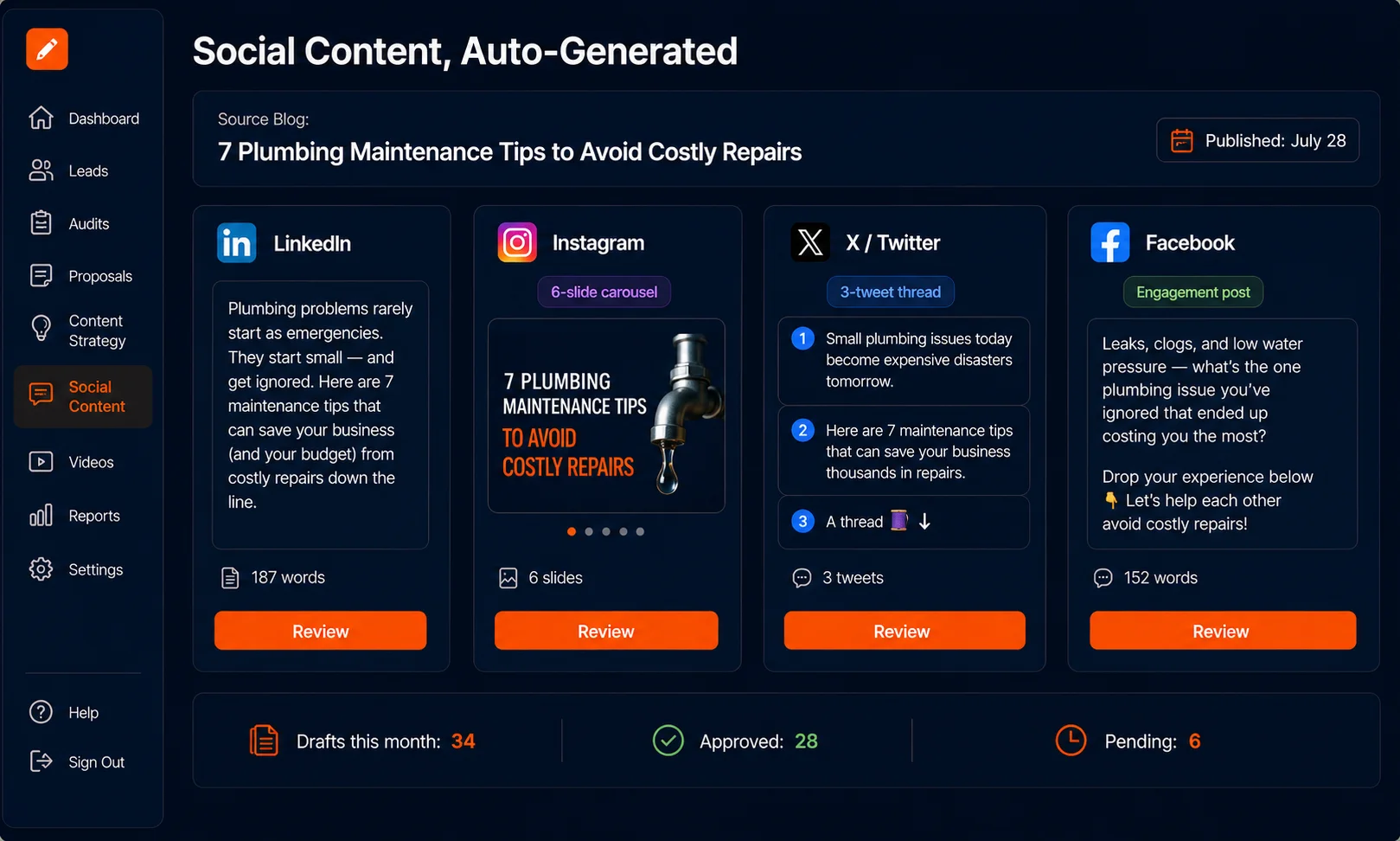
Fig 11 – One published blog post automatically produces 4 platform specific social drafts your team reviews and schedules.
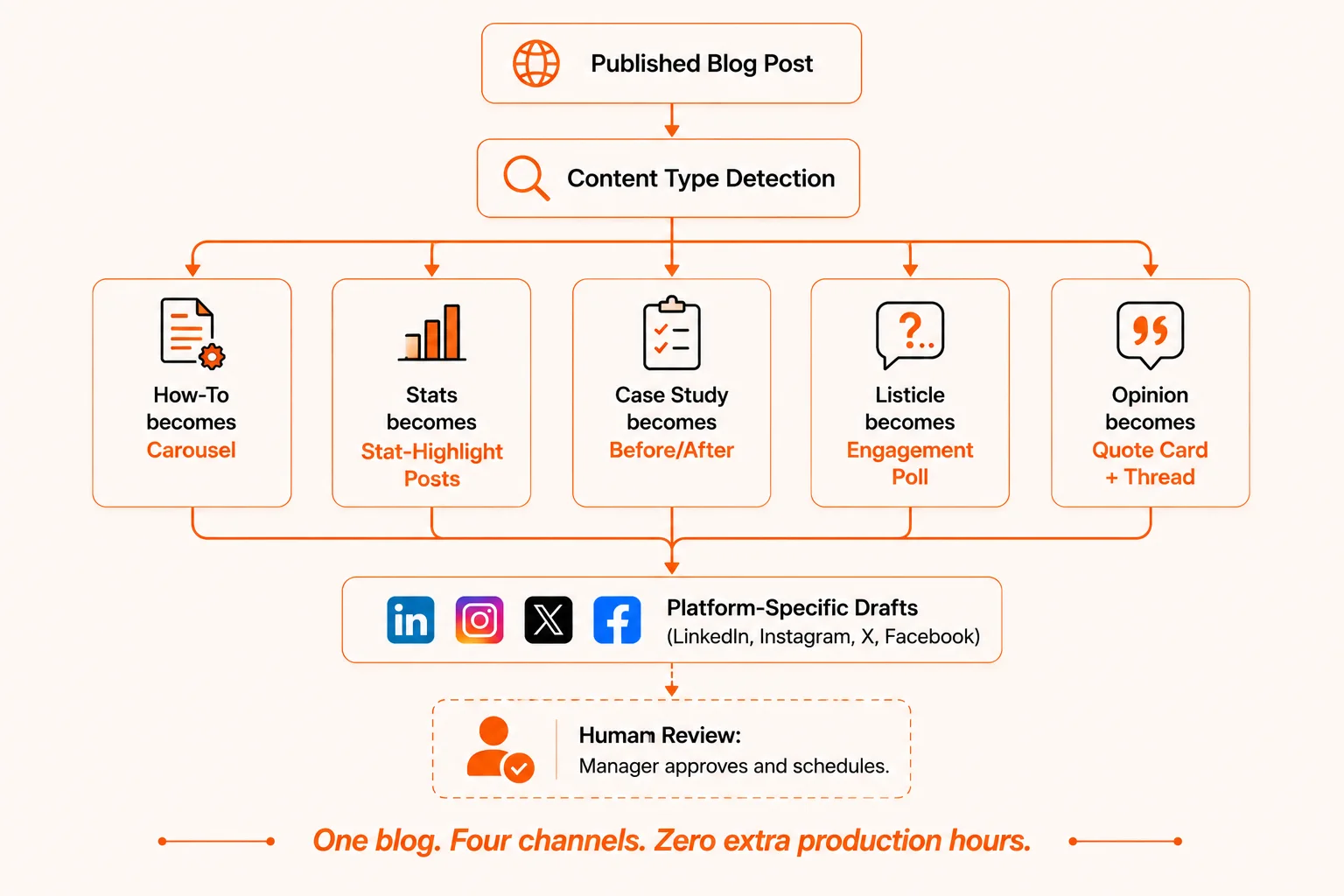
Fig 12 – The agent reads the content type and picks the social format that fits. No one size template for everything.
Workflow 7: Content Review Agent for Client Brand Voice
The problem it solves
Your white label SEO reseller partner delivers a blog post for your dental client. It is well researched. Keywords in the right places. Structure is solid. It reads like a corporate whitepaper when the dentist’s website sounds warm, approachable, and a little bit funny.
Brand voice mismatches are the number one reason clients lose trust in outsourced content. They read the draft and think “this does not sound like us.” When that happens more than twice, they start questioning your agency. Then they start questioning the retainer.
How the workflow runs
A draft enters the review queue on the dashboard, whether the white label partner or your own internal writer produced it.
The agent loads the client’s brand voice profile (built once during onboarding). Tone descriptors, vocabulary preferences, banned terms, sentence length ranges, formality level, and 3 to 5 excerpts from approved past content.
Profile refresh cadence. Brand voice drifts. New leadership, new positioning, a rebrand, or a service line launch all shift how the client wants to sound. The voice profile refreshes every quarter as a scheduled task, and immediately on trigger events (client rebrand notification, new C-suite hire, or three consecutive voice compliance scores below 70% flagging a systemic mismatch that indicates the profile is stale, not the drafts).
- Scores the draft against the voice profile. Tone match, reading level, sentence structure, vocabulary alignment
- Flags specific sentences that deviate with explanations. “This paragraph reads too formal for Denver Dental. Their approved content uses contractions, humor, and direct address. Suggested revision. [rewritten version]”
- Checks factual claims against the client’s approved messaging (catches unapproved statistics or competitor mentions that violate client policy)
- Generates a voice compliance score (percentage match) and a prioritized revision checklist
The agent suggests. It does not rewrite on its own. It highlights what is off and offers a direction.
Where humans review
Your editor or account manager reviews the flags on the dashboard and decides which to accept. Final copy approval is always human. The agent is quality control. Your team creates the quality.
This is the bridge between white label on page SEO production and your client. It catches voice mismatches before the business owner ever sees the work.
Cost and operational benefit
Manual content review. 30 to 45 minutes per piece, longer when heavy rewriting is needed.
Agent assisted. 10 to 15 minutes focused on flagged sections only.
At 15 content pieces per month, that saves roughly 5 to 7.5 hours. The real value is client trust. Content that matches the client’s voice on the first pass builds confidence. Content that needs three revision rounds erodes it.
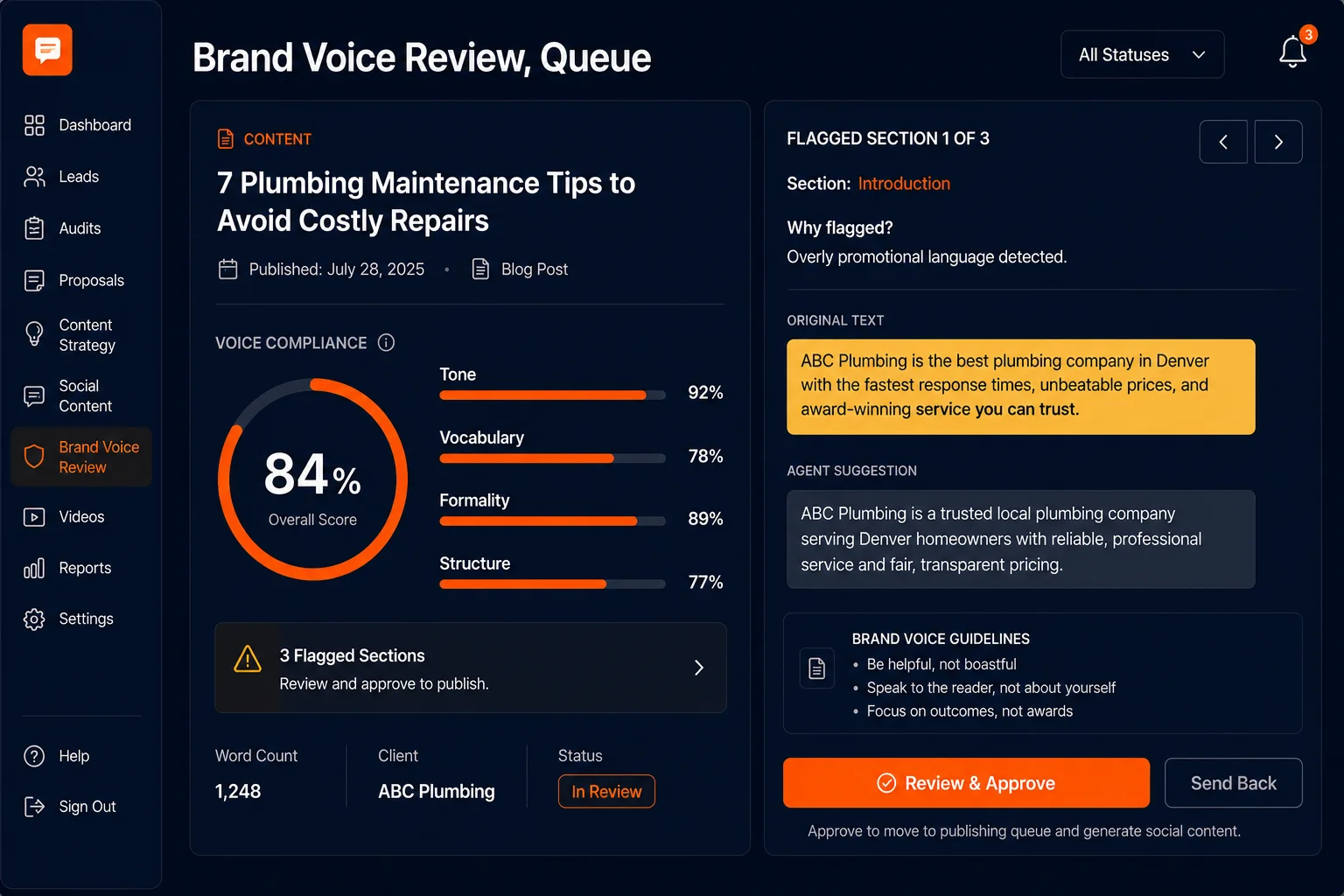
Fig 13 – An 84% voice compliance score with three flagged sentences, reviewed in 10 minutes. The manual review took 45.
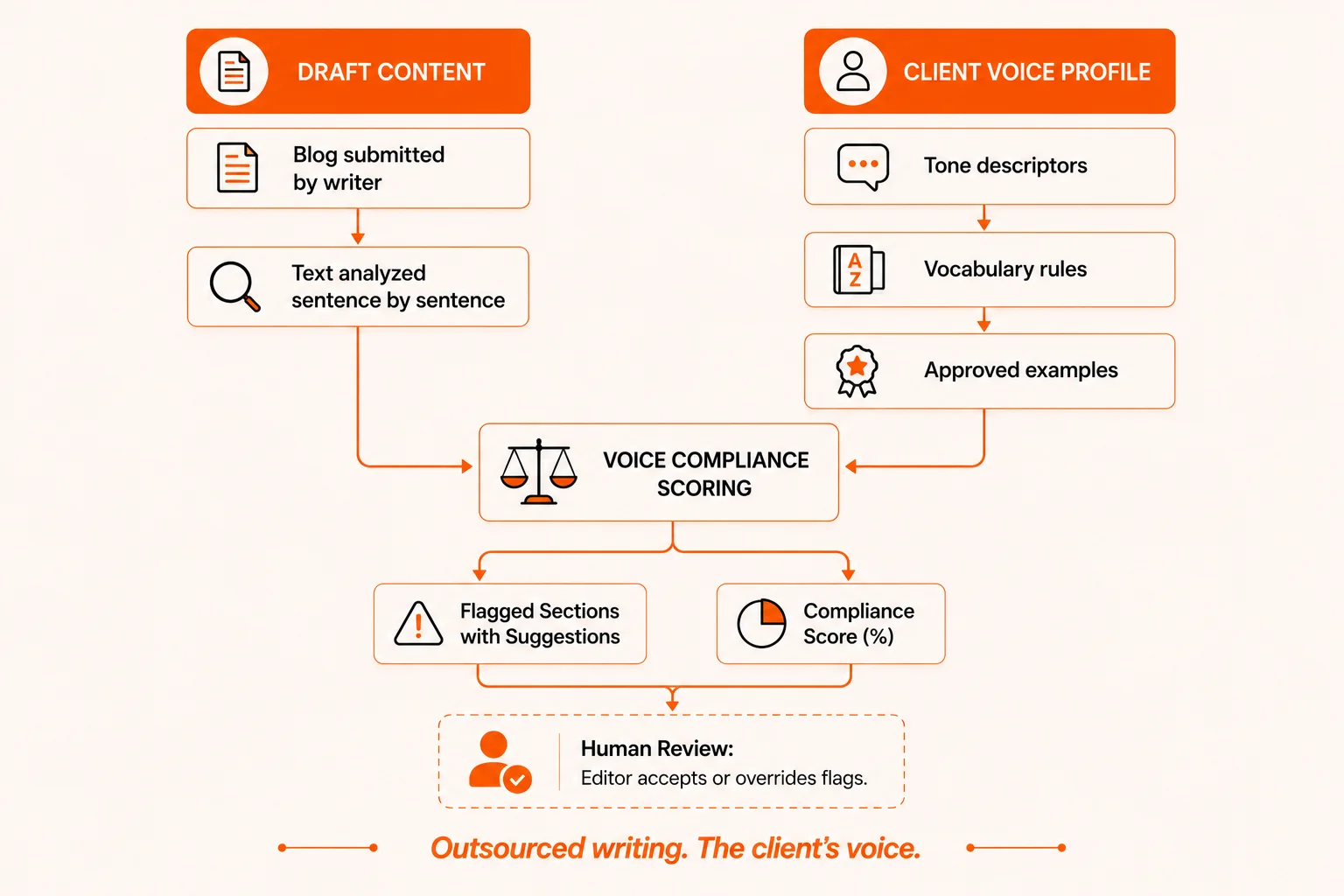
Fig 14 – Every draft gets scored against the client’s voice profile before anyone on the client’s team sees it.
Intelligence and Oversight Workflows
Outsourcing production is only half the equation. The other half is seeing what is happening. Most agencies that use a white label SEO agency for fulfillment lose visibility the moment work leaves their hands. They trust. They hope. They find out about a problem when the client calls with a complaint.
These three workflows give your agency eyes on everything. Your fulfillment partner’s performance and your client’s competitors’ moves. Intelligence you control. Production you delegate.
Workflow 8: Partner Performance Review Automated Report
Why this workflow exists (a note on multi-provider agencies)
Most agencies operating at scale do not put all their eggs in one basket. They work with two or three white label providers concurrently, splitting workload by service line, geography, language, or turnaround requirement. A common setup involves one partner handling technical SEO and content production, a second running link building, and a third covering GEO and AI answer engine optimization. This workflow assumes that reality. It scores each provider independently so your agency can compare, rebalance workload, or renegotiate rates based on actual delivered impact. For agencies working with a single provider (including Clixlogix), the workflow still runs, and the scorecard gives you the numbers to hold that single provider accountable.
The problem it solves
You have one or more white label SEO partners delivering work for your clients. How do you know the work is good? Most agencies answer that question with “we check the reports” or “we look at rankings.” That is not measurement. That is hoping.
Without structured performance tracking, you do not know which provider is slipping on delivery timelines, which is dropping content quality, or which is deprioritizing your accounts to serve a higher-paying agency. You find out when a client churns. By then the damage is done.
How the workflow runs
Runs monthly on a set date (typically the 1st). Can also trigger on demand from the dashboard before a partner review meeting. Weekly light-touch reports run every Monday and link ranking wins from the previous 7 days back to the specific partner deliverables that produced them (the content asset, the link acquired, the technical fix), so wins get attributed to the right provider in near real time.
The agent compiles the following per provider.
- From the project management tool. Tasks assigned to the partner, completion rates, on time delivery percentage, revision request count per deliverable type
- From Workflow 7’s data. Average content QA scores, factual errors caught, brand voice deviation frequency
- From SEO tracking. Ranking movement on pages the partner built for your clients, organic traffic to partner produced content, backlinks acquired through the partner’s outreach
- Weekly wins attribution. Every keyword that moved 3 or more positions in the last week gets tagged back to the deliverable that likely caused the move (with a confidence score) and the partner that produced it
Partner scorecard with three sections, produced per provider so you can compare side by side.
- Delivery. On time rate, completion percentage, turnaround per task type
- Quality. Content QA pass rate, error frequency, voice compliance averages
- Impact. Keyword movement across your client portfolio, traffic generated, links acquired, and confidence-weighted attribution to specific partner deliverables
Each metric compares against the previous 3 month rolling average and against the other providers in your stack. Anything below your agency’s threshold gets flagged.
Written overview. Which provider is working best on which service line, what is slipping, and recommended discussion points for your next round of partner check ins.
Where humans review
You or your ops manager review the report on the dashboard before any conversation with the partner. The report gives you the data. You decide what to do with it.
This is how agencies running a serious white label SEO program hold their partner accountable with numbers, not gut feeling.
Cost and operational benefit
Manual partner review. 2 to 4 hours per month pulling data from different tools.
Automated. 15 to 20 minutes reviewing a pre built scorecard.
The time savings matter. The real benefit is catching quality drift in month 2, well before month 6 when a client is already unhappy.
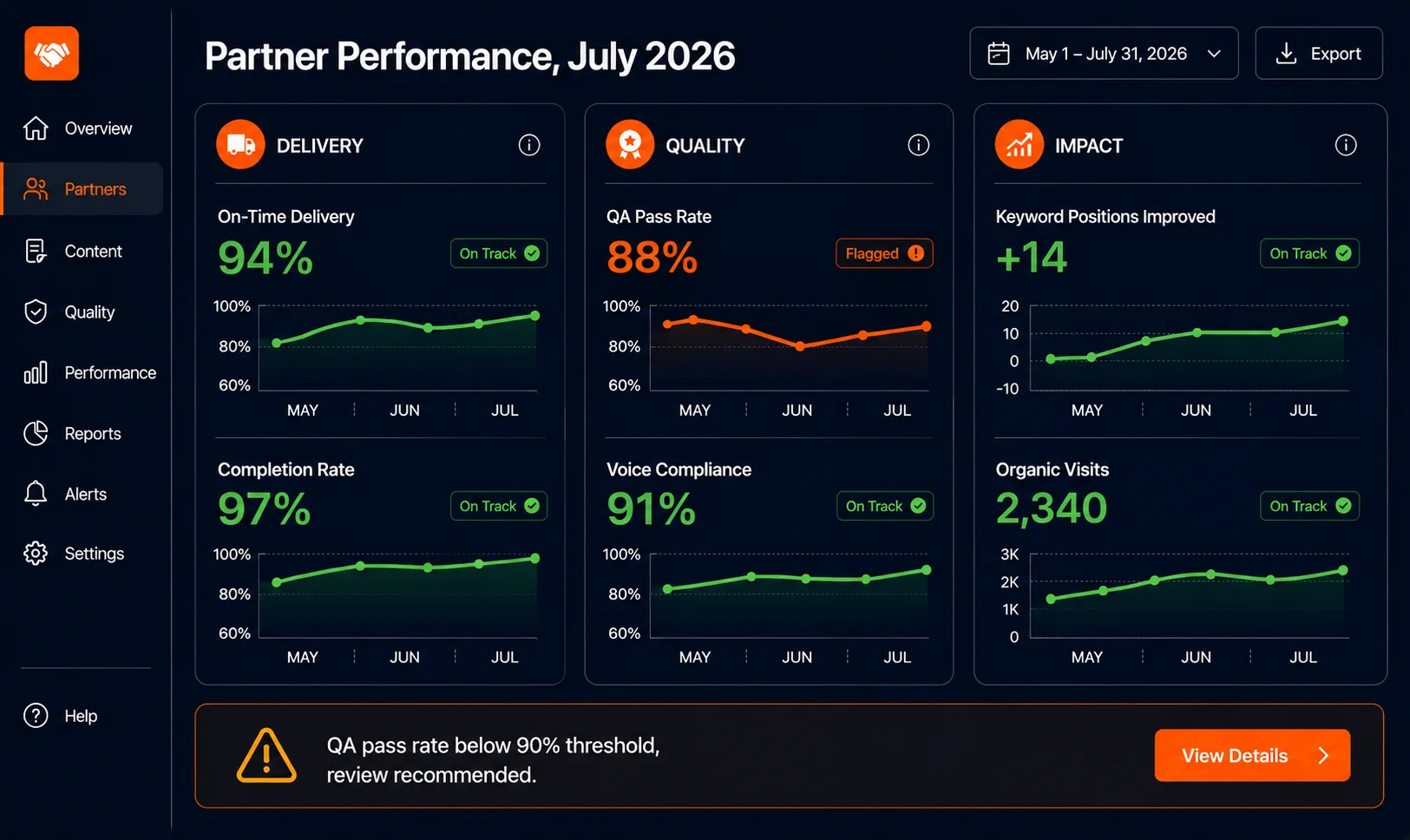
Fig 15 – Three scorecard sections that tell you in 15 minutes whether your white label partner is holding up their end.
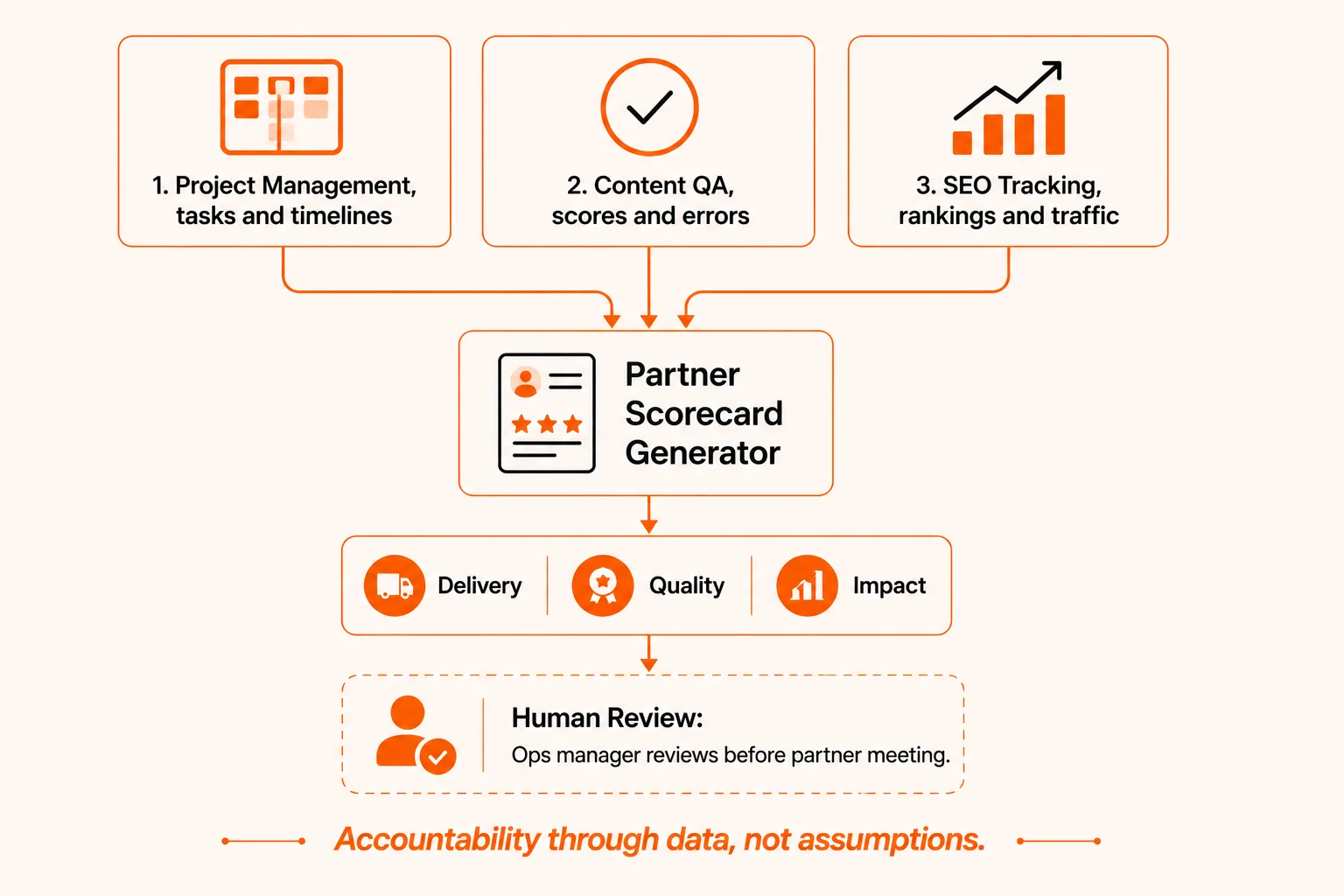
Fig 16 – Three data sources converge into one scorecard that replaces hours of manual spreadsheet work.
Workflow 9: Competitor Sniper Automation
The problem it solves
Your client’s competitors do not send you a memo when they publish a new landing page or pick up 15 backlinks in a week. Right now, competitive monitoring for your business clients is whatever someone on your team remembers to check. You find out about competitor moves weeks or months after they happen, when the ranking damage is already done.
For agencies outsourcing white label link building services through a fulfillment partner, this is especially painful. You cannot direct the partner to build counter content or target counter links if you do not know what the client’s competition just did.
How the workflow runs
The agent maintains a competitor watchlist per business client. 3 to 5 competing businesses in the same market, configured during onboarding.
Weekly scan.
- Checks each competitor’s blog and content section for new pages published in the last 7 days
- Monitors competitor social profiles for new posts and engagement spikes. Pulls data from APIs of tools like Semrush or Ahrefs.
- Flags any new pages targeting keywords the client is also tracking
- Detects new backlinks competitors acquired
- Posts a bullet point alert to the dashboard
Monthly deep scan.
- Full keyword overlap. Keywords the competitor ranks for that the client does not
- Content gap identification. Topics they cover that the client has not addressed
- Technical change detection. New schema, site restructure, new landing pages
- Estimates traffic impact using position-weighted CTR curves, not raw keyword volume. Position 1 captures roughly 30% of clicks, position 3 captures 10%, and anything past position 10 captures under 2%. Volume alone overstates the threat.
- Paid search competitor monitoring. Tracks new Google Ads campaigns competitors launched, the keywords they are bidding on, ad copy variants they are testing, and estimated spend based on search volume and average CPC. A competitor sitting at organic position 5 and running aggressive paid ads against the client’s brand terms is a threat the workflow otherwise misses.
- Compiles an “Opportunities and Threats” brief. “Competitor X (another Denver dentist) published a guide on ‘dental implants cost in Colorado’ targeting a keyword with 1,200 monthly searches. They currently rank position 4, capturing an estimated 6% of clicks. Your client has no content here. Priority. 8 out of 10.”
API cost reality. Semrush and Ahrefs API pulls at weekly cadence across 10 clients cost $200 to $600 per month in API units on top of the base subscription, which itself requires the
Semrush Business plan at $499.95 per month or an Ahrefs equivalent. DataForSEO offers a cheaper pay-as-you-go alternative at roughly $0.60 per 1,000 SERP requests for agencies watching budget.
Where humans review
Your SEO reseller strategist reviews the brief and decides which opportunities to act on. Not every competitor move deserves a response. The strategist picks the battles. The white label partner then executes. Writing counter content, building links, updating technical SEO for the client’s site.
Intelligence stays with your agency. Production scales through the partner.
Cost and operational benefit
Manual competitor monitoring done properly. 2 to 4 hours per client per month. Most agencies do not do it properly because they do not have the hours.
Automated. 10 to 15 minutes reviewing a pre scored brief.
At 10 business clients, that saves 17 to 37 hours monthly. Response speed changes completely. Competitor publishes Monday. You see it Tuesday. You brief the partner Wednesday. Counter content is in production by Friday.
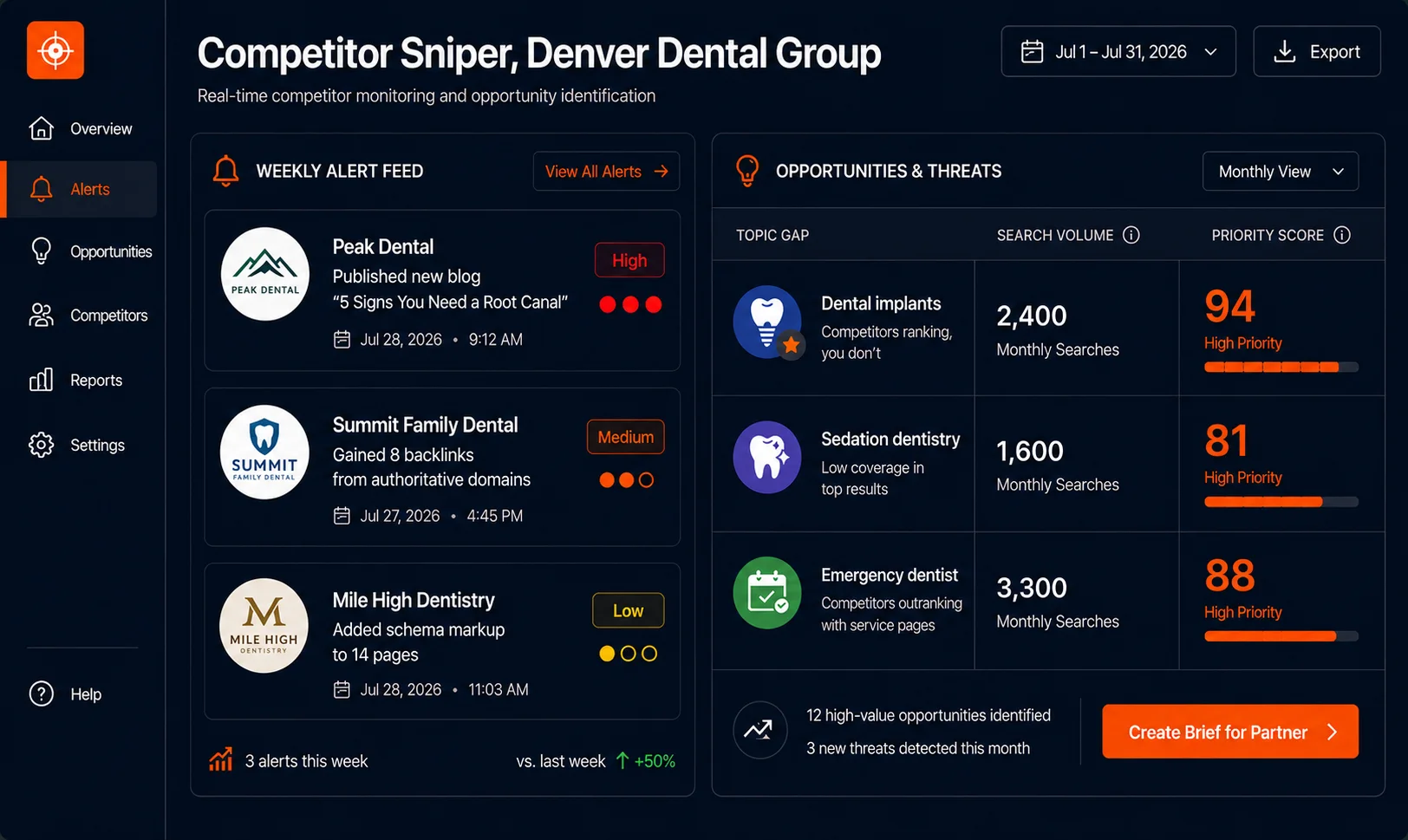
Fig 17 – Weekly alerts and monthly deep scans keep your agency ahead of every client’s competitors without manual checking.
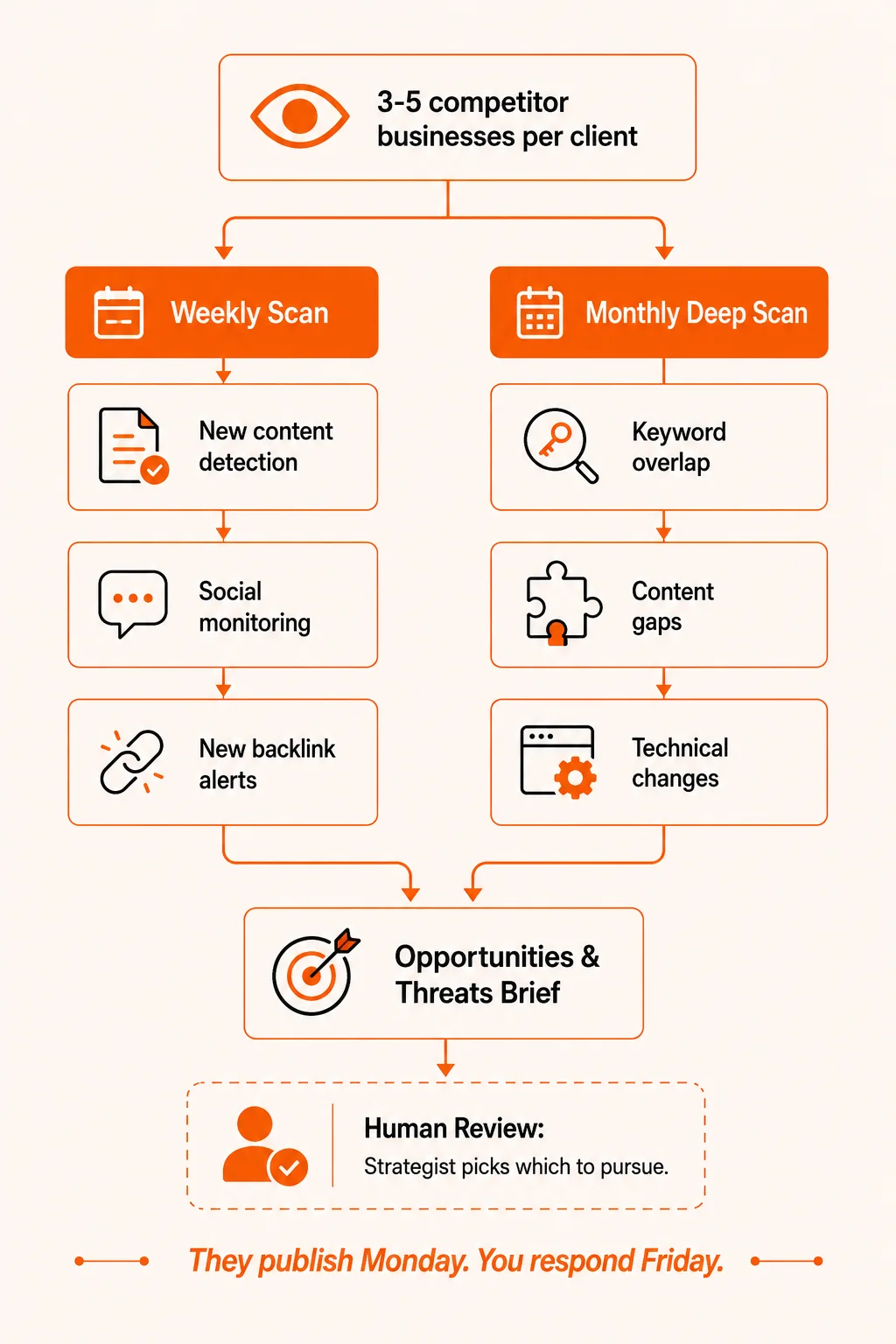
Fig 18 – Two scan cadences, one weekly for speed and one monthly for depth, feed a single prioritized action brief.
Client Retention Workflows
Here is a number worth thinking about. Amy Gallo’s 2014 Harvard Business Review analysis, drawing on Bain & Company research, puts customer acquisition at 5 to 25 times more expensive than retention depending on industry. Professional services and B2B agencies typically sit at the 5 to 7 times end of that range. And the number one reason SEO clients leave is poor visibility into the results, well ahead of the results themselves.
When a business owner cannot see what your agency is doing, they assume you are not doing anything. When they get a PDF of charts they do not understand, they feel confused. When the quarterly review is a data dump in place of a business conversation, the renewal meeting becomes a negotiation.
Workflow 10: Monthly Digest Email Plus Quarterly Interactive Business Impact Report
The problem it solves
Agencies spend 4 to 5 hours per client per month on reporting. At 20 business clients, that is 80 to 100 hours per month. At a loaded cost of $85 per hour, that is roughly $6,800 to $8,500 in labor spent assembling documents that clients skim for 3 minutes.
And the quarterly review is usually a rushed deck built the night before, full of charts that make sense to SEOs but not to a law firm partner or a dental practice owner. The client nods, says “looks good,” and privately wonders whether they are getting their money’s worth.
The white label SEO dashboard feeds the raw data. Raw data does not renew contracts. Business language renews contracts.
How the workflow runs
Monthly report (last business day of each month).
The agent pulls from Google Analytics, Google Search Console, rank tracking, and the project management system.
- Organic traffic trend with month over month change
- Keyword ranking movement for the client’s top 20 tracked keywords
- Pages indexed
- New backlinks acquired
- Content published this month with links to each piece
- Technical issues resolved
Then it writes a plain English narrative the business owner will actually care about. “Your website brought in 840 new visitors this month from Google searches, 12% more than last month. 23 of those visitors filled out your contact form and 46 users called your office directly from the website. The article about dental implant costs that went live in June is now showing up on the first page of Google for 3 search terms your potential patients are typing in. We also fixed a technical issue that was hiding your crown replacement page from Google, so that page is now visible to searchers for the first time.”
No jargon. No acronyms. How many people found you, how many reached out, what we did, and what is working.
It creates a digest email version. The same narrative condensed into 5 to 7 bullet points with a link to the full report. Queued for your account manager to approve before sending.
Quarterly business impact report (end of each quarter).
This is the one that keeps clients renewing.
The agent aggregates 3 months of data and translates SEO language into business language. No jargon. No acronyms the business owner will not understand. Money, leads, and growth.
“This quarter, 6,340 people found your website through Google. Out of them, 180 called your office and 197 filled out a contact form, totalling 377 leads. That is up from 280 last quarter. If your average new patient is worth $5,000 to the practice, those 377 inquiries represent roughly $300,000 in potential revenue that came from people searching Google, not from paid ads. And here is the comparison. Each lead from Google cost you about $47. Each lead from your Google Ads cost $128. The Google search channel is getting cheaper per lead as the content builds up.”
The quarterly report includes revenue attribution estimates, cost per lead comparison across channels, ROI calculation, and next quarter’s priorities.
Delivered as an interactive web report the client accesses through a branded URL. Filterable charts. Expandable sections. Click to drill into specific months or keyword groups. The business owner can forward the link to their business partner without needing to explain anything. Export to PDF with one click for a static version.
Where humans review
Your account director reviews both reports on the dashboard. Monthly gets a light pass. Quarterly always gets a thorough review because it carries financial projections and strategic recommendations.
This is where SEO reseller services stop being about production and start being about client intelligence. The data comes from the dashboard. The narrative comes from the agent. The strategic judgment comes from you.
Cost and operational benefit
Manual monthly reporting. 4 to 5 hours per client. The Agency Management Institute’s 2024 research identifies reporting as the single largest non-billable time sink in most account management organizations.
Automated. 15 to 20 minutes of review per client.
At 20 business clients, monthly reporting alone saves 70 to 90 hours per month. That works out to roughly $5,950 to $7,650 in labor cost every single month.
Client portal access. The interactive quarterly report lives inside a branded client portal that Clixlogix white label partners can white label under your agency domain. Business owners log in with their own credentials, view live data between report cycles, and access historical reports without emailing your account team. Client-initiated access to the story reduces reactive support requests and shifts the retention conversation from “prove your value” to “here is what you already see.”
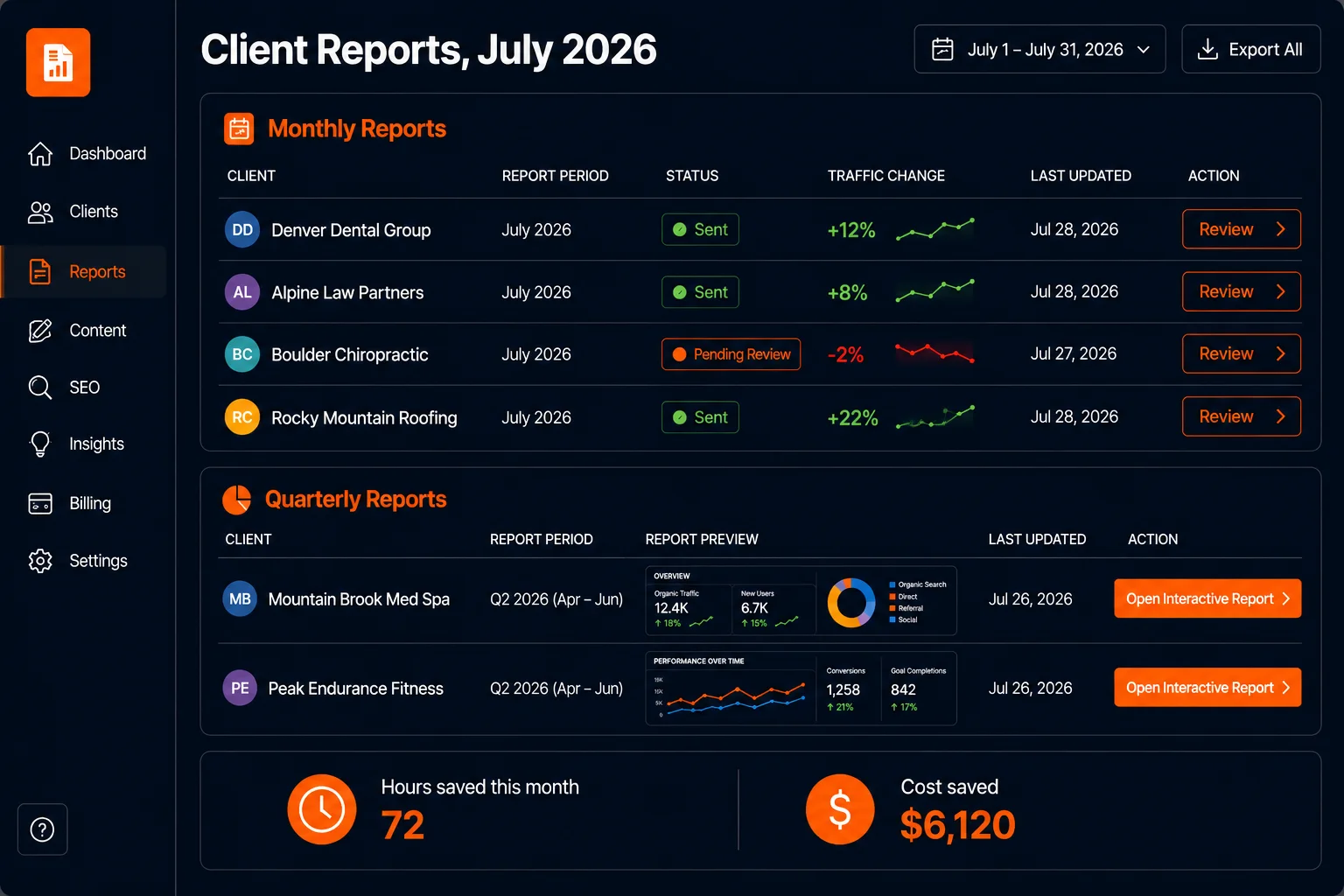
Fig 19 – Monthly reporting across 20 clients drops from 90 hours to under 7 hours of review time.
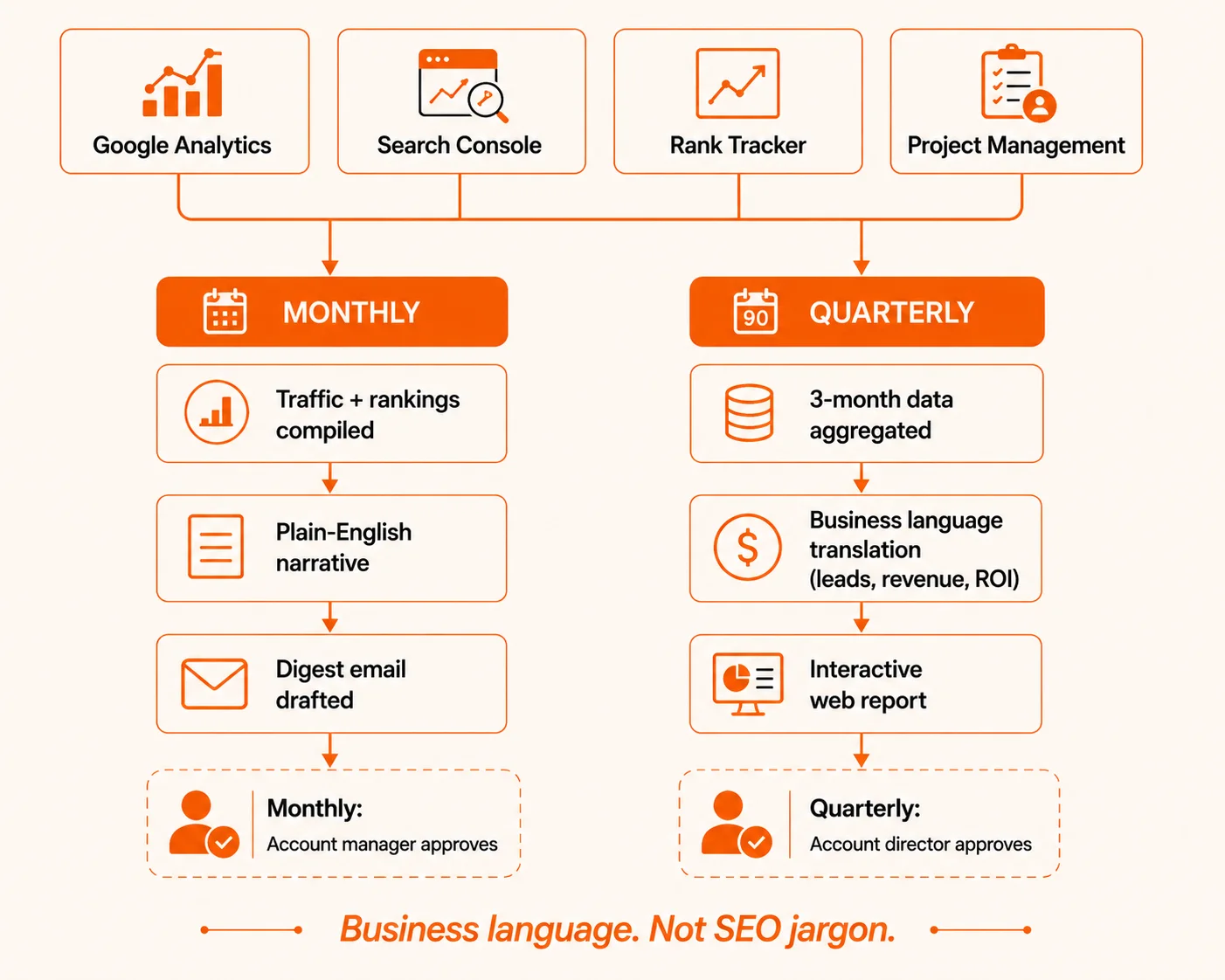
Fig 20 – Four data sources feed two report tracks, one monthly and one quarterly, each with its own review checkpoint.
What This Means for Your Agency’s Numbers
Here are the estimated numbers for a 15 client agency roster with a loaded labor cost of $85 per hour. The two right columns separate hours displaced from work your team was already doing against hours added for capabilities most agencies were not delivering before. Both matter. Confusing them inflates the ROI claim and gets spotted by any sophisticated agency owner who reads the piece.
| Workflow | Hours Displaced (existing work) | Hours Added (new capability) | Monthly Cost Displaced | Additional Value |
|---|
| 1. AI Sales Chatbot | 7 to 9 hrs | 0 | $595 to $765 | Faster lead response, higher booking rate |
| 2. Automated SEO Audit | 20 to 28 hrs | 0 | $1,700 to $2,380 (net of $150 to $400 API cost) | More prospect audits without added labor |
| 3. Proposal Builder | 9 to 15 hrs | 0 | $765 to $1,275 | Higher close rate from personalized proposals |
| 4. Video Automation | 3 to 5 hrs | 15 to 25 hrs | $255 to $425 | Multi format content most agencies were not producing |
| 5. Content Strategy Agent | 5 to 10 hrs | 20 to 35 hrs | $425 to $850 | Locally relevant content at scale |
| 6. Social Content | 2 to 4 hrs | 10 to 20 hrs | $170 to $340 | Net new social signals for AI visibility |
| 7. Brand Voice Review | 5 to 7.5 hrs | 0 | $425 to $638 | Fewer revision rounds, stronger client trust |
| 8. Partner Performance | 2 to 4 hrs | 4 to 6 hrs | $170 to $340 | Multi provider comparison, early quality drift warning |
| 9. Competitor Sniper | 4 to 8 hrs | 15 to 25 hrs | $340 to $680 | Faster competitive response for clients |
| 10. Reporting | 70 to 90 hrs | 0 | $5,950 to $7,650 | Client retention through business language reporting |
Honest totals.
- Hours displaced from work your team was already doing. 127 to 180 per month. Roughly $10,400 to $14,800 in labor cost recovered each month after subtracting API spend.
- Hours added as new capability. 64 to 111 per month. This is work most agencies were not doing at all before, which shows up as competitive positioning and client retention improvement, not as line-item labor savings.
The prior version of this table lumped both numbers together at $14,110 to $21,888. That headline read well and was misleading. The split above is the number that survives due diligence.
Human review time at aggregate. Each workflow claims 10 to 15 minutes of review per invocation. Across 10 workflows at their actual frequencies and 15 to 20 clients, senior review time totals 30 to 50 hours per month across the agency. Senior time costs more than the junior time being displaced, so honest ROI accounts for that offset. The displaced-hours numbers above already do.
Setup cost and payback. Building all 10 workflows with real integrations (CRM, GA4, GSC, Semrush or Ahrefs API, video pipeline, n8n orchestration, dashboard) is a 3 to 5 month engagement. Realistic build cost lands between $25,000 and $75,000 depending on your existing tool stack, the number of client accounts, and how deep the integrations need to go. Most agencies see payback in month 4 to 7 based on the displaced-hours number alone. The new-capability value compounds after that.
Those hours do not vanish. They move. They move to strategy calls with clients. They move to prospecting new business. They move to the work that actually grows your agency in place of just maintaining it.
Sequencing depends on your existing tooling. The right starting point is not the same for every agency.
- If your data infrastructure is already wired (rank tracker, GA4, GSC, backlink API, project management), start with Workflow 10 because it delivers the largest displaced-hours number fastest.
- If your data infrastructure is thin or fragmented, start with Workflow 2 (audit) because it is the most self-contained and generates immediate ROI in the sales pipeline without requiring your full stack to be integrated first.
- Use the freed hours from either starting point to build the rest of the sales pipeline workflows (1 and 3). Use the sales velocity to grow the client roster. Use the larger roster to justify the content and intelligence workflows (4 through 9).
That is how a 15 client agency becomes a 30 client agency without doubling headcount.
Data Governance and Failure Modes
Two topics most agentic workflow content skips over. Both matter for agencies handling business client data at scale.
Data governance. Client data flowing through OpenAI, Anthropic, ElevenLabs, Semrush, and third-party video generation APIs raises data residency and processing concerns for any client on an enterprise agreement with GDPR, CCPA, HIPAA, or SOC 2 obligations. Before onboarding a client into these workflows, verify three things. First, whether the client’s data processing agreement permits AI vendor processing, and whether specific vendors are pre-approved or blocklisted. Second, whether data must remain in a specific region, which rules out several US-hosted AI APIs for EU clients. Third, whether the client requires zero-retention API calls (available on OpenAI enterprise plans and Anthropic through the API, not on consumer ChatGPT). Skip enterprise clients whose contracts prohibit these integrations, or run their workloads on a separate, contracted-vendor pipeline. Do not paper over the mismatch.
Failure modes. Every workflow above is described as if it always works. Real production is messier. Semrush API goes down for 4 hours a quarter. Webhooks fire twice. LLMs hallucinate competitor URLs. The video pipeline generates footage with the wrong client’s brand colors. Each workflow needs three things baked in. A retry loop with exponential backoff on API failures. A dead-letter queue where failed jobs land for manual triage. A human fallback path that alerts the account manager when the workflow cannot complete, and does not silently drop the deliverable. The account manager’s job is to catch the exceptions the automation cannot handle. Without an alerting surface, exceptions become silent failures, which become client-facing embarrassments.
How Clixlogix Fits Into This
We do two things. They work better together, and they are separate services.
First, we are your white label SEO partner. We handle the SEO fulfillment for your business clients. Audits, content production, link building, technical fixes, local SEO management, AI answer engine optimization. All delivered under your brand. Your client, the business owner, never knows we exist. You bring in the client, set the strategy, manage the relationship, and collect the retail margin. We do the production work behind the scenes.
Second, we have a digital engineering team. When these 10 workflows are what your agency needs, our engineers can build them for you. They connect automations to your tools, configure triggers and review checkpoints, and get the system running. This is a separate service from the white label SEO fulfillment, built for agencies that want the operational surface on top of the partnership.
Most white label SEO for agencies stops at fulfillment. We think that is only half the picture. The agencies winning right now have both. A reliable SEO Reseller Services partner doing the client work, and an operational system that keeps everything visible, accountable, and connected to growth.
For agencies managing 5 or more business clients where operational overhead is starting to eat margins, this is the conversation to start. The question is no longer whether to outsource SEO. The question is how to make SEO delivery profitable at 20, 30, 50 clients.
That is the question we help agencies answer.
Frequently Asked Questions