Theodore Lowe, Ap #867-859 Sit Rd, Azusa New York
How Clixlogix delivered a full Zoho One overhaul for a Midwest hospitality SaaS platform, integrating 9 Zoho One products into a single automated pipeline from lead capture to recurring subscription billing across 5 milestones.
Clixlogix delivered a full Zoho One overhaul for a Midwest based SaaS company that builds a white label platform for the hospitality industry. The client’s three person leadership team (CEO, COO, CMO) was running sales, contracting, billing, and follow ups across disconnected Zoho modules and spreadsheets. Clixlogix integrated 9 Zoho One products into a single automated pipeline that eliminated every manual step between a prospect’s first website visit and their first recurring invoice. The system was designed for the client to operate and extend independently, without ongoing consultant dependency.
The client is a Midwest based SaaS company that provides a white label platform for property and venue operators across multiple service verticals. The platform enables operators to manage guest communication, scheduling, commerce, and location based services through branded digital channels. The company operates across multiple English speaking markets and serves hundreds of managed properties.
The company runs a subscription based revenue model segmented by service vertical and facility size tier. Property operators sign up through a demo driven sales process, select a product tier, sign a digital contract, and pay recurring license fees. The sales team consists of three principals: the CEO, COO, and CMO, each handling different service verticals.
Before engaging Clixlogix, the company used Zoho CRM with limited automation. Leads arrived from multiple website forms and booking sources without structured routing, meaning the leadership team manually triaged every inbound inquiry. A Zoho Blueprint that had previously guided the lead conversion process had disappeared from the system without explanation, and no one on the team had the Zoho expertise to diagnose why. Quoting, contract signing, and subscription activation required manual steps across disconnected Zoho modules, adding overhead to every deal and introducing billing errors that took hours to untangle. Follow up emails after demos were sent manually by the CMO. The company was paying for Zoho One but using it as a contact database with spreadsheets doing the actual work.
Fig 1 — Operational transformation across 7 CRM functions from manual to fully automated.
The client reached Clixlogix through a Zoho services inquiry. After an initial CRM audit, the Clixlogix team identified four core operational gaps.
No lead routing by service vertical. The company serves multiple service verticals, with a new segment under active development at the time of engagement. Leads arrived from website forms, a scheduling tool, and a self serve platform, but none of these sources classified incoming leads by vertical or assigned them to the correct sales representative. Leads accumulated without structured distribution.
Broken conversion workflow. The CRM had previously used a Zoho Blueprint to guide the sales team through lead qualification, deal creation, and quoting. This Blueprint had disappeared from the system. Without it, the team performed each conversion step manually, and there were no validation rules preventing incomplete records from entering the pipeline.
Manual, error prone quoting and contracting. Quotes required manual creation. Contract signing involved switching between Zoho CRM and Zoho Sign as separate workflows. Subscription records in Zoho Billing were also created manually after contract execution. This multi step manual process introduced data consistency issues, including duplicate account records and mismatched customer identifiers in billing.
No marketing automation. The company held a Zoho Marketing Automation license but had never completed the platform onboarding. SPF and DKIM records were not configured. There were no automated email sequences for demo reminders, post demo follow ups, or onboarding instructions.
Clixlogix structured the engagement as 5 sequential milestones, each delivering a functional layer of the CRM automation before the next phase began. A dedicated team of Zoho specialists (business analyst, consultant, delivery manager, account manager) worked alongside the client’s leadership throughout.
Fig 2 — Scope coverage across 5 milestones, from assessment through marketing automation.
Clixlogix mapped the client’s full lead to revenue process across the existing Zoho CRM and identified nine operational gaps. The assessment went beyond a technical audit. The team traced how a lead entered the system, how it moved (or stalled) through qualification and demo scheduling, where data was lost during manual handoffs between modules, and where the sales team compensated with spreadsheets.
Three findings shaped the engagement architecture:
First, the client’s quoting and contract process assumed that sales representatives entered data accurately before sending contracts. In practice, unverified entries produced contract errors that delayed revenue recognition and required the CEO to intervene manually after signing. Clixlogix recommended inserting a Zoho Creator confirmation step between CRM and Zoho Sign, making the prospect the verifier of their own selections before any contract is generated. This shifted data validation from an internal QA problem to a natural step in the buyer’s journey, and eliminated a class of post signature corrections that had been consuming leadership time on every deal.
Second, the previous Zoho Blueprint that guided lead conversion had disappeared from the system. The client had adapted by performing each step manually, but this also meant there were no enforcement rules preventing incomplete records from entering the pipeline. Clixlogix recommended rebuilding the Blueprint rather than replacing it with background workflow rules. A Blueprint provides a guided interface that walks sales representatives through each required field and decision, making process compliance visible and enforceable. Workflow rules run silently and offer no guidance when a step is skipped.
Third, the client held licenses for Zoho Marketing Automation but had never onboarded it. All follow up emails were sent manually from individual CRM records. Clixlogix recommended completing the MA onboarding and moving all prospect communication into journey based automation, which would provide deliverability tracking, sequencing logic, and vertical specific segmentation that CRM email templates do not support.
The output was a solution design document defining the target state architecture across the client’s Zoho One suite, with a phased delivery plan that built each layer on verified output from the previous milestone.
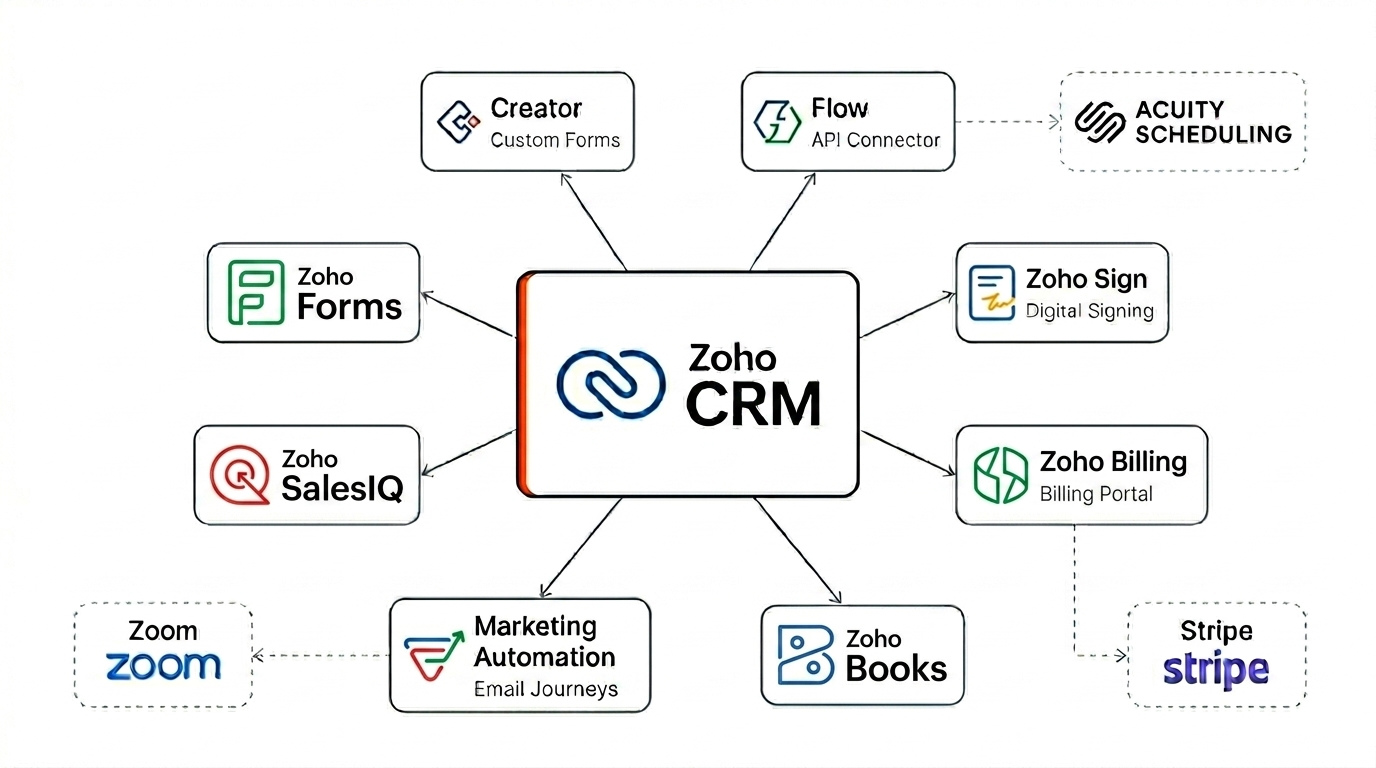
Fig 3 — Nine Zoho One products integrated into a single automated pipeline with Acuity Scheduling, Stripe, and Zoom as external connectors.
The client’s leads arrived from six different sources with no classification, no routing, and no assignment logic. Clixlogix unified all six into a single CRM intake with automated vertical based routing.
Fig 4 — Six lead sources feeding a unified CRM intake with vertical based routing and round robin assignment.
The six sources (website forms, Zoho SalesIQ live chat, Zoho Forms for trade shows, Excel/CSV bulk imports, Acuity Scheduling bookings, and the self serve platform) now feed into a structured lead lifecycle with automated outreach at each stage. Demo bookings from Acuity automatically create calendar events with conferencing links in the CRM, eliminating a manual scheduling step.
Clixlogix recommended user group based round robin assignment over hardcoded rep assignment. The distinction matters operationally: hardcoded assignment means calling a consultant every time a sales rep joins or leaves. User groups let the client manage their own team changes inside the CRM without technical help. When the client launched a new service vertical mid engagement, Clixlogix extended the routing and product mapping to cover it within the existing architecture, without disrupting live verticals or requiring a scope change. This validated the design principle the team applied from the start: build for the client’s next decision, not just the current one.
The client’s Zoho Blueprint had disappeared, leaving no guided conversion process. Clixlogix rebuilt it from scratch and automated the full journey from qualified lead through quote generation.
Qualifying a lead now triggers automatic creation of the Account, Contact, Deal, and Quote records with line items pre filled from the data collected during the demo session. Clixlogix advised the client to make key fields mandatory before conversion, based on a pattern observed during the audit: incomplete leads were entering the pipeline and causing silent failures in downstream automations. Quote generation would fail without surfacing an error, and the sales team had no visibility into why a deal was stuck. Prospects went cold while the system silently failed to advance their records. The mandatory field gates now block conversion until the record is complete, surfacing the issue to the rep at the point of entry rather than losing the deal downstream.
A single click action on the Lead record runs all qualification checks and advances the conversion, reducing the per deal workflow from multiple screens to one interaction.
Fig 5 — Automated pipeline from lead capture to active subscription with customer self service portal.
After quote approval, prospects receive an automated email linking to a Zoho Creator confirmation page where they verify their selections, confirm billing preferences, and provide required consents. The form dynamically updates the Quote, and the prospect proceeds to digital signature through Zoho Sign.
Fig 6 — Zoho Creator confirmation form concept. Prospects verify selections and provide consent before proceeding to digital signature.
Clixlogix recommended building the confirmation form inside Zoho Creator rather than as a standalone web application. A standalone form would have required custom code that only a developer could modify. Creator sits within the Zoho ecosystem, so data flows back to CRM and Subscriptions natively, and the client’s team can update form fields, product options, and consent language themselves without writing code or calling a developer. This is the difference between delivering a system the client owns and delivering one the client depends on a vendor to maintain.
After signature, the system creates a subscription record in Zoho Billing automatically. Clixlogix designed the subscription logic to use the organization level Account Name as the customer identifier rather than the individual Contact Name. This prevents duplicate account creation when multiple contacts from the same organization interact with the system, a problem that had generated data cleanup work in the client’s previous manual process.
Clixlogix also identified an operational gap in the contract workflow: when prospects missed the initial email containing the confirmation form link, the sales team had no systematic way to retrieve and resend it. Clixlogix added a dedicated field on the Deal record that stores the link automatically at quote approval, giving the sales team a reliable fallback without requiring manual URL construction.
Deals that stall at any stage trigger automated outreach and re engagement sequences. Unresponsive prospects move to a winback journey rather than being lost.
Clixlogix also recommended and configured a Zoho Subscription Portal giving each of the client’s customers self service access to invoices, payments, and account management. This shifted routine billing inquiries away from the client’s support team, which had been handling payment questions and card update requests manually.
Clixlogix set up domain authentication for email deliverability and built automated journeys spanning the full prospect lifecycle: demo reminders, post demo follow ups segmented by service vertical, and timed nurture sequences.
Rather than relying on CRM email templates (which the client had been using for manual sends), Clixlogix moved all prospect communication into Zoho Marketing Automation journeys. This gave the CMO direct control over prospect nurturing without needing to ask the CRM team to build individual emails. MA journeys provide sequencing logic, engagement tracking, and vertical specific segmentation that CRM templates do not support. Each journey validates data completeness before sending, with fallback routing that creates a task for the record owner when a record is incomplete. This prevents prospects from receiving emails with broken links or missing information, a problem that would have been invisible in a CRM template based approach.
The client’s marketing team had begun manually editing workflow email templates one by one but did not have capacity to complete the work. Clixlogix took over the full template standardization, applying brand and content consistency changes systematically across all automated emails in the system.
The full pipeline was built and validated in a Zoho CRM sandbox environment before going live. This is not standard practice for most Zoho implementations, but Clixlogix treats sandbox validation as a non negotiable step for any system that touches billing. The approach caught a payment gateway configuration difference between test and production that would have generated incorrect invoices for every customer processed in the first billing cycle. The issue was resolved before the system processed a single live deal.
Clixlogix then ran 3 structured post live sessions to validate production behavior with live customer deals. Testing surfaced 10 issues across data validation, billing logic, document ownership, and email accuracy. All 10 were resolved within the support window without requiring a scope change.
The system was transitioned to the client with full access to all configurations and a documented handoff process.
The client’s leadership team now operates a CRM and sales system that runs without manual intervention from lead intake through recurring subscription billing. The CEO, COO, and CMO each have visibility into their verticals without maintaining spreadsheets. Six lead sources feed a single lifecycle with automated routing, and the system is designed so the client can add verticals, reps, and product tiers without consulting Clixlogix.
9 Zoho One products connected into a single pipeline from lead capture to recurring billing with no manual handoffs between modules.
The system was designed so the client can add verticals, reps, and product tiers without consulting Clixlogix or requiring developer support.
The CEO, COO, and CMO no longer manually triage leads, build quotes, send contracts, or track billing in spreadsheets. The system runs their sales operations end to end.
A Zoho Subscription Portal gives the client's customers direct access to invoices, payments, and account management, eliminating routine billing inquiries from the support workload.
When the client launched a new service vertical mid engagement, the routing, product mapping, and automation extended to cover it without disrupting existing verticals or requiring a scope change.
Platform Suite: Zoho One
CRM Platform: Zoho CRM (Enterprise)
Automation Engine: Zoho Flow, Zoho Marketing Automation, Zoho Blueprint
Custom Applications: Zoho Creator (Confirmation Form, Property Detail Collection Form)
Digital Signing: Zoho Sign (integrated with CRM Quotes module)
Billing and Subscriptions: Zoho Subscriptions (with Customer Self Service Portal), Zoho Books, Stripe (payment gateway)
Live Chat: Zoho SalesIQ
Forms: Zoho Forms (trade show lead capture)
External Integrations: Acuity Scheduling (via Zoho Flow API connector, creates Zoho Events + Zoom links)
Email Deliverability: SPF, DKIM configuration for Zoho Marketing Automation domain
Testing Environment: Zoho CRM Sandbox, Stripe Test Gateway
Our team can share client references, scope your project, and answer any question about your delivery.
More engagements where our delivery teams shipped similar outcomes for clients across industries. Read on for context on the patterns we reused, the trade offs we navigated, and the metrics that landed in production.