The way people search for things has changed, and it happened faster than most marketers expected.
A few years ago, the routine was predictable: type a question into Google, scan the blue links, open a few tabs, and piece together an answer. Today, a growing share of people skip that process entirely. They open ChatGPT, type a question, and get a direct answer. No links to sort through, no tabs to manage, no list of results to evaluate. Even on Google when people search, Google shows an AI Overview above those traditional blue links. These AI Overviews answers directly in natural language.
That shift has direct consequences for how brands get found. And now it has opened a new advertising surface. As of February 2026, OpenAI officially began testing ChatGPT ads for logged-in users on its free plan. By April, a self-serve ads manager was quietly available to a select group of pilot advertisers. The channel is not open to most marketers yet, but it is real, it is developing fast, and understanding it now puts you ahead of the conversation.
This article covers what ChatGPT ads actually look like today, how the pricing has shifted since launch, which business categories are positioned to benefit early, and what strategies are worth thinking through before you get access.
Search Has Stopped Showing You a List of Links
To understand why ChatGPT advertising matters, it helps to look at what has happened to search itself.
When someone types a question into Google today, they often see an AI-generated answer at the top of the page before any traditional search results. Google calls it AI Overviews. Perplexity delivers a synthesized response with citations. ChatGPT gives you a full conversational answer. In all three cases, most of the blue links that used to define search are pushed down or bypassed altogether. The AI decides what is relevant, builds a response, and delivers it. Your website may not appear at all, even if it ranks well in traditional search.
For brands, this creates two clear pressures. First, getting your content cited naturally by AI engines is becoming as important as ranking on Google. That is the idea behind Generative Engine Optimization, or GEO, which is about structuring your content so that AI tools like ChatGPT and Perplexity choose to quote and reference it. Clixlogix has a full guide on how to approach that: What is Generative Engine Optimization?.
Second, paid placement inside these AI interfaces is now a way to guarantee visibility in a space where organic presence is not guaranteed. That is what ChatGPT ads represent: the first concrete version of paid advertising inside a conversational AI platform at scale.
How ChatGPT Ads Actually Look Like Right Now
OpenAI launched its advertising pilot on February 9, 2026, for logged-in adult users on Free and Go plans. Paid subscribers on Plus, Pro, Business, Enterprise, and Education plans do not see ads. OpenAI has been clear about keeping paid tiers ad-free, at least for now.
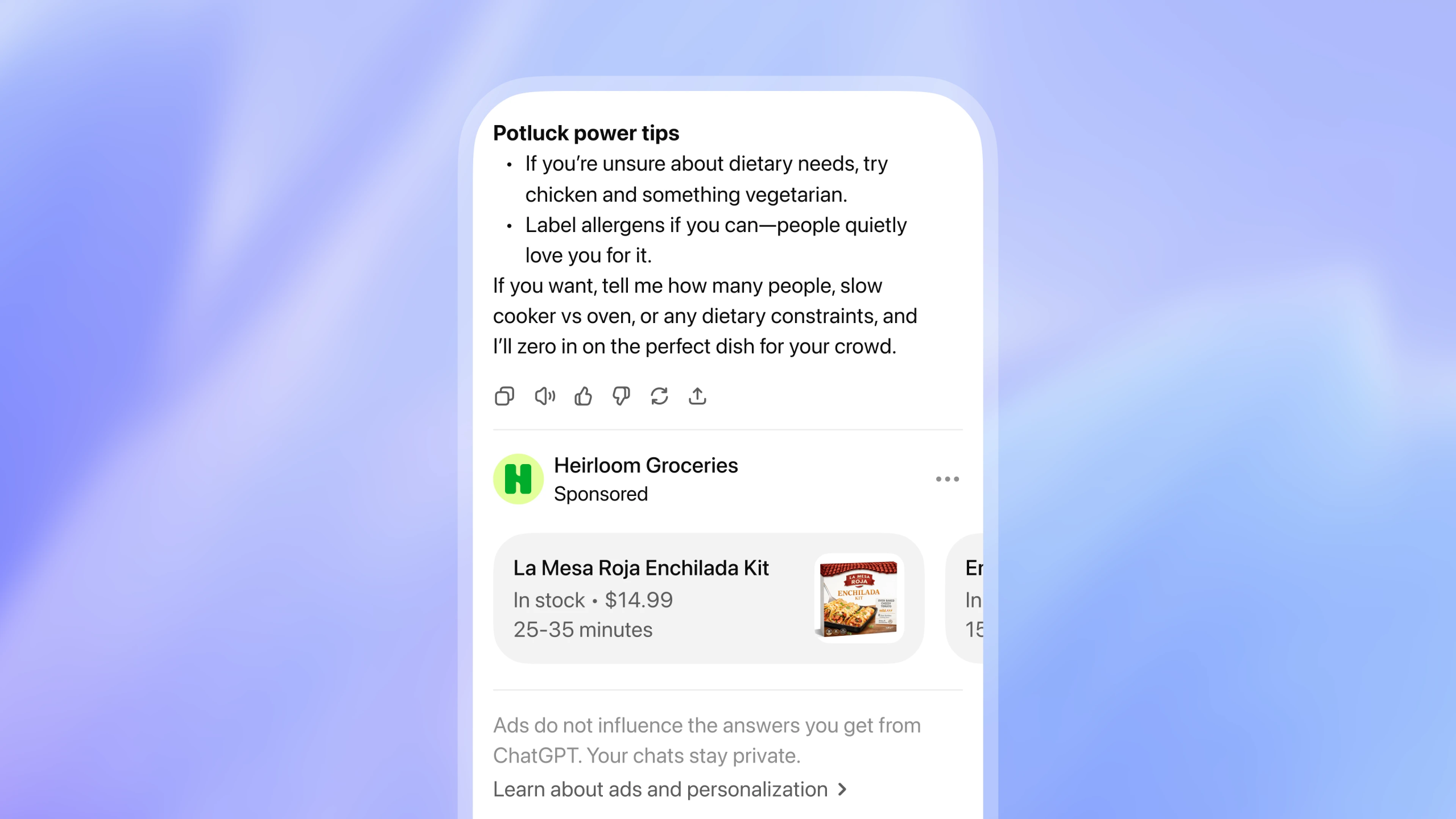
Where do the ads appear? Below ChatGPT’s responses, clearly labeled as “Sponsored.” They do not appear inside the AI’s answer itself. OpenAI has stated that ads do not influence what ChatGPT says. The ad unit sits separately at the bottom of the response and includes a headline, a short description, and an optional square image.
This is how Ads in ChatGPT conversations look like
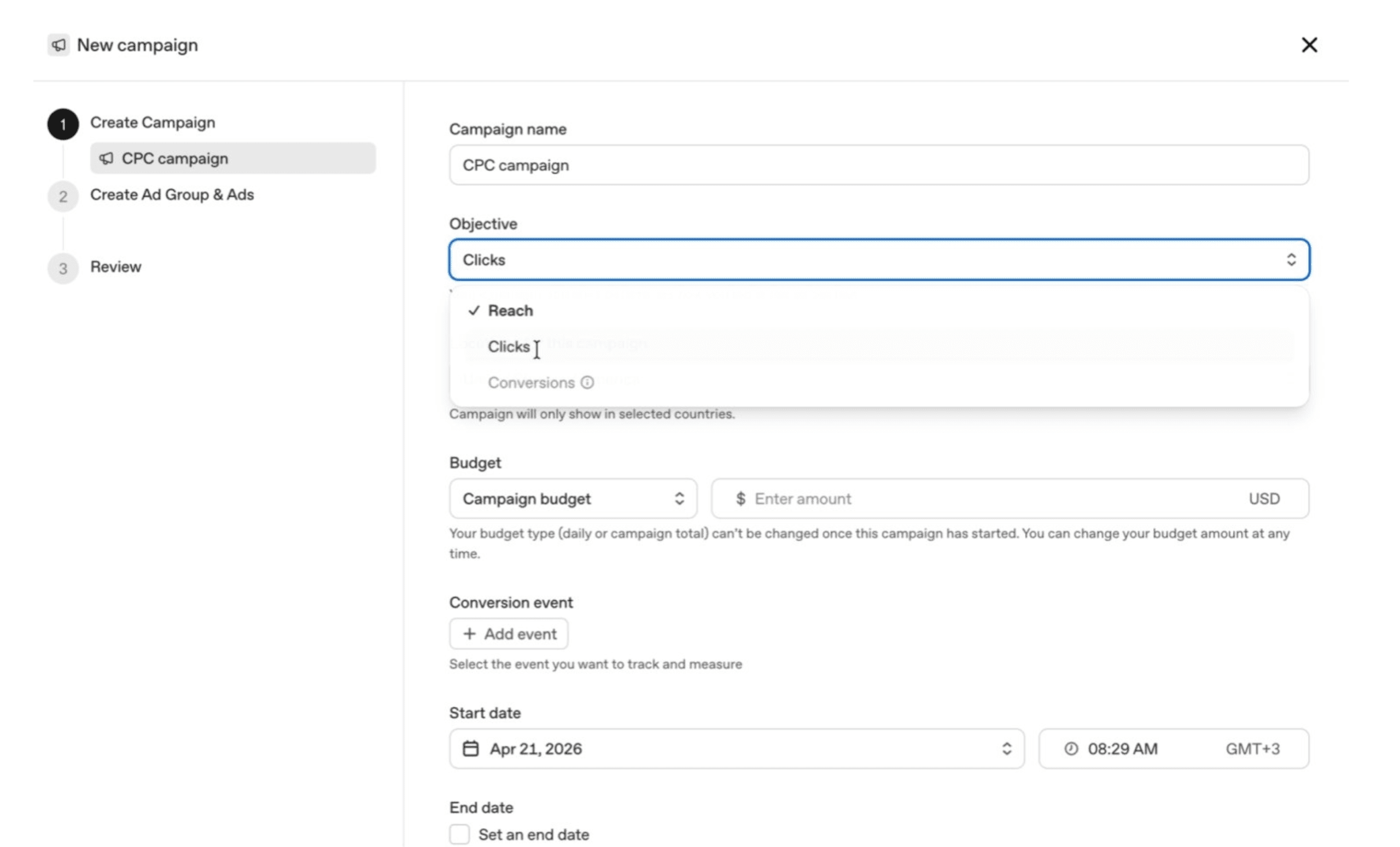
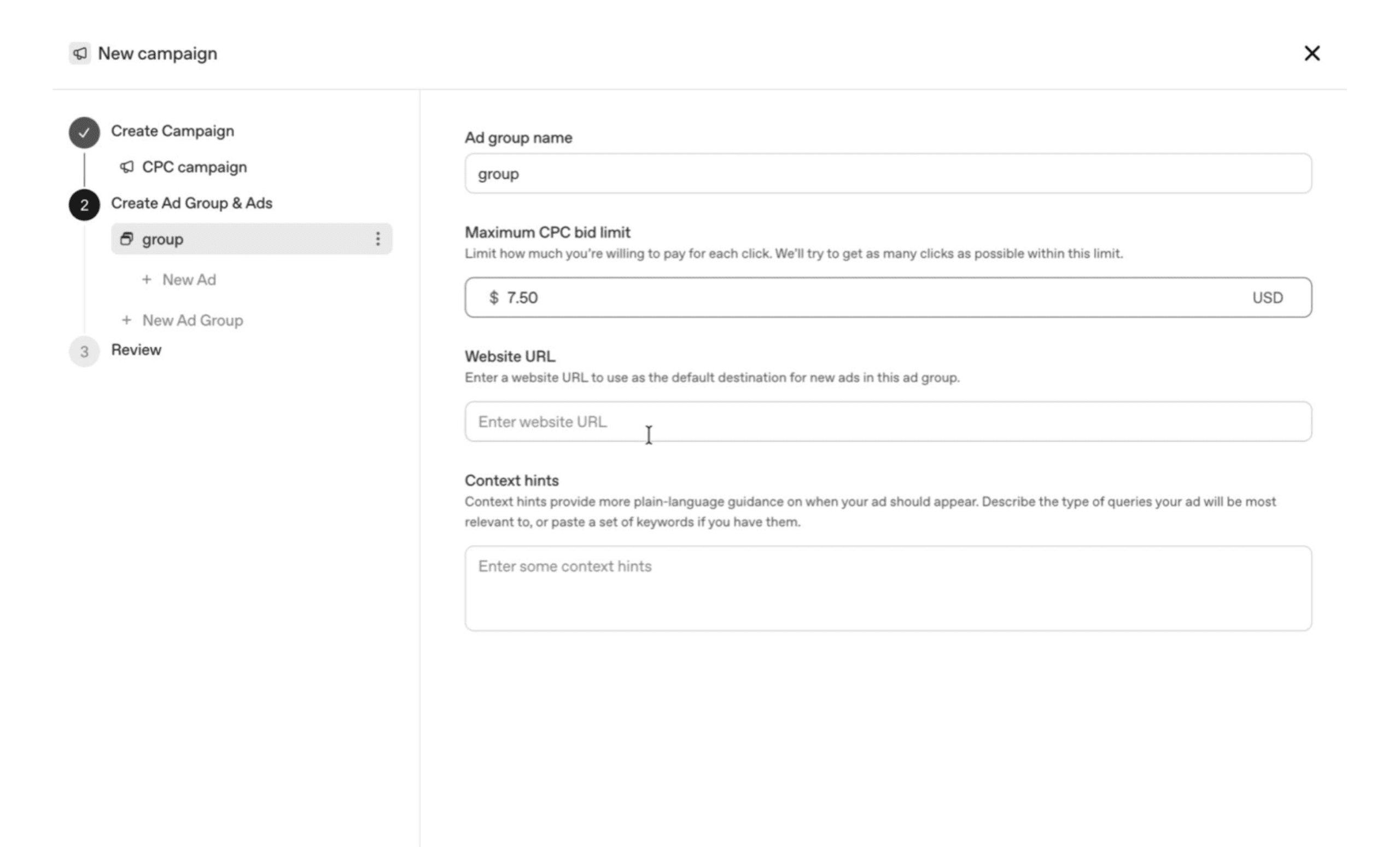
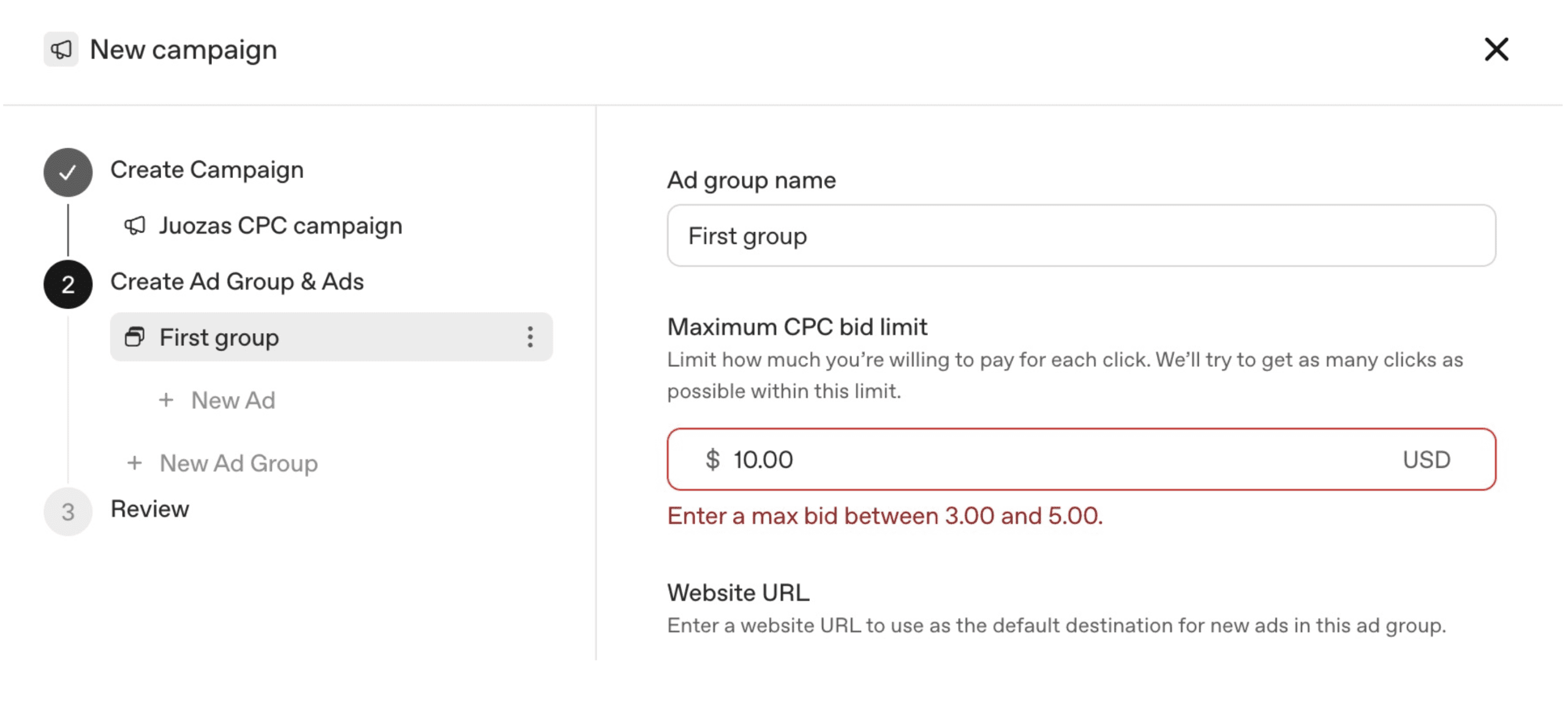
On April 10, 2026, Digiday reported that OpenAI quietly launched a self-serve ads manager for a subset of pilot advertisers. Screenshots shared by digital marketer Glenn Gabe on X and reported by Search Engine Roundtable show an interface built around a three-tier structure: Campaigns, Ad Groups, and Ads. Anyone who has used Google Ads or Meta Ads Manager will recognize the layout immediately.
The targeting system is different from what most performance marketers are used to. There is no demographic targeting, no behavioral audiences, no interest segments. Instead, advertisers write “context hints,” plain-language descriptions of when their ad should appear. Something like: “When users ask about project management software for remote teams.” Country-level geographic targeting is the only additional parameter currently available.
The platform currently supports two campaign objectives: Reach (CPM-based) and Clicks (CPC-based). A conversions objective is listed in the interface as coming soon.
How the Pricing Has Changed Since Launch
The ChatGPT ads pilot has gone through a notable evolution in its first few months, and the direction is consistently toward wider access.
When the pilot launched in February 2026, the minimum spend commitment was set between $200,000 and $250,000, depending on the source. The CPM rate was $60 per thousand impressions. That pricing put the channel firmly in enterprise territory.
By April 2026, the minimum spend had dropped to $50,000. CPC bidding became available, with suggested bids ranging from $3 to $5 per click, according to screenshots shared by Juozas Kaziukenas and Glenn Gabe. The CPM rate has remained steady at $60.
Here is where the platform stands as of April 2026:
Metric
Current Figure
Minimum spend commitment
$50,000
CPM rate
$60 per 1,000 impressions
CPC range
$3 to $5 per click
Reported early CTR (ChatGPT)
0.91%
Average CTR on Google Search
6.4%
Advertisers in pilot (April 2026)
600+
Users eligible for ads
~85% of Free and Go users
Users shown ads daily
Fewer than 20%
The CTR figure needs some context. A 0.91% click-through rate looks low against Google Search’s 6.4% average. But the user behavior is different. A Google search implies a specific query. ChatGPT usage tends to be more exploratory and open-ended. Whether the conversion quality compensates for the lower click volume is something early advertisers are still working through.
One early data point worth noting: internal Criteo data from 500 US retailers in February 2026 found that users referred from LLM platforms like ChatGPT converted at roughly 1.5 times the rate of other referral channels. It is a small sample from one ad tech partner, but it suggests the intent quality of ChatGPT advertising traffic may be higher than raw CTR implies.
OpenAI crossed $100 million in annualized advertising revenue within six weeks of the pilot launch. More than 600 advertisers joined the program in that period, including Target, Best Buy, Ford, Adobe, and Expedia.
Which Businesses Have the Best Early Advantage
Not every business category fits this channel equally. The ones that stand to benefit most share a common trait: their buyers are naturally in a research and comparison mode before they make a purchase decision.
Think about how people actually use ChatGPT. They describe a situation and ask for recommendations. They compare options. They ask followup questions. They are often mid-funnel, trying to figure out what they need before they start looking for where to buy it. That behavior is commercially significant. Here are the categories that fit it best:
B2B software and SaaS: When a buyer is evaluating tools for their team, they often ask ChatGPT to compare options, explain features, and suggest what fits their specific setup. If you build or sell software, your prospects are likely already having these conversations.
Education and online learning: People use ChatGPT to research courses, ask about career outcomes, and evaluate programs before they ever visit a school’s website. Placement in those conversations is valuable early-funnel territory.
Travel and hospitality: Trip planning is a natural fit for conversational AI, from itineraries to accommodation comparisons to destination research. Travel brands have real commercial opportunity here.
High-consideration e-commerce: Categories like furniture, home appliances, electronics, and outdoor equipment involve real research before a purchase. Buyers want to understand their options before they commit.
Professional services: Law firms, marketing agencies, financial advisors, and consultants often sell something that requires a conversation before a sale. Buyers use ChatGPT to understand their options and evaluate providers before making contact.
The common thread across all of these: the higher the consideration involved in the purchase, the better the fit for a channel where users are actively thinking through decisions.
Strategies Worth Thinking Through Before You Get Access
Access to ChatGPT ads is limited right now. But there are things worth preparing before it opens up. Here is how to think through your first test:
Write context hints that match real buyer conversations. Since targeting here is context-based, your hints should reflect the specific questions your buyers are asking ChatGPT, not a broad demographic description. Something specific like ‘When users compare cloud storage options for small business teams’ will outperform a vague audience category.
Start with CPC rather than CPM. With ChatGPT ads cpc currently at $3 to $5, performance marketers can measure actual traffic behavior from day one. Impression-based spending makes more sense once you have baseline data on what a ChatGPT click is actually worth to your business.
Write copy that fits the conversational context. ChatGPT users are mid-conversation when they see your ad. Copy that sounds direct and specific to the conversation they are having will feel natural. Copy lifted straight from a Google Search ad will not.
Build a proxy measurement plan now. The conversions objective is not yet live. Until native attribution catches up, plan to track performance through UTM parameters, landing page behavior, assisted conversions in your existing analytics setup, and branded search lift after a campaign runs.
Be specific about what you want to learn. With a $50,000 minimum spend floor, going in with ‘let’s see what happens’ is expensive. Define upfront whether you are testing conversion rate, cost per lead versus existing channels, landing page fit for ChatGPT traffic, or something else.
What Is Still Being Figured Out
ChatGPT ads are in early formation. These are not excuses to dismiss the channel, just honest context for planning a test.
Measurement is still developing. The conversions objective is listed as coming soon in the interface. OpenAI is currently hiring its first advertising marketing science leader, which means the attribution methodology is being built from scratch. Early advertisers are largely working with proxy metrics: UTM data, landing page behavior, and weekly CSV performance exports.
Targeting is limited to context hints and country-level geography. There are no demographic or behavioral parameters today. That will likely change as the platform grows, but it is the current reality.
User sentiment is worth monitoring. Sensor Tower data cited by The Verge showed ChatGPT app uninstalls jumped 132% year-over-year in April 2026. A significant portion was tied to controversy around OpenAI’s Pentagon partnership rather than ads specifically, but how users respond to increasing ad exposure over time is an open question.
None of this means the channel is not worth attention. It means entering with a clear test hypothesis and realistic expectations is more important than rushing in to claim early presence.
Organic AI Visibility Works Alongside Paid
One thing worth saying directly: a paid placement in ChatGPT puts your brand in the interface. But a brand being cited naturally in ChatGPT’s answers has a different kind of presence, one that does not depend on ad spend.
When ChatGPT recommends your product or mentions your company in the body of its response, that is organic AI visibility. It comes from having content that AI engines trust, cite, and choose to reference. Running both strategies in parallel gives you coverage across the full interface: paid placement when you have access, and organic AI citations through content that earns its place.
Clixlogix has built a practical starting point for the organic side of this: GEO Implementation Checklist for LLM-Ready SEO. It is worth working through now, regardless of when you get ChatGPT ads access.
The Bottom Line
ChatGPT ads are a real advertising surface in early development. In roughly ten weeks, the channel moved from an enterprise-only pilot at $250,000 minimum spend to a self-serve ads manager with CPC bidding at $3 to $5 per click. The targeting is context-based, the measurement is still maturing, and the early conversion data from ChatGPT-referred traffic is encouraging but limited in scope.
The businesses best positioned to benefit early are those whose buyers naturally use ChatGPT for research before they decide. The strategies worth preparing now are the ones that take the conversational nature of the platform seriously, specific context hints, CPC-first testing, and a proxy measurement plan.
Access is limited for most marketers today. That will change. The time to understand this channel is before it opens, not after.
If your current Google and Meta campaigns are not yet returning consistent results, fixing that foundation first will almost always outperform opening a new channel.
Running paid campaigns across Google, Meta, or emerging AI platforms?
Clixlogix’s paid media team helps you figure out where your budget works hardest and builds campaigns that actually convert, across every channel that matters.
Abdullah Habib is a digital marketing specialist with expertise in SEO, content marketing, social media, digital advertising, and data analysis. He excels in creating strategic, data-driven campaigns that boost organic traffic, enhance brand visibility, and drive growth for clients.
TL;DRThe average dental practice loses 15 to 20% of its patient base every year. For a practice producing $1.2M annually, that is $500,000 to $750,000...
TL;DRVibe coding is a legitimate prototyping tool. But the same properties that make LLMs fast at generating code, stateless context, completion bias, local optimization, make...
TL;DRThe Zoho CRM and Projects integration connects sales and delivery across 10 CRM modules. But the native integration has real limits, no Vendor module support,...