AI agents are autonomous systems that go beyond chatbots to reason, access business tools, and execute multistep tasks. In e-commerce, they are producing measurable results in customer support (60 to 80% ticket deflection), cart recovery, dynamic pricing, and inventory management.
The technology is real, but so are the failure rates – 80 to 90% of AI agent projects stall in pilot phase. This guide covers seven proven use cases, three deployment architectures, realistic cost benchmarks, and the infrastructure decisions that separate successful implementations from expensive experiments.
KEY TAKEAWAYS
If your “AI agent” can’t access your CRM, inventory, and order system and take action across them, it’s a chatbot with better grammar.
The #1 predictor of agent failure is data quality, not model quality. Clean your CRM before you buy an agent.
Most mid market e-commerce businesses get the best ROI from the Integrate path, SaaS agents for support, middleware agents (n8n, Zoho Flow) for operations.
Start with one use case, one agent, 90 days. Measure. Then expand. Klarna tried the opposite and had to walk it back.
Agentic commerce is not a future trend. 20% of Cyber Week 2025 orders were AI influenced. Your product data now serves two audiences – humans and machines.
What AI Agents Actually Do in E-Commerce (And What They Don’t)
The term “AI agent” has reached the point where it gets applied to everything from a simple FAQ chatbot to a fully autonomous purchasing system. That dilution is a problem for e-commerce operators trying to make real technology decisions.
If you need a baseline on what an AI agent actually is, we covered the fundamentals, decision frameworks, and the perceive learn act cycle in a dedicated deep dive. This post builds on that foundation and focuses specifically on how AI agents function inside e-commerce operations.
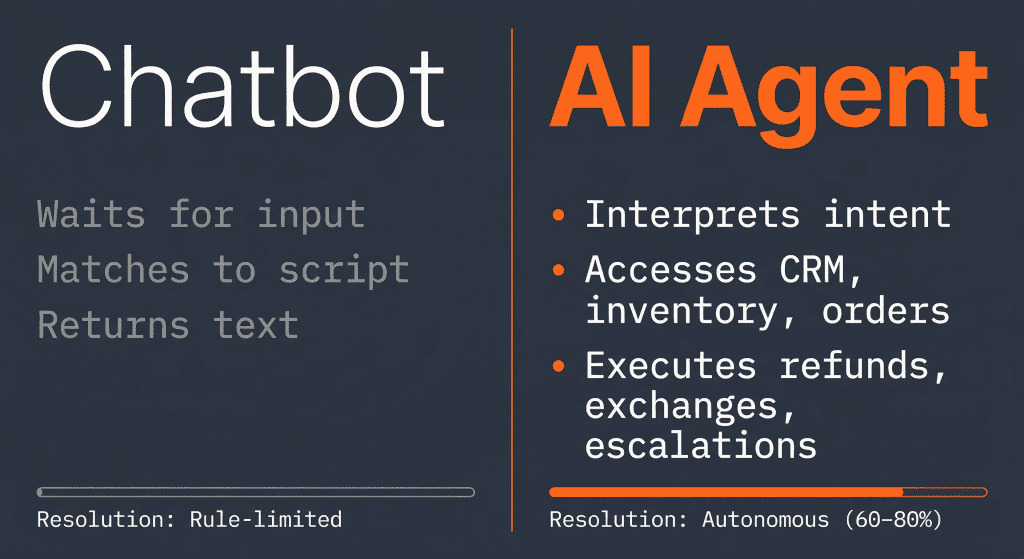
The simplest distinction is that a chatbot waits for a question and returns a scripted answer. An AI agent interprets intent, accesses live business systems (your CRM, your inventory database, your order management platform), reasons through options, and takes action. When a customer says “I ordered the wrong size and I’m flying out Thursday,” a chatbot surfaces your return policy FAQ. An AI agent checks the order status, confirms the item is in stock in the correct size, initiates an exchange, flags it for expedited shipping, and sends the customer a confirmation, all within the same conversation.
That difference matters because it changes what you can automate. Chatbots deflect. Agents resolve. And resolution is where the economics shift: support costs drop, cart abandonment decreases, and per customer revenue increases.
But the qualifier is important. A 2025 RAND study found that 80 to 90% of AI agent projects never leave the pilot phase. Gartner projects that 40% of agentic AI initiatives will be abandoned by 2027. The technology works. The implementation is where it breaks.
Most failures trace back to three causes:
1. poor data quality feeding the agent
2. misaligned expectations about what the agent can handle autonomously, and
3. missing integration infrastructure between the agent and the commerce stack.
The rest of this guide addresses all three.
7 Use Cases Where AI Agents Deliver Measurable ROI
Not every e-commerce workflow benefits from an AI agent. The ones that do share a similarity, they involve high volume, multi step tasks where the cost of human handling is high and the data required for decision making already exists in your systems. Here are seven that have moved past pilot and are producing consistent results.
1. Customer Support Resolution
This is the most mature use case. AI agents handle tier 1 inquiries (order status, return initiation, shipping questions, account changes) with 60 to 80% autonomous resolution rates. The difference from a chatbot is that the agent connects to your order management system, accesses real time shipping data, and can execute actions like issuing refunds or modifying orders within policy guardrails you define. Brands using Gorgias, Ada, or Siena on Shopify are reporting 40 to 60% reductions in support operating costs while maintaining or improving CSAT scores. For businesses exploring AI booking and receptionist agents, the same agent architecture applies to appointment oriented e-commerce models.
2. Personalised Product Recommendations
Recommendation engines have existed for years, but AI agents add a conversational layer. A shopper who types “I need a waterproof bag for a 15 inch laptop under $80” gets a filtered, ranked set of options drawn from your live catalog, not a static “customers also bought” widget. Agents that connect to browsing history, purchase history, and inventory availability produce conversion lifts of 15 to 20% and measurable increases in average order value.
3. Inventory Management and Demand Forecasting
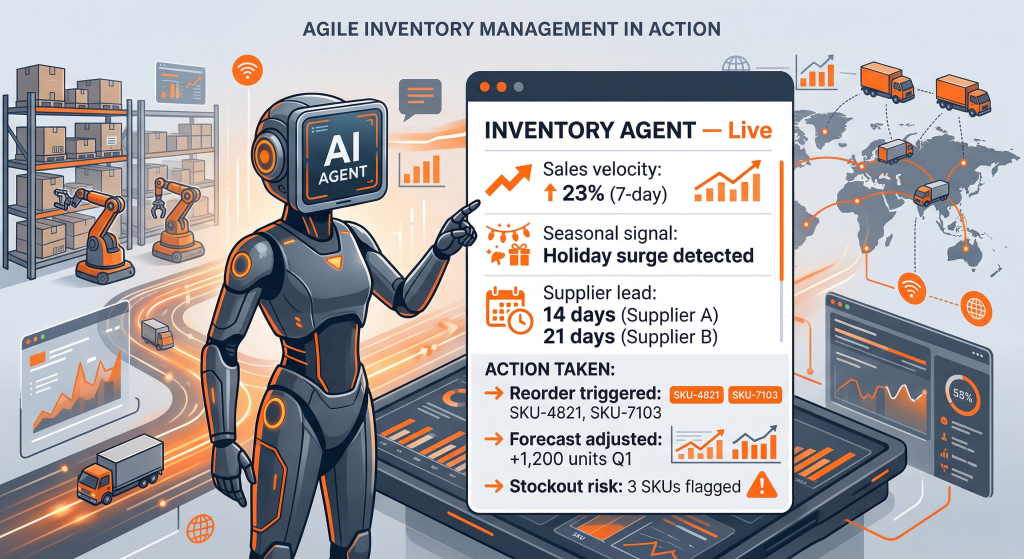
AI agents monitor stock levels, analyse sales velocity against seasonal buys, cross reference supplier lead times, and trigger reorder alerts or purchase orders automatically. This is particularly valuable for businesses managing 500+ SKUs across multiple channels. The agent reduces stockout risk and prevents over ordering, both of which have direct margin impact. A well connected inventory agent achieves 30 to 50% improvement in forecast accuracy over manual methods.
Fig 1. – difference between a chatbot and an AI agent
4. Cart Abandonment Recovery
Standard abandoned cart emails run at 5 to 10% recovery rates. AI agents improve this by diagnosing the abandonment reason in real time. If the customer hesitated at shipping costs, the agent can surface a threshold based free shipping offer. If they were comparing sizes, it can prompt with fit guidance. If the cart sat idle for 30 minutes, the agent can send a channel appropriate nudge (email, SMS, WhatsApp) with the specific items and a time limited incentive. Recovery rates with agent driven approaches run 2 to 3x higher than rule based email flows.
5. Dynamic Pricing Optimisation
AI pricing agents monitor competitor prices, demand fluctuations, inventory depth, and margin thresholds to adjust prices at a frequency and granularity that manual processes cannot match. Retailers using AI driven pricing strategies report 5 to 10% margin improvements on average. The agent balances competing objectives – revenue maximisation, competitive positioning, inventory movement, and brand perception.
6. Marketing Content and Campaign Execution
AI agents can generate product descriptions at scale, create SEO metadata, draft email campaigns, and adjust ad copy based on performance signals. The value is in throughput, what takes a content team weeks to produce across a 5,000 SKU catalog, an agent can draft in hours. The output still requires human review, but the bottleneck shifts from creation to curation. For a deeper look at how this applies across marketing operations, our guide on AI marketing automation covers the full workflow.
7. Fraud Detection and Transaction Monitoring
AI agents assign risk scores to transactions in real time, flagging anomalies like unusual purchase, mismatched shipping/billing addresses, or velocity spikes. The advantage over rule based fraud filters is the agent’s ability to weigh multiple signals simultaneously and reduce false positives, which means fewer legitimate customers get blocked at checkout.
How to Deploy AI Agents Across Your Existing Commerce Stack
The most common mistake in AI agent adoption is treating it as a software purchase. It is an integration project. The agent is only as useful as the business systems it can access and the data quality of what those systems contain.
There are three deployment patterns. Each has different cost, control, and time to value profiles.
Fig. 2 – AI inventory agent workflow and its impact
Deployment Type #1 – Platform Native Agents
If your store runs on Shopify, you already have access to platform native AI through Shopify Magic, Sidekick, and integrated apps like Gorgias and Tidio. These agents are preconnected to your store data (products, orders, customers) and require minimal configuration. The tradeoff is limited customisation. You operate within the platform’s defined agent capabilities and cannot extend the agent to systems outside the Shopify ecosystem without additional middleware.
Best for: Single platform stores with straightforward support and merchandising needs. Typical deployment time: 1 to 2 weeks.
Deployment Type #2 – Middleware Based Integration
This is where tools like n8n, Zoho Flow, and Make sit. You build agent workflows that connect multiple business systems: your e-commerce platform (Shopify, Magento, WooCommerce), your CRM (Zoho, Salesforce, HubSpot), your ERP, your communication channels (email, WhatsApp, SMS). The agent’s intelligence comes from an LLM (GPT-4, Claude, Gemini) accessed via API, but the orchestration, the logic of what the agent does with the LLM’s output, is defined in the workflow tool.
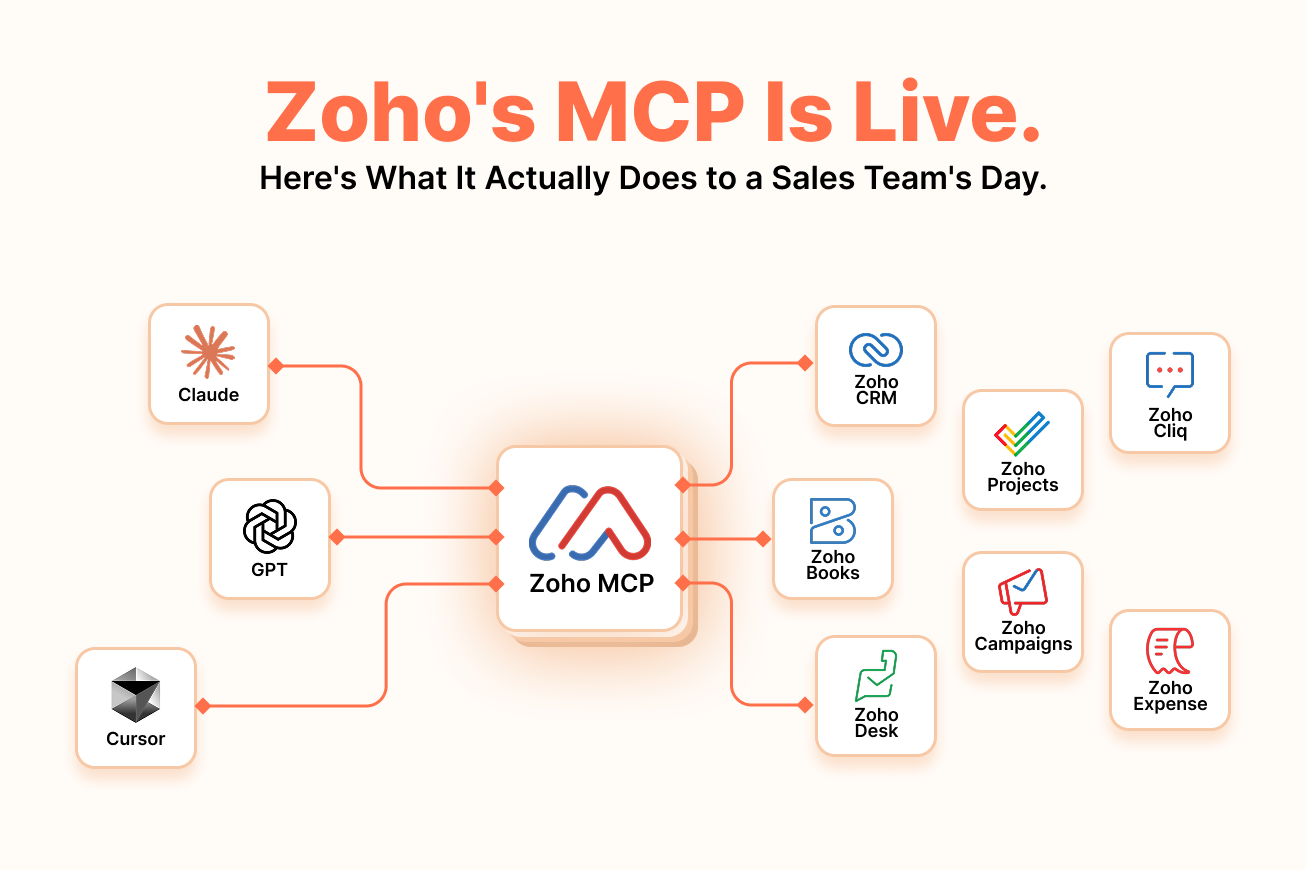
This is what we see producing the strongest results for mid market e-commerce businesses. We have written extensively about how this works in practice, the Zoho MCP integration] post covers how AI agents connect to Zoho CRM data and take action across 15+ Zoho apps. The multi agent CRM orchestration guide walks through building agent meshes where specialised agents handle different CRM workflows and coordinate with each other. And for businesses using WhatsApp as a commerce channel, our WhatsApp CRM integration piece covers the specific data plumbing required.
Best for: Businesses running multiple systems (commerce + CRM + ERP + communication channels) that need agents operating across all of them. Typical deployment time: 4 to 8 weeks.
Deployment Type #3 – Custom Built Agents
For businesses with unique requirements, high transaction volumes, or proprietary logic that cannot be replicated in off the shelf tools, custom-built agents are the path. This involves direct LLM API integration, vector databases for product knowledge retrieval (RAG architecture), custom tool definitions, and purpose-built guardrails. The agent connects to your commerce APIs, applies domain specific reasoning, and executes actions programmatically.
This pattern is most relevant when you need agents that handle multistep workflows involving proprietary business rules, such as a returns agent that factors in customer lifetime value, product condition, and margin impact before deciding whether to offer a replacement, refund, or store credit.
Best for: Businesses with engineering capacity, high complexity, or proprietary workflows. Typical deployment time: 2 to 6 months.
Build vs. Buy vs. Integrate – Choosing the Right Deployment Model
The decision framework is simpler than most vendors make it seem. It comes down to three variables – how much control you need over agent behaviour, how fast you need to be operational, and what technical capacity you have inhouse.
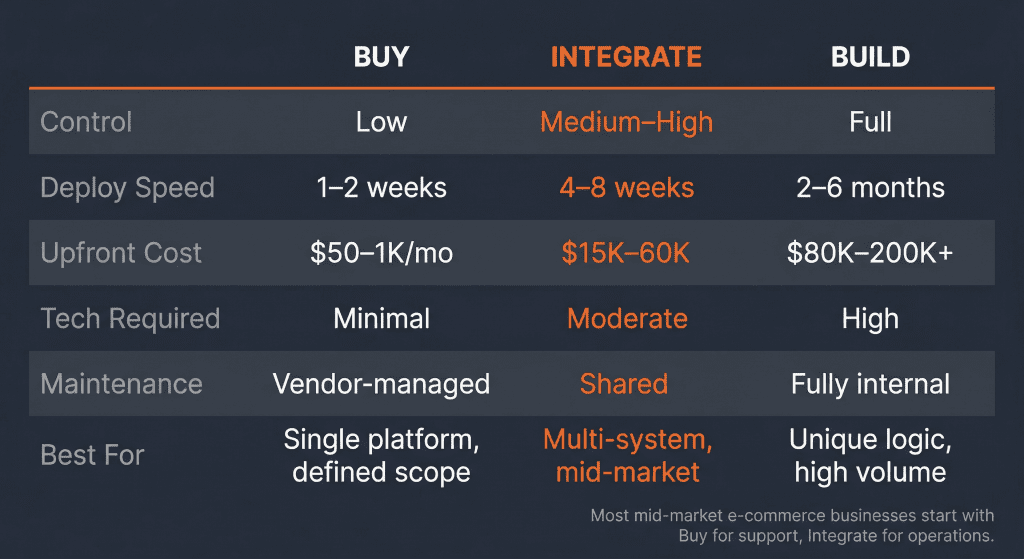
Fig 3, – Three deployment paths for e-commerce AI agents
1. Buy (SaaS Agent Platforms): Choose this when your use case is well defined, your platform is widely supported (Shopify is the best served ecosystem), and you want results within weeks. Gorgias, Ada, Tidio, and Siena all offer agents that plug into Shopify and handle customer support, recommendations, and cart recovery. Monthly costs run $50 to $1,000+ depending on volume. The limitation is flexibility. You are operating within the vendor’s capability boundary.
2. Integrate (Middleware + LLM): Choose this when you need agents that span multiple business systems and your use cases require custom logic. This is the n8n automation workflows approach, wherein, you define the agent’s behaviour, connect it to your data sources, and control what it can and cannot do. For a direct comparison of agent building platforms, our OpenAI Agent Builder vs n8n analysis covers the practical tradeoffs.
3. Build (Custom Development): Choose this when your workflows are genuinely unique, your data volumes justify the investment, and you have engineering resources to maintain the system. Custom agents cost $20,000 to $200,000+ to develop and require ongoing model tuning, prompt engineering, and infrastructure management. The ROI is real at scale, but the breakeven timeline is longer.
Most mid market e-commerce businesses get the best results from the Integrate path – SaaS agents for customer facing workflows (support, chat) combined with middleware-based agents for operational workflows (inventory, CRM, order processing).
What Breaks & Common Failure Patterns and How to Avoid Them
The AI agent market has a credibility problem. A significant portion of products marketed as “AI agents” are rebadged chatbots or rule based automation tools with an LLM layer for language generation. The AI community has a term for this – “agent washing”. Recognising these failure patterns before you invest saves both money and institutional trust in the technology.
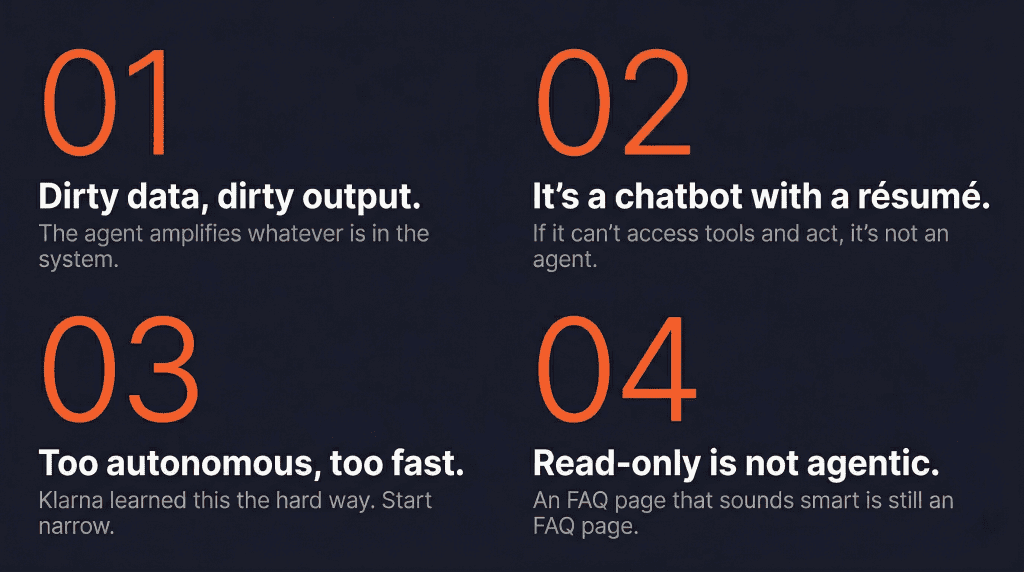
Fig 4, – Four ways e-commerce AI agent projects die before going live
Failure Pattern 1 – Data Quality
An AI agent pointed at a CRM with incomplete customer records, inconsistent product attributes, or outdated inventory data will produce unreliable outputs. The agent amplifies whatever is in the system. If your product catalog has missing size attributes, your recommendation agent will make poor suggestions. If your order database has inconsistent status labels, your support agent will give customers wrong information. The fix is not the agent. It is the data layer beneath it. Clean CRM data, standardised product attributes, and real time inventory sync are prerequisites, not nice to haves.
Failure Pattern 2 – Agent Washing
If a product cannot take initiative (it only responds when prompted), cannot handle unexpected situations (it crashes or loops when the conversation deviates from its script), does not use external tools (it only generates text, never queries a database or triggers an action), and cannot maintain context across a multi-step task, it is not an AI agent. It is a chatbot with a language model. The practical test is straightforward – give it a task that requires accessing two different systems, making a judgement call, and taking an action. If it cannot do that without human intervention at every step, it is not agentic.
Failure Pattern 3 – Over Automation Without Guardrails
The opposite failure is deploying agents that are too autonomous too quickly. Agents that can issue refunds, modify pricing, or send customer communications need human in the loop checkpoints, at least during the first 90 days of deployment. Klarna’s well publicised experience is instructive – its initial all in AI support strategy drew customer backlash and required reintroducing human agents. The lesson is not that AI agents do not work. It is that the rollout velocity matters. Start narrow, measure, expand.
Failure Pattern 4 – Integration Gaps
An agent that can answer questions about orders but cannot actually modify an order is a knowledge base, not an agent. The value of agentic AI is in the “act” part of the perceive reason act loop. If your agent is connected to read only data sources and cannot trigger actions (refunds, reorders, status updates, escalations) in your commerce and fulfilment systems, you have built an expensive FAQ page.
The Economics – Realistic Costs, Timelines, and ROI Benchmarks
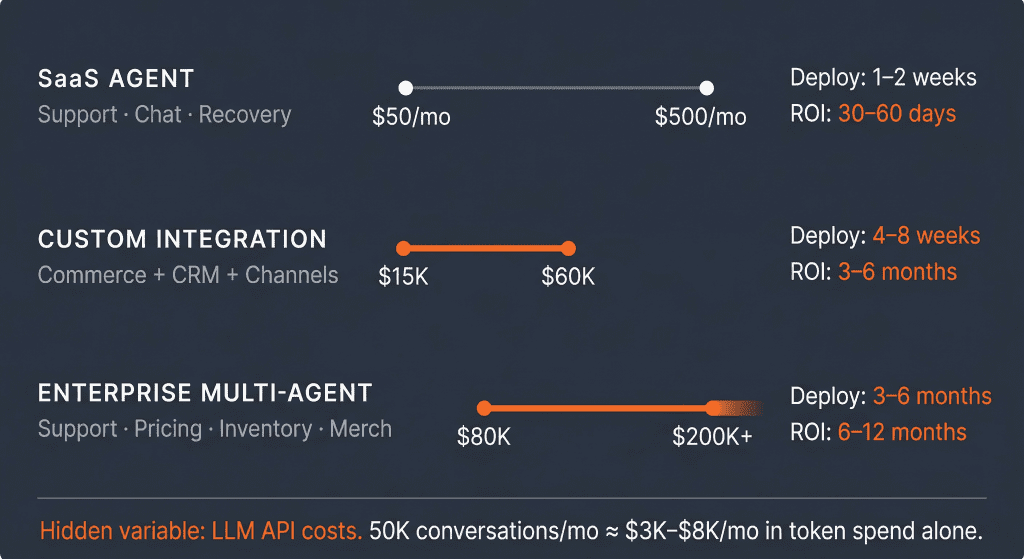
Pricing in the AI agent market is opaque by design. Most enterprise vendors require “custom pricing discussions,” which makes comparison difficult. Here are the ranges we see in practice, based on project complexity.
Tier 1: SaaS Agent (Customer Support / Chat)
Monthly cost: $50 to $500 for SMB plans, $500 to $2,000+ for enterprise.
Deployment: 1 to 2 weeks.
Typical ROI timeline – measurable within 30 to 60 days.
Primary savings – support ticket reduction (40 to 60%), faster first response, and after hours coverage.
Platforms: Gorgias, Ada, Tidio, Intercom.
Tier 2: Custom Integration (Multi-System Agent)
Project cost: $15,000 to $30,000 for v1 build.
Ongoing cost: $1,000 to $3,000/month for hosting, model costs, and maintenance.
Deployment: 4 to 8 weeks.
ROI timeline: 3 to 6 months. This covers agents that span your commerce platform + CRM + communication channels using middleware like n8n or Zoho Flow. Gemini based document processing is an example of how multi system AI integrations perform in practice.
Tier 3: Enterprise Multi-Agent System
Project cost: $80,000 to $200,000+ for development.
Ongoing: $5,000 to $15,000/month.
Deployment: 3 to 6 months.
ROI timeline: 6 to 12 months.
This is for businesses deploying multiple specialised agents (support agent, merchandising agent, inventory agent, pricing agent) that coordinate through shared data layers. The economics work at transaction volumes above $5M to $10M annual GMV, where even small percentage improvements in conversion, margin, or support efficiency translate to significant dollar amounts.
Key cost variables: LLM API costs (per token pricing from OpenAI, Anthropic, or Google), vector database hosting (for RAG powered product knowledge), middleware platform fees, and ongoing prompt engineering/tuning. The most common cost surprise is model API spend at scale: a high traffic support agent processing 50,000 conversations/month can run $3,000 to $8,000/month in API costs alone, depending on conversation length and model choice.
Preparing Your E-Commerce Infrastructure for Agentic Commerce
The larger shift happening beneath individual agent deployments is structural. AI shopping assistants from Amazon (Rufus), OpenAI (Instant Checkout), and Perplexity are changing how consumers discover and purchase products. Traffic to US retail sites from AI powered browsing tools increased significantly through 2025, and the trajectory is accelerating. Morgan Stanley projects that agentic commerce could capture 10 to 20% of US e-commerce spending by 2030.
For e-commerce businesses, this means your product data needs to serve two audiences: human shoppers and AI agents. The infrastructure requirements for both are converging.
Structured Data as a Foundation
Implement Schema.org markup (Product, Offer, AggregateRating, Review, BreadcrumbList) across your product catalog. AI agents and AI-powered search systems use structured data to understand your products programmatically. If your product pages lack structured data, they are invisible to agent-driven discovery. This directly connects to generative engine optimization and the work we have documented on getting Shopify product pages in AI Overviews.
API Readiness
AI agents transact through APIs, not through browsing your website. If your commerce platform does not expose product availability, pricing, and order creation through well documented API endpoints, external AI agents cannot interact with your store. Shopify and modern headless platforms handle this natively. Legacy platforms may require an adapter layer.
Machine Readable Content
Beyond Schema.org, the emerging standard is llms.txt and machine readable content, a protocol that helps LLMs and AI agents understand your site’s content structure. Early adoption positions your store for the agentic discovery channel that is building now.
Every product page, FAQ, and category description should begin with a direct, extractable answer. AI agents synthesise responses from clear, structured content. Pages that bury the key information in marketing copy get skipped. The content strategy for agentic commerce is the opposite of the longscroll, conversion optimized landing page –
✔️ Lead with facts, specifications, and
✔️ Direct answers to purchase relevant questions.
Fig 5, – What AI agents actually cost: SaaS, custom integration, and enterprise tier benchmarks
Ready to Explore AI Agents for Your E-Commerce Operations?
Clixlogix has been building AI powered integrations across Shopify, and custom commerce stacks since before AI agents became a market category. If you are evaluating where AI agents fit in your operations, we can help you identify the highest ROI starting point and build the integration layer that connects your agent to your actual business systems.
Abdullah Habib is a digital marketing specialist with expertise in SEO, content marketing, social media, digital advertising, and data analysis. He excels in creating strategic, data-driven campaigns that boost organic traffic, enhance brand visibility, and drive growth for clients.
Google's biggest Maps overhaul in over a decade just changed how local businesses get discovered. Here is what local SEO professionals and business owners need...