Last week, I got a call from a friend in Colorado, who sells semi-precious jewellery online. She walked me through her last holiday season.
They had what she called a “perfect” Black Friday: ads were humming, traffic was wild, orders were rolling in non-stop.
Two weeks later, things went quiet.
December was flat.
Most of those new customers never came back.
She asked me to help her fix the situation. Once I pulled up the analytics, the pattern was obvious. They didn’t have a traffic problem. They had a follow-up problem.
No real welcome flow. Weak cart reminders. No post-purchase emails to explain the product. No refill prompts. Just manual blasts and hope.
I recommended ecommerce marketing automation that would make buyers feel wanted and would maintain an ongoing relationship with them. Done right, it quietly handles the boring but crucial work in the background:
- Welcoming new visitors
- Nudging people who viewed or added to cart
- Guiding first-time buyers so they don’t refund out of confusion
- Asking for reviews, refills, and repeat orders at the right time
And this isn’t just her story. I see versions of this across a lot of ecommerce brands right now. So, in this guide, I’m putting the whole playbook on the table.
We’ll keep it simple and practical: how marketing automation for ecommerce should work across email, SMS, WhatsApp, push, and ads during the holiday rush, and which flows you should build first if you actually want Black Friday customers to still be around in February.
What Ecommerce Marketing Automation Means in 2025 (Minus the Buzzwords)
Marketing automation for ecommerce is the set of rules, data, and flows that decide who hears from you, on which channel, and at what moment, without manual effort each time.
When people talk about ecommerce marketing automation, they’re not talking about one magic tool. They’re talking about a system where:
- Messages go out based on what a shopper does, not when someone on your team finds time
- Offers and reminders follow real behavior: visits, clicks, carts, purchases
- Your team spends less time pushing buttons and more time deciding what should be said
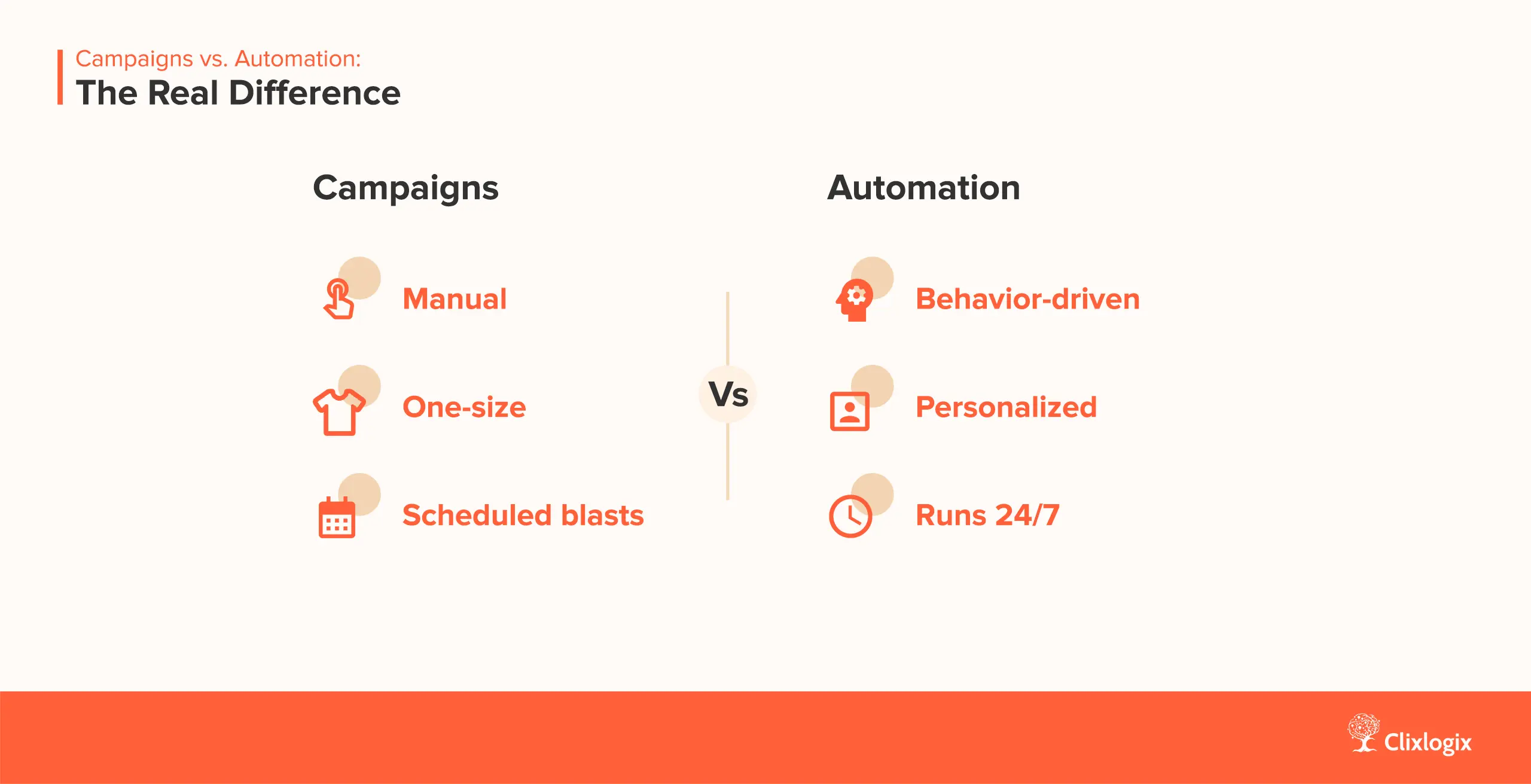
Campaigns vs. Automation: the easy way to see the gap
Campaigns ride on top of your marketing automation ecommerce setup. However, most stores are heavy on campaigns and light on automation:
- Campaigns are the one-off blasts:
- “Black Friday is live,” “New collection,” “Weekend sale.”
Someone writes it, schedules it, hits send.
- Automation is everything that runs on its own once you set it up:
- Welcome emails for new subscribers
- Cart reminders for people who left items behind
- Refill prompts for products that run out
- Winback emails for customers who have gone quiet
It’s not just email anymore
A few years ago, “marketing automation for e-commerce” mostly meant email flows. Today, even mid-size stores can connect with their buyers via:
- Email
- SMS
- WhatsApp
- Push notifications (web or app)
- Product-based remarketing ads
The shopper doesn’t care which channel you used; they just feel either:
- “This brand is helpful and on time.”
- Or: “This brand is annoying, and everywhere.”
The difference is whether your channels talk to each other or behave like separate teams. A smooth setup might look like this:
- Email carries the main story and details
- SMS or WhatsApp only step in when timing is tight (cart, delivery, last-day reminder)
- Push handles gentle nudges: “back in stock,” “price dropped,” “you left something”
- Ads show the exact products someone viewed or added, instead of random catalog it
Why this matters more in a holiday season
During Black Friday and the other holidays, three things happen at once:
- Traffic spikes
- Support volume spikes
- Attention span drops
If your follow-up is manual, your team will default to broad campaigns and ignore the smaller, high-value moments such as:
- The person who viewed your best seller product three times but never added it
- The first-time buyer who needs a quick “here’s how to use this” email so they don’t refund
- The loyal customer who should see a VIP offer before you run a public sale
An effective ecommerce marketing automation setup turns these into automatic flows, not “if we have time” tasks. That keeps sales coming in even after the big weekend and stops your list from burning out under panic emails.
How You Should Shift your Mindset
If you want this to work, the mindset has to move from “What can we send this week?” to:
- “Which moments in the customer’s path are we missing right now?”
- “What data do we already have and fail to use?”
- “Which of these can be handled by an AI bot instead of a person?”
Once you think that way, tools, AI help, and everything else we’ll cover later are just ways to make those decisions faster.
Let’s map the seven most important moments for an ecommerce store, and see where your automation is already doing the heavy lifting and where it’s missing completely.
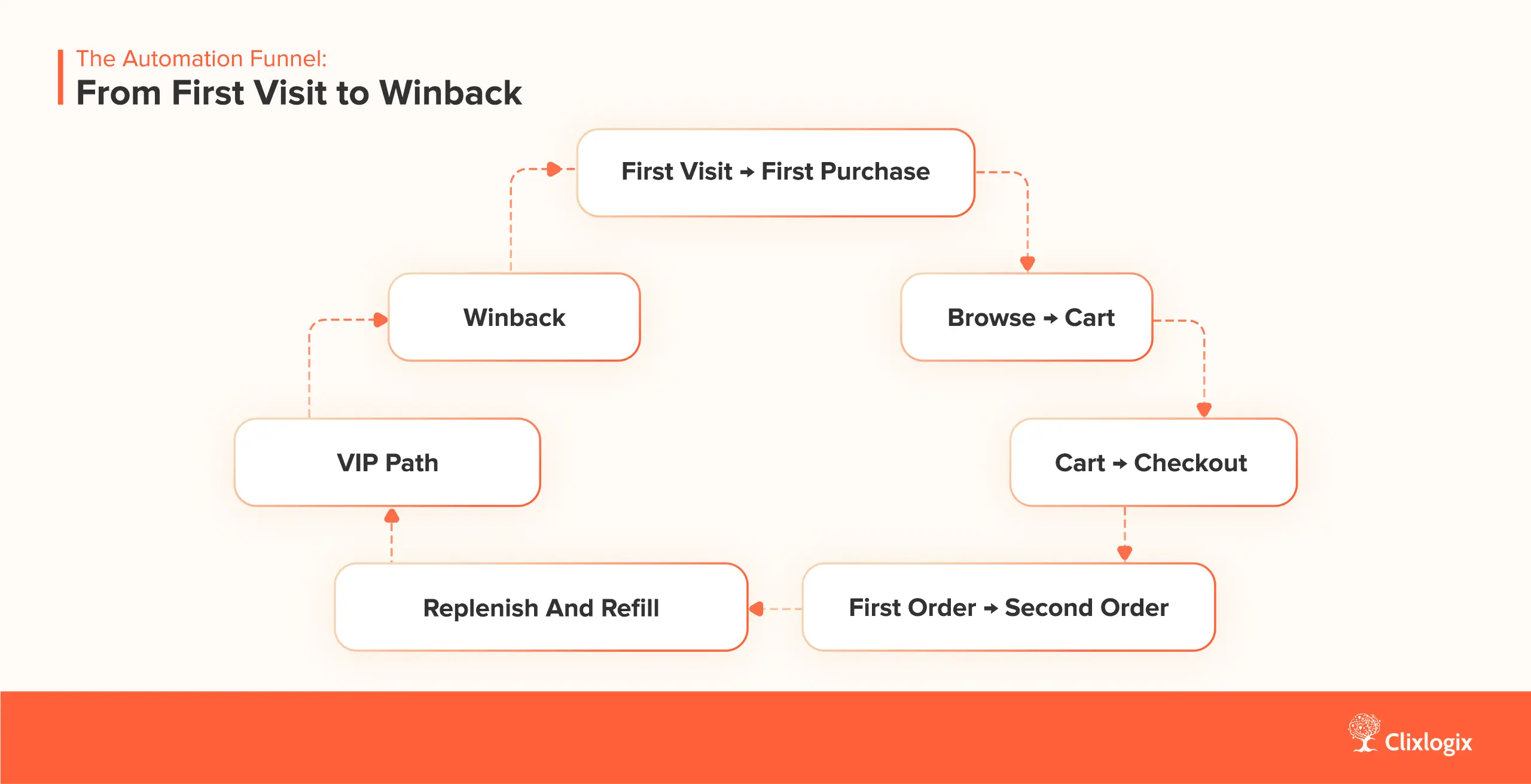
The 7 Moments That Matter Most in Ecommerce Marketing Automation
If you try to build every possible flow, you’ll stall. The fastest way to make ecommerce marketing automation useful is to focus on a few high-impact moments first.
Think of these seven as the basic wiring that will make things move faster. Once these are in place, campaigns work better, ads make more sense, and your team spends less time firefighting.
1. First Visit to First Purchase
This is where most stores leave money on the table. Someone visits, maybe signs up for a discount, and then… they get nothing for days.
A good ecommerce email marketing automation setup starts the second a visitor gives you an email or phone number:
- A clear welcome email that sets expectations
- A follow-up that shows best sellers or a quiz to learn what they care about
- A gentle reminder if they haven’t purchased after a few days
For holiday traffic, this might look like:
- Day 0: “Welcome, here’s how our store works during Black Friday / holiday sales”
- Day 1–2: A short story about the brand and top products by use case
- Day 3–4: A nudge with social proof, not just a bigger discount
Goal: turn a random visitor into someone who actually knows your store and feels safe buying.
2. Browse to Cart
Next, you’ve got people who keep looking at things but don’t even add them to the cart.
You already have strong intent here. Your marketing automation for ecommerce should catch it:
- Track which products or categories a visitor views
- Trigger browse emails if they view a few times without adding to cart
- Use the page they viewed as the main item in that email (not something random from your catalog)
Example: Someone views three different protein powders and leaves. A day later, they get an email that leads with those products, with a quick “how to pick the right one” guide and maybe a short FAQ. No hard push, just helpful context and a way back. Or they see ads of that product with discounted prices on Facebook or Instagram.
3. Cart to Checkout
Cart abandonment is the classic use case for ecommerce marketing automation, and most stores still do the bare minimum: one sad email an hour later.
You can do better without being annoying:
- Email: main channel for context and reassurance
- SMS or WhatsApp: only for higher cart values or repeat visitors
- Push: “you left this behind” for people who opted in on web or app
- Ads: show the exact products they added or viewed
A simple flow:
- 1 hour later: email with the cart and a quick “Any Questions?”
- 12–24 hours later: second email with reviews or social proof
- 24–48 hours later: SMS for high-value carts only (“Your cart is still waiting, sale ends soon”)
In parallel: cart-based ads on social for a few days
Goal: Recover the sale without turning every channel into a siren.
4. First Order to Second Order
This is the part most teams ignore. They chase new customers and forget the ones who already trusted them once.
Your ecommerce marketing automation setup should treat the first order as the start of a new relationship, not the end. Here’s what your automated workflows should do:
- Order confirmation –> shipping updates (email + SMS if opted in)
- “Here’s how to use what you just bought” content
- A check-in email once they’ve had time to try it
- A suggestion for what to buy next, based on that first product
Example: A customer buys a skincare starter kit.
- Day 0: order + shipping emails
- Day 2: “How to use these products together” with a simple routine
- Day 10: “Common mistakes to avoid so your skin isn’t irritated”
- Day 21: gentle nudge toward one add-on product that fits that routine
If you never guide that first use, you pay for support tickets and returns instead.
5. Replenish and Refill
If you sell anything that runs out (supplements, pet food, beauty, coffee, grooming products), refills are where a huge chunk of long-term profit hides.
Good marketing automation for e commerce can:
- Estimate when a product usually runs out
- Trigger refill reminders by email, SMS, or push a bit before that
- Offer simple options: “refill now,” “change flavor,” “skip this time”
Example timing:
- Day 20: “How is it going?” email with tips, no sale pitch
- Day 25–30: refill reminder email
- Day 32–35: SMS reminder for customers who usually respond well to text
- Later: add these people to ads that feature bundle refills or bigger packs
You want people to feel like the brand has their back, not like you’re just chasing another order.
6. VIP and High-Value Customers
Not all customers are equal. Some buy once during a sale and vanish. Some come back over and over, refer friends, and rarely complain.
Ecommerce marketing automation should treat those groups differently:
- Tag customers by basic patterns: how recent, how often, how much
- Give repeat buyers early access to sales
- Offer small “thanks for sticking with us” perks that regular buyers never see
Example moves:
- Early access emails for VIPs 24 hours before a public Black Friday sale
- Exclusive product drops to people with 3+ orders
- Occasional surprise upgrade on shipping or samples, backed by an email that explains it
You’re not giving away the store. You’re protecting the customers who keep the store alive.
7. At-Risk Customers and Winback
Last group: customers who bought once (or even a few times) and then went quiet.
A basic winback system might:
- Wait a certain number of days with no purchase or no opens
- Send a “still here for you?” email that asks what changed
- Offer help first, deals second
Possible flow:
- After X days of no purchase: email asking if they still want to hear from you, with a simple preference link
- A few days later: “here’s what you missed” email with recent best sellers or improvements
- Only after that: a small, time-bound deal to bring them back
- If no engagement: slowly reduce how often they hear from you or move them to a low-frequency list
Winback isn’t “spam them until they buy again.” It’s a last chance to keep the relationship before you stop leaning on them.
If these seven moments are wired, you stop relying on luck and last-minute campaigns.
In the next section, we’ll talk about how email, SMS, WhatsApp, push, and ads each play their part without stepping on each other’s toes.

Your Channel Stack: Email, SMS, WhatsApp, Push & Ads Working Together
More than a channel problem, stores suffer from poor coordination between different channels.
Email is doing one thing, SMS is doing another, ads are running on old audiences, and nobody is quite sure how many times a single customer gets pinged in a day.
Ecommerce marketing automation brings it all together. The tools don’t matter if each channel behaves like a separate brand.
Let’s keep this simple.
Email: Still the Workhorse
If you took everything else away and left only email, a good setup would still make money.
This is where most of your core flows should reside:
- Welcome
- Browse reminder
- Cart reminder
- Post-purchase education
- Refill prompts
- Winback
Email is where you explain, tell stories, answer objections, and give people time to think. It’s the foundation of email marketing automation for ecommerce.
If your email is only doing “newsletter + sale,” you’re driving with half the dashboard turned off.
SMS and WhatsApp: High-Intent, Not High-Spam
Texts reach people directly on their phone. It’s power, and it’s also a risk.
Use SMS and WhatsApp when:
- There’s less time (sale ending, stock running low, delivery updates)
- The cart value is high
- The customer has already shown strong interest
Good use:
“Hey Sarah, your skincare routine from last month is about to run out. Want us to ship the refill this week?”
Bad use:
“FLASH SALE!!! 20% OFF STOREWIDE” to everyone, three times in a weekend.
In a smart marketing automation for ecommerce setup, SMS and WhatsApp don’t copy email. They step in where email is too slow or too easy to ignore, and do not copy email.
Push Notifications: Gentle Reminders
Push works best when people have already allowed web push or installed your app.
Use push to:
- Remind buyers about carts and wishlists
- Share price drops or back-in-stock alerts
- Give small nudges during events like Black Friday (“your saved item is now on sale”)
Think of push as a small tap on the shoulder. Short, clear, easy to dismiss. No essays, no drama.
Ads & Remarketing: Quiet Persistence
Ads are a vital part of your ecommerce marketing automation journey. If your product feed and tracking are set up, platforms can show people the exact items they:
- Viewed
- Added to cart
- Bought in the past
Here’s an example of a simple, but effective use:
- Someone views three winter jackets and leaves
- Over the next week, they see ads for those jackets and close alternatives
- If they purchase, they drop out of that group and move into a “recent buyers” group that sees different ads (care tips, accessories, or future drops)
This is where good tracking and your marketing automation tools for ecommerce start to work together. Email handles the explanation. Ads quietly follow up for people who didn’t open or didn’t click.
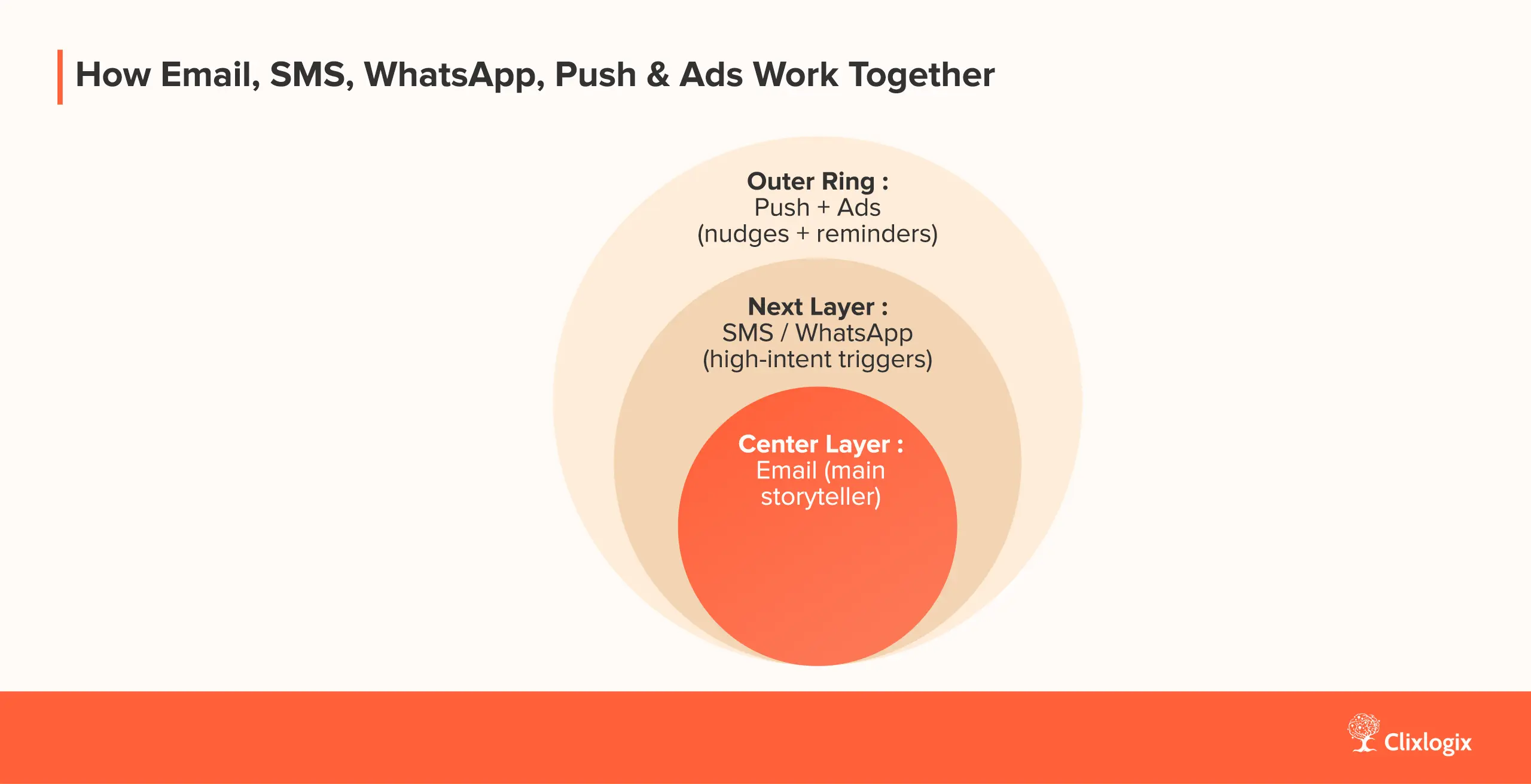
How They Work Together Without Being Annoying
Here’s a simple way to think about the stack:
- Email: main storyteller and closer
- SMS / WhatsApp: urgent or high-value prompts
- Push: light reminders and alerts
- Ads: background follow-up for people who clicked but didn’t convert
Basic rules that make sure that each channel plays its part:
- Don’t send the same person an email, SMS, and push about the same cart in the same hour
- If someone just completed a purchase, pause cart and promo flows for a reasonable amount of time
- Let ad audiences update based on real events (purchases, refunds, unsubscribes), so you don’t chase people who are already done
Once these simple rules are in place, each channel stops fighting for attention and starts playing its part.
Holiday-Focused Ecommerce Marketing Automation: From Black Friday to New Year
The holiday season doesn’t start on Black Friday. By the time your sale email goes out, people have already seen dozens of “BIGGEST SALE EVER” messages from other stores.
If your ecommerce marketing automation is only active on the sale days, you’re late.
Let’s break it into three clear phases.
Before Black Friday – Warm People Up Early On
You don’t need more discount codes. You need a better signal on who wants what.
In the 2–4 weeks before Black Friday:
1. Build a simple VIP list
Ask people to join an “early access” list for Black Friday
Promise something specific: early access, limited bundles, or low-stock items first
Put VIPs in a separate segment so they get slightly better timing and offers
Simple automation:
- Someone signs up for VIP –>
- Instant email: “You’re on the early list, here’s what to expect”
- Closer to Black Friday: “Your early access starts at X time, here’s a preview”
2. Collect intent, not just emails
This is where marketing automation for ecommerce can already start helping:
- Short poll: “What are you planning to shop for this year?”
- Android Mobile Phone
- Iphone
- Tablet
- Laptop
- Desktop
- Tag people based on answers
- Use those tags in your flows:
- Pre-BF emails that focus on their category
- Different hero products for each segment
- Different cart reminders when the time comes
3. Warm-up content, not just warm-up discounts
Your flow in this phase doesn’t have to shout “Sale is coming!” every time.
Ideas:
- “Top 5 products our regulars wait for during Black Friday”
- “How to pick the right [category] for you so you don’t waste the discount”
- “What usually sells out first and how to avoid missing it”
By the time Black Friday hits, you want your core list to know:
- What you sell
- What’s worth grabbing first
- That you’re not going to spam them from six channels at once
During Black Friday & Cyber Monday
Things get intense during the BFCM. These are the days when bad automation setups expose themselves. People get:
- 3 emails
- 2 texts
- A push notification
- The same product ad 10 times
All in 24 hours. Then they unsubscribe and block you.
To keep ecommerce marketing automation from acting like a firehose, set a few control rules.
1. Channel rules for the sale window
Examples:
- Email: main driver of offers and details (daily is fine during BFCM if the list is warm)
- SMS/WhatsApp:
- Only for VIPs or people with high cart value
- Only once or twice during the whole event
- Push: short, simple “now live” or “ending soon” alerts
- Ads: heavier remarketing during the event, but exclude recent purchasers fast
If someone is in your VIP group, they may get:
- One early access email
- One public sale email
- One SMS reminder if they haven’t bought and usually respond well to text.
2. “Quiet” segments for buyers and heavy engagers
Automation works both ways. It can stop sending as well as send.
Create a simple rule:
- If someone buys during the sale –>
- Move them out of “hard sale” promos within a few hours
- Switch them into a “post-purchase” or “thank you + here’s what’s next” flow
Also:
- If someone opened or clicked multiple messages in a day but didn’t buy, dial it down for 24–48 hours. Let them breathe instead of hammering them and sounding desperate.
This keeps your ecommerce marketing automation stack from feeling desperate.
3. Use flows instead of random blasts
Even during BFCM, flows should handle:
- Cart reminders
- Browse reminders
- Post-purchase emails
- Basic winback for older segments who didn’t respond last year.
After Cyber Monday – Turn Festival Buyers into Long-Term Customers
Most brands go silent or switch to “last chance” messages until New Year.
That’s a waste.
You just acquired a huge number of new buyers. This is where ecommerce marketing automation can turn them into regulars.
1. Holiday-specific post-purchase flows
Right after the rush:
- Order + shipping emails as usual
- Then a short series focused on:
- How to use what they bought
- How to avoid common mistakes
- How to get help if something isn’t right
For gifts, adjust:
- “If this was a gift, here’s how to help them with size, setup, or support”
- “Here’s how to exchange or adjust without friction”
2. Refill and second-order planning
Don’t wait until March to think about repeat orders.
- For wellness and beauty: set refill triggers based on average use
- For fashion: show ways to style what they bought, then related products
- For electronics: send setup guides, then accessories, then upgrade invites at the right time
This isn’t about spamming them after the sale. It’s about not ignoring your new customers .
3. Clean up your list before the new year
After the dust settles:
- Identify people who never opened anything during the sale
- Run a short “do you still want to hear from us?” flow
- Move cold profiles into a low-frequency group or stop mailing them aggressively
That single clean-up step improves deliverability for the next year more than one more sale email ever will.
Free Holiday Automation Check-Up
If you read this and you’re thinking, “We’re not even close to this,” that’s normal. Most teams are buried in day-to-day work by the time Q4 hits.
If you want help spotting the fastest fixes in your own setup, I’m opening 20 free consultation calls for this season.
On this call, we’ll:
- Look at your current flows for ecommerce marketing automation
- Pick the top 2–3 moments you should fix before or during the holiday rush
- Outline what you can do with the tools you already have
No long pitch, no 40-slide deck. Just a focused call to stop obvious leaks while there’s still time.
If that sounds useful, grab one of the remaining spots and we’ll go through your setup together.