The average dental practice loses 15 to 20% of its patient base every year. For a practice producing $1.2M annually, that is $500,000 to $750,000 in lost lifetime revenue walking out the door. Every dental marketing strategy blog tells you to get more new patients. This one tells you to stop the bleeding first, then build a discovery system that compounds. AI search, dental social media, and digital booking are all covered here.
But the order matters.
KEY TAKEAWAYS
Retention is the highest ROI marketing investment for any established dental practice. Most owners are not measuring it.
Automated recall, two way texting, and reactivation sequences recover patients who would otherwise never return.
AI search now covers 89% of clinical healthcare queries. Your blog posts are competing with Google’s AI Overviews for visibility.
60% of patients researching cosmetic treatments start on social media. Short form video is the dominant discovery format.
The practices that win over the next three years will build a system, retain first, then get discovered, then convert frictionlessly.
Part 1. The Retention Leak That Costs Dental Practices $500,000 a Year
Here is a number that should keep you up at night.
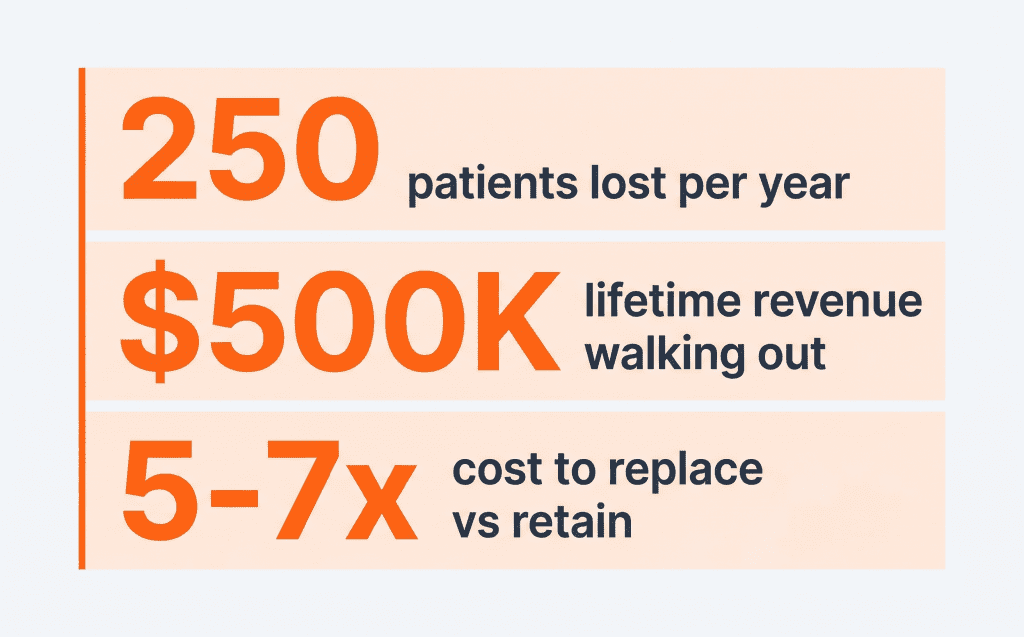
The average dental practice loses 15 to 20% of its active patient base every year. Patients who came in for a cleaning, said they would book their next appointment, and never did. Patients who got a treatment plan for a crown, nodded along, and disappeared. Patients who moved across town and just stopped showing up.
For a practice producing $1.2 million per year with 1,500 active patients, a 17% annual attrition rate means roughly 250 patients vanish every twelve months. Each patient is worth $800 to $1,500 per year in production. Over a 10 year relationship, that is $8,000 to $15,000 in lifetime value per patient.
Do the math, 250 patients x $2,000 average lifetime value lost in the first two years alone = $500,000 walking out the door. Every year.
You would never leave the back door of your office unlocked at night. But that is exactly what you are doing with your patient base when you have no automated recall system, no reactivation sequences, and no way for patients to rebook without calling during business hours. This is the first thing any serious marketing for dental offices should address.
Fig 1. The attrition math behind a $1.2M dental practice
Why Dental Practices Lose Patients
Your patients like you just fine. You simply have no system to keep them engaged between visits.
A 2025 systematic review on dental treatment decision making found that the two biggest factors influencing whether patients follow through on treatment are out of pocket cost and dental fear. Credentials and technology ranked lower. That means even patients who trust your clinical skills will delay, defer, or disappear if the financial friction is too high or if they are anxious about the next procedure.
Your dental practice marketing has to address these two barriers continuously, between appointments, through automated channels, with specific and personal messaging. A 2025 report from 3Shape on patient expectations found that patients now expect booking at their fingertips with 24/7 access, digital checkin, virtual consults, and secure access to records and billing. Calling your office during business hours and leaving a voicemail is a dealbreaker for most of them.
The Automated Fix That Pays for Itself in Month One
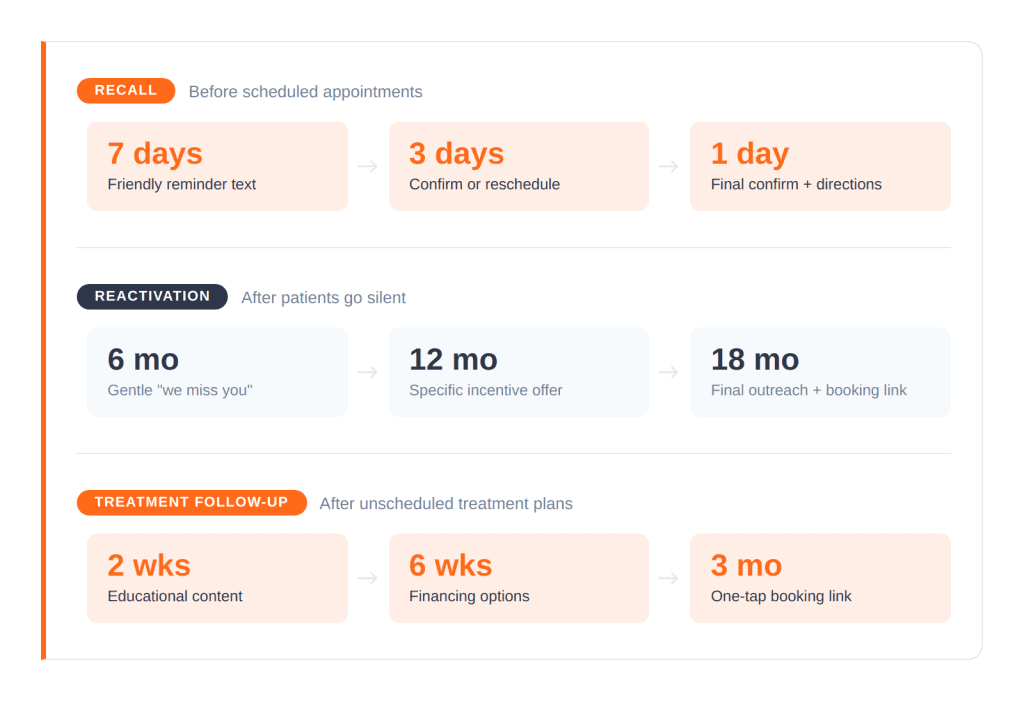
Recall sequences. Text message reminders at 1 week, 3 days, and 1 day before a hygiene appointment. Two way texting so patients can confirm or reschedule without calling. Text outperforms email by a wide margin for appointment confirmations.
Reactivation sequences. Automated messages that trigger at 6, 12, and 18 months of inactivity. Each message is slightly different in tone and offer. The 6 month message is a gentle reminder. The 12 month message acknowledges the gap and offers a specific incentive. The 18 month message is a final “we miss you” with a direct booking link.
Treatment followup sequences. After a patient receives a treatment plan but does not schedule, an automated sequence follows up at 2 weeks, 6 weeks, and 3 months with educational content about the procedure, financing options, and a one tap booking link.
Spending $200 per month on an automated recall system that recovers even 10% of lapsed patients pays for itself in the first month. This is the unsexy side of practice growth. It is also the most profitable.
Fig 2: The three automated messages that bring patients back
Part 2. Online Marketing for Dentists in 2026, Three Discovery Channels
Once you have plugged the retention leak, you can build the dental patient acquisition layers that actually compound. There are three discovery channels that matter for dental practices in 2026, and you probably have one of them partially working and two of them turned off entirely.
Channel 1. AI Search and Your Dental Practice
OpenAI reported in January 2026 that more than 40 million people ask ChatGPT healthcare questions every single day. Seven out of ten of those conversations happen outside normal clinic hours. Patients are making decisions about their dental care when your office is closed and your front desk team is at home.
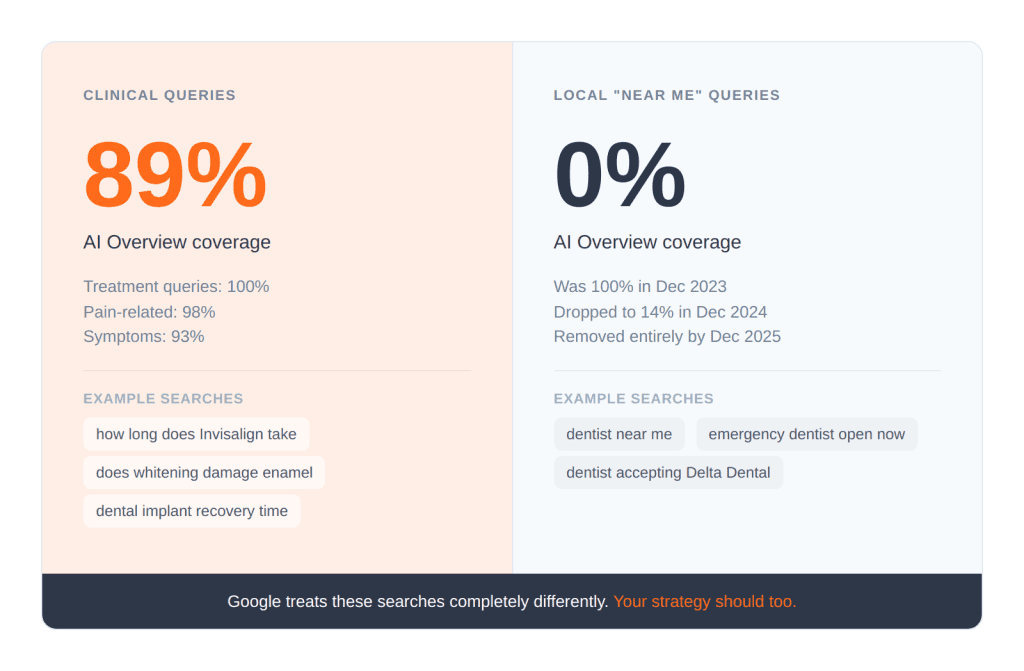
Google’s AI Overviews now appear on 89% of clinical healthcare queries, according to a BrightEdge study tracking healthcare keywords from December 2023 through April 2026. Treatment queries hit 100% coverage. Pain related queries sit at 98%.
When a patient searches “how long does Invisalign take” or “does teeth whitening damage enamel,” they get an AI generated answer at the top of the page. Organic click through rates for healthcare content dropped 61% when AI Overviews are present, falling from 1.76% to 0.61%. The implications for content strategy are significant.
But here is the nuance that most dental marketing agencies are missing.
Google completely reversed its approach to local healthcare searches. “Near me” and provider finding queries went from 100% AI Overview coverage in December 2023 to 0% in December 2025. Google removed AI entirely from local provider discovery.
Your clinical content (blog posts, treatment explainers, FAQ pages) is competing directly with AI summaries. Your local SEO investment (Google Business Profile, local citations, reviews) still drives patient acquisition the way it always has. You need both strategies, and they serve completely different functions in your online marketing for dentists.
Fig 3: Google shows AI answers for 89% of clinical searches. For local ‘near me’ searches? Zero
Channel 2. Dental Social Media and Cosmetic Dentist Marketing
This is the channel most dental practices ignore entirely. And it is where the highest value cosmetic dentist marketing actually happens.
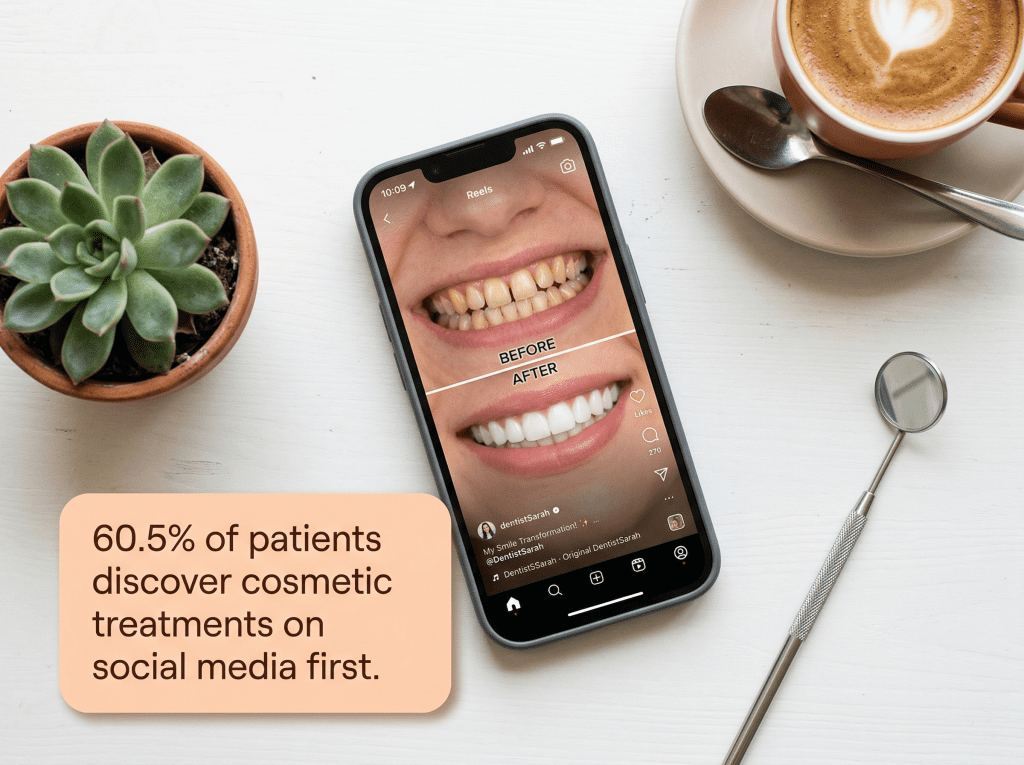
A peer reviewed patient study found that 60.5% of patients used social media as their first source of information about aesthetic dental treatments. And 58.3% said they trusted the information they found there. Social media outranked search engines and personal referrals as the starting point for cosmetic dental research.
Think about what this means for your practice. A 32 year old considering veneers is scrolling Instagram Reels on her lunch break. She sees a before and after transformation from a practice 15 minutes away. She taps the profile, watches two more videos, reads a few comments, and sends a DM asking about pricing. She never opened Google. The entire discovery to inquiry cycle happened inside one app in under three minutes.
Short form video (Reels, TikTok, YouTube Shorts) is the dominant format. Smile makeovers, whitening results, Invisalign progress, office tours, and the personality of the dentist and staff. Patients are choosing practices based on vibes and visual proof before they check credentials or proximity.
The biggest objection I hear from practice owners is “we don’t have time to produce video content every week.” That objection is dissolving fast. We have been using Google’s Veo 3.1 to generate 30 days of dental social content in roughly 4 hours. Procedure explainers, office walkthroughs, patient education clips, seasonal promotions. The production bottleneck that kept most practices off dental social media is gone. The practices that figure this out early will own their local feed while competitors are still debating whether to hire a videographer.
Fig 4: Social Discovery for Cosmetic Dentistry
Channel 3. Local SEO for Dentists Still Drives Bookings
Google Maps, the local three pack, and organic results still work. They work especially well for high intent, ready tobook queries like “emergency dentist open now” or “dentist accepting Delta Dental near me.” Google deliberately removed AI from these queries because they require realtime, local, and highly specific information that generative AI cannot reliably provide.
Your Google Business Profile is the anchor for local SEO for dentists. Complete profiles with accurate hours, services, insurance information, photos, and a steady flow of recent reviews continue to drive new patient calls. You can track how your practice appears in AI search queries directly inside Google Search Console.
Reviews do triple duty. They influence your local pack ranking directly. They build patient trust when someone is comparing you to two other practices. And they feed AI systems with the specific language patients use to describe your services: “gentle,” “painless,” “great with kids,” “explained everything clearly.” When a patient asks ChatGPT for a dentist who is good with nervous patients, the AI pulls from review language across platforms.
Your practice information needs to be identical on Google, Yelp, Healthgrades, Zocdoc, the ADA directory, and every other platform where you have a listing. Same name, same address, same phone number, same hours, same services. AI engines cross reference these sources to verify trustworthiness. Mismatches reduce the likelihood of being recommended.
Part 3. Dental Practice Marketing That Converts
You got discovered. You built trust. Now the patient is ready to book. This is where most practices lose them.
Your website has one job now: convert visitors who already trust you into booked appointments. That means real-time online scheduling, clear pricing or financing information for high-value procedures, and treatment-specific landing pages that answer the exact questions patients are asking.
Every service you offer should have its own dedicated page. A page with the procedure explained in plain language, what to expect, recovery timeline, cost range, insurance information, and an embedded booking widget. These pages serve double duty: they convert website visitors and they give AI engines structured, citable content about your practice.
Out of pocket cost is the number one factor in treatment decisions. If your website hides pricing behind “schedule a consultation,” you are losing patients to practices that publish cost ranges. You do not need to publish exact fees. But saying “Veneers typically range from $900 to $2,500 per tooth at our practice, and we offer financing through CareCredit with monthly payments starting at $89” gives the patient what they need to take the next step. Vague costs create anxiety. Specific ranges create confidence.
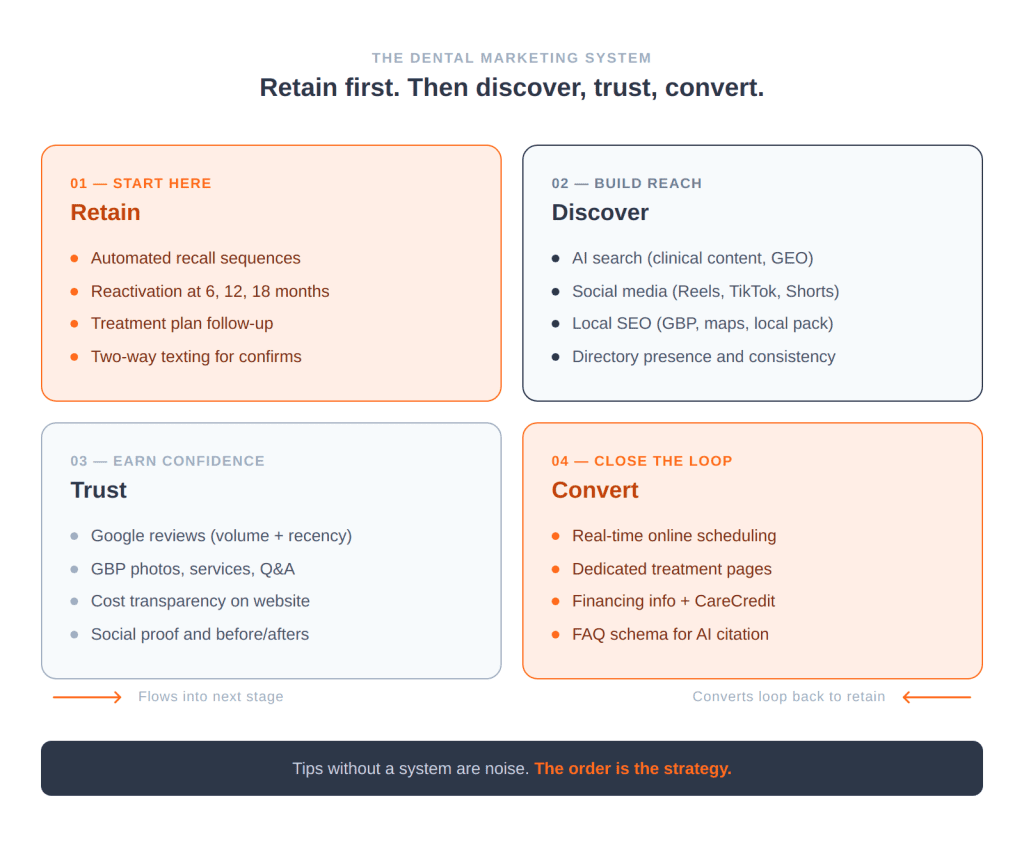
Fig 5: The system that turns one dental patient into ten years of revenue
The 90 Day Marketing for Dental Offices Playbook
You cannot do everything at once. Here is the order that generates the fastest ROI.
Priority
Action
Why It Matters
Difficulty
Week 1–2
Set up automated recall and reactivation sequences for your existing patient base.
This is the single highest-ROI action. You are recovering revenue from patients you already acquired.
Medium
Week 1–2
Audit and fix your Google Business Profile. Every field complete, every hour accurate, every service listed.
Affects local pack ranking, patient trust, and AI visibility simultaneously.
Low
Week 2–4
Implement a systematic review collection process. Ask every patient at checkout. Use text-based review requests.
Review volume and recency directly influence local rankings and AI recommendation signals.
Low
Week 3–6
Audit directory listings across Google, Yelp, Healthgrades, Zocdoc, and ADA. Fix every NAP inconsistency.
AI engines cross-reference directories to verify practice information. Mismatches reduce trust scores.
Medium
Week 4–8
Create dedicated service pages for your top 5 procedures with FAQ schema, cost ranges, and booking widgets.
These pages convert visitors and provide structured content for AI engines to cite.
Medium
Week 4–8
Start posting 2–3 short-form videos per week: before/afters, office tours, team intros, patient testimonials (with consent).
Social content drives cosmetic procedure discovery and builds brand recognition that AI engines pick up.
Medium
Week 8–12
Add FAQ-style blog content answering the top 20 questions patients ask about your core procedures.
What Dental Marketing Strategies to Stop Spending Money On
We want to be direct about this because we see dental practices burning cash on dental marketing strategies that no longer move the needle.
Do not pay for a website redesign before you have plugged your retention leak and fixed your Google Business Profile. A $15,000 website with zero reviews, inconsistent directory data, and no automated recall will underperform a $3,000 website with 200 five-star reviews, perfect directory consistency, and a $200/month recall system.
Do not pay for “AI SEO” packages that promise to get you recommended by Google’s Gemini or ChatGPT in a week. Nobody can guarantee that. What you can control is your content quality, your structured data, your review volume, and your brand consistency across the web. Those are the inputs. AI recommendations are the output.
The System Behind Effective Marketing for Dental Offices
Every dental marketing blog on the internet gives you a list of 10 to 25 tips. Optimize your GBP. Get reviews. Post on social. Build service pages. You have read those lists. They did not move the needle because tips without a system are just noise.
Here is what is different about this article, the order.
Retain first. Stop the $500,000 leak before you pour more patients into a bucket with a hole in it. Then build discovery across three channels: AI search for clinical visibility, dental social media for cosmetic discovery, and local SEO for dentists targeting high-intent bookings. Then convert frictionlessly with real-time booking, cost transparency, and dedicated treatment pages.
That is a system. It compounds. And the practices that build it now will have a structural advantage over every competitor who is still reading another “25 dental marketing tips for 2026” listicle.
Your next 100 patients are not hiding. They are asking Google’s Gemini at 10 PM, scrolling Reels at lunch, and checking your Google reviews on their commute. The question is whether your practice is visible and ready when they look.
If you want help auditing your current digital visibility and building a plan across all three layers, reach out. We will tell you where you stand and what to fix first.
Do not ignore dental social media because you think it is not serious marketing. For cosmetic dentistry, social is the primary discovery channel. If you are not posting, you are not being discovered by the patients who spend the most on elective procedures.
Find Out How Much Your Practice Is Leaking
We’ll audit your retention systems, directory consistency, AI search visibility, and social presence. You get a one page scorecard showing exactly where patients are falling out of your funnel, what to fix first, and what it will cost. Just the numbers and a prioritized fix list.
Most established practices allocate 5-8% of annual revenue to marketing. For a practice producing $1.2 million per year, that is $60,000 to $96,000 annually across all channels. The critical insight is allocation: retention systems ($200-$500/month) should be funded first because they have the highest ROI. Remaining budget splits across local SEO, social media content, paid ads, and website improvements. Practices in growth mode or new markets may spend 10-12%.
The most effective marketing for dental offices in 2026 is a system that layers retention, discovery, and conversion. Retention (automated recall, reactivation, treatment follow up) protects your existing revenue. Discovery spans three channels: AI search optimization for clinical content, social media for cosmetic and elective procedure visibility, and local SEO for high intent bookings. Conversion means real-time online scheduling, cost transparency, and dedicated treatment pages with embedded booking.
Up to a point, but not once structural problems have accumulated. When your codebase is small and the bug is isolated, feeding the error back to the AI can work. But past a certain complexity threshold, every prompt level fix introduces new regressions because the AI has no persistent memory of your full architecture. This is the prompt regression loop described in our post. Once you’re in it, the answer is to stop prompting and bring in someone who can map the actual dependency structure and refactor with a system level view.
AI engines pull from multiple signals, your Google Business Profile completeness, review volume and language, directory consistency across platforms (Google, Yelp, Healthgrades, Zocdoc, ADA), and the quality and structure of your website content. FAQ pages, treatment specific service pages with schema markup, and educational blog content that directly answers patient questions all increase your chances of being cited. There is no shortcut or guarantee, but these inputs are what AI systems evaluate.
For cosmetic and elective procedures, yes. A peer reviewed patient study found that 60.5% of patients used social media as their first source of information about aesthetic treatments like veneers, whitening, and Invisalign. Short form video (Reels, TikTok, YouTube Shorts) showing before-and-after transformations, office tours, and the personality of the dentist and staff drives discovery. For general dentistry (cleanings, emergency visits), local SEO and Google Business Profile remain more effective acquisition channels.
Automated communication systems handle the three biggest attrition drivers. Recall sequences send text reminders before scheduled appointments. Reactivation sequences reach out to patients who have been inactive for 6, 12, or 18 months. Treatment follow-up sequences reengage patients who received a treatment plan but never scheduled. Two way texting, direct booking links, and financing information in followup messages reduce the friction that causes patients to delay or disappear.
Google reviews influence three systems simultaneously. They directly affect your local pack ranking on Google. They build patient trust when someone is comparing your practice to two others. And they feed AI systems with specific language about your services. When a patient asks ChatGPT for a dentist who is “gentle” or “good with kids” or “painless,” the AI draws from review language across platforms. Volume, recency, and response rate all matter.
Local SEO is more valuable than ever because Google removed AI Overviews entirely from “near me” and provider-finding queries. Your Google Business Profile, directory listings, and local citations still drive high intent patient acquisition. Clinical SEO (blog posts, treatment explainers) faces more competition from AI Overviews, which now cover 89% of clinical healthcare searches. For clinical content, the goal shifts from ranking for clicks to being cited as a source in AI generated answers.
Retention systems (automated recall and reactivation) can show results within 30 to 60 days because you are re-engaging patients who already know your practice. Google Business Profile optimization and review collection take 2 to 3 months to impact local rankings. Social media content typically needs 3 to 6 months of consistent posting to build an audience and generate inbound inquiries. Blog content and AI search optimization are 6 to 12 month investments that compound over time.
Written By
Sr. Digital Marketing Manager
Abdullah Habib is a digital marketing specialist with expertise in SEO, content marketing, social media, digital advertising, and data analysis. He excels in creating strategic, data-driven campaigns that boost organic traffic, enhance brand visibility, and drive growth for clients.
TL;DRVibe coding is a legitimate prototyping tool. But the same properties that make LLMs fast at generating code, stateless context, completion bias, local optimization, make...
TL;DRThe Zoho CRM and Projects integration connects sales and delivery across 10 CRM modules. But the native integration has real limits, no Vendor module support,...
TL;DR AI agents are autonomous systems that go beyond chatbots to reason, access business tools, and execute multistep tasks. In e-commerce, they are producing measurable...